FDA Adds Kybella Warning After Serious Adverse Events With Off-Label Injections
post on 19 Sept 2026 · Updated 01 Oct 2026
post on 19 Sept 2026 · Updated 01 Oct 2026
 Medical Toxicologymedicaltoxic.com
https://medicaltoxic.com/news/fda-kybella-warning-off-label-injection-risks
FDA Adds Kybella Warning After Serious Adverse Events With Off-Label Injections
FDA updated Kybella labeling after reviewing adverse events associated with injections outside the approved under-chin region and persistent injection-site nodules and masses.
An FDA-approved injectable can become a very different safety problem when it is placed in an anatomical site for which its safety and effectiveness have not been established.
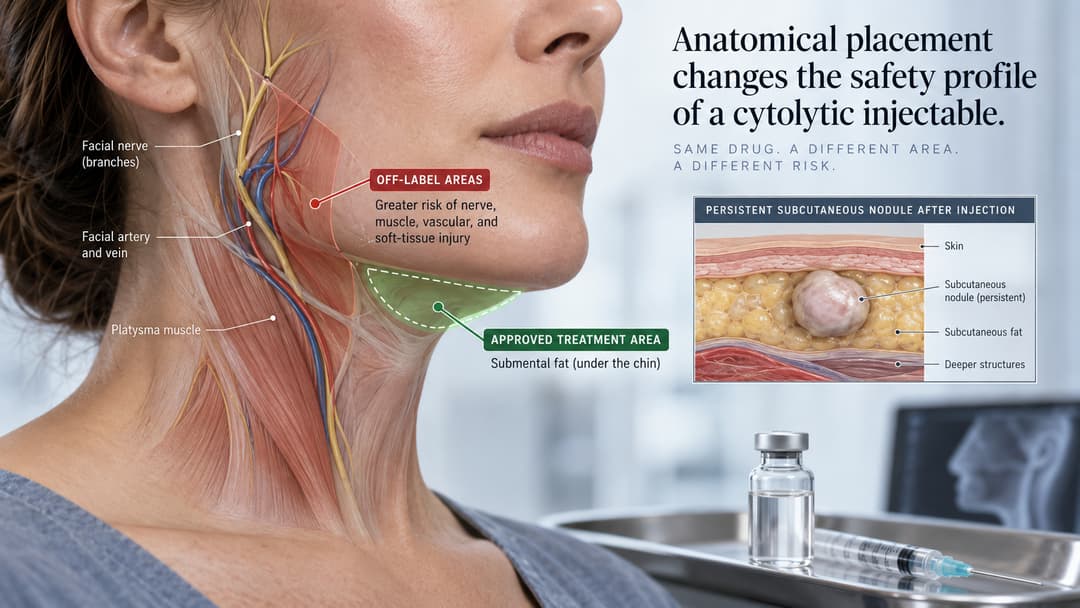
On September 15, 2026, the U.S. Food and Drug Administration announced additional warning language for Kybella (deoxycholic acid) injection after reviewing reports from the FDA Adverse Event Monitoring System, formerly FAERS, and the medical literature. FDA recommends against injecting Kybella outside its approved submental fat region—the area under the chin. [1]
FDA identified 129 cases of adverse events involving deoxycholic acid administered outside the approved submental region. Reported serious events included visual disturbances after periorbital use and muscle or nerve injury, including facial paresis and paresthesia. FDA also warns patients about reported involuntary eye contractions, weakness, numbness, and difficulty walking after use at unapproved anatomical sites. [1]
The agency separately identified 117 cases of unresolved injection-site nodules or masses, some of which had persisted for months and could require medical intervention. [1]
For medical toxicology, the key issue is not cosmetic medicine itself.
It is anatomy-dependent exposure to a pharmacologically active injectable.
Kybella has been FDA-approved since 2015 to improve the appearance of moderate-to-severe fullness associated with submental fat in adults.
It is not approved for treatment of subcutaneous fat elsewhere in the body.
FDA's September action adds a warning concerning adverse reactions associated with use outside that approved submental region and reinforces the recommendation against such use. [1]
FDA also added language to the Warnings and Precautions section regarding injection-site nodules and masses that can persist and may require medical intervention.
That second change matters because it is not limited to off-label injection sites.
FDA says nodules and masses have been reported after deoxycholic acid injections both in the approved submental region and outside it. [1]
The numbers in the FDA communication describe two related but distinct safety analyses:
FDA finding | Cases | What the number represents |
|---|---|---|
Adverse events after use outside the approved submental region | 129 | Reports involving off-label anatomical injection sites |
Unresolved nodules or masses | 117 | Persistent lesions associated with deoxycholic acid injections that could occur at approved or unapproved sites |
The 117 cases are not described by FDA as simply another 117 off-label cases, and the two numbers should not be added together to create a total adverse-event count.
FDA reports that the unresolved nodules or masses had been present for a mean of 143 days—approximately five months—at the time they were reported. They occurred after either initial or subsequent deoxycholic acid injections. [1]
That does not mean the lesions resolved after 143 days.
They were still described as unresolved at the time of reporting.
Kybella is not simply an inert filler.
Its prescribing information identifies deoxycholic acid as a cytolytic drug. When injected into tissue, it physically disrupts cell membranes and causes cell lysis. [2]
That pharmacology makes tissue location important.
The existing prescribing information already emphasizes correct injection location and technique because vulnerable structures—including nerves, muscles, salivary glands, lymph nodes, arteries, and veins—can be injured if the drug is placed incorrectly. [2]
Existing warnings include:
marginal mandibular nerve injury and facial muscle weakness;
dysphagia;
tissue damage;
vascular injury;
injection-site ulceration;
necrosis;
infection; and
The September 2026 FDA action adds another layer: adverse events have now been identified specifically in the setting of administration outside the anatomical region for which Kybella is approved.
The case reports do not establish a single mechanism for every reported neurologic, visual, muscular, or tissue event. But they reinforce why an anatomical change in exposure can materially alter the safety problem.
FDA's review identified 129 cases since Kybella's approval in 2015 involving use outside the submental region. [1]
Reported events included:
blurred or reduced vision, particularly with periorbital use;
involuntary eye contractions;
facial paresis;
paresthesia and numbness;
muscle or nerve injury;
weakness; and
difficulty walking. [1]
These reports are clinically important, but the number 129 is not an incidence rate.
FDA does not provide the number of people who received off-label deoxycholic acid injections during the same period. Without that denominator, the reports cannot tell us what percentage of off-label injections resulted in injury.
MedicalToxic's What Is FAERS and Why It Matters in Medical Toxicology explains why spontaneous adverse-event reports are useful for identifying safety signals but cannot by themselves establish incidence or precise comparative risk.
FDA's second finding involved 117 unresolved nodules or masses associated with deoxycholic acid injections.
FDA defines nodules as lesions 3 cm or smaller and masses as those larger than 3 cm. [1]
Importantly, these lesions were not confined to patients treated outside the approved region.
FDA says nodules or masses may occur following injections within the approved submental area or outside it.
Some may persist and require medical intervention.
That is why the new labeling action covers not only off-label-site adverse events but also persistent injection-site lesions.
FDA advises health care providers to review the prescribing information before administering Kybella and emphasizes that the drug is not approved for use in areas other than the submental region. [1]
Providers should also recognize that injection-site nodules and masses may persist.
FDA recommends advising patients to seek medical attention for adverse events, including signs of marginal mandibular nerve paresis such as an asymmetric smile or facial weakness, difficulty swallowing, or serious injection-site reactions. [1]
This News article does not extend those recommendations into management protocols for nerve injury, tissue necrosis, vascular injury, or infection.
The regulatory pathway is also important.
FDA says the revised labeling followed review of reports from FAERS—now referred to by FDA as the Adverse Event Monitoring System—and the medical literature. [1]
That distinction matters.
AEMS/FAERS reports can identify patterns that merit investigation, but raw case counts do not establish:
the incidence of an adverse event;
whether reporting frequency is increasing;
the absolute risk associated with an injection;
how risk compares with correctly administered submental treatment; or
causality in every individual report.
MedicalToxic recently examined another example of postmarketing safety information progressing to regulatory action in FDA Toxicology Update: Injectafer Boxed Warning and DNP Recall.
The Kybella action follows the same broader pharmacovigilance principle: spontaneous reports can trigger deeper evaluation and, when FDA determines additional safety communication is warranted, labeling can change.
The September action should not be interpreted as evidence that Kybella is generally unsafe when used for its approved indication.
FDA's warning is more specific.
The agency recommends against use outside the approved submental fat region and has added information about serious adverse events associated with that unapproved use. [1]
The data also do not show that:
129 cases represent the incidence of complications;
adverse events are increasing nationally;
every reported event was definitively caused by deoxycholic acid;
all 117 unresolved nodules or masses followed off-label injections; or
the 129 and 117 case counts can be added together.
Those distinctions are essential for accurate risk communication.
The key new development is regulatory, not merely observational.
FDA has reviewed postmarketing reports and medical literature and has now approved additional Kybella labeling that:
warns about serious adverse reactions associated with administration outside the submental region;
recommends against that unapproved anatomical use; and
adds specific warning language about persistent injection-site nodules and masses. [1]
The toxicology lesson is straightforward:
An approved drug does not carry the same evidence base when the anatomical exposure changes.
With a cytolytic injectable, wrong-site exposure can create a safety problem involving nerves, muscle, tissue, vasculature, and persistent local lesions rather than simply changing cosmetic effectiveness.
FDA's September 15 labeling action adds an important safety boundary around Kybella.
The agency identified 129 adverse-event cases involving administration outside the approved submental region and separately identified 117 unresolved nodules or masses associated with deoxycholic acid injections. [1]
Those numbers are clinically important, but they are not incidence estimates and they should not be combined.
The strongest MedicalToxic interpretation is therefore not that an approved cosmetic injection has suddenly become broadly unsafe.
It is that site of exposure matters: when a cytolytic injectable is used outside the anatomical region for which it was evaluated and approved, the resulting safety profile can include a different set of neuromuscular, tissue, vascular, and persistent injection-site complications.
U.S. Food and Drug Administration. (2026, September 15). FDA Approves Additional Information in Labeling for Kybella (Deoxycholic Acid) Injection Warning of Adverse Reactions Associated with Unapproved Use.
National Library of Medicine. KYBELLA — deoxycholic acid injection, solution. DailyMed, U.S. National Library of Medicine.
Keep reading
Regulatory and Policy Updates
07 Oct 2026 · Updated 09 Oct 2026
Regulatory and Policy Updates
04 Sept 2026 · Updated 02 Oct 2026

Regulatory and Policy Updates
15 Jul 2026 · Updated 26 Sept 2026
Regulatory and Policy Updates
24 Oct 2025 · Updated 26 Sept 2026
