FDA Reviews OTC Imidazoline Misuse Toxicity Signals
post on 07 Oct 2026
post on 07 Oct 2026
 Medical Toxicologymedicaltoxic.com
https://medicaltoxic.com/news/fda-otc-imidazoline-misuse-toxicity-signals
FDA Reviews OTC Imidazoline Misuse Toxicity Signals
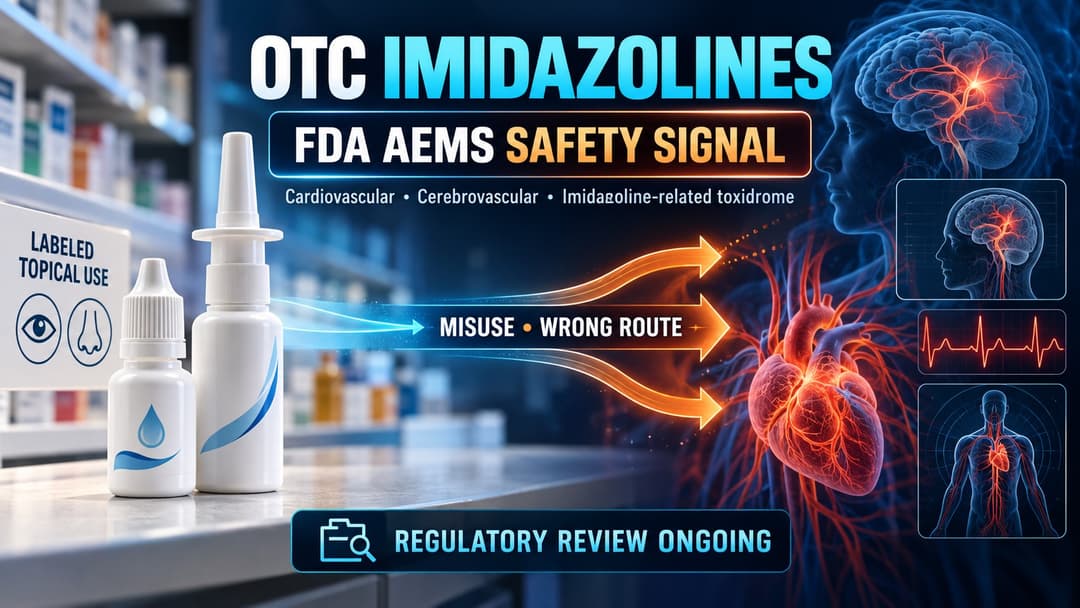
FDA has identified two potential serious safety signals involving nonprescription imidazoline products: intentional misuse and administration by an incorrect route.
A familiar nonprescription topical drug class has appeared in the U.S. Food and Drug Administration's latest quarterly safety-signal review for a distinctly toxicologic reason: the route and purpose of exposure may fundamentally change the risk.
FDA's April–June 2026 Adverse Event Monitoring System, or AEMS, table lists two separate potential serious safety signals for “imidazoline containing products (nonprescription).” [1] U.S. Food and Drug Administration
One involves:
cardiovascular, cerebrovascular and imidazoline-related toxidrome events associated with intentional product misuse.
The second involves the same broad event spectrum associated with:
incorrect route of product administration.
For both entries, FDA's current status is the same:
“FDA is evaluating the need for regulatory action.” [1] U.S. Food and Drug Administration
That wording matters. This is a formal potential safety signal under evaluation, not a conclusion that the class has been proved to cause a newly increased risk.
The FDA quarterly table, with additional information current as of September 4, 2026, does not identify individual brands or active ingredients behind these two imidazoline entries.
It identifies the product class only as:
“Imidazoline containing products (nonprescription).” [1]
That distinction prevents several unsupported conclusions.
FDA has not said that every OTC product containing an imidazoline is unsafe. It has not announced a recall, class-wide warning, new labeling requirement or restriction. The table also does not provide a case count, exposure denominator or incidence rate for either signal. U.S. Food and Drug Administration
Instead, FDA has selected these patterns for further evaluation.
The unusual feature is that both signals center on how the products were used, rather than simply adverse events during routine labeled topical use.
One specifically concerns intentional misuse.
The other concerns an incorrect route of administration.
For medical toxicology, that is clinically meaningful because topical availability does not guarantee safety when a pharmacologically active product reaches the body in a different dose or by a different route.
FDA's public table does not specify what incorrect routes were represented in the reports, so ingestion, injection or any other route should not be attributed to this AEMS signal unless FDA releases more detailed information.
There is, however, established toxicology literature showing that some imidazoline drugs used in topical products can cause systemic poisoning when exposure occurs outside their intended use. [3]
The imidazoline class includes pharmacologically active compounds capable of producing central and cardiovascular effects.
A major clinical toxicology review describes toxicity from alpha-2 adrenergic and imidazoline receptor agonists as including central nervous system depression, bradycardia, hypotension, respiratory depression, miosis and hypothermia. Early or transient hypertension can also occur, illustrating that the hemodynamic pattern is not always uniform. [3] PubMed
Those established clinical effects help explain why FDA's use of the term “imidazoline-related toxidrome” is relevant to emergency medicine and poison-center practice.
The quarterly table also specifically identifies cardiovascular and cerebrovascular events, but it does not provide enough case-level detail to define which diagnoses or manifestations drove those categories. [1]
Accordingly, specific events such as stroke, arrhythmia or another diagnosis should not be assigned to the AEMS signal without supporting FDA documentation.
FDA does not say that tetrahydrozoline generated the new signal, so it should not be presented as the implicated ingredient.
It is nevertheless a well-established example of an OTC imidazoline with route-dependent toxicity.
Poison Control notes that tetrahydrozoline-containing anti-redness eye drops are intended for topical ophthalmic use but can produce serious systemic toxicity when swallowed, including sleepiness, hypotension, marked bradycardia and breathing difficulty. [4] Poison Control
Published toxicology literature similarly describes tetrahydrozoline and related imidazolines as capable of causing CNS depression and cardiovascular instability after systemic exposure. [3]
The point is not that tetrahydrozoline caused the FDA signal.
The point is that the FDA finding fits a known toxicologic principle: changing the route or purpose of exposure can transform a topical OTC medication into a clinically significant systemic poison.
“Nonprescription” describes regulatory access. It does not mean a drug lacks pharmacologic potency.
This distinction is particularly important for products designed for localized topical administration. A concentration and dose intended for the eye, nose or another limited application cannot automatically be assumed to have the same safety profile if intentionally misused, swallowed or otherwise administered by an unintended route.
MedicalToxic discusses this broader ingredient-and-route principle in Personal Care Cosmetics and Topical Products Management, where the relevant toxicologic question is the actual ingredient, formulation, dose and exposure route rather than simply the marketing category of the product. Medical Toxicology
The new FDA signal makes that principle regulatory rather than purely educational.
Accidental pediatric exposure is already part of the established imidazoline toxicology literature.
Small children have developed significant CNS and cardiovascular toxicity after unintended ingestion of tetrahydrozoline-containing products, and Poison Control specifically warns that small amounts can produce substantial effects in young children. [4] Poison Control
That background helps explain why poison specialists take systemic exposure to some topical imidazolines seriously.
But pediatric accidental ingestion should not be conflated with the two newly listed FDA signals. The current quarterly table specifically describes intentional misuse and incorrect-route administration; it does not publicly state that accidental childhood ingestion generated either signal. [1]
FDA's own interpretation guidance is explicit.
Appearance on a quarterly AEMS report means FDA has identified a potential safety signal and is evaluating it. It does not mean FDA has concluded that the drug or product has the listed risk, and it does not establish a causal relationship. [2] U.S. Food and Drug Administration
Spontaneous adverse-event reporting also cannot by itself calculate incidence.
FDA notes that AEMS data can contain duplicate or incomplete reports, that reported events are not necessarily caused by the suspected product, and that rates of occurrence cannot be established from the reports alone. [2] U.S. Food and Drug Administration
For a deeper explanation of those limitations, see What Is FAERS and Why It Matters in Medical Toxicology.
That existing MedicalToxic article remains the broader pharmacovigilance owner. This News concerns only the newly identified Q2 2026 imidazoline misuse and wrong-route signals.
These exposures sit squarely in poison-center territory because the clinical problem may begin with incomplete information: a topical OTC product, an unexpected route and a patient with CNS or cardiovascular abnormalities.
Established imidazoline poisoning can resemble other centrally acting toxic syndromes, and the severity of systemic exposure cannot be inferred simply from the fact that the original product was purchased without a prescription.
For suspected exposure in the United States, Poison Control advises contacting a poison center for individualized guidance; collapse, seizure, breathing difficulty or inability to awaken the patient warrants immediate emergency response. [4]
This article does not establish a new treatment algorithm, antidote strategy, observation period or disposition rule for imidazoline poisoning.
At present, the answer is unknown.
FDA's general AEMS framework says evaluation of a potential signal can ultimately lead to outcomes including additional data collection, safety communications, labeling changes or other regulatory actions if the agency determines that further intervention is warranted. FDA may also determine that no regulatory action is necessary. [2] U.S. Food and Drug Administration
The current imidazoline entries do not indicate which path FDA will take.
A targeted search of current FDA Drug Safety Communications and alerts also found no subsequent class-wide imidazoline safety communication or regulatory action as of October 7, 2026. U.S. Food and Drug Administration
The correct status therefore remains:
FDA has identified potential serious safety signals and is evaluating whether regulatory action is needed.
Systemic imidazoline poisoning itself is not new.
The new development is that FDA has now formally elevated two specific use-pattern concerns involving nonprescription imidazoline products into its curated quarterly potential-signal process:
intentional product misuse; and
incorrect-route administration.
Both are linked in the FDA table to cardiovascular, cerebrovascular and imidazoline-related toxidrome events. [1]
That is enough to warrant attention from toxicologists and poison centers.
It is not enough to claim a newly proven class-wide hazard.
Several important questions remain unanswered.
FDA's public quarterly entry does not identify the specific ingredients, brands, formulations, incorrect routes or individual clinical cases underlying the signals.
It also provides no denominator-controlled incidence rate and does not establish whether events are becoming more common.
The current data cannot determine whether one imidazoline ingredient contributes disproportionately, whether particular formulations or routes carry greater risk, or whether regulatory changes will follow.
Until FDA releases more information, those questions should remain open rather than being filled with assumptions from older case literature.
FDA's new AEMS entries place nonprescription imidazoline products on the regulatory toxicology watchlist for intentional misuse and incorrect-route exposure.
The development matters because systemic imidazoline toxicity can involve clinically important CNS and cardiovascular effects, and existing experience with compounds such as tetrahydrozoline demonstrates that a common topical OTC product can become significantly toxic when exposure changes. [3] [4]
But the regulatory message must remain precise.
FDA has identified two potential serious safety signals. It has not confirmed causality, quantified a new incidence rate or issued a class-wide warning.
For now, the signal is an investigation—not a verdict.
U.S. Food and Drug Administration. (2026). April - June 2026 | New Safety Information or Potential Signals of Serious Risks Identified by the FDA Adverse Event Monitoring System (AEMS).
U.S. Food and Drug Administration. (2026). New Safety Information or Potential Signals of Serious Risks Identified from the FDA Adverse Event Monitoring System (AEMS).
Lowry, J. A., & Brown, J. T. (2014). Significance of the imidazoline receptors in toxicology. Clinical Toxicology, 52(5), 454–469. https://doi.org/10.3109/15563650.2014.898770. PubMed
Johnson-Arbor, K., & Troutman, W. G. What happens when you swallow eye drops?. National Capital Poison Center / Poison Control.
Keep reading
Regulatory and Policy Updates
19 Sept 2026

Regulatory and Policy Updates
04 Sept 2026

Regulatory and Policy Updates
15 Jul 2026

Regulatory and Policy Updates
24 Oct 2025
