Forensic Toxicology
Drug Screens Lie: A Clinician’s Guide to Interpreting Toxicology Tests Safely
Omid Mehrpour
Post on 02 Jan 2026 · 24 min read
Omid Mehrpour
Post on 02 Jan 2026 · 24 min read
 Medical Toxicologymedicaltoxic.com
https://medicaltoxic.com/blogs/drug-screens-lie-a-clinicians-guide-to-interpreting-toxico
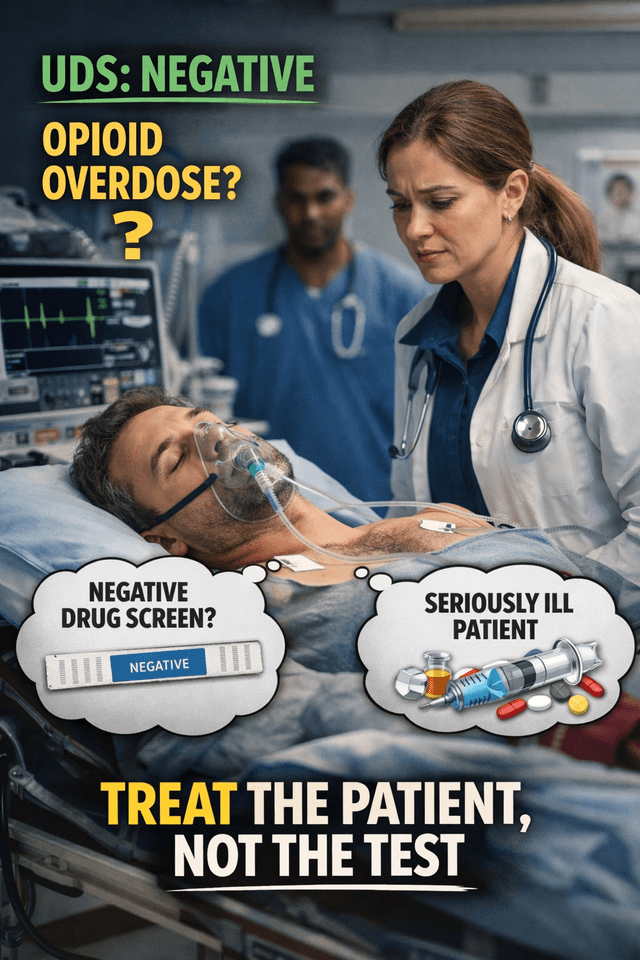
In emergency medicine, critical care, and medical toxicology, urine drug screens (UDS) and other rapid toxicology tests are useful – until they aren’t. A single lab result can mislead clinical teams, delay life-saving treatment, or create false reassurance. Consider common scenarios: a patient with classic opioid overdose signs but a “negative” opioid screen; a deeply sedated patient yet a benzodiazepine screen comes back negative; or a lab report suggests a drug that makes no clinical sense. In each case, blindly trusting the test can be dangerous. Misinterpreting toxicology screens has real consequences – for example, withholding naloxone due to a false-negative opioid screen could prove disastrous, or discharging a patient based on one “negative” result could miss a life-threatening ingestion (1,2). The core principle in clinical toxicology is simple:
Treat the patient, not the test. A negative screen does not reliably exclude a toxin, and a positive screen does not prove causality. (3)
This guide provides a practical, evidence-based approach to interpreting tox screens safely. We’ll explore why a negative UDS doesn’t rule out an exposure, when to obtain confirmatory testing, how to document uncertainties, and how poison centers can help. Throughout, we emphasize keeping clinical judgment at the forefront – anchor decisions on the patient’s physiology, not a urine cup.
Rapid UDS panels are typically immunoassays – tests using antibodies to detect specific drugs or metabolites. They are quick and convenient, but they are not comprehensive toxicology tests (4). A “negative” immunoassay result often means “not detected by this particular assay” – not necessarily “no drug present.” Several factors explain why a true exposure can yield a negative screen:
Immunoassays only detect the substances (or metabolite patterns) they are designed for. Many assays target a narrow group within a drug class. If a patient took a drug outside the assay’s detection spectrum, the screen will miss it (4). Example: Standard opiate immunoassays primarily detect morphine or codeine metabolites and have poor sensitivity for semisynthetic opioids like oxycodone, hydromorphone, or synthetic opioids like fentanyl (1,5). Thus, a patient could be in opioid withdrawal or overdose from fentanyl or oxycodone and still test “negative” on a generic opioid screen (5). Similarly, many benzodiazepine screens only detect oxazepam (a diazepam metabolite), so **benzodiazepines that metabolize differently (e.g. lorazepam, alprazolam, midazolam) often do not register, yielding false negatives (2,4). In short, a negative class screen might just mean the specific drug isn’t covered by that assay – not that the patient didn’t take anything.
Immunoassay antibodies may cross-react with some compounds but not others. Poor cross-reactivity with certain analogues leads to false negatives (4). For instance, older benzodiazepine immunoassays failed to detect lorazepam because they didn’t recognize its glucuronide metabolite – clinical sensitivity was under 70%, meaning many true users tested “negative” (4). (Newer assays improved this by adding enzymes to convert metabolites, raising sensitivity to ~95–100% (4).) On the flip side, excessive cross-reactivity with unrelated substances can cause false positives – e.g. labetalol triggering a fentanyl screen (4) or venlafaxine causing a PCP screen to turn positive (4). Each immunoassay has a unique profile of what it can and cannot detect, so “negative” may simply reflect the test’s blind spots, not the absence of drug.
Immunoassays report a result as “positive” only if the drug concentration is above a set cutoff; anything below is labeled “negative” (5). This threshold is necessary to avoid trivial positives, but it means low levels of a substance will be missed. Diluted urine (e.g. from high IV fluid volumes or diuretics) or timing issues can drop concentrations below detection limits. For example, if a sample is collected very early after ingestion, the drug or its metabolites may not yet have accumulated in urine; conversely, after enough time or metabolism, levels may have fallen below the cutoff (3,6). A technically “negative” result could simply mean the drug was present but under the reporting threshold. Any factor that reduces drug/metabolite concentration – large urine volume, enhanced clearance, delayed sampling – can yield a false-negative screen. Short Detection Windows
Different substances remain detectable in urine for different durations. A “too early” or “too late” sample can miss the window. For instance, fast-eliminating drugs like immediate-release sedatives or stimulants might only be detectable for a day or two, whereas chronic cannabis use might produce positives for weeks (3,6). If a patient presents soon after an overdose, their urine may not yet show metabolites; if they present days later, the substance could be gone. Thus, timing is crucial – a negative result might simply mean the toxin’s window of detection has passed or not yet opened (6). Clinical translation
A UDS “negative” result must be interpreted as “negative for the limited panel of substances this immunoassay can detect at this moment.” It does not prove no toxic exposure. As toxicology experts reiterate, negative screens cannot reliably exclude substance use given these limitations (1). If the clinical toxidrome (the patient’s signs and symptoms) strongly suggests a poisoning or drug effect, do not be falsely reassured by a negative immunoassay. Instead, assume the screen may have missed the culprit and proceed with appropriate treatment or further testing. Always cross-check what drugs are included in your hospital’s panel. In practice: “Negative” often means “not detected by this assay”, not “not present.”
Rapid screens are just that – screens – not definitive tests. Whenever the stakes are high or the clinical picture and lab results don’t align, it’s time to consider confirmatory testing. The guiding rule is: confirm when the decision is high-impact or the story doesn’t fit. Situations where confirmatory toxicology can be critical include:
If the patient’s presentation screams a specific poisoning (e.g. opioid overdose with pinpoint pupils and respiratory depression, or anticholinergic syndrome with delirium and dry skin) but the corresponding screen is negative, don’t stop at the immunoassay. This is a classic scenario for confirmatory testing to avoid misdiagnosis. For example, a comatose patient with respiratory depression might have negative opioid immunoassay if fentanyl or another analog is involved – confirmatory tests can detect those agents even if the screen doesn’t (1,5).
When a toxicology result will drive a major management decision, verify it with a definitive method. This includes choices like ICU admission vs. discharge, whether to continue or stop an antidote (e.g. naloxone infusion or fomepizole), whether to pursue psychiatric commitment vs. medical admission, or actions with medico-legal implications (such as involving child protective services or law enforcement based on a result). If an initial screen result is the linchpin for such decisions, it warrants confirmation. Never base irreversible or critical decisions on an unconfirmed screening test.
Anytime you catch yourself thinking “this lab result doesn’t make sense with what I’m seeing,” consider confirming. Unusual patterns – like a drug detected that shouldn’t cause the observed symptoms, or a result inconsistent with other known data (e.g. a negative tox screen in a patient who admitted to taking something, or a positive for a drug that the patient denies and has no access to) – should prompt a second look via confirmatory testing. It is possible the screen is wrong (false positive/negative) or that there’s a lab error. In either case, confirmation by another method can clarify the truth.
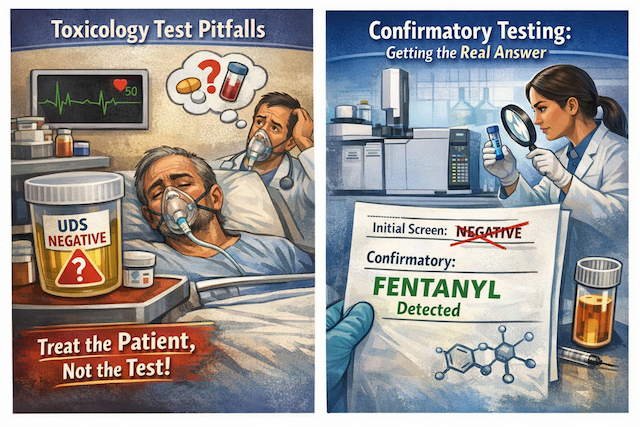
Confirmatory toxicology generally means chromatography/mass-spectrometry based assays, which chemically identify specific compounds with high accuracy (4). Common modalities are GC-MS (gas chromatography–mass spectrometry) and LC-MS/MS (liquid chromatography–tandem mass spectrometry). Instead of relying on an antibody’s cross-reactivity, these methods separate the sample into components and identify molecules by their unique chemical signatures (mass-to-charge spectra and retention times) (4). They are considered gold standard because they offer far superior sensitivity and specificity – they can detect trace amounts and distinguish compounds that immunoassays might confuse (4). In practice, many labs offer “send-out” confirmatory panels or specific drug assays by GC/MS or LC/MS. The downside is turnaround time – mass spec tests often take hours to days and may not be available 24/7. Nonetheless, for critical cases, the wait and effort are justified to get a definitive answer.
Simply saying “send confirmatory tox” is often too vague. Instead, use precise language and communicate with your lab if needed:
Name the suspected agent(s): “Please send confirmatory testing by LC–MS/MS for fentanyl and its analogs,” or “Request GC–MS confirmation for benzodiazepines not detected on screen.” Tailoring the request ensures the lab uses the appropriate targeted assay or broad panel to find what you’re looking for.
Know your immunoassay’s scope: It’s wise to ask the lab, “What does our standard immunoassay panel actually include?” and “What are the cutoff levels and known false positives/negatives for this test?” (7). For instance, some “opiates” screens do not include oxycodone – your lab can tell you if there’s a separate oxycodone assay that wasn’t part of the initial panel. Understanding the built-in limitations (e.g., that a THC screen detects only the marijuana metabolite THC-COOH above 50 ng/mL, or that amphetamine screens can cross-react with certain decongestants (1)) will guide what confirmatory test to order.
Request a specific panel if available: Many labs have targeted confirmation panels for particular drug classes (e.g., a comprehensive synthetic opioids panel by LC-MS, or a designer drug panel). Don’t hesitate to ask “Do we have a targeted panel for this suspected drug class?” If a patient possibly took something exotic like a synthetic cannabinoid or novel stimulant, a specialized panel or an untargeted high-resolution MS scan might be appropriate (4).
Forensic needs (Chain-of-Custody):
If results might be used in legal proceedings (e.g. DUI, workplace testing, or cases involving law enforcement), you must request testing that follows chain-of-custody procedures. These ensure sample integrity and legal defensibility. Routine clinical UDS in the hospital is not forensic-grade and may not hold up in court. So if a situation has medico-legal angles (child custody, legal intoxication levels, etc.), specifically ask for forensic confirmatory testing with chain-of-custody to be safe (3). (Often, hospital labs will send such samples to specialized reference labs for this purpose.)
Use confirmatory testing whenever a toxicology result is counterintuitive or crucial to patient outcomes. As one laboratory medicine guideline puts it, definitive mass-spectrometry testing is recommended to confirm positive screens and to investigate unexpected negatives in high-risk cases (4). It’s an investment in accuracy that pays off by preventing mistakes like needless intubation or premature discharge. Always communicate clearly with your lab about what you need; they are partners in getting the right answer.
Toxicology results can be confusing or misleading – and when a patient’s outcome is on the line, clear documentation is your friend. If the lab results don’t match the clinical toxidrome, your medical note should reflect two key things: (a) that you recognized the discrepancy, and (b) that you responded appropriately (i.e. didn’t ignore the clinical evidence). This not only guides the next provider’s interpretation, but also provides medico-legal protection by showing you weren’t “blindsided” by a potentially flawed test.
A practical approach is to use a standard documentation phrase whenever this situation arises. For example:
“Urine immunoassay drug screen initial result: negative. However, patient’s clinical presentation is highly consistent with a [suspected toxidrome], and I acknowledge the limitations of the immunoassay (possible false negatives). I have requested confirmatory testing by GC/MS (or LC/MS/MS) for the suspected substance(s). Clinical management is being guided by the patient’s symptoms and physiology rather than the screening result.”
In one or two sentences, this communicates that you did not take a “negative” (or positive) result at face value when it conflicted with the clinical scenario. It shows you took responsible steps (ordering confirmation, basing care on clinical judgment) and are aware of test limitations. Such notes can be tremendously important for patient safety – preventing a dangerous substance from being overlooked – and for medico-legal safety – demonstrating that you met the standard of care by not over-relying on an imperfect test.
Acknowledgement of test limitations: e.g. “immunoassay limitations are noted” or “screening tests can have false negatives/positives.” This flags to any reader that a “negative” does not equal “no drug,” or that a “positive” is not definitive (1).
Your interpretation in context: e.g. “despite negative screen, signs point to opioid overdose, so treating with naloxone” or “positive amphetamine screen but patient on bupropion which can cause false positives; no clinical stimulant toxidrome present.” Show that you correlated the lab result with the clinical picture (or lack thereof).
Actions taken: Note if you are obtaining confirmatory tests, consulting toxicology/poison center, starting an antidote, or observing longer. For example, “will manage as toxin X until proven otherwise” or “poison center contact for further recommendations.”
Plan for follow-up: If confirmatory results will return after disposition, mention how they will be followed up (e.g. “pending confirmatory panel; will call patient if results change management” or “results to be reviewed by toxicology service”). This shows closure of the loop.
By explicitly documenting in this manner, you prevent downstream misinterpretation of the situation. Another clinician reading the chart won’t mistakenly assume “UDS negative = patient had no exposure” – because your note makes clear that’s not the case. It also helps consultants (like a toxicologist or psychiatrist) understand your reasoning, and it protects you legally by proving you did not ignore the possibility of a false test. Remember, toxicology screens carry medicolegal implications, and awareness of these should be evident in your documentation (3). In any contentious case (e.g., an overdose death or an impaired healthcare worker evaluation), your chart note may be scrutinized; having a statement that you recognized the limits of the test and prioritized patient care is a strong defensive practice.
Never hesitate to call your local poison control center or medical toxicologist when facing confusing toxicology results. Poison centers are not just for identifying unknown pills or treating overdoses – they also serve as “assay interpreters” and safety nets for frontline providers. Toxicology specialists handle these scenarios daily and can help you avoid the trap of false reassurance or false alarms from a tox screen.
Translating the Test: A poison specialist can often tell you exactly what a given hospital’s standard panel does and does not detect. They keep up-to-date on which immunoassays cross-react with which substances and can say, for example, “that opioid screen won’t detect fentanyl or most synthetics,” or “our regional labs use a benzo screen that misses lorazepam – we see false negatives often.” This insight is invaluable when you have a puzzling result. In fact, new clinical toxicology guidelines emphasize collaboration with toxicologists/poison centers to interpret results and decide on definitive testing (7).
Recommending Confirmation: Poison centers can guide you on whether confirmatory testing is indicated, and what specifically to request. They might suggest a specific confirmatory panel or broader testing based on the case. For instance, if an opioid screen is negative but they suspect a novel opioid, they may recommend a fentanyl analog panel or high-resolution mass spec screen. They can also help arrange testing at specialized laboratories if needed.
Anchoring to Physiology: Perhaps most importantly, a toxicologist will reinforce the mantra to trust the clinical toxidrome over any single lab result. If your patient looks poisoned, the poison center will almost always advise to treat empirically (e.g. give naloxone, administer antidotes, perform decontamination) even if screens are negative. Conversely, if a screen is positive for something that doesn’t fit clinically, they’ll help you avoid over-treating a red herring. In the critical early management – securing airways, controlling seizures, giving antidotes – you often cannot wait for confirmatory results, so poison center input keeps management on the right track while sorting out the labs (7).
Preventing False Reassurance: Poison specialists are keenly aware of toxicological pitfalls. They can cite case examples of lab errors, unexpected cross-reactivities, or unusual kinetics. This perspective can prevent a premature discharge or stop you from abandoning a working diagnosis solely because “the test was negative.” For example, poison center experts know that venlafaxine and lamotrigine can trigger false-positive PCP tests (4) – armed with that knowledge, they might save a patient from being misclassified as a phencyclidine user. They also know when certain quality control issues or rare lab errors have occurred regionally, and can advise a repeat test or alternate sample if something looks off.
In essence, poison centers help keep toxicology decision-making grounded in reality and patient physiology, rather than lab overconfidence. They act as a check against the cognitive bias of “the test must be right.” Many critical management steps in overdose care (airway protection, antidote use, cardiac monitoring, decontamination) must be decided before any confirmatory test is back. A quick call to the poison center (available 24/7 in most regions) can clarify the next steps and give you confidence to do what the patient needs, test results notwithstanding.
If a screen-result mismatch appears, call the poison center early – don’t wait until the patient has deteriorated or many hours have passed. Early consultation can provide guidance on both treatment and the smartest approach to further testing. As highlighted in emerging guidelines, collaboration with medical toxicologists is now considered a best practice for ED toxicology cases (7).
Putting it all together, here’s a stepwise approach when dealing with potential toxic exposures and lab tests:
Assess the patient and stabilize first: Treat immediate life threats (airway, breathing, circulation, seizures, etc.) before worrying about urine tests. Obtain a thorough history (if possible) and perform a careful physical exam for toxidrome signs (pupils, skin, mental status, vital sign patterns).
Order a toxicology screen (if clinically indicated) – but with a grain of salt: Use rapid UDS or point-of-care tox screens as an adjunct to clinical evaluation, not a replacement. Know that it’s a presumptive tool. It’s reasonable to send a urine panel in many cases (unresponsive overdose, unknown ingestion, trauma with altered sensorium, etc.), but do not delay empiric treatment waiting for results. Start antidotes or supportive care as needed based on clinical judgment.
Interpret the screen result in context: When the UDS results come back, check if they make sense. Does a positive result align with the patient’s symptoms or history? Could any prescribed or OTC medications explain it (false positive)? Does a negative result conflict with a strong clinical impression of a certain toxidrome? Always cross-check the specific drugs detected – e.g., a “benzodiazepine positive” could just be a historical diazepam metabolite in a chronic user with a different acute problem, whereas a “negative” opioid screen in a patient on oxycodone means nothing (since oxycodone might not be in the panel) (5).
If there’s a mismatch or high-stakes situation – confirm and consult: For any result that doesn’t fit or any scenario where the tox result is pivotal, arrange confirmatory testing (targeted LC-MS/MS or GC-MS) as discussed in Section 2. At the same time, consult your poison center/medical toxicologist for input. They can often expedite specialized testing or guide additional labs (like serum levels for specific drugs, if applicable). They will also provide treatment recommendations while awaiting confirmation.
Document your plan and uncertainty: As outlined in Section 3, chart the discordance and your next steps. Example: “UDS positive for amphetamines, but suspect false positive from bupropion; no stimulant toxidrome present. Confirmatory GC-MS sent. Will treat blood pressure and agitation supportively. Poison center consulted.” This way, the plan is clear.
Continue management based on clinical status: Do not rely on any lab result to dictate management if it contradicts the patient’s needs. If the patient is unstable or clearly toxic, manage aggressively (intubation, benzodiazepines for seizures, specific antidotes, etc.) even if screens are negative. Conversely, avoid over-treating a stable patient just because of a positive screen (e.g., don’t assume a comatose patient’s positive opioid screen means opioid overdose if they have signs of stroke – pursue the stroke workup). Use tox screens to inform but not override your clinical reasoning.
By following this workflow, you ensure that toxicology screens serve as useful tools rather than traps. You’ll catch false negatives by relying on your exam, and catch false positives by remaining skeptical and confirming. This approach marries lab technology with bedside medicine for the safest patient care.
Even seasoned clinicians can fall into interpretation traps with tox screens. Here are some common mistakes and better approaches:
Mistake 1: “Negative screen means no drug exposure.”
Why it’s wrong: As discussed, a negative immunoassay only means the test did not detect a substance – it could be absent, or it could be present but the test isn’t designed for it or the level is below cutoff. Many important drugs (certain opioids, benzodiazepines, etc.) may not show up on routine panels (1,5).
Better approach: Treat “negative” results as incomplete information. Interpret them as “no substances detected by this specific test,” and consider the possibility of false negatives. Always correlate with the patient’s condition. If clinical suspicion remains high, either test further or act on that suspicion despite the “negative” result (1).
Mistake 2: “Positive screen proves the cause of the symptoms.”
Why it’s wrong: A positive UDS indicates the presence of a substance or metabolite, but not necessarily that the substance is causing the current clinical effects. It could be a residual from prior use (e.g., THC can remain in urine for days to weeks, long after intoxication), or a false positive due to cross-reactivity (1). The patient could also have tolerance (e.g., an opioid-tolerant patient may have a positive opioid screen but their presentation is due to something else).
Better approach: Use positive screens as pieces of the puzzle, not the whole picture. Ask: Does this positive make sense given the patient’s presentation and timeline? Ensure clinical correlation – for example, a positive cocaine metabolite in a patient with chest pain is noteworthy, but if the chest pain is clearly from a STEMI, manage the MI while also addressing cocaine as a risk factor. Do not assume a positive automatically explains everything. Consider timing and dose – a drug present in urine might not be pharmacologically active now. Confirmatory testing can help if there’s any doubt about accuracy.
Mistake 3: Over-trusting a single test result that contradicts the clinical picture.
Why it’s wrong: Laboratory errors, though uncommon, can happen – from mislabeled samples to analyzer malfunctions – and more often, immunoassay limitations can yield bizarre results (false negatives or positives). If a patient unmistakably shows a toxidrome, a conflicting lab result should not derail treatment. Conversely, a lone positive in a patient with no clinical signs should not prompt aggressive treatment without other evidence. Over-reliance on the lab can lead to mismanagement.
Better approach: Trust your clinical assessment first. As toxicology teaching says: “If the tox screen and the patient disagree, believe the patient.” (1) If the exam says opioid overdose, treat for it even if the screen is negative. If the exam says clear sensorium and vitals, don’t sedate and intubate a patient just because some screen is faintly positive for a sedative. Use the lab to support or explore, but never as a replacement for a thorough clinical evaluation. When in doubt, obtain a second sample or confirmation rather than acting on a questionable result.
Mistake 4: Forgetting about lab-side errors or limitations (assuming tests are infallible).
Why it’s wrong: While gross lab errors are rare, they do occur – examples include incorrect calibration, swapped samples, or faulty test batches. More commonly, assay limitations (as we’ve detailed) can produce spurious results. If clinicians assume the lab is always right, they might overlook these issues. The reality is, false positives and negatives are underestimated in frequency (1,4,8). For instance, many PCP false-positives from substances like tramadol or dextromethorphan have been reported (4); some labs eventually dropped PCP from standard panels due to so many false alarms. Not thinking of these possibilities can mislead care.
Better approach: Maintain a healthy skepticism about toxicology results, especially if something seems off. If a result is highly implausible (e.g., PCP positive in an elderly patient on no psychotropic meds except an SSRI – could it be venlafaxine causing it? (4)), verify with the lab or send a confirmatory test. Use your laboratory’s expertise – you can ask to speak with the clinical pathologist or lab scientist about unexpected results; they may repeat the test, run it on a different platform, or identify an interference. Always consider cross-reactivity lists (many are published for common immunoassays (1,4)) and whether the patient is on something that could be causing a false result. In short, if a lab result is bizarre, double-check it – do a confirmatory test, and don’t act on it until you’re sure it’s real.
By avoiding these pitfalls, clinicians can significantly improve the safety and accuracy of toxicology interpretation. In all cases, staying humble about what a test can and cannot do is key.
Rapid urine drug screens (immunoassays) are presumptive tests – not definitive diagnostics. They are prone to false negatives and false positives due to limited targets and cross-reactivity (4). Always interpret UDS results with this in mind, and never let a single screen trump a thorough assessment.
A negative toxicology screen does not reliably rule out a poisoning or drug exposure. Important substances may simply not be included in the panel or fall below detection thresholds (1). If the clinical picture suggests a toxin, continue to pursue that possibility despite a “negative” screen.
A positive screen indicates possible exposure, but does not prove causation. Urine can retain drug metabolites long after the effect has worn off (1), or yield false positives from innocuous substances. Correlate positives with the patient’s symptoms and history, and use confirmatory testing for clarity in ambiguous cases.
Confirmatory testing (GC-MS, LC-MS/MS) is the gold standard for identifying specific toxins (4). Obtain confirmatory tests when results will influence high-stakes decisions or when lab findings conflict with clinical evidence. Tailor the request to suspected agents and use chain-of-custody procedures if results could have legal ramifications.
Document uncertainties and rationale in the medical record. Clearly note when a tox screen result is inconsistent with clinical findings and what steps you took (consultations, confirmatory tests, treatment based on clinical judgment). This protects patient safety by signaling caution, and protects you legally by showing standard of care (recognizing test limitations) (3).
Poison control centers are an invaluable resource for real-time interpretation of toxicology tests and management decisions. They can clarify what a “negative” or “positive” truly means given the assay used, and help ensure that clinical management remains rooted in the patient’s physiology rather than the lab report (7). When in doubt, use them early – their guidance can prevent both therapeutic overreactions and dangerous false reassurance.
In conclusion, treat the patient, not the lab result. Urine drug screens and rapid toxicology tests are tools with significant limitations; used wisely, they provide helpful clues, but used in isolation, they can mislead. By understanding their pitfalls, confirming when needed, and leaning on toxicology experts, clinicians can avoid the “negative screen” trap and deliver safer, more effective care to patients in crisis.
© All copyright of this material is absolute to Medical toxicology
Dr. Omid Mehrpour (MD, FACMT) is a senior medical toxicologist and physician-scientist with over 15 years of clinical and academic experience in emergency medicine and toxicology. He founded Medical Toxicology LLC in Arizona and created several AI-powered tools designed to advance poisoning diagnosis, clinical decision-making, and public health education. Dr. Mehrpour has authored over 250 peer-reviewed publications and is ranked among the top 2% of scientists worldwide. He serves as an associate editor for several leading toxicology journals and holds multiple U.S. patents for AI-based diagnostic systems in toxicology. His work brings together cutting-edge research, digital innovation, and global health advocacy to transform the future of medical toxicology.
Moeller KE, Lee KC, Kissack JC. Urine drug screening: practical guide for clinicians. Mayo Clin Proc. 2008;83(1):66-76.
Melanson S, et al. Clinical interpretation of urine drug tests: what clinicians should know. Mayo Clin Proc. 2017;92(5):774-96.
Mukherji P, Azhar Y, Zubair M, Sharma S. Toxicology Screening. StatPearls [Internet]. Treasure Island (FL): StatPearls Publishing; 2025 [updated 2025 Dec 1; cited 2025 Dec 31]. Available from: NCBI Bookshelf.
Johnson-Davis KL, Saker SJ, Hubbard JA. Modern drug testing in clinical laboratories: a narrative review of practical approaches and emerging technologies. J Lab Precis Med. 2025;10:22.
Urinary Drug Testing in Pain Management. MedCentral/HealthCentral website. Published 2025 [cited 2025 Dec 31].
UIC Drug Information Group. What drugs are likely to interfere with urine drug screens? Drug Information FAQs – May 2021 [cited 2025 Dec 31].
Carpenter A. New toxicology testing guidance to come. CAP Today. Nov 2025.
Manchikanti L, et al. Comparative evaluation of immunoassay vs. LC/MS/MS in urine drug testing. Pain Physician. 2011;14(2):175-87.