Food and Drug Toxicology
Psilocybin Gummies Contaminated with Dangerous Synthetic Compounds
Omid Mehrpour
Post on 17 Jun 2026 · Updated 08 Nov 2026 · 12 min read
Omid Mehrpour
Post on 17 Jun 2026 · Updated 08 Nov 2026 · 12 min read
 Medical Toxicologymedicaltoxic.com
https://medicaltoxic.com/blogs/psilocybin-gummies-contamination-risks
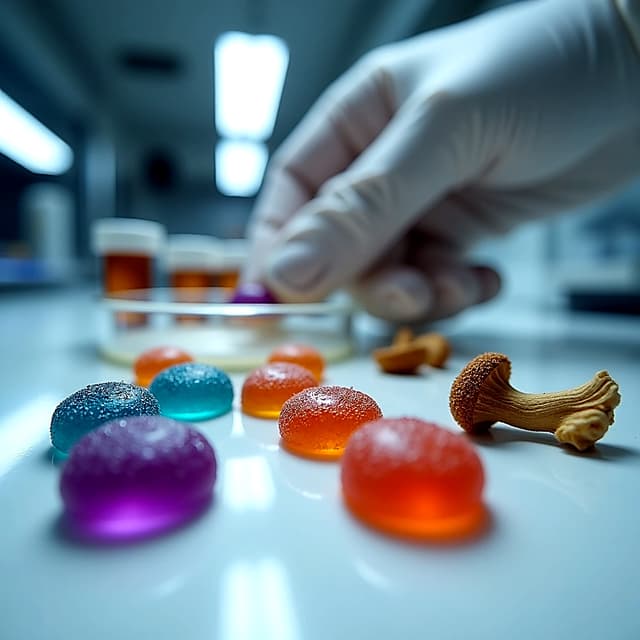
Mushroom gummies sold as psychedelic or “magic mushroom” products do not always contain what their labels suggest.
In a 2025 analysis of 12 mushroom edibles purchased in Portland, Oregon, researchers detected no psilocybin, despite some products being marketed with psychedelic mushroom claims. Instead, several products contained undisclosed psychoactive substances, including psilocin, synthetic tryptamines, cannabinoids, and kava constituents. [1]
However, these findings should not be interpreted as proof that all mushroom gummies are psilocybin-free or that every product contains dangerous synthetic compounds.
A separate 2025 study of eight mushroom gummy products from Portland found psilocin in seven products and psilocybin in one product that was labeled psilocybin-free. [2]
Together, these studies demonstrate a clinically important problem: the ingredients and psychoactive effects of retail mushroom edibles may differ substantially from their labels.
The separate 2024 Diamond Shruumz investigation provides additional evidence that certain mushroom-containing retail products can cause severe illness. It should not, however, be treated as a clinical outcome study of the Oregon laboratory samples. [3]
Laboratory testing has identified undeclared psychoactive ingredients in some retail mushroom gummies and chocolates.
One Oregon study of 12 products found no detectable psilocybin, but identified other active compounds in eight products.
Psilocin was found in two gummies and one chocolate in that study. The chemical can occur naturally or be synthesized; the detected compound alone cannot establish its source.
A separate Oregon study of eight gummies found psilocin in seven products and psilocybin in one product labeled psilocybin-free.
Certain samples contained synthetic tryptamines, but their detection in a small product sample cannot establish the prevalence of these substances across the entire market.
The Diamond Shruumz investigation identified 180 illness reports across 34 states and 73 hospitalizations. CDC reported two associated deaths; FDA separately listed three potentially associated deaths.
Chemical testing and outbreak surveillance answer different questions. A substance found in a retail sample is not automatically the proven cause of an unrelated outbreak.
Severe symptoms after consuming a mushroom edible require urgent medical assessment.
In a study published in JAMA Network Open in September 2025, van Breemen and colleagues investigated the chemical composition of commercial products marketed as psychedelic mushroom edibles.
The researchers purchased 12 products: 11 gummies and one chocolate from retail shops in Portland, Oregon.
Samples underwent chromatographic and mass-spectrometric analysis, including methods capable of identifying several psychoactive compounds. [1]
Psilocybin was not detected in any of the 12 samples.
One gummy was labeled as containing 100 mg of psilocybin, yet none was detected in that sample.
Another gummy listed constituents associated with Amanita muscaria, including muscarine and muscimol, but neither compound was detected.
These findings demonstrate discrepancies between some product labels and the substances identified by laboratory testing.
They do not establish that all products sold as mushroom edibles lack psilocybin. [1]
The investigators reported undeclared ingredients in seven gummies and the chocolate product.
The main findings are summarized below.
Product samples | Constituents detected |
|---|---|
Gummy 2 | Kavalactones |
Gummy 3 | Caffeine |
Gummy 4 | Several cannabinoids, including THC and CBD |
Gummies 6 and 11 | Psilocin |
Gummies 8 and 9 | Synthetic psychoactive tryptamines |
Chocolate 1 | Psilocin |
Gummies 1, 5, 7, and 10 | No targeted active constituents detected |
This table summarizes the researchers' findings and should not be interpreted as a complete toxicological safety certification of the products.
A finding of no detected active constituents means that the study's analytical investigation did not identify those substances. It does not prove that the product contains no potentially relevant chemicals or contaminants. [1]
Two gummies in the Oregon study contained synthetic psychoactive tryptamines, sometimes described as syndelics.
The compounds included:
mipracetin, also known as 4-acetoxy-N-methyl-N-isopropyltryptamine;
4-hydroxy-N,N-diethyltryptamine;
related structural isomers.
These substances differ chemically from psilocybin and are not established as naturally occurring constituents of Psilocybe mushrooms.
Their detection is clinically relevant because reliable human safety data, dose-response information, and interaction profiles for several emerging tryptamines remain limited.
However, their presence in two tested gummies does not establish how commonly these compounds occur in other products or whether they were responsible for specific reported poisoning events. [1]
The Oregon researchers detected psilocin in two gummies and one chocolate product.
Psilocin is a psychoactive compound associated with psilocybin-containing mushrooms. It can be produced through natural biological processes or chemical synthesis.
That distinction matters.
Finding psilocin in a sample does not, by itself, prove that the compound was manufactured synthetically.
In the tested samples, psilocin was detected without psilocybin or the related mushroom alkaloids baeocystin and norbaeocystin. The researchers interpreted this pattern as evidence suggesting the addition of synthetic psilocin.
The interpretation is plausible but remains an inference about origin based on the chemical profile. It is not a direct demonstration of the manufacturing process used for each product. [1]
The findings become more informative when compared with a separate investigation.
Correia and colleagues published a study in Clinical Toxicology in 2025 examining eight recreational psychoactive mushroom gummy products purchased from seven smoke and vape shops in Portland.
Their laboratory analysis found:
psilocin in seven of the eight products;
4-acetoxy-N,N-dimethyltryptamine in six products;
psilocybin in one product labeled psilocybin-free;
undisclosed THC in a product marketed as nootropic;
absence of muscimol and ibotenic acid in two products claiming Amanita muscaria extracts.
These findings are not a contradiction of the 12-product study.
The studies examined different retail product samples.
The important shared finding is inaccurate labeling and unpredictable product composition—not the assertion that every mushroom gummy contains the same substances. [2]
Mislabeled psychoactive edibles create uncertainty before, during, and after an exposure.
Consumers may believe they are taking a known mushroom constituent when they are actually ingesting a different psychoactive compound or a mixture of substances.
For clinicians, this means the reported product label may not accurately identify the exposure.
Potential complications vary with the actual ingredients, dose, co-exposures, and individual susceptibility.
These may include:
agitation, anxiety, or perceptual disturbances;
confusion or altered mental status;
sedation and impaired consciousness;
vomiting;
abnormal heart rate or blood pressure;
seizures;
respiratory compromise in severe cases.
This symptom list reflects reported poisoning presentations involving mushroom-containing retail products. It does not mean that each identified tryptamine is proven to cause every listed effect at typical retail-product doses. [3]
The Diamond Shruumz outbreak is an important example of the potential clinical consequences of poorly characterized mushroom-containing edibles.
It was not a follow-up investigation of the 12 products analyzed by van Breemen and colleagues.
During January–October 2024, federal and state investigators identified 180 reports of moderate or major illness across 34 U.S. states among people who had consumed Diamond Shruumz products or other qualifying mushroom-containing chocolate products.
The investigation reported:
180 illness cases;
73 hospitalizations;
38 ICU admissions;
29 patients requiring endotracheal intubation;
two deaths reported in the CDC investigation.
The 180 cases should not all be described as confirmed Diamond Shruumz exposures.
Of these cases, 118 involved reported Diamond Shruumz consumption, while the remaining cases involved other mushroom-containing chocolate products covered by the investigation's case definition. [3]
FDA's final investigation summary lists three potentially associated deaths.
The CDC's subsequent published outbreak summary and MMWR investigation report two associated deaths. [4] [5]
These figures represent the agencies' reported classifications and should not be combined into a statement that three deaths were definitively caused by Diamond Shruumz products.
The outbreak investigation has ended and transitioned to post-incident activities. Recalled Diamond Shruumz products should not be purchased, sold, or consumed.
FDA tested samples of Diamond Shruumz chocolates, cones, gummies, and a manufacturing ingredient.
Its analyses identified different combinations of substances in different products, including:
acetylpsilocin, also called 4-acetoxy-DMT;
psilocin;
pregabalin;
kavalactones;
muscimol in certain samples.
The tested products did not all contain the same ingredients. Even samples of the same product type or flavor sometimes differed.
FDA also found that muscimol was not present in all tested products and could not explain the full range of reported symptoms by itself.
No single detected ingredient should therefore be presented as the conclusively established cause of every illness in the outbreak. [4]
The evidence supports a clear conclusion: some commercial mushroom edibles have contained unexpected, mislabeled, or undisclosed psychoactive ingredients.
However, the available studies have important limitations.
The Oregon investigations sampled relatively small numbers of products from particular retail settings. Their findings cannot establish national contamination prevalence or prove that every brand follows the same pattern.
The chemical analyses identified compounds in purchased products; they did not measure clinical outcomes in people who consumed those specific samples.
Conversely, the Diamond Shruumz outbreak captured severe clinical illness but could not identify one chemical cause for every case.
The correct synthesis is therefore:
Laboratory studies demonstrate ingredient uncertainty, while the outbreak investigation demonstrates that serious illness can occur after consumption of some retail mushroom-containing edibles.
These are complementary findings, but they are not interchangeable.
Commercial products sold in smoke shops or online should not be equated with pharmaceutical preparations used in controlled clinical research.
Clinical studies use characterized investigational products, defined dosing procedures, eligibility screening, and adverse-event monitoring.
Retail mushroom gummies may be marketed using similar psychedelic terminology without providing equivalent evidence of ingredient identity, dose consistency, or product quality.
That difference matters when discussing both therapeutic research and consumer safety.
For a wider discussion of investigational psychedelics and supervised treatment, see Psychedelics in 2025: What’s Evidence-Based, What Isn’t, and How to Counsel Patients.
Do not rely on a product's name, color, packaging, or claimed mushroom species to identify its active ingredients.
If someone develops severe confusion, loss of consciousness, seizures, difficulty breathing, or another major symptom after consuming a mushroom edible, seek emergency medical care.
For a suspected exposure without immediate life-threatening symptoms, contact a poison center for individualized advice.
In the United States, Poison Help is available at 1-800-222-1222.
When possible, keep the product packaging and remaining contents available for identification. Do not induce vomiting.
Consumers should not use recalled Diamond Shruumz products. FDA advises that recalled products be discarded or returned through the recall process. [4]
When evaluating possible mushroom-edible poisoning, the clinical history should account for potential mislabeling.
Relevant details include:
product name, formulation, and packaging;
estimated amount and time consumed;
co-ingestants;
medications and relevant medical history;
symptoms and their progression;
whether others consumed the same product;
availability of residual product for appropriate testing.
Clinical management should be based on the patient's condition and suspected toxidrome, rather than assuming that the product contains psilocybin alone.
Severe neurological or respiratory presentations require prompt emergency assessment and appropriate supportive management.
Routine toxicology testing may not identify every emerging psychoactive tryptamine, and a negative result on a limited screening panel should not override concerning clinical findings.
The CDC investigation illustrates the importance of poison-center consultation, supportive management, and public-health reporting when unusual severe illness follows consumption of mushroom-containing products. [3]
A product label is not an analytical result.
Ingredient claims should not be treated as confirmation of what a consumer ingested.
One negative psilocybin study does not describe the whole market.
Different retail samples can produce different findings.
Psilocin is not inherently evidence of synthetic manufacture.
Its origin requires careful interpretation of the accompanying chemical profile.
Undeclared ingredients complicate toxidrome interpretation.
Clinical decisions should follow the presentation rather than the marketing label.
Surveillance cases are not population incidence.
The Diamond Shruumz investigation identified reported illness among a defined set of exposures, not the risk per product sold or serving consumed.
Do not attribute all illness to one detected compound.
FDA found substantial variation in the chemical composition of investigated products.
No. Some retail samples contain no detectable psilocybin, while other studies have detected psilocybin, psilocin, or other psychoactive compounds. Product composition varies.
No. The study examined 12 selected retail products. It demonstrated important labeling and ingredient discrepancies in those samples, not the prevalence of contamination in the entire market.
No. Psilocin can occur naturally and can also be synthesized. Finding psilocin alone does not establish its origin.
There is no evidence presented in these studies that the particular Oregon samples caused the Diamond Shruumz outbreak. The laboratory investigations and federal outbreak investigation concern separate product samples and evidence.
Urgent care is warranted for seizures, severe confusion, loss of consciousness, difficulty breathing, or other significant symptoms. Poison-center consultation is appropriate when ingredients are uncertain or symptoms develop.
Retail psychedelic mushroom gummies present a distinctive medical-toxicology challenge because a product's marketed identity may not match its actual chemical composition.
Two independent Oregon studies found significant labeling discrepancies, but their results differed because they examined different products.
The broader Diamond Shruumz investigation independently demonstrated the potential for serious illness after consumption of certain mushroom-containing edibles.
Taken together, the evidence supports stronger product testing, more accurate labeling, appropriate public-health surveillance, and clinically informed risk communication.
It does not justify treating every mushroom gummy as chemically identical, attributing every illness to psilocybin or muscimol, or extrapolating results from a small laboratory sample to the entire market.
The central safety question is not simply what the label says, but what the product actually contains.
© All copyright of this material is absolute to Medical toxicology
Dr. Omid Mehrpour (MD, FACMT) is a senior medical toxicologist and physician-scientist with over 15 years of clinical and academic experience in emergency medicine and toxicology. He founded Medical Toxicology LLC in Arizona and created several AI-powered tools designed to advance poisoning diagnosis, clinical decision-making, and public health education. Dr. Mehrpour has authored over 250 peer-reviewed publications and is ranked among the top 2% of scientists worldwide. He serves as an associate editor for several leading toxicology journals and holds multiple U.S. patents for AI-based diagnostic systems in toxicology. His work brings together cutting-edge research, digital innovation, and global health advocacy to transform the future of medical toxicology.
Keep reading
 Food and Drug Toxicology

Amir Mohammad Mottaghi
 Food and Drug Toxicology

Amirhosein Shabrang
 Food and Drug Toxicology
Amirhosein Shabrang
 Food and Drug Toxicology
Amirhosein Shabrang