Food and Drug Toxicology
Probiotics, Prebiotics, and Synbiotics: Their Role in Gut Health, Toxicology, and Protection Against Environmental Toxicants
Amir Mohammad Mottaghi
Post on 10 Oct 2026 · 6 min read
Amir Mohammad Mottaghi
Post on 10 Oct 2026 · 6 min read
 Medical Toxicologymedicaltoxic.com
https://medicaltoxic.com/blogs/probiotics-prebiotics-and-synbiotics-their-role-in-gut-healt
Introduction
The human body is continuously exposed to a wide range of chemical substances, including environmental pollutants, pharmaceutical compounds, food contaminants, pesticides, heavy metals, and industrial chemicals. The biological effects of these substances are strongly influenced by absorption, metabolism, elimination, and interactions with host physiological systems. One of the most important factors regulating these processes is the gut microbiome, a complex community of trillions of microorganisms residing primarily in the gastrointestinal tract.
The intestinal microbiota plays a critical role not only in digestion and nutrient metabolism but also in xenobiotic transformation, immune regulation, intestinal barrier maintenance, and modulation of inflammatory responses. Alterations in microbial composition, known as dysbiosis, have been associated with increased susceptibility to oxidative stress, inflammation, metabolic disorders, and toxicant-induced tissue injury[1][2][3] .
In recent years, microbiome-targeted strategies, including probiotics, prebiotics, and synbiotics, have gained attention in toxicology because of their potential ability to modify the response of the host to harmful chemical exposures. These approaches may influence toxicant absorption, metabolism, detoxification pathways, oxidative stress responses, and inflammatory signaling.
The Gut Microbiome and Toxicological Responses
The gastrointestinal tract represents one of the major interfaces between the external environment and the internal body. Every day, humans encounter numerous xenobiotics through contaminated food, water, medications, and environmental exposure. Before reaching systemic circulation, many of these compounds interact directly with intestinal microorganisms.
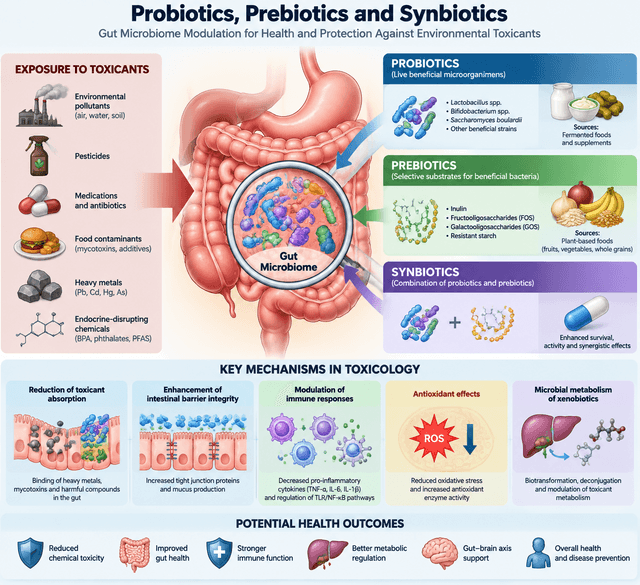
The gut microbiota can influence xenobiotic toxicity through several mechanisms:
1. Modification of Chemical Metabolism
Gut microorganisms contain numerous enzymes capable of transforming chemical compounds through reactions such as:
- Hydrolysis
- Reduction
- Deconjugation
- Demethylation
These microbial metabolic processes may either decrease toxicity by facilitating elimination or increase toxicity by generating bioactive metabolites.
For example, bacterial β-glucuronidase enzymes can reactivate certain compounds that have been detoxified by hepatic conjugation, potentially increasing intestinal exposure and toxicity[4].
2. Regulation of Intestinal Barrier Integrity
The intestinal epithelial barrier acts as a protective defense against harmful substances. Exposure to toxic chemicals, alcohol, heavy metals, pesticides, and some pharmaceuticals may disrupt tight junction proteins and increase intestinal permeability, a phenomenon often described as "leaky gut."
Increased intestinal permeability allows bacterial components such as lipopolysaccharide (LPS) to enter circulation and activate inflammatory pathways, including:
- Toll-like receptor (TLR) signaling
- NF-κB activation
- Cytokine production
Probiotics and prebiotics may help maintain epithelial integrity by increasing mucus production, enhancing tight junction expression, and promoting beneficial microbial metabolites [5].
What Are Probiotics?
According to the International Scientific Association for Probiotics and Prebiotics (ISAPP), probiotics are live microorganisms that, when administered in adequate amounts, provide a health benefit to the host [6].
Common probiotic microorganisms include:
- Lactobacillus species
- Bifidobacterium species
- Saccharomyces boulardii
These microorganisms can influence host physiology through multiple mechanisms, including:
- Competition with pathogenic microorganisms
- Production of antimicrobial compounds
- Regulation of immune responses
- Reduction of oxidative stress
- Modulation of inflammatory pathways [7][8]
Probiotics in Toxicology: Potential Protective Mechanisms
1. Reduction of Toxicant Absorption
Some probiotic strains may bind toxic compounds in the gastrointestinal tract, reducing their absorption into systemic circulation.
This mechanism has been investigated for several contaminants, including:
- Heavy metals
- Mycotoxins
- Food-derived toxic compounds
Certain bacterial cell wall components, particularly peptidoglycan and polysaccharides, may interact with toxic molecules and facilitate their removal through fecal excretion.
2. Antioxidant Effects
Oxidative stress is a common mechanism involved in toxicity induced by many environmental chemicals.
Exposure to compounds such as:
- Heavy metals
- Pesticides
- Endocrine-disrupting chemicals
- Industrial pollutants
can increase reactive oxygen species (ROS) production and impair antioxidant defense systems.
Probiotics may reduce oxidative damage by:
- Increasing antioxidant enzyme activity
- Enhancing glutathione production
- Reducing lipid peroxidation
- Modulating oxidative stress-related signaling pathways [9]
3. Modulation of Inflammatory Responses
Chronic exposure to toxic substances can activate inflammatory pathways, particularly:
- NF-κB signaling
- NLRP3 inflammasome activation
- Pro-inflammatory cytokine production
Probiotic microorganisms may regulate immune responses by decreasing inflammatory mediators such as:
- TNF-α
- IL-6
- IL-1β
and increasing anti-inflammatory responses [10].
What Are Prebiotics?
Prebiotics are selectively utilized substrates that promote the growth and activity of beneficial microorganisms in the gut [11].
Unlike probiotics, prebiotics are not living organisms. They function as nutritional sources for beneficial bacteria.
Important prebiotics include:
- Inulin
- Fructooligosaccharides (FOS)
- Galactooligosaccharides (GOS)
- Resistant starch
Prebiotics and Detoxification Pathways
The metabolism of prebiotics by gut bacteria produces short-chain fatty acids (SCFAs), including:
- Acetate
- Propionate
- Butyrate
These metabolites have important biological effects:
Butyrate
Butyrate is a major energy source for colon epithelial cells and contributes to:
- Maintenance of intestinal barrier function
- Regulation of immune responses
- Reduction of inflammation
- Protection against oxidative injury [12]
By improving gut microbial metabolism, prebiotics may indirectly influence the toxicity profile of environmental chemicals.
What Are Synbiotics?
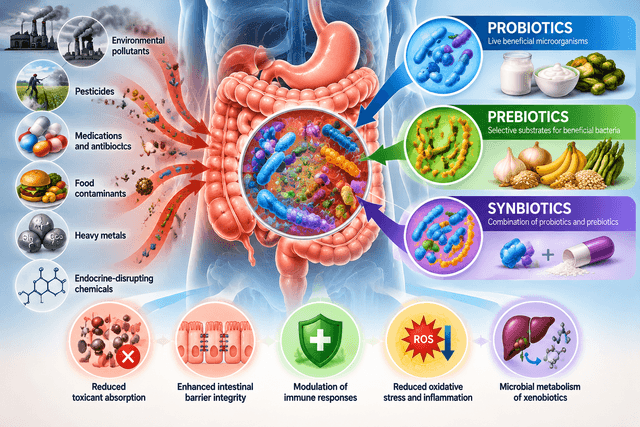
Synbiotics are combinations of probiotics and prebiotics designed to produce synergistic effects by improving the survival and activity of beneficial microorganisms [13].
The principle behind synbiotics is simple:
- Probiotics provide beneficial microorganisms.
- Prebiotics provide the necessary nutrients for their growth.
- Together they enhance microbiome modulation.
Synbiotics are increasingly studied as potential supportive strategies against chemical-induced damage because they combine microbial replacement with microbial stimulation.
Probiotics, Prebiotics, and Specific Toxicological Applications
Heavy Metal Toxicity
Heavy metals such as:
- Lead (Pb)
- Cadmium (Cd)
- Mercury (Hg)
- Arsenic (As)
can induce toxicity through oxidative stress, mitochondrial dysfunction, and inflammation.
Several studies suggest that probiotic bacteria may reduce heavy metal bioavailability by binding metals within the intestinal tract and reducing absorption.
Pesticide Exposure
Pesticides may alter gut microbial composition and contribute to oxidative stress and immune dysfunction.
Probiotics may counteract pesticide-induced damage by:
- Restoring microbial balance
- Reducing inflammatory responses
- Improving antioxidant capacity
Endocrine-Disrupting Chemicals
Environmental chemicals such as:
- Bisphenol A (BPA)
- Phthalates
- Perfluoroalkyl substances (PFAS)
can interfere with hormonal pathways and induce oxidative and inflammatory responses.
The gut microbiome has been suggested to participate in the metabolism and biological effects of endocrine-disrupting chemicals. Microbiome modulation through probiotics and prebiotics is therefore being investigated as a potential protective approach.
Safety Considerations
Although probiotics are generally considered safe, their effects depend on:
- Bacterial strain
- Dose
- Duration of treatment
- Host health condition
Individuals with severe immunosuppression or critical illness may require careful evaluation before probiotic administration because rare cases of probiotic-associated infections have been reported [14][15].
Future Perspectives in Toxicological Research
The emerging field of microbiome toxicology aims to understand how microorganisms influence chemical exposure and toxicity.
Future research directions include:
- Personalized probiotic therapies
- Microbiome-based biomarkers of toxicity
- Engineered beneficial bacteria
- Combination therapies using probiotics and antioxidants
- Application in environmental toxicology and drug safety assessment
Understanding microbiome toxicant interactions may provide new strategies for preventing or reducing chemical-induced damage.
Conclusion
The gut microbiome represents an important biological regulator of toxicological responses. Probiotics, prebiotics, and synbiotics provide promising approaches for maintaining microbial balance and supporting host defense mechanisms against environmental toxicants.
Through mechanisms involving reduction of toxicant absorption, enhancement of antioxidant defense, regulation of inflammation, and improvement of intestinal barrier function, microbiome-based interventions may contribute to future strategies in preventive toxicology.
However, further research is required to determine optimal microbial strains, effective doses, and specific applications for different toxic exposures.
© All copyright of this material is absolute to Medical toxicology
Master’s student in Toxicology at Tarbiat Modares University (TMU), focusing on toxicodynamics, environmental toxicants, and human health risk assessment.
Keep reading
 Food and Drug Toxicology
Amirhosein Shabrang
 Food and Drug Toxicology
Amirhosein Shabrang
 Food and Drug Toxicology
Amirhosein Shabrang
 Food and Drug Toxicology
Amirhosein Shabrang