Food and Drug Toxicology
Mad Honey Poisoning: Grayanotoxin, Bradycardia, Hypotension, and Treatment
Amirhosein Shabrang
Post on 20 Sept 2026 · Updated 01 Oct 2026 · 17 min read
Amirhosein Shabrang
Post on 20 Sept 2026 · Updated 01 Oct 2026 · 17 min read
 Medical Toxicologymedicaltoxic.com
https://medicaltoxic.com/blogs/mad-honey-poisoning-grayanotoxin

Mad honey sounds like an unusual food product, but its toxicology is clinically distinctive. Honey produced from nectar containing grayanotoxins, particularly from certain Rhododendron species, can cause a syndrome dominated by bradycardia and hypotension, often accompanied by nausea, vomiting, dizziness, weakness, diaphoresis, and presyncope or syncope.
The cardiovascular effects can occasionally progress beyond simple sinus bradycardia. Junctional rhythms, atrioventricular (AV) conduction abnormalities, complete heart block, and rarely severe cardiovascular instability have been reported. A systematic review encompassing 1,199 reported cases found sinus bradycardia to be the most frequently reported ECG abnormality, while AV block and nodal rhythms were also documented. [1]
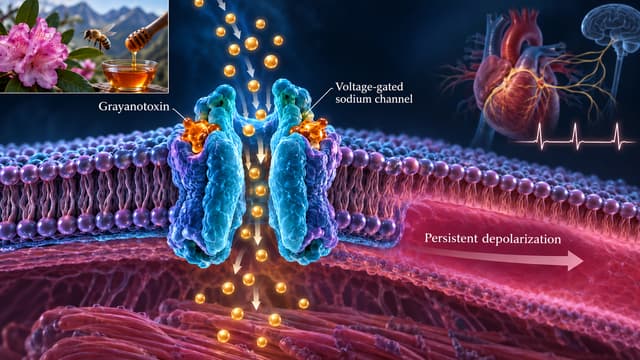
The mechanism is also important. Mad honey poisoning is not a form of digoxin or cardiac glycoside poisoning. Grayanotoxins alter voltage-gated sodium-channel function, producing persistent membrane depolarization and autonomic effects. [2]
Recognition is particularly important as mad honey moves beyond regions where clinicians traditionally encountered it. A 2026 review of poisoning in Nepal found that mad honey is increasingly traded online to consumers in North America, Europe, and East Asia. [3]
Mad honey poisoning results from exposure to grayanotoxins, naturally occurring diterpenoid toxins associated especially with Rhododendron species. [2]
Grayanotoxins alter voltage-gated sodium channels, causing prolonged depolarization and disruption of normal autonomic and cardiac electrophysiology.
The characteristic clinical pattern is bradycardia plus hypotension, often accompanied by dizziness, nausea, vomiting, weakness, sweating, or syncope. [1]
ECG abnormalities can include sinus bradycardia, junctional rhythms and varying degrees of AV block; severe conduction disturbance and asystole have been reported. [4]
Diagnosis is usually clinical, based on the exposure history, symptoms, vital signs, and ECG. Routine hospital testing for blood grayanotoxin concentrations is generally unavailable and unnecessary for most clinical decisions. [3]
Initial treatment is largely supportive. IV crystalloid is appropriate for clinically important hypotension, while atropine is commonly used for symptomatic bradycardia. [1]
Most reported patients recover relatively quickly with supportive management, but a favorable overall prognosis should not be used to dismiss severe bradyarrhythmia, hypotension, or high-grade AV block.
Online availability means a history of travel to Turkey or Nepal is no longer necessary for exposure to be plausible. [3]
Mad honey is honey containing grayanotoxins derived from toxic plant nectar. The best-known sources are plants in the Ericaceae family, particularly Rhododendron species.
The association is especially well described in regions of Turkey and Nepal. A recent Nepalese review describes a pathway in which the Himalayan giant honey bee, Apis laboriosa, forages on toxin-containing Rhododendron flowers and produces honey capable of causing human intoxication. [3]
Not every honey product from a region containing Rhododendron is toxic, and toxin concentrations are not necessarily uniform between products or batches. This variability is clinically important because the amount of honey consumed is an unreliable surrogate for the actual grayanotoxin dose.
Mad honey has historically been consumed for perceived medicinal or psychoactive effects, including attempts to treat hypertension or gastrointestinal problems and to enhance sexual function. These purported benefits should not be confused with established clinical indications. Evidence supporting therapeutic use is limited, while clinically significant poisoning is well documented. [2]
MedicalToxic has previously discussed the historical role of mad honey in A Historical and Conceptual Journey of Toxicology. The clinical issue is different: a seemingly natural food product can produce a recognizable cardiovascular toxidrome requiring emergency assessment.
Grayanotoxins act primarily on voltage-gated sodium channels.
Normally, these channels open transiently during membrane depolarization and then enter an inactivated state. Grayanotoxins interfere with normal channel gating, favoring persistent activation and preventing normal inactivation. The resulting prolonged depolarization disrupts excitable tissues, including cardiac and nervous tissue. [2]
The downstream clinical syndrome reflects more than direct myocardial toxicity. Autonomic disturbance, including enhanced vagal effects, contributes substantially to the combination of bradycardia and hypotension described in human poisoning. Earlier clinical reviews have therefore characterized the presentation as a cholinergic-like syndrome, although grayanotoxin does not act by inhibiting acetylcholinesterase. [4]
This distinction matters.
Mad honey poisoning can superficially resemble other plant-related cardiotoxic syndromes because the patient may have vomiting, bradycardia, hypotension, or AV block.
But grayanotoxin does not inhibit Na+/K+-ATPase in the manner of digoxin, yellow oleander, or foxglove.
That separate mechanism is discussed in Plant Cardiac Glycoside Poisoning: Oleander, Foxglove, ECG Findings, and Treatment.
This is a clinically important distinction because therapies specific to cardiac glycoside poisoning, particularly digoxin immune Fab, should not be automatically transferred to mad honey poisoning.
The classic presentation combines gastrointestinal or neurologic symptoms with cardiovascular depression.
Commonly described symptoms include:
dizziness;
weakness;
nausea;
vomiting;
diaphoresis;
blurred vision;
hypersalivation;
headache;
paresthesias;
presyncope or syncope.
More severe poisoning can produce altered mental status and significant cardiovascular instability. [5]
The combination that should particularly raise clinical suspicion is:
recent honey ingestion + unexplained bradycardia + hypotension.
This pattern is more informative than any one symptom alone.
Cardiovascular effects dominate clinically significant grayanotoxin poisoning.
A systematic review published in 2015 evaluated 1,199 reported cases accumulated across approximately 34 years of case literature. Dizziness, nausea, and presyncope were among the most frequent complaints. Sinus bradycardia was the predominant ECG abnormality reported in the review, while AV block, complete AV block, nodal rhythm, and ST-segment changes were also described. No deaths were identified among those 1,199 cases. [1]
Those numbers require careful interpretation. The evidence base was assembled largely from published cases and case series rather than population surveillance, and individual patients could have more than one ECG abnormality. The reported percentages therefore should not be interpreted as incidence rates among all people who consume mad honey.
Sinus bradycardia is the most characteristic rhythm disturbance.
The heart rate may be only moderately reduced in mild intoxication, but profound bradycardia can occur and become clinically important when accompanied by hypotension, dizziness, syncope, altered mental status, or impaired perfusion.
Hypotension is another central feature and often occurs together with bradycardia.
The 2026 Nepal review identified bradycardia and hypotension in nearly all of the approximately 68 published Nepalese cases it reviewed. No fatalities were recorded in that dataset. [3]
These findings describe the published Nepalese experience; they should not be generalized into a universal incidence estimate for all mad honey exposures.
Grayanotoxin toxicity can impair cardiac conduction sufficiently to cause:
first-degree AV block;
higher-grade AV block;
complete AV block;
junctional or nodal rhythms.
Earlier clinical reviews have also documented asystole. [4]
Therefore, a patient with suspected mad honey poisoning and a very slow pulse should not simply be labeled as having benign sinus bradycardia without obtaining an ECG.
Symptoms generally develop relatively soon after ingestion, but the precise onset varies with the amount and toxin concentration.
Older clinical literature often describes symptoms beginning within minutes to several hours after consumption. Because grayanotoxin concentrations can vary between honey samples, neither the number of spoonfuls nor the reported volume should be treated as a reliable toxic-dose threshold.
The 2015 systematic review noted poisoning frequently after reported consumption in the range of one to several tablespoons, but this observation came from heterogeneous published cases rather than a controlled dose-response study. [1]
There is therefore no clinically reliable rule such as:
“below X tablespoons is safe.”
Product-specific toxin concentration matters, and the patient’s physiology is more useful than an estimated spoon count.
There is no routinely available hospital blood test that clinicians need to wait for before diagnosing mad honey poisoning.
The diagnosis rests on four elements:
Clinical element | What to look for |
|---|---|
Exposure | Mad honey, unusual wild honey, Rhododendron-associated honey, or related botanical exposure |
Symptoms | Nausea, vomiting, dizziness, weakness, sweating, presyncope or syncope |
Hemodynamics | Bradycardia and hypotension |
ECG | Sinus bradycardia, junctional rhythm, AV conduction disturbance or other rhythm abnormality |
A 2026 review found that diagnosis in reported Nepalese cases remained clinical because grayanotoxin assay capability was unavailable across the hospitals represented in the literature. [3]
Yes—in specialized analytical settings.
A small 2017 observational study measured grayanotoxin I and III in six patients using liquid chromatography–tandem mass spectrometry (LC-MS/MS). Blood concentrations declined as the patients recovered, and the investigators explored relationships between toxin concentrations and hypotension. [6]
But six patients are not enough to establish a validated clinical concentration threshold for routine management.
The practical conclusion is straightforward:
Specialized grayanotoxin measurement is scientifically possible, but routine emergency treatment should not wait for it.
For the broader principle of interpreting specialized and screening tests within the clinical picture, see Drug Screens Lie: A Clinician’s Guide to Interpreting Toxicology Tests Safely.
A symptomatic patient with suspected grayanotoxin poisoning should receive a focused cardiovascular and toxicologic assessment.
Important initial steps include:
repeated heart rate and blood pressure measurements;
assessment of mental status and perfusion;
12-lead ECG;
continuous cardiac monitoring when clinically significant poisoning is suspected;
IV access in symptomatic or hemodynamically unstable patients;
glucose and basic laboratory testing when clinically indicated;
evaluation for co-exposures or alternative causes.
Electrolytes, renal function, and other laboratory studies may help assess the patient and alternative diagnoses, but no routine laboratory pattern confirms mad honey poisoning.
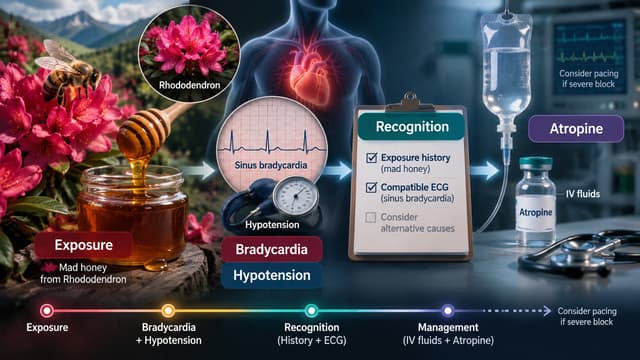
There is no established toxin-specific antidote that neutralizes grayanotoxin.
Treatment focuses on supporting circulation and treating clinically important bradycardia and hypotension while the toxic effects resolve.
Initial management follows standard resuscitation priorities: airway, breathing, circulation, neurologic status, and hemodynamic assessment.
Patients with significant bradycardia, hypotension, syncope, conduction abnormalities, or altered mental status should be monitored continuously.
An ECG should be repeated if the rhythm or clinical condition changes.
IV isotonic crystalloid is commonly used when hypotension is clinically important.
Fluid administration should be individualized rather than automatically given in large volumes, particularly in patients in whom cardiac or renal comorbidity limits volume tolerance.
Published mad honey series consistently describe saline administration as a major component of supportive management. [1]
Atropine is the most consistently reported pharmacologic treatment for clinically important grayanotoxin-associated bradycardia.
The systematic review of 1,199 cases found that atropine was frequently used, commonly in reported doses of 0.5 or 1 mg in the historical case literature. [1]
Those numbers describe historical treatment patterns; they should not be interpreted as a modern universal dosing protocol. Current treatment of symptomatic bradycardia should follow contemporary resuscitation practice and be individualized to the patient, age, rhythm, hemodynamics, and clinical response.
A small published series similarly reported improvement in most patients treated with IV atropine and saline. [7]
The clinical target is not a specific heart-rate number. Treatment is most important when bradycardia is associated with:
hypotension;
syncope or near-syncope;
altered mental status;
evidence of poor perfusion;
ischemic symptoms;
significant conduction disturbance.
Most published cases improve with supportive treatment, but severe poisoning should be approached as unstable symptomatic bradycardia rather than assumed to be self-limited.
High-grade AV block or persistent hemodynamic instability despite initial therapy may require escalation according to standard critical-care and bradycardia management principles.
Temporary pacing has been reported in severe cases, including patients with complete AV block. [5]
Because these cases are uncommon, the evidence supporting invasive escalation is primarily case-based rather than trial-based.
Early consultation with a poison center or medical toxicologist is appropriate when cardiovascular toxicity is severe, persistent, atypical, or diagnostically uncertain.
The evidence for gastrointestinal decontamination specifically in mad honey poisoning is limited.
Because patients may present with nausea, vomiting, bradycardia, hypotension, or altered consciousness—and because most cases are managed successfully with supportive therapy—activated charcoal should not be treated as routine therapy for every mad honey exposure.
If a patient presents very early after a potentially significant ingestion, any decision regarding charcoal should be individualized according to timing, airway safety, clinical status, and toxicology consultation.
Inducing vomiting at home is not appropriate.
The presentation is recognizable once the exposure is known. Without that history, however, bradycardia and hypotension have a broad differential diagnosis.
Important alternatives include:
Digoxin, foxglove, yellow oleander, and related glycosides can cause gastrointestinal symptoms, bradycardia, AV block, and hypotension.
However, their molecular target is Na+/K+-ATPase, not the voltage-gated sodium-channel mechanism of grayanotoxin.
See Plant Cardiac Glycoside Poisoning: Oleander, Foxglove, ECG Findings, and Treatment for the distinct diagnostic and antidotal considerations.
Both can produce clinically significant bradycardia and hypotension. Medication history, glucose abnormalities, ECG findings, severity, and exposure circumstances can help distinguish them.
Sweating, salivation, gastrointestinal symptoms, bradycardia, and hypotension can create superficial overlap.
However, organophosphate and carbamate poisoning generally produces a much broader cholinergic syndrome, potentially including bronchorrhea, bronchospasm, miosis, diarrhea, urinary effects, fasciculations, weakness, and respiratory failure.
Grayanotoxin does not inhibit acetylcholinesterase.
Both grayanotoxin and ciguatoxin alter voltage-gated sodium-channel physiology and both foodborne syndromes can include gastrointestinal, neurologic, and cardiovascular manifestations.
However, ciguatera typically follows consumption of contaminated reef fish and often features characteristic sensory abnormalities and a potentially much longer neurologic course. For comparison, see Ciguatera Fish Poisoning: Causes, Symptoms, and Treatment Guide.
Inferior myocardial ischemia, intrinsic conduction disease, sick sinus syndrome, and other cardiovascular disorders remain important alternatives, especially in older patients or those with cardiovascular risk factors.
A history of unusual honey consumption should inform the differential—not terminate it.
The prognosis reported in modern mad honey literature is generally favorable.
The 2015 systematic review identified no deaths among 1,199 reported cases, and most patients recovered sufficiently for discharge within approximately 24 hours. [1]
Similarly, the 2026 review of approximately 68 published Nepalese cases found no fatalities. [3]
But these observations require an important qualification:
absence of deaths in published series does not mean the toxin is incapable of causing dangerous cardiovascular toxicity.
Severe bradycardia, complete AV block, profound hypotension, altered consciousness, and asystole have all been described in the literature. [4]
The useful clinical message is therefore not that mad honey poisoning is “benign.” It is that most recognized and appropriately treated cases resolve without lasting consequences, despite the potential for dramatic early cardiovascular toxicity.
There is no single validated observation period that applies to every mad honey exposure.
Many published patients recover over several hours, and the systematic review found that discharge within 24 hours after recovery was common. [1]
Disposition should instead be guided by the clinical course.
Continued monitored care is appropriate when there is:
persistent symptomatic bradycardia;
hypotension;
recurrent symptoms;
high-grade AV block;
another significant ECG abnormality;
altered mental status;
uncertainty about the exposure;
suspected co-ingestion;
significant underlying cardiovascular disease.
A patient should not be discharged simply because a predefined number of hours has elapsed if clinically important toxicity persists.
Historically, clinicians could associate mad honey poisoning with specific geographic regions.
That assumption is becoming less reliable.
The 2026 Nepal review reports that mad honey is increasingly sold online to consumers in North America, Europe, and East Asia, potentially exposing people with little experience of the product or its variable toxicity. [3]
This changes the exposure history clinicians should take.
Instead of asking only:
“Have you recently traveled to Nepal or Turkey?”
it may be more useful to ask:
“Have you consumed wild, imported, medicinal, psychoactive, or internet-purchased honey?”
A product purchased online does not become predictable simply because it is commercially packaged. Botanical source, harvest conditions, blending, and toxin concentration may vary.
No reliable bedside or consumer method can determine grayanotoxin concentration from appearance alone.
Color, flavor, smell, origin claims, or marketing terms cannot establish a safe dose.
This is especially important because the term “natural” says nothing about toxicologic safety.
The toxin originates from a natural plant-bee-food pathway; that does not make its pharmacologic effects mild or predictable.
The most reliable prevention strategy is to avoid using mad honey as a self-treatment or recreational product.
Consumers should be particularly cautious with honey marketed for:
blood-pressure reduction;
sexual enhancement;
psychoactive effects;
traditional medicinal purposes;
unusually potent or “strong” effects.
Anyone who develops dizziness, fainting, severe weakness, persistent vomiting, a markedly slow pulse, chest symptoms, or altered consciousness after consuming suspected mad honey should seek urgent medical evaluation.
Do not attempt to treat significant poisoning at home, induce vomiting, or assume that prior uneventful consumption guarantees that another batch will have the same toxin concentration.
Think exposure when bradycardia and hypotension arrive together. A patient with nausea, dizziness, syncope, and otherwise unexplained bradycardia deserves a targeted history about unusual honey and botanical products.
Do not confuse grayanotoxin with digoxin. Both can cause bradyarrhythmias, but the molecular targets and toxin-specific treatments are different.
The ECG matters more than the product label. “Mad honey” is not a standardized pharmaceutical dose. Evaluate the patient's rhythm, blood pressure, perfusion, and clinical trajectory.
Atropine is supported mainly by accumulated clinical experience rather than randomized trials. It is frequently effective for symptomatic grayanotoxin-associated bradycardia, but severe refractory cardiovascular instability requires escalation.
Do not wait for a grayanotoxin level. Specialized LC-MS/MS detection is possible, but routine diagnosis remains clinical.
A reassuring mortality record is not the same as harmless toxicity. Complete AV block and asystole have been reported.
Geography is no longer an exclusion criterion. Online trade means clinicians outside traditional endemic areas may encounter mad honey poisoning.
Mad honey poisoning is caused by grayanotoxins, naturally occurring diterpenoid compounds found particularly in certain Rhododendron species. Bees can transfer these toxins from nectar into honey. The toxins alter voltage-gated sodium-channel function and disrupt autonomic and cardiovascular physiology. [2]
The most clinically useful pattern is bradycardia and hypotension after mad honey ingestion, often accompanied by dizziness, nausea, vomiting, weakness, sweating, presyncope, or syncope. AV block and other rhythm abnormalities can occur in more severe poisoning. [1]
There is no established grayanotoxin-neutralizing antidote. Treatment is mainly supportive. IV fluids are commonly used for hypotension, and atropine is frequently effective when clinically important symptomatic bradycardia is present. Severe persistent conduction disturbance or instability may require escalation of standard bradycardia management. [1]
No. Both may produce bradycardia, hypotension, gastrointestinal symptoms, and conduction abnormalities, but the toxins act differently. Grayanotoxins primarily alter voltage-gated sodium channels, whereas oleander cardiac glycosides inhibit Na+/K+-ATPase. Digoxin immune Fab can have a role in severe cardiac glycoside poisoning; it is not an established treatment for grayanotoxin poisoning. [2]
Yes. The toxin-producing botanical ecology is geographically concentrated, but the product is traded internationally. The 2026 Nepal review specifically notes increasing online distribution to consumers in North America, Europe, and East Asia. [3]
Mad honey poisoning is a distinctive foodborne toxic syndrome in which a natural product produces clinically important cardiovascular effects through grayanotoxin-mediated disruption of voltage-gated sodium channels.
The bedside pattern is memorable: recent mad honey exposure followed by dizziness, gastrointestinal symptoms, bradycardia, and hypotension.
Most documented patients recover with monitoring and supportive treatment. IV fluids and atropine are the most consistently reported interventions for clinically significant hypotension and symptomatic bradycardia. Nevertheless, high-grade AV block, profound hemodynamic instability, and rare asystole make it inappropriate to dismiss the exposure as merely an unusual food reaction.
The most useful approach is therefore clinical: recognize the exposure, obtain an ECG, monitor symptomatic patients, support circulation, treat clinically important bradycardia, escalate when instability persists, and involve a poison center or medical toxicologist when the presentation is severe or uncertain.
As online distribution expands beyond traditional mad honey regions, clinicians should increasingly consider grayanotoxin poisoning even in patients with no travel history to Nepal or Turkey.
© All copyright of this material is absolute to Medical toxicology
As the Growth & Content Lead at MedicalToxic.com, I work on content strategy, development, and digital growth. My focus is on making MedicalToxic’s content clear, practical, and accessible, while helping expand the platform’s reach and strengthen its position as a trusted resource in clinical toxicology.
Keep reading
 Food and Drug Toxicology
Amir Mohammad Mottaghi
 Food and Drug Toxicology
Amirhosein Shabrang
 Food and Drug Toxicology
Amirhosein Shabrang
 Food and Drug Toxicology
Amirhosein Shabrang