Environmental and Occupational Toxicology
Understanding Arsenic Poisoning: Causes, Symptoms, and Prevention
Omid Mehrpour
Post on 02 Sept 2024 · Updated 28 Nov 2026 · 11 min read

Omid Mehrpour
Post on 02 Sept 2024 · Updated 28 Nov 2026 · 11 min read
 Medical Toxicologymedicaltoxic.com
https://medicaltoxic.com/blogs/arsenic-poisoning-causes-symptoms-and-prevention
Arsenic poisoning can result from exposure to contaminated drinking water, food, industrial materials, or certain arsenic-containing products. The health effects depend on the chemical form of arsenic, the amount absorbed, the route of exposure, and the duration of exposure.
Acute arsenic poisoning may cause severe gastrointestinal, cardiovascular, and neurological complications. Chronic inorganic arsenic exposure can produce gradual skin and nerve changes and increase the risk of certain cancers.
Recognizing a credible exposure source is essential because many symptoms are nonspecific, and the wrong laboratory test can lead to misleading results or unnecessary treatment. [1] [2]
Inorganic arsenic is a major concern in contaminated drinking water and certain occupational exposures.
Acute severe poisoning may cause vomiting, profuse diarrhea, hypotension, cardiac abnormalities, and multiorgan injury.
Long-term inorganic arsenic exposure can cause characteristic skin changes, neuropathy, and increased risks of skin, lung, and bladder cancers.
Urine arsenic testing with chemical speciation is particularly useful for evaluating recent exposure.
Hair and nail arsenic measurements have limited routine clinical utility.
Chelation may be considered for selected patients with clinically significant acute poisoning, under specialist supervision.
For chronic exposure, identifying and eliminating the source is the most important intervention.
Testing drinking water and reducing avoidable environmental exposure are central preventive measures.
Arsenic is a naturally occurring metalloid found in soil, groundwater, rocks, and various manufactured materials.
Its toxicity depends on chemical form, solubility, and bioavailability.
Certain organic arsenic compounds found in seafood, particularly arsenobetaine and arsenocholine, have substantially lower toxicity than inorganic arsenic.
However, not every compound containing carbon and arsenic has identical toxicological properties. Therefore, the general term "organic arsenic" should not be interpreted as a guarantee of safety.
Seafood consumption can substantially increase total urinary arsenic measurements without necessarily indicating toxic inorganic arsenic exposure. [1]
Inorganic arsenic compounds, including arsenite and arsenate, are particularly important in environmental and occupational toxicology.
Exposure can occur through contaminated drinking water, certain foods, mining and smelting activities, industrial dust, and historical arsenic-containing products.
Different inorganic compounds can also vary in their toxicokinetic and toxicodynamic properties.
Elemental arsenic is not chemically identical to soluble inorganic arsenic compounds.
A 2025 report described two patients who deliberately ingested elemental arsenic without developing apparent systemic toxicity, despite elevated arsenic measurements. The authors suggested that poor solubility and limited bioavailability contributed to these outcomes.
These were two case reports, not evidence that arsenic ingestion is generally safe. Their results must not be generalized to soluble inorganic arsenic compounds or used to justify avoiding emergency assessment. [3]
The clinical presentation depends on the type, dose, and timing of exposure.
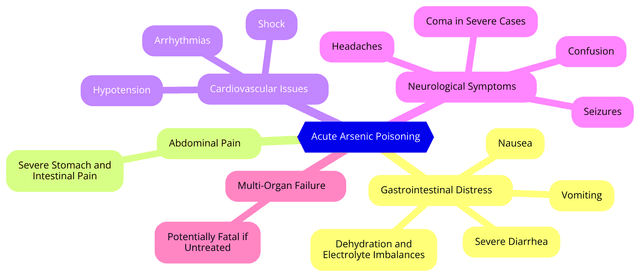
Severe acute poisoning, particularly after ingestion of a toxic inorganic arsenic compound, can produce:
Nausea and repeated vomiting
Severe abdominal pain
Profuse diarrhea
Dehydration and electrolyte disturbances
Low blood pressure and shock
Cardiac rhythm abnormalities
Confusion, seizures, or other neurological complications
Kidney or other organ injury in severe cases
Early symptoms can resemble gastroenteritis, making an accurate exposure history especially important.
Patients with suspected severe arsenic poisoning require emergency medical evaluation. Delayed neurological or hematologic complications may also occur after significant acute exposure. [4]
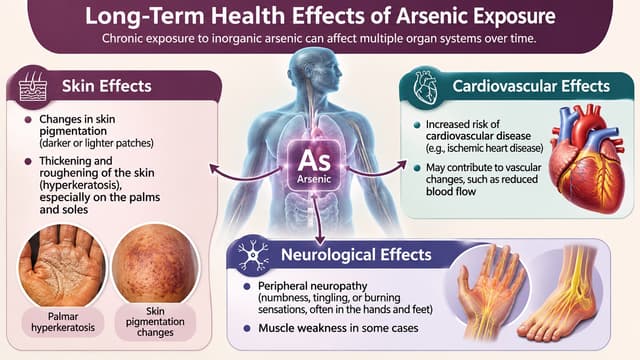
Chronic inorganic arsenic exposure may produce symptoms gradually, often after years of exposure.
Potential findings include:
Patchy hyperpigmentation or hypopigmentation
Hyperkeratosis, especially on the palms and soles
Numbness, tingling, or weakness associated with peripheral neuropathy
Gastrointestinal symptoms in some patients
Vascular or cardiovascular complications
Mees' lines, which are transverse white bands across the nails, may occur after arsenic poisoning but are not specific to arsenic. Their absence does not exclude exposure.
Symptoms such as fatigue, abdominal discomfort, or numbness alone cannot establish arsenic poisoning without supporting exposure and clinical evidence. [1] [2]
Long-term exposure to inorganic arsenic is an established human carcinogenic hazard.
Strong evidence links chronic exposure with cancers of the skin, lung, and urinary bladder.
Some studies have also investigated associations with other cancers, but evidence strength differs by site. Liver cancer should not be presented as having the same level of established evidence as skin, lung, and bladder cancer in every exposure context. [1]
Long-term inorganic arsenic exposure has been associated with cardiovascular disease, including ischemic heart disease and vascular abnormalities.
Studies have also reported associations with diabetes and other metabolic outcomes.
These findings concern exposure-related population risk. They do not mean that a particular patient's hypertension, diabetes, or cardiovascular disease was necessarily caused by arsenic exposure. [2]
Chronic exposure may contribute to peripheral neuropathy and other neurological effects.
Prenatal and early-life exposures have also been associated with adverse developmental outcomes.
The severity and likelihood of these effects depend on the exposure circumstances, and findings from highly exposed populations should not be applied directly to people with minimal or unconfirmed exposure. [2]
Naturally contaminated groundwater is a major source of chronic inorganic arsenic exposure worldwide.
Arsenic may enter groundwater through natural geological processes. Mining, industrial activities, and historical pesticide use can also contribute to contamination.
Private wells are particularly relevant because their water quality may not be monitored under the same regulatory programs as public drinking-water systems.
Rice can accumulate inorganic arsenic from soil and irrigation water, particularly under conditions that favor arsenic uptake.
However, rice can still form part of a balanced diet. FDA advises consuming a variety of nutritious foods and grains rather than eliminating rice without a specific reason.
For infants, rice cereal does not need to be the only or first grain offered. Other iron-fortified cereals provide alternatives.
FDA also notes that cooking rice in excess water and draining the cooking water can reduce inorganic arsenic, although this method can remove some added nutrients from enriched rice. [5]
Apple juice is another food product subject to arsenic monitoring. For a product-specific example of regulatory action, see Arsenic in Apple Juice: The Hidden Danger in Your Child’s Favorite Drink and What You Must Know Now.
A product recall involving elevated arsenic does not necessarily establish acute poisoning in consumers, and regulatory action levels should not be confused with clinical toxicity thresholds.
Certain mining, metal-smelting, semiconductor manufacturing, and other industrial processes may involve arsenic-containing materials.
Workers can be exposed to arsenic-containing dust or fumes when appropriate controls are absent.
Prevention requires exposure assessment, engineering controls, suitable protective equipment, workplace monitoring, and compliance with applicable occupational safety regulations.
Additional sources can include contaminated soil, burning certain treated wood products, and selected imported or traditional medicinal preparations.
The relevance of each source depends on local conditions and the individual's exposure history. [1]
The World Health Organization retains a provisional guideline value of 10 micrograms per liter (10 µg/L, approximately 10 ppb) for arsenic in drinking water.
This is a public-health guideline intended to support exposure reduction. It is not a threshold below which all lifetime cancer risk becomes zero.
WHO published an updated edition of its drinking-water quality guidelines in June 2026, incorporating the first, second, and third addenda. [6]
In the United States, the Environmental Protection Agency's maximum contaminant level for arsenic in regulated public drinking-water systems is also 10 µg/L.
Private wells are generally the responsibility of their owners and may require independent testing and appropriate water treatment. [7]
Test drinking water when relevant. Households using private wells should follow local public-health advice for arsenic testing, particularly in areas known to have elevated groundwater arsenic.
Use an appropriate alternative water source when needed. If well-water arsenic exceeds applicable health guidance, use water shown to be suitable for drinking and cooking while addressing the contamination.
Select verified water treatment. Reverse osmosis and properly selected arsenic-removal media may be effective. Treatment performance depends on the water chemistry, equipment, installation, maintenance, and independent testing. Ordinary water softeners and basic activated-carbon filters should not be assumed to remove arsenic adequately. [7]
Maintain a varied diet. Follow FDA guidance on rice, grains, drinking water, and dietary sources of environmental contaminants. [5]
Control workplace exposure. Use appropriate industrial hygiene measures and exposure monitoring.
Avoid unvalidated detoxification products. Supplements and unapproved chelation products should not replace source control or clinical evaluation.
Diagnosis begins with a detailed history of possible exposure, including:
Drinking water source and private well use
Occupation and industrial exposures
Recent ingestion of potentially contaminated substances
Dietary history, particularly recent seafood consumption
Relevant imported products, medicines, and supplements
Symptoms and their timing
Examination may focus on gastrointestinal, neurological, cardiovascular, and skin findings.
For recent arsenic exposure, a 24-hour urine arsenic test with chemical speciation, when available, is particularly useful.
Speciation helps distinguish toxicologically important inorganic arsenic and its metabolites from less toxic organic arsenic compounds.
A spot urine sample, interpreted with an appropriate creatinine measurement, may be useful in urgent situations.
Total urinary arsenic alone can be misleading after recent seafood consumption because some seafood arsenicals increase the measured total without indicating significant inorganic arsenic poisoning. [1]
Blood arsenic measurements may have a role in selected recent exposures, but arsenic can leave the bloodstream relatively quickly, limiting the usefulness of a normal result for excluding poisoning.
Hair and nail arsenic measurements can sometimes contribute to specialized exposure investigations. However, they have limited routine clinical utility because of interpretive problems, including external contamination and inadequate standardized reference ranges.
They should not be presented as routine diagnostic alternatives to appropriately selected urine testing.
Routine laboratory evaluation in significantly exposed patients may also include blood counts, kidney function, liver function, electrolytes, and other investigations guided by the presentation. [1]

Severe acute inorganic arsenic poisoning is a medical emergency.
Initial care focuses on stabilization, including airway and breathing assessment, treatment of shock, fluid and electrolyte management, cardiac monitoring, and evaluation of organ dysfunction.
Treatment should not be delayed while waiting for specialized arsenic test results in a patient with a strongly suggestive exposure and serious clinical findings.
Chelating agents such as dimercaprol (BAL) may be considered for selected patients with clinically significant acute inorganic arsenic poisoning.
Other chelating agents, including succimer, may be considered depending on the circumstances and specialist advice.
Chelation has important risks, contraindications, and formulation-specific considerations. Agent selection, timing, and dosing require supervision by a medical toxicologist or another appropriately experienced clinician.
Chelation must not be portrayed as automatically necessary after any detectable arsenic exposure, nor should it be started as self-treatment.
Older ATSDR medical management guidance describes the role of specialist-directed chelation in significant acute poisoning. Current clinical assessment must also account for the specific compound, exposure history, patient condition, and evolving evidence. [4] [1]
The primary treatment for chronic inorganic arsenic exposure is identifying and eliminating or reducing the source.
Management may also involve evaluation and treatment of neurological, dermatologic, cardiovascular, or other complications.
Chelation is not a routine treatment for every case of chronic arsenic exposure. Its potential benefit must be evaluated individually, particularly when exposure is ongoing or clinically important toxicity is established.
Follow-up may require collaboration with medical toxicology, occupational medicine, primary care, and appropriate specialists. [1]
Acute significant poisoning may initially cause severe vomiting, abdominal pain, and diarrhea. Chronic exposure can remain asymptomatic for years before recognizable skin or neurological findings develop.
No. Symptoms are often nonspecific. Diagnosis requires considering the exposure history, clinical findings, and appropriately selected tests.
No. Chemical form, solubility, and bioavailability strongly influence toxicity. Inorganic arsenic compounds are particularly important in environmental and clinical poisoning.
The 10 ppb value is an important public-health and regulatory benchmark, not a guarantee of zero lifetime risk.
Yes. Some appropriately designed and maintained treatment systems can reduce arsenic levels. Testing before and after treatment is important to verify performance.
Not routinely. Eliminating the exposure source is the priority. Chelation may be considered only in selected clinical circumstances under specialist supervision.
Arsenic poisoning remains an important environmental, occupational, and clinical toxicology concern.
Acute high-level exposure can cause life-threatening gastrointestinal and cardiovascular complications, while prolonged inorganic arsenic exposure can contribute to skin disease, neuropathy, and increased cancer risk.
Accurate assessment depends on the chemical form, exposure history, and appropriate laboratory testing. Urine arsenic speciation is particularly useful, while indiscriminate hair testing and unproven detoxification approaches can lead to misleading conclusions.
The most effective long-term strategy is preventing further exposure through safe drinking water, appropriate environmental controls, and clinically justified investigation and treatment.
For a broader comparison with other toxic metals, see Understanding How Toxic Metals Impact Your Health.
© All copyright of this material is absolute to Medical toxicology
Dr. Omid Mehrpour (MD, FACMT) is a senior medical toxicologist and physician-scientist with over 15 years of clinical and academic experience in emergency medicine and toxicology. He founded Medical Toxicology LLC in Arizona and created several AI-powered tools designed to advance poisoning diagnosis, clinical decision-making, and public health education. Dr. Mehrpour has authored over 250 peer-reviewed publications and is ranked among the top 2% of scientists worldwide. He serves as an associate editor for several leading toxicology journals and holds multiple U.S. patents for AI-based diagnostic systems in toxicology. His work brings together cutting-edge research, digital innovation, and global health advocacy to transform the future of medical toxicology.
Keep reading
 Environmental and Occupational Toxicology

Amir Mohammad Mottaghi
 Environmental and Occupational Toxicology
Amir Mohammad Mottaghi
 Environmental and Occupational Toxicology
Omid Mehrpour
 Environmental and Occupational Toxicology
Omid Mehrpour
We would like to use analytics and session-replay tools to understand how this site is used. They are optional and the site works fully without them. Signing in still needs its own cookie either way. Our Privacy Policy names each one.