Public Health and Poison Prevention
Arsenic in Apple Juice: Recall, Risks, and FDA Limits
Omid Mehrpour
Post on 30 Aug 2024 · Updated 26 Nov 2026 · 10 min read
Omid Mehrpour
Post on 30 Aug 2024 · Updated 26 Nov 2026 · 10 min read
 Medical Toxicologymedicaltoxic.com
https://medicaltoxic.com/blogs/arsenic-in-apple-juice-recall-risks-fda-limits
In August 2024, a U.S. apple juice recall brought renewed attention to inorganic arsenic, a naturally occurring contaminant that can enter the food supply.
The recall initially involved 9,535 cases of Great Value apple juice manufactured by Refresco Beverages US Inc. and sold through Walmart. The affected product contained a reported inorganic arsenic concentration of 13.2 parts per billion (ppb), above the FDA's 10 ppb action level for apple juice. [1]
The recall subsequently expanded to additional apple juice brands and retailers in September 2024. [2]
These events raised legitimate food-safety concerns, particularly regarding children's dietary exposure. However, an arsenic concentration above an FDA action level should not automatically be interpreted as evidence that consuming one serving causes acute arsenic poisoning.
Understanding the difference between regulatory limits, cumulative exposure, and acute toxicity is essential.
The original August 2024 Great Value apple juice recall involved 9,535 cases and an inorganic arsenic result of 13.2 ppb.
In September 2024, the broader Refresco recall expanded to approximately 133,500 cases involving multiple brands.
FDA's 10 ppb action level for inorganic arsenic in apple juice is designed to help reduce dietary exposure.
The action level is not a threshold separating completely harmless exposure from inevitable poisoning.
Long-term exposure to inorganic arsenic can cause serious health effects, but findings from highly exposed populations cannot be directly applied to a single serving of apple juice.
Whole fruit and water are generally preferable to frequent juice consumption in children.
Families should follow product-specific recall notices rather than assume all apple juice is contaminated.
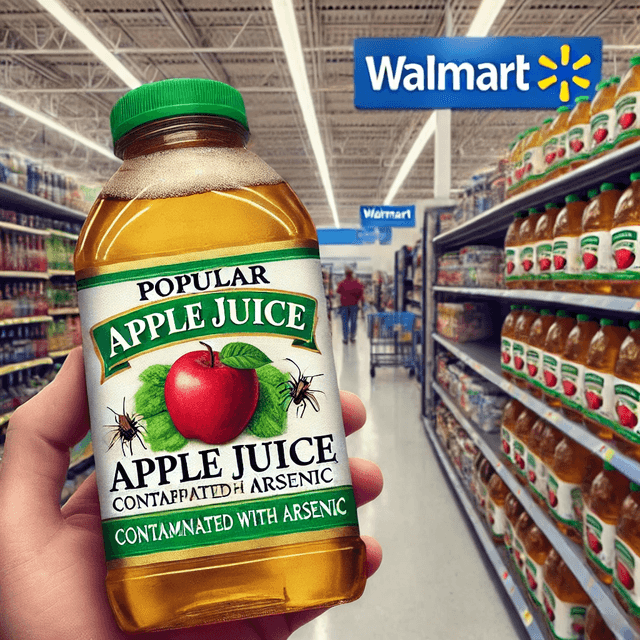
On August 15, 2024, Refresco Beverages US Inc. initiated a voluntary recall of specific Great Value 100% apple juice products.
The original FDA recall record identified:
Recall detail | Initial Great Value recall |
|---|---|
Manufacturer | Refresco Beverages US Inc. |
Product | Great Value 100% Apple Juice |
Packaging | Six-pack of 8-ounce plastic bottles |
Quantity | 9,535 cases |
Reported inorganic arsenic | 13.2 ppb |
FDA recall classification | Class II |
Recall initiation | August 15, 2024 |
The original affected product was identified by UPC 0-78742-29655-5 and the date code DEC2824 CT89-6.
These identifiers describe the initial historical recall and should not be treated as a complete list of all products included in subsequent expansions. [1]
The original Walmart recall was not the final scope of the incident.
By September 2024, the recall had expanded to approximately 133,500 cases of apple juice produced by Refresco and sold through additional retailers, including Aldi, Walgreens, BJ's Wholesale Club, and others.
The affected products included several private-label brands and different packaging sizes.
The expanded quantity refers to the broader recall, not an additional 133,500 cases of the original Great Value six-packs.
Contemporary reporting stated that no illnesses had been reported at that time. This is a historical statement, not a claim about comprehensive subsequent health surveillance. [2]
The recall was a specific product-quality event in 2024. It should not be presented as a newly emerging recall in 2026.
In June 2023, the FDA finalized guidance establishing an action level of 10 ppb of inorganic arsenic in apple juice, equivalent to 10 micrograms per kilogram.
The purpose is to reduce dietary exposure, particularly among children, using a level FDA considers achievable with current good manufacturing practices.
An FDA action level is a regulatory benchmark that can inform enforcement decisions. It is not a claim that concentrations below 10 ppb have zero biological risk or that concentrations just above 10 ppb necessarily cause immediate illness. [3]
The numerical value is similar, but the regulatory standards are not identical.
The FDA action level applies to inorganic arsenic in apple juice.
The U.S. Environmental Protection Agency's 10 micrograms-per-liter drinking water maximum contaminant level applies to total arsenic in regulated drinking water.
These standards address different products, exposure patterns, and regulatory frameworks. They should not be treated as interchangeable measures of individual health risk. [4]
Arsenic occurs naturally in rocks, soil, and groundwater. Human activities, including historical pesticide use, mining, and certain industrial processes, can also contribute to environmental contamination.
Plants may absorb arsenic from soil or irrigation water. Agricultural raw materials and food-processing inputs can therefore contain varying amounts of arsenic.
However, the presence of arsenic in a finished apple juice product does not by itself identify the precise source of contamination.
The original 2024 recall record did not establish that soil contamination at a particular orchard caused the elevated result.
Source attribution requires appropriate environmental, ingredient, and manufacturing investigations. [4]
Arsenic occurs in different chemical forms.
Inorganic arsenic is generally more toxicologically concerning and is associated with important long-term health risks.
Organic arsenic compounds vary considerably. Certain forms found in seafood, including arsenobetaine, are substantially less toxic than inorganic arsenic.
Chemical form matters. A test measuring total arsenic does not always provide the same toxicological information as a test that distinguishes individual arsenic species.
For a broader explanation of exposure, diagnosis, and health effects, see Understanding Arsenic Poisoning: Causes, Symptoms, and Prevention.
The health effects of arsenic depend on its chemical form, dose, duration of exposure, and individual susceptibility.
Severe acute inorganic arsenic poisoning can cause:
Nausea and vomiting
Severe abdominal pain
Profuse diarrhea
Dehydration and circulatory instability
Cardiac and neurological complications in serious cases
These manifestations are associated with substantial acute exposures.
They should not be presented as expected outcomes from drinking a single serving of apple juice containing an arsenic concentration slightly above FDA's action level. [4]
Long-term inorganic arsenic exposure, particularly through highly contaminated drinking water, has been linked to skin lesions and increased risks of several cancers, including skin, bladder, and lung cancer.
Research has also associated chronic exposure with cardiovascular disease, diabetes, and adverse neurodevelopmental outcomes.
The strength and interpretation of these findings depend on the exposure assessment, population, and outcome studied. [5]
These risks are the reason exposure reduction remains important even when individual exposures are not expected to cause immediate symptoms.
However, evidence from communities consuming heavily contaminated water over many years cannot be used to calculate an individual's cancer or developmental risk from one recalled juice product without a valid exposure assessment.
It is inappropriate to assess the safety of arsenic in apple juice by comparing the number of servings consumed with the dose of arsenic trioxide used as a prescription cancer treatment.
The chemical formulation, route of administration, dosing schedule, population, monitoring, and clinical purpose are fundamentally different.
A calculation showing how many liters of juice would contain a particular mass of arsenic cannot establish a safe consumption threshold or rule out long-term risks.
Food-safety guidance instead uses toxicological evidence, exposure modeling, and regulatory risk assessment.
FDA conducts sampling, publishes analytical data, and establishes contaminant action levels to reduce exposure through the food supply.
Its publicly available arsenic monitoring resources include historical testing results for apple juice and arsenic speciation data.
These surveillance datasets help evaluate contamination patterns and regulatory priorities, but samples collected in past years should not be described as direct measurements of every product currently on the market. [6]
FDA also continues its broader Closer to Zero initiative addressing exposure to arsenic, lead, cadmium, and mercury in foods consumed by infants and young children.
This initiative does not mean that FDA has announced that every food containing detectable arsenic is unsafe. [7]
Parents do not need to eliminate every fruit juice product solely because an arsenic recall occurred in 2024.
However, water and whole fruit are generally preferable to relying heavily on juice.

The American Academy of Pediatrics recommends:
Age | Recommended maximum 100% fruit juice |
|---|---|
Under 12 months | No routine fruit juice |
1–3 years | 4 ounces per day |
4–6 years | 4–6 ounces per day |
7–18 years | 8 ounces per day |
These recommendations address overall nutrition, sugar intake, dental health, and dietary quality—not arsenic exposure alone. [8]
Whole apples provide dietary fiber that apple juice lacks.
Offering a varied diet may also help avoid relying excessively on one food or beverage as a potential source of environmental contaminants.
No.
Organic production practices do not eliminate naturally occurring arsenic in soil, groundwater, or agricultural inputs.
Consumers should not assume that an organic label guarantees lower inorganic arsenic concentrations in a specific product without relevant testing.
For any current food-safety concern:
Check the product name, packaging, lot code, and dates against the relevant official recall notice.
Do not consume a product confirmed to be included in an applicable recall.
Follow the recall's instructions for disposal or returning affected products.
Contact a healthcare professional or poison center if there is a significant exposure concern or concerning symptoms.
The 2024 Refresco recall products had historical date codes. Those old identifiers should not be confused with evidence of a new recall in 2026.
A person who consumed a small amount of a product involved in the 2024 incident does not automatically need laboratory testing, chelation therapy, or other medical treatment.
Evaluation depends on the exposure circumstances and clinical findings. Decisions about arsenic testing or treatment should be guided by an appropriately qualified clinician. [4]
For a broader discussion of toxic metal exposure, diagnosis, and prevention, see Understanding How Toxic Metals Impact Your Health.
Yes. The original August 2024 recall identified an inorganic arsenic concentration of 13.2 ppb in affected Great Value apple juice, above FDA's 10 ppb action level.
Yes. The original recall expanded in September 2024 to include additional brands and retailers. Product identifiers varied, so the initial Great Value code was not sufficient to identify every affected product.
No. The FDA action level is a benchmark for reducing exposure and supporting regulatory action. It is not a guarantee of zero risk or a threshold for immediate poisoning.
The arsenic concentrations reported in the 2024 recall were not characteristic of exposures expected to cause severe acute arsenic poisoning from an ordinary serving.
This does not make repeated avoidable exposure desirable or mean that regulatory action was unnecessary.
Yes, in age-appropriate amounts as part of a balanced diet. Water and whole fruit should generally be preferred, and children younger than 12 months should not routinely receive fruit juice.
No. Organic certification alone does not establish a product's inorganic arsenic concentration or guarantee freedom from environmental contaminants.
The 2024 apple juice recall highlighted the importance of monitoring inorganic arsenic in commonly consumed foods.
The initial recall involved 9,535 cases of Great Value apple juice and subsequently expanded to other brands. FDA's 10 ppb action level provides a regulatory approach to reducing exposure, not a dividing line between guaranteed safety and inevitable poisoning.
Consumers should follow specific recall instructions and use evidence-based dietary guidance. For children, whole fruit, water, and a varied diet remain practical ways to support nutrition while avoiding unnecessary reliance on juice.
The goal is informed exposure reduction—not alarm, unsupported toxicity calculations, or avoidance of all apple juice.
© All copyright of this material is absolute to Medical toxicology
Dr. Omid Mehrpour (MD, FACMT) is a senior medical toxicologist and physician-scientist with over 15 years of clinical and academic experience in emergency medicine and toxicology. He founded Medical Toxicology LLC in Arizona and created several AI-powered tools designed to advance poisoning diagnosis, clinical decision-making, and public health education. Dr. Mehrpour has authored over 250 peer-reviewed publications and is ranked among the top 2% of scientists worldwide. He serves as an associate editor for several leading toxicology journals and holds multiple U.S. patents for AI-based diagnostic systems in toxicology. His work brings together cutting-edge research, digital innovation, and global health advocacy to transform the future of medical toxicology.
Keep reading
 Public Health and Poison Prevention
Omid Mehrpour
 Public Health and Poison Prevention
Omid Mehrpour
 Public Health and Poison Prevention

Sherika Whitelocke
 Public Health and Poison Prevention
Omid Mehrpour
We would like to use analytics and session-replay tools to understand how this site is used. They are optional and the site works fully without them. Signing in still needs its own cookie either way. Our Privacy Policy names each one.