Environmental and Occupational Toxicology
Personal Care Cosmetics and Topical Products Management
Omid Mehrpour
Post on 02 Jun 2026 · Updated 24 Sept 2026 · 13 min read

Omid Mehrpour
Post on 02 Jun 2026 · Updated 24 Sept 2026 · 13 min read
 Medical Toxicologymedicaltoxic.com
https://medicaltoxic.com/blogs/personal-care-cosmetics-and-topical-products-management
Personal care and cosmetic exposures sit at the intersection of cosmetics, OTC drugs, and dual-status products. Under U.S. law, many “personal care products” are cosmetics, but products such as fluoride rinses, benzocaine gels, acne medications, topical analgesics, and minoxidil also carry drug claims and are regulated as drugs or as both cosmetics and drugs depending on intended use. The practical implication for poison specialists is a classic example of mechanistic medical toxicology: triage must be based on the actual ingredients, concentration, formulation, route, and symptoms, not the marketing category on the package.
For most unintentional exposures to soap, shampoo, lotion, alcohol-free mouthwash, ordinary toothpaste, sunscreens, and many make-up products, toxicity is limited to local irritation or brief gastrointestinal upset. The clinically important exceptions are a smaller set of high-risk products: topical salicylates and wintergreen oil, camphor-containing products, concentrated fluoride preparations, topical anesthetics that can cause methemoglobinemia, minoxidil solutions, acetonitrile- or nitroethane-containing artificial nail removers, strongly alkaline depilatories or relaxers, and oxidative hair dyes containing p-phenylenediamine or related sensitizers. These products account for the bulk of serious poison-center decisions in this category.
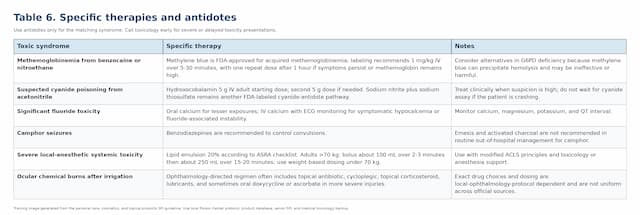
Three principles dominate management. First, decontamination is route-specific and time-sensitive: immediate irrigation for eye and skin exposures, fresh air for inhalation exposures, and avoidance of home emesis or home charcoal for ingestions. Second, telephone triage can safely keep many patients at home only when the exact product and maximum possible amount are verified low-risk, symptoms are absent or minor and expected, no high-risk route/source/formulation is present, and the caretaker is reliable. Third, the handful of high-risk products should trigger early dose-based referral or symptom-based escalation, targeted monitoring, and antidote-specific thinking, including methylene blue for clinically significant methemoglobinemia, calcium for significant fluoride toxicity or hydrofluoric acid injury, cyanide antidotes when acetonitrile poisoning becomes clinically evident, and lipid emulsion for severe local anesthetic systemic toxicity.
The evidence base in this area is heterogeneous. This report uses a practical evidence grading scheme: Level A for official guidance, poison-center practice guidelines, major society statements, regulatory documents, and FDA-approved labeling; Level B for cohort studies, case series, and systematic reviews; and Level C for case reports, product SDS, and lower-level expert synthesis when stronger data are unavailable.
The operational scope of this category includes products intentionally applied to the skin, hair, nails, oral cavity, or periocular area for cleansing, grooming, appearance, odor control, or local symptom relief. That includes classic cosmetics such as perfumes, moisturizers, shampoos, hair dyes, nail products, make-up, and deodorants, as well as borderline or dual-status products such as mouthwashes, fluoride rinses, topical acne drugs, topical anesthetics, topical analgesics, and hair-regrowth solutions. Products frequently described by consumers as “personal care” are not all regulated the same way, so poison triage should classify the exposure by ingredient and toxic mechanism, not by shelf location.
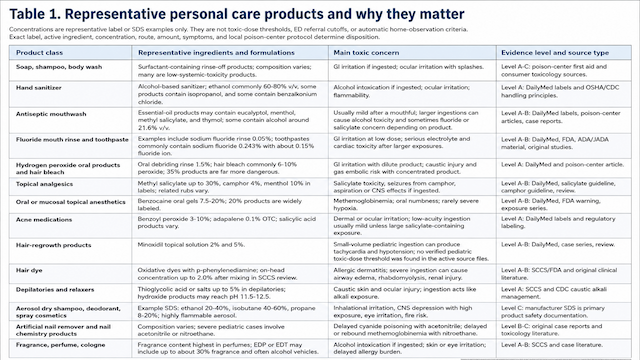
The concentration tables above are representative label or SDS examples only, not toxic-dose thresholds, ED referral cutoffs, or automatic home-observation criteria. Across brands and countries, formulations vary significantly, and some exact concentrations are not publicly specified beyond product labeling or SDS. When triaging a real patient, the highest-yield move is still to obtain the actual label or SDS.
Dermal exposure usually produces local irritation because the stratum corneum limits systemic uptake. The important exceptions are products containing methyl salicylate, some local anesthetics, rarely camphor, and repeated or occlusive applications on damaged skin. Risk rises with infant skin, large body surface area, prolonged contact, repeated dosing, heat, occlusion, or excoriation. Strong alkalis are different: they continue penetrating until physically removed, with injury sometimes underestimated early.
Ocular exposure is an emergency because contact time drives injury. Copious irrigation is the key intervention. Alkalis such as sodium or potassium hydroxide penetrate rapidly by saponification and can damage conjunctiva, cornea, limbus, and anterior segment structures; acids often coagulate surface proteins and may not penetrate as deeply, although strong acids still cause severe injury. Many shampoos, soaps, and cosmetic surfactants cause painful but self-limited epithelial irritation rather than deep liquefaction injury.
Inhalational exposure from sprays, dry shampoos, deodorants, and perfumes is usually irritant rather than systemically toxic, but concentrated exposure can produce cough, wheeze, nasal congestion, and dizziness; aerosol products are frequently highly flammable and pressurized. In poorly ventilated spaces or during misuse/intentional inhalation, solvent and propellant effects become more important.
Ingestion is the route that separates low-acuity from dangerous cases. Small tastes of ordinary toothpaste, shampoo, soap, or a mouthful of mouthwash are often tolerated. Serious systemic poisoning clusters around a small number of ingredients: camphor with rapid neurotoxicity, methyl salicylate and wintergreen oil with salicylism, fluoride with GI and electrolyte toxicity, benzocaine with methemoglobinemia, minoxidil with vasodilatory shock physiology, and acetonitrile or nitroethane with delayed toxicity.
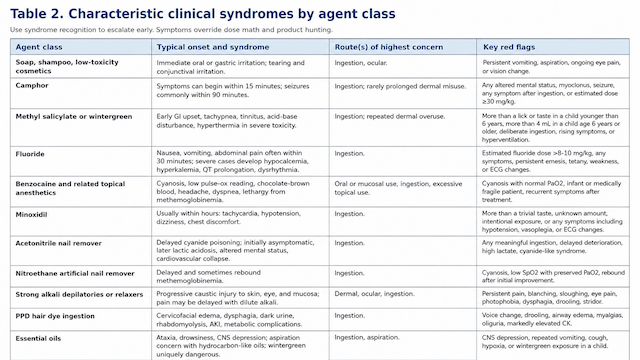
For PPD hair dye ingestion, the regulatory literature strongly supports PPD as a common hair dye ingredient and a significant allergen, but detailed ED-management specifics in official English guidance are comparatively limited; the most severe acute syndrome is described predominantly in original clinical literature rather than in U.S. regulatory labeling. That is an area where local toxicology practice is often more specific than public official sources.
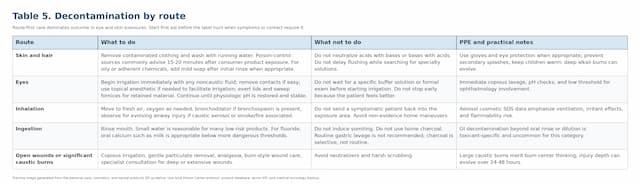
The first-pass telephone approach should be standardized: identify the patient, product, route, amount, time, symptoms, and any first aid already given, then immediately triage to resuscitation, urgent referral, or home observation. The core home-first-aid steps recommended by poison-control and HRSA sources are: skin/eye irrigation for 15–20 minutes, fresh air for inhalation, and no home emesis or home charcoal. Severe symptoms at any point warrant emergency services.
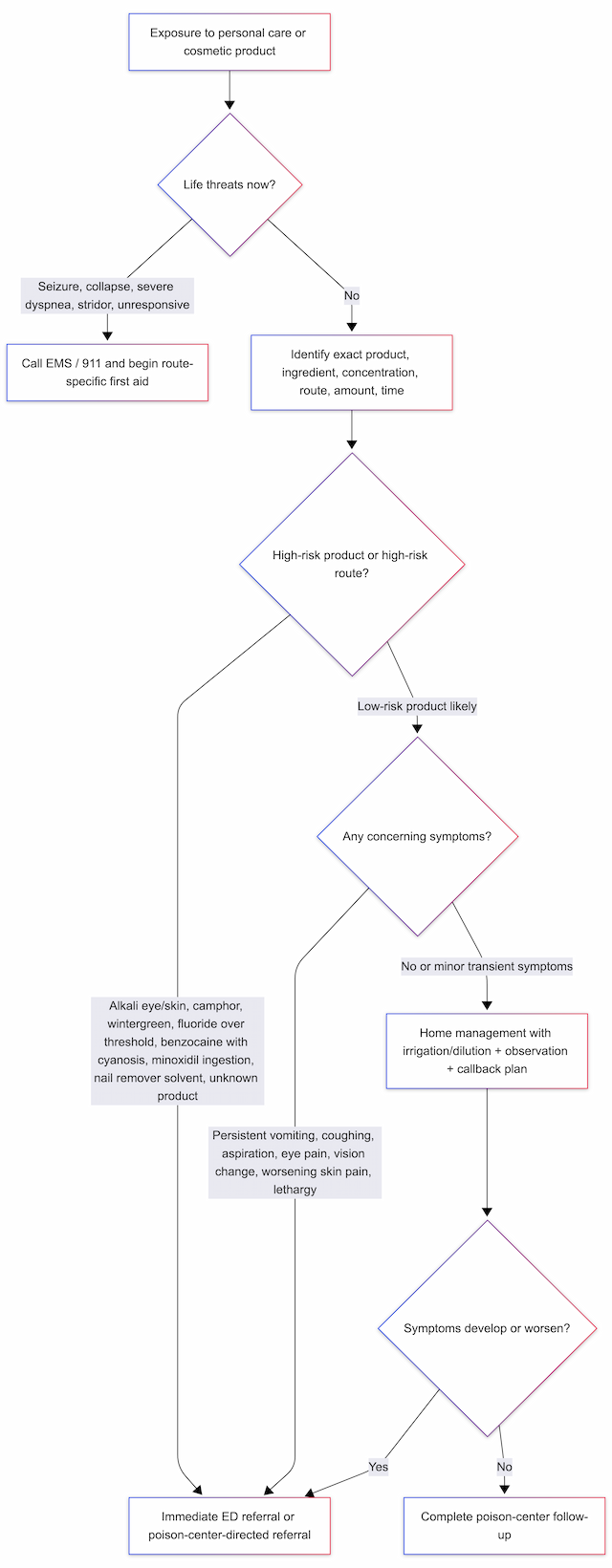
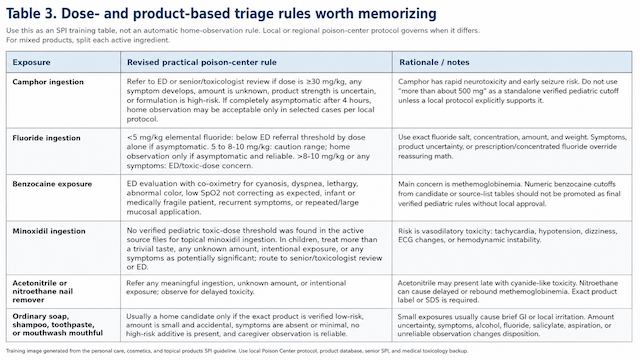
When a local or regional poison-center protocol differs from the simplified thresholds above, the local protocol should govern. Exact referral cutoffs for some mixed-ingredient products remain unspecified in public official documents and depend on product formulation.
Use this checklist before disposition:
Who: age, approximate weight, pregnancy status, comorbid lung disease, G6PD deficiency if methemoglobinemia is possible, ocular history, skin disease.
What: exact product name, active ingredients, concentration, tablet/gel/liquid/foam/aerosol/oil formulation, label or SDS if available.
When: exact time, single versus repeated exposure, ongoing versus completed exposure.
How much: sip, mouthful, teaspoon, mL, “lick/taste,” number of sprays, body area involved, duration of skin contact.
How exposed: ingestion, eye, skin, inhalation, mixed-route.
Symptoms now: breathing, cough, vomiting, drooling, voice change, drowsiness, seizure, cyanosis, eye pain, vision change, skin pain.
What has already been done: irrigation, washing, milk, water, medication given, anything unsafe such as attempted emesis.
Who can observe: reliable adult, language needs, transport barriers, abuse/neglect or self-harm concerns.
This checklist aligns with poison-control first-aid structure and route-based triage principles.
Low-risk shampoo or soap ingestion
“Most small accidental swallows of shampoo or soap cause at most some stomach upset or a bad taste. Please wipe the mouth out, give a few sips of water, and do not induce vomiting. Watch for repeated vomiting, coughing, trouble breathing, or unusual sleepiness. If any of those happen, go to the emergency department or call back immediately.”
Eye splash from cosmetic or skin product
“Start rinsing the eye now with room-temperature water or saline and keep going for at least 15 to 20 minutes. Remove contact lenses if they come out easily. Hold the lids open while rinsing. If there is severe pain, blurred vision, or the product is a relaxer, depilatory, or other caustic chemical, this needs emergency evaluation even if the eye starts to feel better.”
High-risk ingestion such as camphor, wintergreen, minoxidil, fluoride over threshold, or nail remover solvent
“This product can cause serious poisoning. Do not make them vomit and do not give charcoal at home. If the person is awake and able to swallow safely, do only the route-specific first aid we discussed. I want you to go to the emergency department now, and if they become sleepy, blue, shaky, short of breath, or have a seizure, call EMS immediately.”
ED care begins with ABCs, route-specific exam, and product verification. The highest-yield bedside data are: mental status, airway exam for drooling/voice change/stridor, cardiovascular status, pulse oximetry, ECG in potentially systemic cases, focused skin exam for pH or caustic injury, and early ocular pH/vision assessment for eye exposures. For most low-risk cosmetic ingestions, no routine laboratory testing is needed. For higher-risk products, testing should be targeted.
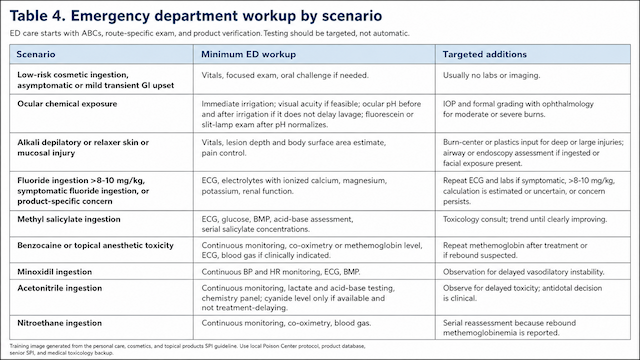
For salicylate poisoning, aggressive specifics such as alkalinization and dialysis decisions are best anchored to standard salicylate protocols and specialist consultation. Public official documents clearly identify salicylate poisoning as a major toxicology topic, but detailed bedside thresholds are often contained in full toxicology guidance rather than in public snippets. That level of detail is therefore protocol-dependent and partly unspecified here.
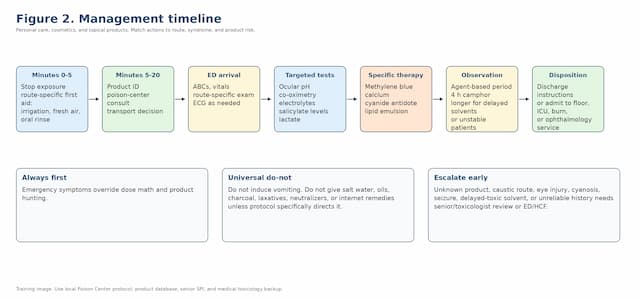
Immediate first aid dominates outcome more than late decontamination in this category, especially for eye and skin injuries.
Ocular chemical exposure order set template
Immediate continuous eye irrigation with normal saline, lactated Ringer’s, or water until ocular pH normalizes.
Topical ocular anesthetic to facilitate irrigation.
Remove contact lenses if present and easily removable.
Visual acuity when feasible.
Ocular pH before and after irrigation; repeat after a rest period.
Lid eversion and fornix sweep if particulate caustic suspected.
Fluorescein examination and slit lamp after stabilization.
Ophthalmology consult for persistent pain, epithelial defect, abnormal pH rebound, limbal ischemia, corneal haze, or reduced vision.
Analgesia and antiemetic as needed.
High-risk topical-product ingestion order set template
Cardiac monitoring and pulse oximetry.
Bedside glucose.
12-lead ECG.
Product identification from label/SDS and poison-center consult.
Route-specific decontamination only; no routine emesis or charcoal.
Add labs by agent:
fluoride: ionized calcium, magnesium, potassium, BMP;
benzocaine/nitroethane: co-oximetry/methemoglobin;
salicylate products: serial salicylates, BMP, acid-base testing;
acetonitrile: lactate, chemistry panel, blood gas;
minoxidil: BMP plus hemodynamic monitoring.
PRN benzodiazepine for seizures.
Trigger antidote order sets as clinically indicated.
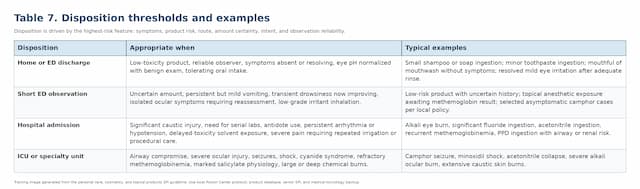
Children are disproportionately vulnerable because a small swallowed volume can represent a large mg/kg dose. Official labeling and toxicology literature specifically highlight pediatric risk for camphor, fluoride, benzocaine, and minoxidil, while poison-center educational material emphasizes supervision for mouthwash and toothpaste. In older adults, lower physiologic reserve, polypharmacy, ocular disease, and challenges with self-irrigation or reliable home observation justify a lower threshold for in-person assessment.
For acute accidental exposures, initial toxicologic management is generally the same as in nonpregnant adults: prompt decontamination, maternal stabilization, and targeted monitoring. The more important pregnancy issue in this category is usually chronic or intentional use, not a single small accidental exposure. Public labels and FDA warnings are especially relevant for topical adapalene/retinoid products and minoxidil, while the FDA has recently warned consumers to avoid illegitimate OTC skin-lightening products containing mercury and/or hydroquinone. When exposure involves these products, poison triage should address both acute toxicity and teratogenic or lactational counseling needs.
Not all clinically important morbidity is immediate. Several product types are disproportionately associated with delayed contact dermatitis, sensitization, or chronic injury:
PPD in hair dye and “black henna” can trigger severe allergic reactions, and prior black-henna reactions increase future hair-dye allergy risk.
Fragrance allergens remain a major cosmetic-allergy burden, especially in leave-on products and perfumes.
Methylisothiazolinone has been a major preservative allergen; SCCS concluded 15 ppm is considered safe only in rinse-off products from an induction standpoint, with important limitations.
HEMA and related acrylates used in nail products are important sensitizers in both nail technicians and consumers.
Tattoo inks and temporary tattoo products can cause infection and allergic reactions; FDA has documented both.
Mercury- and hydroquinone-containing skin-lightening products can cause chronic toxicity and should be regarded as unsafe.
Dermatology or ophthalmology follow-up is appropriate for persistent dermatitis, recurrent urticaria, blistering or deep burns, abnormal pigmentation, chronic ulceration, persistent dry-eye or photophobia, epithelial defects, limbal ischemia, or reduced vision after eye injury. Burn or hand-surgery/plastic-surgery input is appropriate for deep hand burns, circumferential injuries, function-threatening contracture risk, or delayed necrosis.
In the United States, the Modernization of Cosmetics Regulation Act of 2022 created mandatory serious adverse event reporting obligations for responsible persons; the FDA states that serious adverse events associated with cosmetic products must be reported within 15 business days, with follow-up material information also reportable. Clinicians and consumers can also submit voluntary reports through MedWatch. America’s Poison Centers maintains the U.S. near-real-time poisoning surveillance system, so poison-center documentation remains part of public-health detection as well as bedside care.
For clinical teams, practical reporting triggers include severe or unusual toxicity from ordinary-use products, suspected contamination or adulteration, clusters of salon-related injuries, suspected mercury-containing cosmetics, occupational exposures, intentional self-harm, abuse/neglect, or cases likely to generate a recall or public health action. The specific employer, health department, workplace safety, or child protection pathway is jurisdiction-dependent and therefore locally specified rather than nationally uniform.
What to do right away
If the person is not breathing, has a seizure, collapses, or cannot be awakened, call emergency services immediately. If the product is on the skin, take off contaminated clothing and rinse with water for 15–20 minutes. If it is in the eye, rinse with water for 15–20 minutes. If it was inhaled, move to fresh air. If it was swallowed, rinse the mouth, but do not make the person vomit and do not give charcoal unless a clinician tells you to. Then contact Poison Help or your regional poison center.
Keep products safer at home
Store products up high and out of sight, preferably locked. Keep them in their original containers. Do not transfer mouthwash, perfume, sanitizer, or nail products into drink bottles. Supervise young children when they use fluoride mouth rinses. Avoid OTC skin-lightening products containing hydroquinone or mercury. Patch-test and follow label instructions for hair dyes. Use gloves and eye protection for depilatories, relaxers, and salon chemicals. Ventilate rooms when using sprays or aerosols and keep them away from heat or flame.
When to seek urgent medical care
Go now if there is eye pain that does not stop, blurred vision, worsening skin pain or blistering, repeated vomiting, drooling, trouble swallowing, blue lips, shortness of breath, unusual sleepiness, shaking, or collapse. Children who swallow camphor, wintergreen oil, minoxidil, concentrated fluoride, or nail-remover solvents need especially urgent evaluation.
Some bedside details that toxicologists routinely use are not fully specified in public official English-language sources and often depend on local ophthalmology, burn-center, anesthesia, or poison-center protocols. That is especially true for the exact medication regimen after severe ocular burns, endoscopy timing after cosmetic-product caustic ingestion, and the operational referral thresholds for highly variable mixed cosmetic formulations. Current retail availability of acetonitrile- and nitroethane-containing nail removers is also product- and region-specific, so a real case should rely on the exact package or SDS whenever possible.
© All copyright of this material is absolute to Medical toxicology
Dr. Omid Mehrpour (MD, FACMT) is a senior medical toxicologist and physician-scientist with over 15 years of clinical and academic experience in emergency medicine and toxicology. He founded Medical Toxicology LLC in Arizona and created several AI-powered tools designed to advance poisoning diagnosis, clinical decision-making, and public health education. Dr. Mehrpour has authored over 250 peer-reviewed publications and is ranked among the top 2% of scientists worldwide. He serves as an associate editor for several leading toxicology journals and holds multiple U.S. patents for AI-based diagnostic systems in toxicology. His work brings together cutting-edge research, digital innovation, and global health advocacy to transform the future of medical toxicology.
Poison Control: First Aid for Poisonings
Poison Help: First Steps in a Poisoning Emergency
Poison Control: Help for Poisons Splashed in the Eye
Poison Control: Activated Charcoal
FDA: Is It a Cosmetic, a Drug, or Both? Or Is It Soap?
FDA: FDA Authority Over Cosmetics
FDA: Are All Personal Care Products Regulated as Cosmetics?
FDA: Cosmetics Laws and Regulations
European Commission: Regulation EC No 1223/2009 on Cosmetic Products
Poison Control: Hand and Dish Soap
Poison Control: Hydrogen Peroxide
Poison Control: Essential Oils
DailyMed: Ethyl Alcohol 70% Hand Sanitizer Label
DailyMed: Antiseptic Mouth Rinse Label
DailyMed: Sodium Fluoride Rinse Label
DailyMed: Sodium Fluoride Toothpaste Label
DailyMed: Hydrogen Peroxide Oral Rinse Label
DailyMed: Benzoyl Peroxide 10% Label
DailyMed: Minoxidil 5% Topical Solution Label
DailyMed: Benzocaine 20% Gel Label
DailyMed: Camphor, Menthol, Methyl Salicylate Topical Product Label
Clinical Toxicology: Camphor Poisoning Guideline PDF
Royal Children’s Hospital: Camphor Poisoning Guideline
PubMed: Camphor Poisoning Evidence-Based Guideline
PubMed: Methyl Salicylate Poisoning Review
PubMed: Pediatric Minoxidil Exposure
PubMed: Minoxidil Pediatric Toxicity Review
FDA: Benzocaine Safety Communication PDF
PubMed: Benzocaine-Associated Methemoglobinemia
PubMed: Acetonitrile Poisoning From Artificial Nail Remover
PubMed: Acetonitrile Poisoning Case Report
PubMed: Nitroethane-Induced Methemoglobinemia
PubMed: Nitroethane Artificial Nail Remover Toxicity
American Academy of Ophthalmology: Irrigation of Chemical Burns
American Academy of Ophthalmology: Treating Acute Chemical Injuries of the Cornea
Royal College of Ophthalmologists: Emergency Eye Care Commissioning Guidance
CDC/ATSDR: Sodium Hydroxide Medical Management Guidelines
CDC/ATSDR: Sodium Hydroxide ToxFAQs
FDA: Temporary Tattoos, Henna, Mehndi, and Black Henna
European Commission SCCS: Opinion on p-Phenylenediamine
European Commission SCCS: Opinion on Thioglycolic Acid and Salts
European Commission SCCS: Opinion on Sodium Hydroxide in Cosmetic Products
European Commission SCCS: Fragrance Allergens in Cosmetic Products
European Commission SCCS: Methylisothiazolinone Opinion
FDA Label: Methylene Blue Injection
FDA Label: Hydroxocobalamin for Injection
FDA Label: Nithiodote, Sodium Nitrite and Sodium Thiosulfate
FDA Label: Calcium Gluconate Injection
ASRA: Local Anesthetic Systemic Toxicity Checklist PDF
ASRA: Checklist for Treatment of Local Anesthetic Systemic Toxicity
FDA: Modernization of Cosmetics Regulation Act of 2022
FDA: Serious Adverse Event Reporting for Cosmetic Products
FDA: How to Report a Cosmetic Product-Related Complaint
FDA: MedWatch Forms for FDA Safety Reporting
Keep reading
 Environmental and Occupational Toxicology
Amir Mohammad Mottaghi
 Environmental and Occupational Toxicology
Amir Mohammad Mottaghi
 Environmental and Occupational Toxicology
Omid Mehrpour
 Environmental and Occupational Toxicology
Omid Mehrpour