Environmental and Occupational Toxicology
Endocrine-Disrupting Chemicals: How Everyday Exposures Affect Human Health
Amir Mohammad Mottaghi
Post on 05 Sept 2026 · Updated 02 Oct 2026 · 10 min read

Amir Mohammad Mottaghi
Post on 05 Sept 2026 · Updated 02 Oct 2026 · 10 min read
 Medical Toxicologymedicaltoxic.com
https://medicaltoxic.com/blogs/endocrine-disruptors
Endocrine-Disrupting Chemicals: How Everyday Exposures Affect Human Health
Introduction
Hormones regulate some of the most fundamental processes in the human body, including growth, reproduction, metabolism, immune function, development, and energy balance. Unlike conventional toxicants that may cause damage at relatively high concentrations, endocrine-disrupting chemicals (EDCs) can interfere with highly sensitive hormonal signaling pathways, sometimes at exposure levels relevant to everyday life.
EDCs are exogenous chemicals or mixtures that can interfere with aspects of hormone action. They may mimic endogenous hormones, block their receptors, alter hormone synthesis or metabolism, or modify downstream cellular signaling. Importantly, endocrine disruption is not limited to a single organ: because hormones coordinate communication between multiple tissues, disruption of endocrine signaling can have consequences throughout the body.
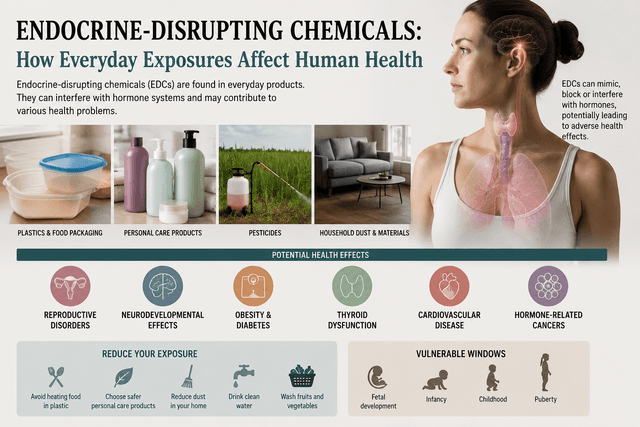
EDCs are encountered in numerous everyday environments. They may be present in food packaging, plastics, cosmetics, personal-care products, pesticides, household materials, flame retardants, and contaminated water or food. Exposure can occur through ingestion, inhalation, or dermal contact.
The concern is therefore not simply whether a particular chemical is "toxic." A more important question is whether repeated exposure to hormonally active chemicals can interfere with biological signaling during periods when the endocrine system is particularly vulnerable.[1][2][3][4]
What Are Endocrine-Disrupting Chemicals?
The endocrine system is a complex communication network involving glands and tissues such as the thyroid, pancreas, adrenal glands, ovaries, testes, pituitary gland, liver, adipose tissue, and brain.
Hormones act at extremely low concentrations. This means that relatively small changes in hormone production, receptor activation, transport, or metabolism can potentially alter physiological processes.
EDCs can interfere with endocrine signaling through several mechanisms:
* Hormone mimicry: a chemical activates a hormone receptor and produces an inappropriate biological signal.
* Receptor antagonism: a chemical blocks the action of a natural hormone.
* Altered hormone synthesis: exposure changes the activity of enzymes responsible for hormone production.
* Altered hormone metabolism: chemicals can modify hormone degradation or clearance.
* Changes in hormone transport: disruption of hormone-binding proteins can alter the amount of biologically available hormone.
* Interference with intracellular signaling: EDCs may alter signaling pathways downstream of hormone receptors.
* Epigenetic mechanisms: some exposures can modify gene regulation without changing the DNA sequence.
The Endocrine Society has emphasized that EDCs can act through estrogenic, antiandrogenic, thyroid-related, metabolic, nuclear-receptor, steroidogenic, and other signaling pathways.[5]
Where Are We Exposed to EDCs?
One reason endocrine disruption is an important public-health issue is that exposure does not necessarily occur in an industrial workplace. Many potential EDCs are associated with products used in daily life.
1. Food and Food Packaging
Food can be an important route of exposure to chemicals used in packaging and food-contact materials.
Bisphenols and phthalates are among the best-known examples. Chemicals may migrate from packaging or processing materials into food, depending on the chemical, material, temperature, storage conditions, and duration of contact.
Consequently, exposure may occur without a person intentionally using a chemical product.
2. Cosmetics and Personal-Care Products
Fragrances, preservatives, plasticizers, and other ingredients used in cosmetics and personal-care products can contribute to chemical exposure.
Because many of these products are applied directly to the skin, dermal exposure may be relevant. Some chemicals can also be inhaled or unintentionally ingested.
3. Pesticides
Several pesticides have endocrine-disrupting properties or have been investigated for their ability to interfere with hormonal pathways.
Exposure may occur through occupational activities, contaminated food or water, household pesticide use, or environmental contamination.
4. Household Materials
Potential EDCs can also be present in furniture, flooring, textiles, electronics, cleaning products, and other consumer materials.
Some flame retardants, for example, have been investigated for endocrine activity.
5. Drinking Water and the Environment
Industrial chemicals, pesticides, pharmaceutical residues, and persistent environmental contaminants can enter aquatic systems.
This creates the possibility of chronic low-level exposure through drinking water and food chains.
Why Does Dose Matter Differently for Endocrine Disruptors?
Traditional toxicology often relies on the principle that increasing the dose generally increases the severity of toxicity.
Endocrine toxicology can be more complicated.
Hormonal systems naturally operate within narrow physiological ranges, and endocrine receptors can respond to very small concentrations of signaling molecules. Consequently, the biological effects of an endocrine-active chemical cannot always be predicted simply by assuming that "more exposure equals proportionally more effect."
Researchers have therefore paid particular attention to low-dose exposure, non-monotonic dose-response relationships, and the timing of exposure.
This does not mean that every low-dose exposure causes disease. Rather, it means that conventional high-dose toxicity testing may not capture every biologically relevant effect of endocrine-active chemicals.
NIEHS notes that even relatively small alterations in hormone signaling may have important developmental and biological consequences, particularly because endocrine systems regulate processes that are intrinsically sensitive to changes in signaling.
The Timing of Exposure May Be as Important as the Dose
One of the most important concepts in endocrine toxicology is the existence of critical windows of susceptibility.[6][7]
These include:
fetal development
pregnancy
infancy
childhood
puberty
During these periods, hormones act as developmental signals. Interference with these signals may have consequences that are not immediately apparent.
For example, exposure during fetal development could potentially alter organ development or endocrine programming, while exposure during puberty could interfere with reproductive or metabolic maturation.
WHO and UNEP have identified early development as a particular concern because some developmental effects may be persistent and may only become apparent later in life.
Reproductive Health
The reproductive system is one of the major targets of concern in endocrine toxicology.
EDCs may interfere with:
estrogen signaling
androgen signaling
steroidogenesis
gametogenesis
reproductive tract development
menstrual and ovarian function
sperm production and quality
Both male and female reproductive systems can potentially be affected.
Research reviewed by the Endocrine Society has identified associations and mechanistic evidence involving EDC exposure and reproductive outcomes, including effects on male and female reproductive biology.
Importantly, reproductive toxicity may not result from direct cellular damage. A chemical may instead interfere with hormonal signals required for normal development and function.[8]
Metabolism, Obesity and Diabetes
The endocrine system is also central to energy metabolism.
This has led to increasing interest in a class of chemicals sometimes referred to as obesogens environmental chemicals that may promote processes associated with adipogenesis, altered energy metabolism, or metabolic dysfunction.
Potential mechanisms include interference with:
PPARγ signaling
adipocyte differentiation
insulin signaling
thyroid hormone pathways
glucocorticoid signaling
appetite and energy-regulatory pathways
EDCs have been investigated in relation to obesity and diabetes, although the strength of evidence differs among chemicals and health outcomes. The Endocrine Society has identified obesity and diabetes as major areas of translational EDC research.
This field is particularly important because metabolic disease is influenced by multiple factors including genetics, diet, physical activity, sleep, socioeconomic conditions, and environmental exposures. EDCs should therefore be viewed as potential contributors rather than single causes of obesity or diabetes.[9][10]
Thyroid Function
The thyroid axis is another important target.
Thyroid hormones are essential for:
brain development
metabolism
growth
cardiovascular function
thermoregulation
EDCs can potentially interfere with thyroid biology by altering hormone synthesis, transport, metabolism, receptor signaling, or regulatory feedback.
The developmental period is especially important because adequate thyroid hormone signaling is critical for normal neurological development.[11]
Brain Development and Neuroendocrine Function
Hormones interact extensively with the nervous system.Some endocrine-active chemicals have therefore been investigated for potential effects on:
neurodevelopment
cognition
behavior
attention
stress responses
neuroendocrine signaling
The Endocrine Society has identified neurodevelopment and neuroendocrine systems among the major areas where evidence regarding EDC effects has accumulated.
However, associations between environmental exposure and complex neurological outcomes must be interpreted cautiously because these outcomes are influenced by numerous genetic, environmental, and social factors.[12][13]
Cardiovascular Effects
Endocrine signaling also contributes to cardiovascular physiology.
Hormonal pathways regulate:
blood pressure
vascular tone
lipid metabolism
glucose homeostasis
inflammation
cardiac function
Accordingly, endocrine-active chemicals may potentially influence cardiovascular risk through several interconnected pathways.
The Endocrine Society has specifically identified cardiovascular endocrinology as one of the areas affected by endocrine-disrupting mechanisms.[14][15][16]
Cancer and Hormone-Sensitive Tissues
Some cancers are strongly influenced by hormonal signaling.
This is particularly relevant for tissues such as:
breast
prostate
endometrium
ovary
thyroid
EDCs may potentially contribute to carcinogenesis through altered hormone signaling, changes in cell proliferation, developmental programming, epigenetic mechanisms, oxidative stress, and interactions with other signaling pathways.The scientific evidence does not mean that exposure to a particular EDC automatically causes cancer. Rather, endocrine disruption may represent one component of a complex network of factors contributing to cancer development.Breast and prostate cancer have been specifically examined in the EDC literature and in Endocrine Society scientific statements.[17][18]
The Mixture Problem: We Are Rarely Exposed to One Chemical
One of the biggest challenges in environmental toxicology is that humans are exposed to chemical mixtures rather than isolated compounds.
A person may simultaneously encounter:
bisphenols
phthalates
pesticides
PFAS
flame retardants
air pollutants
metals
The biological response to such a mixture may not simply equal the effect of each chemical considered independently.
Potential interactions include:
Additivity
The combined effect approximates the sum of individual effects.
Synergism
The combined effect is greater than expected from the individual chemicals.
Antagonism
One chemical reduces the effect of another.
This mixture problem represents one of the major challenges for modern risk assessment.
NIEHS research programs increasingly consider multiple environmental exposures and critical windows of susceptibility rather than studying each chemical in isolation.
Why EDCs Are Different From Conventional Toxicants
A major conceptual shift in toxicology is necessary when discussing endocrine disruption.
An EDC does not necessarily have to destroy cells or cause obvious organ damage to produce biological effects.
Instead, it may change the instructions that cells receive.
This distinction is important.
The final health effect may therefore appear long after the initial exposure.[19][20]
Can We Avoid Endocrine-Disrupting Chemicals?
Complete avoidance is generally unrealistic.EDCs are widely distributed throughout modern environments, and individuals can encounter multiple chemicals through food, water, air, consumer products, and occupational settings.However, exposure reduction may still be possible.
Practical strategies can include:
reducing unnecessary contact with plastic food containers, particularly under high heat;
following food-storage recommendations;
reducing unnecessary use of fragranced personal-care products;
washing produce appropriately;
avoiding unnecessary pesticide exposure;
improving indoor ventilation;
following occupational safety procedures;
avoiding heating food in materials not intended for that purpose.
These approaches should be understood as risk-reduction strategies rather than guarantees of eliminating exposure.
NIEHS similarly emphasizes informed choices to reduce exposure while recognizing that EDC exposure cannot realistically be eliminated altogether.
What Should Clinicians Know?
For healthcare professionals, endocrine disruption presents a difficult challenge because exposure histories are rarely straightforward.
Patients are typically exposed to mixtures of chemicals over long periods, while symptoms may be nonspecific.
Potentially relevant clinical contexts include:
* unexplained reproductive problems
* abnormal pubertal development
* thyroid dysfunction
* metabolic disorders
* occupational chemical exposure
* developmental concerns
* repeated exposure to pesticides or industrial chemicals
Clinicians do not necessarily need to identify a single "culprit chemical."
Instead, environmental exposure should increasingly be considered as one component of a patient's overall risk profile, particularly when exposure is substantial, repeated, or occurs during sensitive developmental periods.
WHO is also working to improve information, research capacity, and prevention strategies related to EDC exposure and child health.
Conclusion
Endocrine-disrupting chemicals represent a distinctive challenge for modern toxicology because they interfere with one of the body's most fundamental communication systems.
Exposure can occur through food, water, air, consumer products, cosmetics, pesticides, and occupational environments. Potential consequences extend across multiple physiological systems, including reproduction, metabolism, thyroid function, neurodevelopment, cardiovascular health, and hormone-sensitive cancers.
Perhaps the most important lesson is that timing, dose, duration, and chemical mixtures all matter.
EDC research does not suggest that every everyday chemical exposure will cause disease. Instead, the growing evidence indicates that certain chemicals can interfere with hormonal pathways under biologically relevant conditions, making exposure reduction, improved testing, better risk assessment, and continued research important components of public health.
As environmental exposures become increasingly complex, endocrine toxicology may provide one of the most important frameworks for understanding how seemingly small chemical disturbances can contribute to long-term human health.
The challenge is no longer simply identifying toxic chemicals
it is understanding how the chemical environment interacts with the body's hormonal architecture throughout the lifespan.
© All copyright of this material is absolute to Medical toxicology
Master’s student in Toxicology at Tarbiat Modares University (TMU), focusing on toxicodynamics, environmental toxicants, and human health risk assessment.
Keep reading
 Environmental and Occupational Toxicology
Amir Mohammad Mottaghi
 Environmental and Occupational Toxicology
Omid Mehrpour
 Environmental and Occupational Toxicology
Omid Mehrpour
 Environmental and Occupational Toxicology
Omid Mehrpour