Environmental and Occupational Toxicology
Plasticizers in Treated Wastewater Disrupt Zebrafish Development and Behavior, New Study Finds
Amir Mohammad Mottaghi
Post on 03 Oct 2026 · 4 min read

Amir Mohammad Mottaghi
Post on 03 Oct 2026 · 4 min read
 Medical Toxicologymedicaltoxic.com
https://medicaltoxic.com/blogs/plasticizers-in-treated-wastewater-disrupt-zebrafish-develop
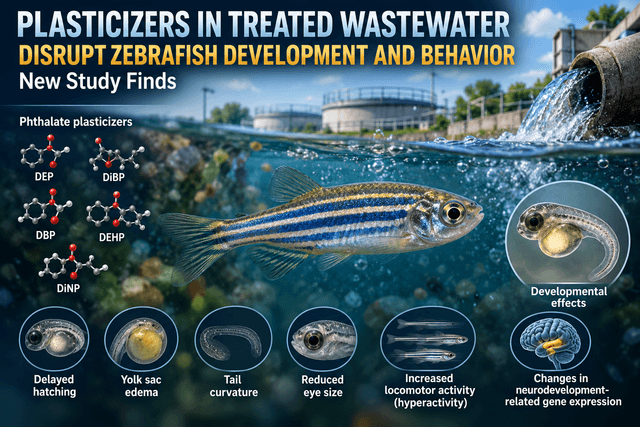
A new study published in Environmental Toxicology and Chemistry suggests that mixtures of phthalate plasticizers found in treated sewage effluent may interfere with normal development and nervous system function in zebrafish (Danio rerio)[1]
.
The study, published on September 16, 2026, investigated whether environmentally relevant concentrations of commonly detected plasticizers could produce measurable developmental and neurobehavioral effects in zebrafish embryos and larvae.
The researchers examined a mixture containing five phthalate-related plasticizers: diethyl phthalate (DEP), diisobutyl phthalate (DiBP), dibutyl phthalate (DBP), di(2-ethylhexyl) phthalate (DEHP), and diisononyl phthalate (DiNP).
These compounds are widely used in plastic manufacturing and can enter aquatic environments through wastewater discharge.
Unlike many laboratory toxicology studies that use relatively high concentrations of a single chemical, the researchers exposed zebrafish embryos to a mixture of several plasticizers at concentrations ranging from approximately 28 to 600 ng/L.
These exposure levels were selected to better reflect concentrations that may occur in treated sewage effluent.
This approach is particularly important because aquatic organisms are rarely exposed to one contaminant at a time in real environmental conditions.
Instead, they encounter complex mixtures of chemicals that may interact and produce effects that would not be apparent when each compound is studied separately.
Exposure to the plasticizer mixture was associated with changes in normal embryonic development.
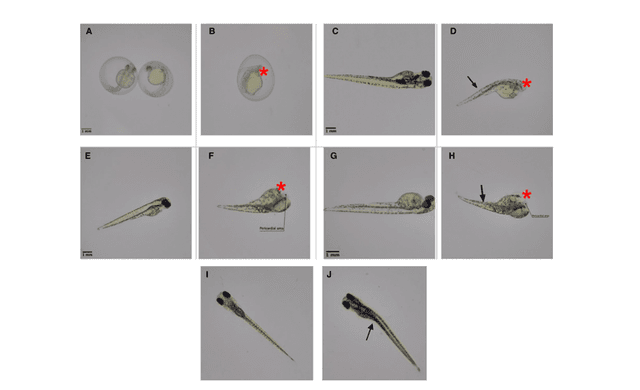
The researchers observed delayed hatching at approximately 72 hours post-fertilization, together with several morphological abnormalities.
Reported developmental changes included:
yolk sac edema;
tail curvature;
reduced eye size;
enlargement of the yolk sac; and
alterations in normal embryonic development.
These findings suggest that even relatively low environmental concentrations of plasticizer mixtures may influence sensitive developmental processes in zebrafish.
One of the most notable findings involved zebrafish behavior.
Larvae exposed to the plasticizer mixture showed a significant increase in locomotor activity, described as a hyperactivity-like response.
Behavioral changes in zebrafish are frequently used as early indicators of neurotoxicity because swimming activity depends on the coordinated function of sensory systems, motor pathways, neurotransmission, and brain development.
Changes in locomotor behavior may therefore indicate that chemical exposure has affected the developing nervous system.
However, the findings should not be interpreted as evidence that similar environmental exposures necessarily cause hyperactivity or neurological disorders in humans.
Zebrafish are widely used as a model for developmental toxicology, but further studies are needed before results can be translated directly to human health.
The study also identified changes in the expression of genes involved in nervous system development and function.
Genes associated with cholinergic signaling, axonal development, neuronal differentiation, and glial cell development showed reduced expression following exposure.
In contrast, expression of brain-derived neurotrophic factor (BDNF) increased.
BDNF is an important neurotrophic factor involved in neuronal survival, development, plasticity, and repair.
The researchers suggested that increased BDNF expression could represent a compensatory neurobiological response to chemical-induced stress or developmental disruption.
Zebrafish have become an important model organism in environmental and developmental toxicology.
Their rapid development, transparent embryos, high reproductive capacity, and well-characterized nervous system allow researchers to identify subtle changes in development, behavior, and gene expression after chemical exposure.
Many fundamental molecular pathways involved in vertebrate development are also conserved between zebrafish and humans.
This makes zebrafish particularly useful for early screening of potentially neurotoxic environmental contaminants.
The significance of the study lies not only in the individual chemicals examined, but also in the use of a realistic chemical mixture at environmentally relevant concentrations.
Traditional toxicological testing often evaluates one substance at a time.
In natural aquatic environments, however, organisms may be continuously exposed to mixtures of plasticizers, pharmaceuticals, pesticides, heavy metals, and other contaminants.
The new findings support growing concern that low-level chemical mixtures may produce measurable biological effects even when individual compounds are present at concentrations that would not normally be considered highly toxic.
The study may therefore have implications for environmental monitoring and wastewater management, particularly in regions where treated sewage effluent is reused for irrigation or discharged into aquatic ecosystems.
Phthalates and related plasticizers are recognized as widespread environmental contaminants.
Because some members of this chemical group have endocrine-disrupting and developmental effects, their presence in wastewater has become an important area of environmental health research.
The new zebrafish findings suggest that evaluating only the concentration of individual contaminants may underestimate the biological impact of real-world chemical mixtures.
More research will be necessary to determine whether similar effects occur in other aquatic species and whether long-term exposure could influence reproduction, neurological development, or population health.
A new 2026 zebrafish study suggests that mixtures of phthalate plasticizers at concentrations relevant to treated wastewater can alter embryonic development, locomotor behavior, and the expression of genes involved in nervous system development.
The findings highlight the value of zebrafish as a model for detecting subtle developmental and neurotoxic effects of environmental contaminants.
They also reinforce the importance of studying chemical mixtures, rather than evaluating environmental pollutants only one at a time.
© All copyright of this material is absolute to Medical toxicology
Master’s student in Toxicology at Tarbiat Modares University (TMU), focusing on toxicodynamics, environmental toxicants, and human health risk assessment.
Keep reading
 Environmental and Occupational Toxicology
Amir Mohammad Mottaghi
 Environmental and Occupational Toxicology
Omid Mehrpour
 Environmental and Occupational Toxicology
Omid Mehrpour
 Environmental and Occupational Toxicology
Omid Mehrpour