Food and Drug Toxicology
Are Essential Oils Really Safe?
Omid Mehrpour
Post on 24 Mar 2026 · 9 min read

Omid Mehrpour
Post on 24 Mar 2026 · 9 min read
 Medical Toxicologymedicaltoxic.com
https://medicaltoxic.com/blogs/are-essential-oils-really-safe
Natural does not mean harmless. Not even close.
Essential oils have a very polished reputation.
They smell clean. They look elegant. They arrive in tiny bottles with botanical names and the quiet confidence of something that expects not to be questioned. And because they come from plants, many people assume they must be safer than synthetic chemicals.
That is the sales story.
It is not the toxicology story.
In toxicology, “natural” is not a safety category. Hemlock is natural. Cyanide can be natural. Poison ivy is aggressively natural. Nature, for all its beauty, has never signed a contract promising gentleness.
So when people ask whether essential oils are safe, the real answer is not a neat yes or no. It is more interesting than that.
It depends.
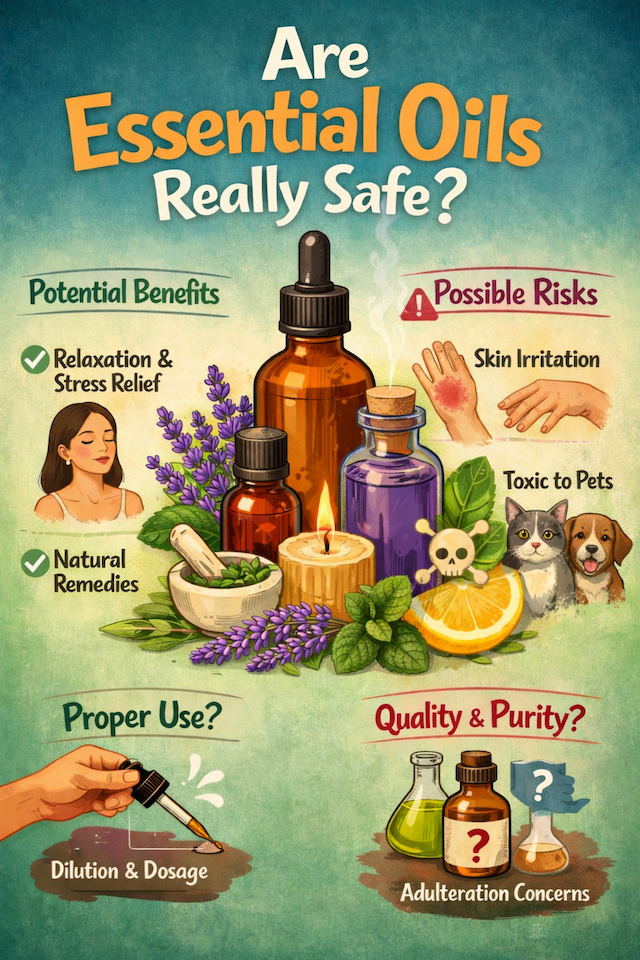
Essential oils are highly concentrated extracts of chemical compounds derived from plants. That sounds innocent enough until you stop and notice the key word there: concentrated.
That word does a lot of work.
Smelling a lavender plant in a garden is one kind of exposure. Applying or diffusing lavender essential oil is another. Same botanical origin. Entirely different dose. A flower in the breeze is a whisper. A concentrated extract is the same song played through a stadium speaker.
And the body notices.
So from a scientific standpoint, essential oils are not just “plant essence.” They are chemical mixtures delivered in a far more intense form than what you would usually encounter in nature.
That changes the risk picture immediately.
The biggest mistake people make is simple: they confuse origin with safety.
If it comes from a plant, it must be mild. If it smells soothing, it must be harmless. If it is sold in a wellness aisle, it must be friendly.
Sounds reasonable, yeah?
But toxicology does not care whether a substance was born in a forest, a lab, or a suspicious-looking factory with bad coffee. Toxicology cares about exposure.
That means asking the boring but crucial questions:
How much?
How often?
By what route?
In whom?
That is where the truth lives.
Not in the label.
If there is one principle that quietly governs nearly all of toxicology, it is this: risk depends on exposure.
Not branding. Not intention. Not scent profile.
Exposure.
And in practical terms, three factors matter most:
Dose
Frequency of use
Route of exposure
So let’s make that concrete.
A) Whether it is natural
B) The brand
C) Dose and frequency of use
D) Smell and color
The answer is C) Dose and frequency of use.
Because that is how toxicology works. A small, occasional exposure is one thing. Repeated exposure, in higher amounts, through the lungs or on the skin, is another story entirely.
Small bottle. Big difference.
Diffusers often get treated like harmless décor with ambition. A little vapor, a pleasant smell, a room that now believes it has emotional depth.
But here is the catch.
When essential oils are diffused in a closed room, the compounds are released into the air and inhaled over time. And unlike the outdoors, indoor air does not always dilute those compounds efficiently. In a poorly ventilated space, exposure can build.
That is the real issue.
Not that the diffuser “destroys the oil.” Not that it weakens the scent. The concern is that it increases inhalation exposure, especially when used repeatedly or for long periods in closed environments.
A) It reduces scent
B) It weakens the oil
C) It increases inhalation exposure
D) It destroys the oil
The correct answer is C) It increases inhalation exposure.
And yes, that can matter.
Possible effects include:
irritation of the nose, throat, or airways
headache
cough
eye irritation
worsening symptoms in people with asthma or fragrance sensitivity
If someone starts coughing, wheezing, or getting a headache in that beautifully scented room, that is not the body applauding the ambiance.
It is objecting.
The lungs are not a passive decoration. They are built for absorption. That is one of their main jobs.
Which means inhaling essential oil vapors is not just “enjoying a fragrance.” Some compounds can move from the lungs into the bloodstream, where the body then has to metabolize and eliminate them.
That does not mean every diffuser session is dangerous. Let’s not wander into melodrama. But it does mean inhalation is a real route of exposure, not a cosmetic one.
That matters.
Topical use is another place where people get comfortable too quickly. Essential oils are often used on the skin for massage, relaxation, or skin care. But direct use, especially undiluted use, can irritate the skin.
That may show up as:
redness
stinging
burning
dryness
rash
That part is fairly straightforward.
The deeper issue is sensitization… wait, immune sensitization, not just temporary irritation.
And this is where people often get blindsided.
Sensitization means the immune system begins reacting to a substance after repeated exposure. In plain English, your body may initially tolerate an oil just fine, then later decide it has had enough and start reacting.
That delayed turn catches people off guard.
Because the usual logic is: “I used this before, and nothing happened.” But prior tolerance is not a lifelong peace treaty.
So let’s put it in question form.
A) Reduced sensitivity
B) Becoming dependent on scent
C) The immune system starts reacting after repeated exposure
D) Increased vitamin absorption
The right answer is C) Immune system starts reacting after repeated exposure.
This is one reason repeated skin use deserves more caution than people think. A person may apply an oil many times without obvious problems, then later develop a rash or allergic-type reaction. Some fragrance-related compounds are well known for this pattern in dermatology and toxicology references.
So no, “I’ve always used it” is not a serious safety argument. No.
Now we come to one of the more elegant little illusions in this space: therapeutic grade.
It sounds official. Medical, even. Like somewhere, a panel of grave-faced experts certified the oil as clinically safe and spiritually accomplished.
That is not what is happening.
In most settings, “therapeutic grade” is a marketing term. It is not a universal medical safety standard. It is not a guarantee of harmlessness. It is not a formal pharmaceutical classification.
It is branding dressed up as authority.
A) A medical safety standard
B) A guarantee of safety
C) A marketing term
D) A pharmaceutical classification
The correct answer is C) A marketing term.
Do not bury the lead: a polished phrase on a bottle is not a toxicology credential.
Could product quality vary? Absolutely. Purity matters. Storage matters. Oxidation matters. Adulteration matters. But “therapeutic grade” is not some enchanted legal category that makes risk vanish.
That would be convenient. It would also be false.
Related Blog: Vitamin Toxicity: When “Natural” Isn’t Safe
Not all bodies have the same margin for exposure. That part gets overlooked far too often.
Some groups are more vulnerable because of body size, airway sensitivity, skin barrier issues, physiology, or species-specific metabolism.
Groups that deserve extra caution include:
children
pregnant individuals
people with asthma or reactive airways
people with eczema or other skin conditions
pets
Children and pets, in particular, can be more sensitive because smaller bodies and different physiology may change how exposure affects them.
So here is the next checkpoint.
A) Athletes
B) Children and pets
C) Healthy adults
D) Elderly without illness
The answer is B) Children and pets.
And that is not a trivial detail. What feels mild to a healthy adult may be more irritating, more concentrated, or simply less well tolerated in a child or household animal sharing the same air.
A cozy room for one creature can be a chemical fog for another.
This is the part where the answer becomes gloriously unglamorous.
Safer use is not about mystical intuition. It is about reducing exposure.
That means:
Lower frequency means lower cumulative exposure. Revolutionary, I know.
Open windows. Avoid running diffusers for long periods in closed rooms. Outdoor or semi-open environments are a different exposure world.
Undiluted oils are far more likely to irritate the skin. Use an appropriate carrier oil and consider patch testing first.
Essential oils and fragrance compounds may also appear in soaps, candles, laundry products, sprays, cosmetics, and cleaners. Sometimes the problem is not one exposure. It is the whole scented parade marching through the day.
Headache. Rash. Cough. Wheeze. Burning. Eye irritation.
Those are not charming little side notes.
They are warnings.
What helps:
less frequent use
good ventilation
dilution for skin application
caution around sensitive groups
awareness of repeated and combined exposures
What does not help:
Assuming natural means harmless
Assuming a nice smell means low risk
Trusting “therapeutic grade” as proof of safety
Applying oils directly to skin because “it’s just plant-based”
Running diffusers for hours in closed spaces
We have all been there, wanting the simple answer.
The bottle says calm. The science says context.
Related Blog: How to Prevent Poisoning at Home: A Parent’s Essential Safety Guide
Essential oils are not automatically dangerous. They are not tiny botanical villains plotting from a bathroom shelf. But they are also not automatically safe simply because they come from plants.
They are concentrated chemical mixtures.
That is the frame that keeps the whole conversation honest.
Once you see them that way, the safety question becomes much clearer. The most important issue is not whether the oil is natural. It is how much is used, how often it is used, how it enters the body, how well the space is ventilated, and who is being exposed.
So, in short, essential oils can sometimes be used with relatively low risk, but only when the exposure pattern is sensible.
Not magical. Sensible.
Natural does not mean risk-free.
Plant origin is not a safety certificate.
Dose and frequency matter most.
That is the real center of gravity in risk assessment.
Ventilation, dilution, and vulnerable groups matter.
Especially for children, people with asthma, and pets.
© All copyright of this material is absolute to Medical toxicology
Dr. Omid Mehrpour (MD, FACMT) is a senior medical toxicologist and physician-scientist with over 15 years of clinical and academic experience in emergency medicine and toxicology. He founded Medical Toxicology LLC in Arizona and created several AI-powered tools designed to advance poisoning diagnosis, clinical decision-making, and public health education. Dr. Mehrpour has authored over 250 peer-reviewed publications and is ranked among the top 2% of scientists worldwide. He serves as an associate editor for several leading toxicology journals and holds multiple U.S. patents for AI-based diagnostic systems in toxicology. His work brings together cutting-edge research, digital innovation, and global health advocacy to transform the future of medical toxicology.
Goldfrank’s Toxicologic Emergencies
Casarett & Doull’s Toxicology: The Basic Science of Poisons
Patty’s Toxicology
Keep reading
 Food and Drug Toxicology
Amirhosein Shabrang
 Food and Drug Toxicology
Amirhosein Shabrang
 Food and Drug Toxicology
Amirhosein Shabrang
 Food and Drug Toxicology
Amirhosein Shabrang