Research and Innovations
The Role of AI in Medical Toxicology: Revolutionizing Toxicity Prediction and Drug Safety
Omid Mehrpour
Post on 11 Sept 2024 · Updated 19 Nov 2026 · 16 min read

Omid Mehrpour
Post on 11 Sept 2024 · Updated 19 Nov 2026 · 16 min read
 Medical Toxicologymedicaltoxic.com
https://medicaltoxic.com/blogs/ai-medical-toxicology-etoxpred-clinical-limits

Artificial intelligence (AI) has become an increasingly important research tool in toxicology, with potential applications ranging from computational drug-safety screening to clinical prediction, laboratory data analysis, and decision support.
However, these applications answer different questions and require different types of evidence.
A model that estimates whether a chemical structure resembles known toxic substances does not necessarily identify poisoning in an emergency department. Similarly, a model that predicts the likelihood of a particular intoxication cannot automatically determine the correct antidote or improve patient outcomes.
Understanding these differences is essential for using AI responsibly in medical toxicology.
One example is eToxPred, a machine-learning approach developed to estimate the toxicity and synthetic accessibility of small organic molecules. Its original publication reported toxicity-classification accuracy of up to 72% under specified testing conditions. This result concerned molecular classification, not clinical diagnostic accuracy or demonstrated patient benefit. [1]
Clinical machine-learning research addresses another problem: whether patient data can help identify specific exposures or predict clinically relevant outcomes. Such systems require validation in the populations and settings where they may be used.
This article explains what AI can contribute to toxicology, what eToxPred actually demonstrated, and why model performance must not be confused with evidence of safer patient care.
AI in toxicology includes molecular screening, experimental data analysis, clinical prediction research, and potential decision-support applications.
eToxPred was developed for molecular toxicity and synthetic accessibility prediction during drug discovery.
The reported 72% eToxPred accuracy was obtained on a defined independent molecular dataset. It is not accuracy for diagnosing poisoning in patients.
The original eToxPred study did not document prevention of specific patient injuries, selection of antidotes, or improved hospital outcomes.
Clinical ML models require separate evaluation using patient-level data and clinically relevant endpoints.
A 2026 multicenter emergency-department study reported promising discrimination for psychostimulant intoxication, but its sensitivity was insufficient for use as a standalone rule-out test.
FDA and EMA support responsible AI development through risk-based principles and defined contexts of use. This is not an endorsement of every individual AI tool.
Neither molecular nor clinical AI should replace appropriate experimental evidence, clinical assessment, specialist consultation, or established poisoning-management principles.
Artificial intelligence is not a single diagnostic or therapeutic technology.
In toxicology, its potential applications can be divided into several distinct areas.
Application | Main input | Typical research question | Evidence required |
|---|---|---|---|
Molecular toxicity prediction | Chemical structures, fingerprints, assay data | Could a compound have a toxicological liability? | Relevant experimental data and model validation |
Synthetic accessibility prediction | Molecular structure | How difficult might a compound be to synthesize? | Comparison with appropriate synthetic-accessibility measures |
Clinical poisoning prediction | Patient history, symptoms, vital signs, laboratory results | Is a specific exposure or complication likely? | Patient-level validation in relevant clinical settings |
Laboratory data analysis | Analytical signals, spectra, assay outputs | Can computational methods help interpret complex laboratory information? | Analytical validation and quality control |
Clinical decision support | Patient data and clinical knowledge sources | Could a system help organize information or support a clinical decision? | Workflow, safety, clinical-performance, and impact evaluation |
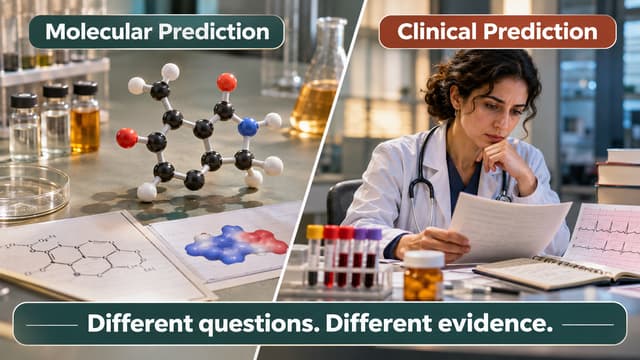
The distinction between drug discovery and clinical poisoning management is particularly important.
Computational screening may help researchers prioritize molecules for further study. It does not establish that a molecule is safe to administer to humans.
Similarly, clinical decision-support software may help clinicians organize or interpret information, but its reliability depends on the exact task and the evidence supporting that application.
eToxPred is a computational approach described by Pu and colleagues in BMC Pharmacology and Toxicology in 2019.
The method was developed to estimate two properties of small organic molecules:
Toxicity potential, based on patterns learned from molecular fingerprints and labeled chemical datasets.
Synthetic accessibility, an estimate of how difficult a molecular structure may be to synthesize.
The purpose was to help prioritize compounds during computational drug discovery and virtual screening. [1]
In the original study, eToxPred used molecular fingerprints—representations of structural features—to support machine-learning classification.
An Extremely Randomized Trees, or Extra Trees, classifier was used for toxicity prediction.
The model generated a toxicity score based on the chemical information and the patterns learned from its training data.
A lower predicted score indicated that a molecule was more similar, under the model, to compounds assigned to the lower-toxicity class. A higher score indicated greater similarity to compounds assigned to the toxic class.
This score is a computational estimate.
It is not a directly measured human toxicity threshold, a probability of poisoning after a specific dose, or a prediction of an individual patient's clinical course.
A potentially useful drug candidate may be difficult to synthesize.
The original eToxPred framework therefore included a synthetic-accessibility component to help prioritize molecules that appeared more feasible for further research.
This is a practical application of computational chemistry: research resources can be directed toward candidates judged more promising for subsequent investigation.
However, ease of synthesis and toxicological safety are different properties.
A molecule that is easy to synthesize is not necessarily safe, and a molecule with a favorable predicted toxicity score still requires experimental assessment.
The frequently repeated statement that eToxPred achieves “72% accuracy” is incomplete without describing the data and outcome being predicted.
In the original publication, the authors evaluated the Extra Trees toxicity classifier using molecular datasets assembled from drug and chemical databases.
The primary training and evaluation framework used FDA-approved drug molecules and chemicals from TOXNET.
An independent evaluation used compounds from KEGG-Drug and the Toxic Exposome Database, or T3DB. [1]
Evaluation | Reported result | Correct interpretation |
|---|---|---|
Initial FDA-approved/TOXNET evaluation | Approximately 76% accuracy | Molecular classification in the study's original evaluation framework |
Independent KEGG-Drug/T3DB evaluation | Approximately 72% accuracy | Molecular classification on a different dataset |
Independent test sensitivity | Approximately 63% | Performance for the class defined as non-toxic in the study |
Independent test false-positive rate | Approximately 25% | Misclassification relative to the study's assigned chemical labels |
These findings demonstrate measurable computational performance, but they do not establish universal predictive accuracy.
They also do not describe the probability of a clinical poisoning diagnosis being correct.
The study used approved drugs as a proxy for the lower-toxicity or “non-toxic” class and selected hazardous chemicals as a proxy for the toxic class.
This was a modeling decision, not a literal declaration that approved medications cannot cause poisoning.
An FDA-approved medicine can cause severe toxicity in overdose, through medication errors, or in susceptible patients.
Likewise, a chemical's hazard and clinical consequences depend on exposure conditions that cannot be inferred from molecular classification alone.
The study also identified overlap and inconsistent toxicity labels between datasets. Such differences help explain why performance may change when a model is evaluated outside its original training environment. [1]
The 72% figure is therefore best understood as a benchmark result for a defined molecular-classification task—not a general measure of clinical safety or diagnostic performance.
The original researchers also evaluated the approach against datasets representing selected toxicological endpoints.
These included:
cardiotoxicity-related assay results;
endocrine-disruption-related data;
carcinogenicity-related data;
acute oral toxicity.
Performance varied by dataset and endpoint.
The study reported area under the receiver operating characteristic curve (AUC) values of approximately 0.80 for the cardiotoxicity and acute oral toxicity datasets, 0.75 for endocrine disruption, and 0.72 for the carcinogenicity dataset. [1]
These are useful experimental benchmarks.
However, an AUC from a molecular toxicology dataset does not establish that the model can predict actual cardiac arrest, liver injury, renal failure, or mortality in an individual overdose patient.
A clinically important outcome involves additional factors, including dose, exposure route, timing, metabolism, underlying disease, drug interactions, and treatment.
The original eToxPred evaluation was not designed to validate those patient-level predictions.
This distinction is central to medical toxicology.
A patient with suspected poisoning may present with gastrointestinal, neurological, cardiovascular, metabolic, respiratory, hepatic, or renal abnormalities.
For example, toxic exposures can produce:
nausea, vomiting, or abdominal pain;
altered mental status or seizures;
respiratory depression;
hypotension or dysrhythmias;
metabolic acidosis;
acute kidney or liver injury.
Recognizing and managing these findings requires clinical assessment.
A chemical's predicted molecular toxicity cannot, by itself, determine which substance a patient ingested or whether that substance caused the current symptoms.
Clinical toxicology assessment may involve:
exposure history and timing;
vital signs and physical examination;
recognition of toxidromes;
electrocardiography;
targeted laboratory testing;
toxicology testing when appropriate;
poison-center or medical-toxicology consultation;
ongoing reassessment of the patient's clinical course.
Laboratory results also have limitations.
For example, an ordinary urine immunoassay may fail to detect substances outside its assay targets. A negative screening result should not automatically exclude a concerning exposure.
For more detail about the limitations of toxicology testing, see Drug Screens Lie: A Clinician’s Guide to Interpreting Toxicology Tests Safely.
eToxPred has not been established as a clinical test for diagnosing an individual poisoning or selecting patient treatment.
Clinical ML research is distinct from eToxPred's molecular-screening approach.
A useful contemporary example is a 2026 multicenter study by Yu and colleagues examining machine-learning models for predicting psychostimulant intoxication among emergency-department patients.
The researchers studied 1,382 patients with suspected substance intoxication and used laboratory information to establish the study's reference outcome.
A later temporal validation cohort included 382 patients. [2]
The highest-performing extreme gradient boosting (XGBoost) model achieved the following results in temporal validation:
Metric | Result |
|---|---|
AUC | 0.836 |
Accuracy | 86.6% |
Sensitivity | 68.1% |
Specificity | 91.0% |
The model demonstrated useful discrimination under the study conditions.
However, sensitivity of 68.1% also means it was not sufficiently sensitive to exclude intoxication reliably when the result was negative.
The study compared model performance with predictions from physicians of varying experience levels, but its findings should not be interpreted as proof that the model improved survival, reduced hospitalizations, or safely replaced confirmatory testing.
This model was not eToxPred. It used a different research approach, a different population, different input data, and a different outcome. [2]
A model may perform well in a development dataset and less well in another hospital or patient population.
Differences can arise from:
patient characteristics;
local drug exposure patterns;
data collection methods;
missing or inconsistent variables;
assay availability;
selection bias;
changing disease or drug patterns;
model thresholds and calibration.
The PROBAST+AI framework provides methods for assessing the methodological quality, risk of bias, and applicability of clinical prediction model studies, whether they use conventional statistical methods or artificial intelligence. [3]
For a clinical AI model, good performance in a single study is a starting point—not automatic authorization for routine patient care.
AI-assisted clinical decision support is an active area of development, but the capabilities of a particular system must be supported by evidence for its intended use.
Poisoning treatment depends on the specific toxicant, exposure, physiology, clinical severity, and applicable guidelines.
Depending on the circumstances, management may involve:
airway and respiratory support;
cardiovascular stabilization;
appropriate antidotal treatment;
carefully selected gastrointestinal decontamination;
treatment of seizures or dysrhythmias;
extracorporeal treatment for certain indications;
monitoring for delayed complications.
These are patient-specific decisions.
eToxPred was not developed or clinically validated to select antidotes, determine antidote doses, decide which patients need dialysis, or optimize bedside treatment protocols.
Likewise, the fact that a different AI model can estimate the likelihood of an exposure does not establish that following its recommendation will improve clinical outcomes.
Evidence supporting treatment recommendations must remain tied to the actual intervention, patient population, and clinical context.
Regulatory agencies are increasingly engaged in the evaluation of artificial intelligence for drug development and regulatory science.
In January 2026, FDA and the European Medicines Agency jointly published Guiding Principles of Good AI Practice in Drug Development.
The principles emphasize clear contexts of use, multidisciplinary expertise, risk-based assessment, data governance, transparency, and life-cycle management. [4]
This represents a framework for responsible AI development.
It is not a regulatory endorsement of eToxPred, nor proof that eToxPred has achieved clinical diagnostic validation.
FDA's January 2025 draft guidance, Considerations for the Use of Artificial Intelligence To Support Regulatory Decision-Making for Drug and Biological Products, proposes a risk-based credibility assessment framework.
The guidance focuses on whether evidence supports the reliability of a model for a clearly defined regulatory purpose. It is draft, nonbinding guidance, not a blanket approval of AI-generated predictions. [5]
For example, using a model to prioritize chemical candidates for research presents different risks from using a model's output to influence a high-stakes clinical decision.
The evidence required should reflect those differences.
Yes.
FDA's National Center for Toxicological Research describes an AI4TOX research program exploring applications such as predictive toxicology, histopathology analysis, document analysis, and translation of experimental findings. [6]
This demonstrates genuine regulatory-science interest in AI.
However, FDA research activity should not be confused with approval, qualification, or endorsement of every publicly available toxicity-prediction tool.
Computational methods may help researchers prioritize compounds, improve experimental design, and identify candidates that warrant further investigation.
Such applications could contribute to more efficient nonclinical research and support efforts to reduce unnecessary animal use.
FDA's AI research and new approach methodology initiatives are relevant to these goals. [6]
However, potential reduction in experimental burden is not the same as a demonstrated reduction achieved by a particular tool.
The original eToxPred publication did not establish that its use caused a measured reduction in animal experiments across drug-development programs.
Nor did it demonstrate that computational screening can universally replace experimental toxicology.
The appropriate conclusion is more limited:
Molecular toxicity prediction can support prioritization and research planning, while the need for subsequent testing depends on the intended application and applicable scientific and regulatory requirements.
For high-consequence applications in medical toxicology, validation must be tied to a clearly defined clinical purpose.
Important questions include:
What is the intended use? Is the model screening compounds, predicting an exposure, estimating prognosis, or suggesting treatment?
What population was studied? Does the validation population resemble the patients in the intended clinical setting?
How was the outcome established? Was the reference standard clinically meaningful and sufficiently reliable?
How accurate and well-calibrated is the model? Do sensitivity, specificity, predictive values, and calibration support its proposed use?
Has performance been tested elsewhere? Does it generalize across institutions, time periods, and relevant patient subgroups?
What happens when it is wrong? Could a false-negative result delay an antidote, or could a false-positive result lead to unnecessary treatment?
Does it improve care? Has implementation been evaluated for its effects on clinical decisions, safety, workflow, or patient outcomes?
These questions are consistent with the concerns addressed by modern clinical prediction-model evaluation frameworks. [3]
A model's technical performance is important, but high-stakes clinical usefulness requires more than a promising accuracy statistic.
For broader context on emerging clinical decision-support research and its limitations, see New Poisoning Research Points to Faster ED Triage, Methanol Mortality Markers and Safer AI Use in Toxicology.
Even appropriately developed AI systems may face important limitations.
Models learn from available datasets.
If those datasets contain inconsistent labels, biased samples, incomplete measurements, or underrepresented populations, model performance may be affected.
A model validated on one chemical library or hospital population may not perform equally well with unfamiliar compounds, different exposure patterns, or new clinical settings.
Model outputs can appear precise even when the underlying information is incomplete.
A numerical toxicity score should not be mistaken for an experimentally verified clinical prediction.
In emergency toxicology, incorrect predictions can have immediate consequences if they delay recognition of a life-threatening exposure or create false reassurance.
Data quality, documentation, accountability, transparency, and human oversight remain important.
These are not reasons to reject AI research. They are reasons to evaluate each application according to the evidence required for its intended use.

Molecular prediction is not clinical diagnosis.
eToxPred screens molecular properties; it does not identify the cause of poisoning in a patient.
Accuracy is task-specific.
A 72% molecular classification result cannot be transferred to emergency-department diagnosis.
Approved drugs can still be toxic.
Using approved drugs as a model's lower-toxicity reference class does not imply safety in overdose.
AUC does not establish patient benefit.
Even good discrimination does not demonstrate improved treatment outcomes.
Clinical AI requires independent validation.
Performance must be evaluated in the population and setting where the model is intended to operate.
Regulatory guidance is not product endorsement.
FDA and EMA principles establish expectations for responsible development; they do not validate every named AI tool.
Human oversight remains essential.
Clinical assessment, laboratory evidence, poison-center expertise, and established treatment guidance remain central to poisoning care.
eToxPred is a computational tool developed to estimate molecular toxicity and synthetic accessibility, particularly for compound prioritization during early drug discovery. It is not a validated bedside poisoning-diagnosis or antidote-selection tool. [1]
No. The reported 72% accuracy concerned classification of compounds in the independent KEGG-Drug/T3DB molecular evaluation. It did not measure the accuracy of diagnosing poisoning in patients.
Clinical prediction models may help estimate the likelihood of certain exposures using patient information. Their performance depends on the model, population, reference standard, and validation. They do not automatically replace clinical assessment or confirmatory toxicology testing.
Some clinical decision-support systems may be developed to assist with treatment information, but any such use requires specific validation and safety assessment. eToxPred has not demonstrated antidote-selection accuracy or improved poisoning outcomes.
The original eToxPred publication does not establish FDA or EMA endorsement of eToxPred as a clinical diagnostic or treatment system. FDA and EMA have published broader principles for responsible use of AI in drug development.
Computational screening may help researchers prioritize experiments and support the development of alternatives. However, the original eToxPred study did not establish a specific, measured reduction in animal testing attributable to the tool.
Artificial intelligence has meaningful potential in toxicology, but its applications must be evaluated according to the questions they are designed to answer.
eToxPred demonstrates how machine learning can help estimate selected molecular properties and prioritize chemical compounds for further research.
Its published performance—including the frequently cited 72% toxicity-classification accuracy—describes results on defined molecular datasets. It does not establish clinical diagnostic accuracy, proven prevention of drug-related injuries, or improved treatment outcomes.
Clinical AI research is progressing independently. Studies involving emergency-department patients have demonstrated promising predictive performance, but such results still require careful interpretation, appropriate validation, and evidence of clinical usefulness.
The future value of AI in medical toxicology depends not on broad claims of revolutionizing patient care, but on transparent methods, clearly defined purposes, reliable validation, and responsible integration with clinical expertise.
© All copyright of this material is absolute to Medical toxicology
Dr. Omid Mehrpour (MD, FACMT) is a senior medical toxicologist and physician-scientist with over 15 years of clinical and academic experience in emergency medicine and toxicology. He founded Medical Toxicology LLC in Arizona and created several AI-powered tools designed to advance poisoning diagnosis, clinical decision-making, and public health education. Dr. Mehrpour has authored over 250 peer-reviewed publications and is ranked among the top 2% of scientists worldwide. He serves as an associate editor for several leading toxicology journals and holds multiple U.S. patents for AI-based diagnostic systems in toxicology. His work brings together cutting-edge research, digital innovation, and global health advocacy to transform the future of medical toxicology.
Keep reading
 Research and Innovations
Omid Mehrpour
 Research and Innovations

Paniz Seifi
 Research and Innovations
Omid Mehrpour
 Research and Innovations
Paniz Seifi
We would like to use analytics and session-replay tools to understand how this site is used. They are optional and the site works fully without them. Signing in still needs its own cookie either way. Our Privacy Policy names each one.