Research and Innovations
A Historical and Conceptual Journey of Toxicology
Post on 03 Dec 2025 · Updated 22 Sept 2026 · 5 min read

Post on 03 Dec 2025 · Updated 22 Sept 2026 · 5 min read
 Medical Toxicologymedicaltoxic.com
https://medicaltoxic.com/blogs/a-historical-and-conceptual-journey-of-toxicology
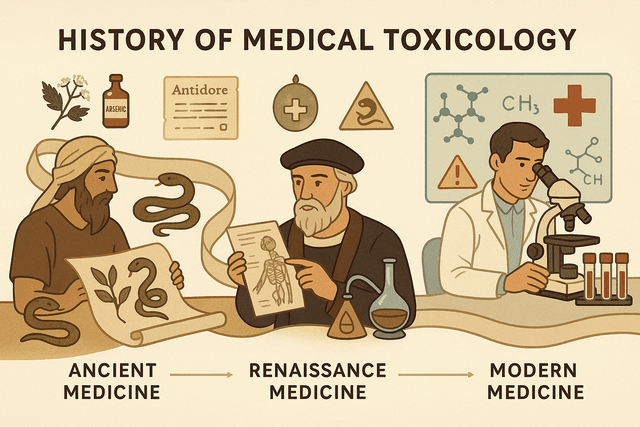
Toxicology, the study of poisonous substances and their effects on the human body, has a history as old as human civilization. The Ancient Greeks and Romans were the first to document the intentional and therapeutic use of poisons, as well as early attempts to identify antidotes—knowledge that later shaped the foundations of medical science and eventually led to the establishment of toxicology as an independent discipline.
This article explores the historical and linguistic origins of the term “toxic,” its evolution within medical science, and notable examples of poisoning across history. By tracing this conceptual journey, we gain deeper insight into humanity’s long-standing interaction with toxic substances and the critical importance of understanding and managing their effects.
The word “toxic” entered the English language in the 1660s, meaning “of or pertaining to poison.” It comes from the French toxique and directly from Late Latin toxicus, meaning “poisoned,” with its ultimate origin in Latin toxicum and in Ancient Greek toxikon (pharmakon), which meant “poison for use on arrows.” The Greek adjective toxikos, meaning “pertaining to arrows or archery,” is derived from toxon, meaning “bow.” In the past, poisons were applied to the tips of arrows to kill enemies or prey, and symptoms of poisoning would appear after impact. The primary purpose was to harm the enemy in order to kill, not because of the wound, but because of the toxic effects that appeared after the strike. Over time, the meaning of the word expanded beyond poisoned arrows to include any substance harmful to the body.
The word toxicity entered English around 1890 and means “the state of being toxic.” In medicine, the word toxin has been used since 1888 for biologically produced poisons, and toxic waste has been used since 1955 for chemical or radioactive byproducts. The evolution of this term demonstrates how human understanding of poisons has progressed from practical use in hunting and warfare to scientific study and forming the foundation of modern toxicology.
Poisoning has been one of humanity’s oldest tools of power, revenge, and survival. As early as antiquity, natural toxins from plant extracts to venoms and even “mad honey” were used not only for hunting or warfare but also for political intrigue and assassination.
One striking example dates to the 1st century BCE during the wars between the Kingdom of Pontus and Rome. In a clever ambush, forces of Pontus used “mad honey”, honey contaminated with grayanotoxins to incapacitate Roman soldiers; the unfamiliar symptoms of poisoning left them powerless and led to a Roman defeat.
The King of Pontus, Mithridates VI (132–63 BC), was concerned that his mother was intent upon killing him. Mithridates began taking small doses of poisons to build up his resistance to them. Taking poisons became part of his daily routine and he continued his efforts to build up immunity. For example, he drank blood from the ducks that fed on poisonous plants. His theory was that, if the ducks could happily live on poisonous food, then they must have, within their blood, a means of resisting or destroying the poison.
His efforts at building immunity gave rise to the word ‘mithridatize’ which is still in use today. mithridatize means to render someone resistant to a poison through gradually increasing doses. He systematically studied poisons, testing them on criminals awaiting execution and evaluating the effectiveness of antidotes. One of his antidotes, antidotum mithridatum, was based upon herbal remedies. Containing 15 ingredients, it became something of a universal antidote.
This historical example illustrates how the concept of “toxic” evolved beyond poisoned arrows, showing that humans have interacted with toxicity through everyday substances long before modern toxicology emerged.
Plants contain numerous compounds that, when beneficial to humans, are categorized as “medicinal” and when harmful they are termed “poisonous”. Secondary products derived from plants, such as some honey, can contain a number of chemical compounds that, depending on their concentration and application, can also be considered medicinal or poisonous.
Mad honey collected by bees from certain plants, especially species of the genus Rhododendron which contain toxins known as grayanotoxins. Such honey has been documented since antiquity and was sometimes used as a method of poisoning, even as a biological weapon.
Grayanotoxin is a potent neuro‑toxin that disrupts sodium ion channels in neural and cardiac cells, leading to lowered blood pressure, bradycardia, dizziness, nausea and in serious cases cardiac disorders or loss of consciousness.
Over time, the use of poisons extended beyond hunting and warfare, as scholars and physicians sought a scientific understanding of their effects. The 16th‑century physician‑alchemist Paracelsus famously stated: “it is the dose that determines toxicity” meaning that any substance can be harmful if taken in excess.
In the 19th century, Mathieu Orfila laid the foundation of modern toxicology. He systematically classified poisons and their effects, establishing toxicology as an independent scientific discipline. Advances in analytical chemistry enabled the precise detection and measurement of toxic substances in biological samples, transforming toxicology from anecdotal observation into a rigorous science.
By the late 19th and early 20th centuries, toxicology had branched into multiple subfields: clinical toxicology (diagnosis and treatment of poisoning), forensic toxicology (legal-medico investigations), industrial and environmental toxicology, pharmaceutical toxicology, and regulatory toxicology. This transformation marked a conceptual shift: poisons were no longer seen merely as tools for assassination or warfare, but as chemical agents whose risks could be measured, controlled, and mitigated. Modern toxicology thus evolved from human interaction with natural toxins into a precise scientific discipline central to medicine, public health, and drug development.
Related Blog: Famous People Who Died from Confirmed Poisonings
Throughout history, humans have interacted with toxic substances, from poisoned arrows and “mad honey to sophisticated laboratory analyses. The term “toxic” has evolved alongside scientific understanding, reflecting the transition from practical use of poisons to the systematic study of their effects. Modern toxicology, with its specialized subfields, ensures that chemical risks are understood, managed, and mitigated. This historical and conceptual journey highlights how human curiosity, observation, and scientific rigor transformed toxic substances from deadly tools into a cornerstone of medical science.
Poisons that once killed now teach us how to heal
© All copyright of this material is absolute to Medical toxicology
Keep reading
 Research and Innovations
 Research and Innovations
 Research and Innovations
 Research and Innovations