Why Can PaO₂ Be Normal When SpO₂ Is Low in Methemoglobinemia?

Amirhosein Shabrang
Post on 16 Sept 2026 · Updated 02 Oct 2026
Amirhosein Shabrang
Post on 16 Sept 2026 · Updated 02 Oct 2026
 Medical Toxicologymedicaltoxic.com
https://medicaltoxic.com/tox-spotlight/normal-pao2-low-spo2-methemoglobinemia
Why Can PaO₂ Be Normal When SpO₂ Is Low in Methemoglobinemia?
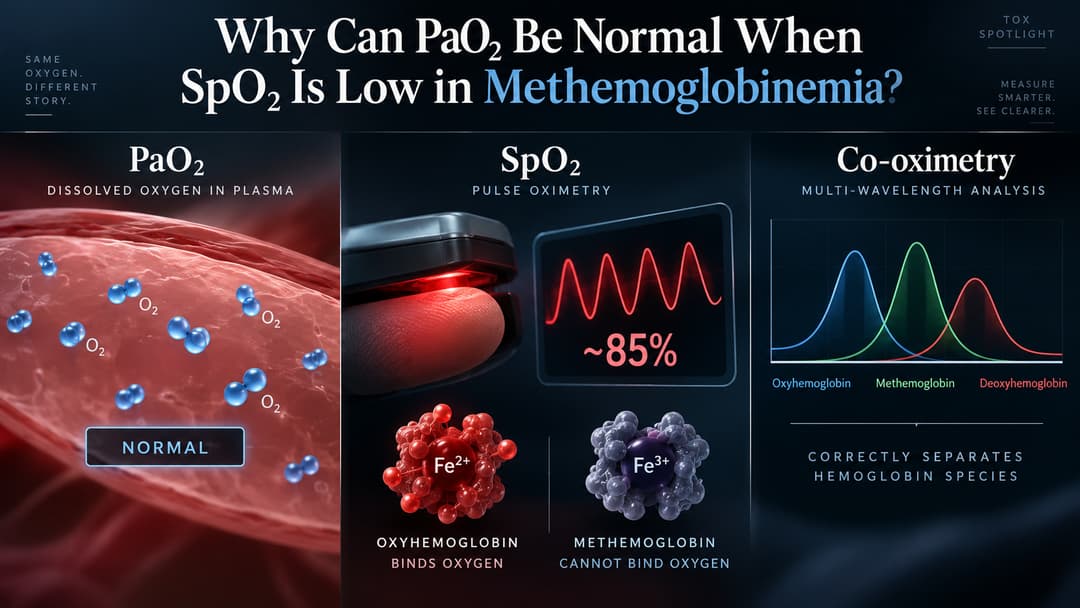
PaO₂ and SpO₂ can tell very different stories in methemoglobinemia because one reflects dissolved oxygen while the other depends on how light interacts with hemoglobin.
PaO₂ measures the partial pressure of oxygen dissolved in plasma. Methemoglobinemia primarily disrupts hemoglobin, so PaO₂ may remain normal—or become high with supplemental oxygen—even while effective oxygen carriage is impaired. [1] [2]
Conventional pulse oximetry measures something different. As methemoglobin rises, standard two-wavelength pulse oximeters become increasingly unreliable and tend toward readings in the mid-80% range, classically around 85%, rather than accurately reflecting true oxyhemoglobin saturation. [2] [3]
The apparent contradiction is therefore not a contradiction at all:
PaO₂ is measuring dissolved oxygen; SpO₂ is an optical estimate affected by abnormal hemoglobin.
Most oxygen in arterial blood is carried by hemoglobin, but PaO₂ does not measure that oxygen directly.
Instead, a blood-gas electrode measures the pressure generated by oxygen dissolved in plasma. If pulmonary gas exchange is intact, oxygen can continue to cross the alveoli and dissolve normally even when part of the circulating hemoglobin has been oxidized to methemoglobin. [1] [4]
In methemoglobin, the heme iron is oxidized from Fe²⁺ to Fe³⁺. Ferric heme cannot bind oxygen normally, and the remaining functional heme also has altered oxygen-release characteristics. The result is impaired oxygen transport despite a potentially reassuring PaO₂. [1]
A normal PaO₂ does not exclude clinically important methemoglobinemia.
Supplemental oxygen can make PaO₂ even higher because it increases dissolved oxygen. It does not, by itself, correct the abnormal hemoglobin species.
Standard pulse oximeters usually estimate oxygen saturation using light at approximately 660 nm and 940 nm.
The calculation assumes that the important circulating hemoglobin species are primarily oxyhemoglobin and deoxyhemoglobin.
Methemoglobin violates that assumption.
As its concentration increases, absorption at the two wavelengths becomes increasingly similar. The resulting signal drives many conventional pulse oximeters toward a displayed saturation near 85%. [2] [3]
This does not mean every patient with methemoglobinemia will have an SpO₂ of exactly 85%.
It means the number progressively loses its usual relationship with actual oxyhemoglobin saturation.
At substantial MetHb concentrations, true oxygen-carrying capacity can continue to worsen while the pulse-oximeter value changes relatively little. [3]
An additional trap is the oxygen saturation printed on some arterial blood-gas reports.
Many blood-gas analyzers do not directly measure hemoglobin saturation. They calculate SaO₂ from PaO₂ using equations that assume normal hemoglobin physiology. [2] [4]
Because PaO₂ may remain normal or high in methemoglobinemia, the calculated SaO₂ can also appear reassuring.
That value is fundamentally different from a direct measurement of the hemoglobin species.
Co-oximetry uses multiple wavelengths to distinguish oxyhemoglobin, deoxyhemoglobin, methemoglobin, carboxyhemoglobin, and other species depending on the analyzer. It is therefore the appropriate laboratory method when clinically significant methemoglobinemia is suspected. [1] [5]
The mismatch between an unexpectedly low SpO₂ and a reassuring PaO₂ or calculated SaO₂ is commonly called a saturation gap.
It is an important diagnostic clue—but not a requirement.
A systematic review of published acquired-methemoglobinemia cases found that the expected relationship between saturation measurements was not present in every reported patient. [6]
A saturation gap should raise suspicion, but its absence should not rule out methemoglobinemia.
PaO₂ is only expected to remain reassuring when pulmonary oxygen transfer is reasonably preserved.
A patient with methemoglobinemia can simultaneously have pneumonia, aspiration, pulmonary edema, ventilation-perfusion mismatch, or another cause of conventional hypoxemia. In those situations, PaO₂ may also be low.
The practical response to discordant oxygen measurements is therefore not to decide which single number is “correct.”
Instead, ask:
What does each measurement actually measure?
When dyshemoglobinemia is suspected, measure the hemoglobin species directly with co-oximetry.
PaO₂ measures dissolved oxygen—not whether hemoglobin can carry it normally.
When a low or strangely fixed SpO₂ coexists with a reassuring PaO₂, think beyond the lungs and consider dyshemoglobinemia.
PaO₂ ≠ SpO₂ ≠ co-oximetry.
Acquired Methemoglobinemia: Causes, Diagnosis, and Treatment
Twine AJ, Rees DC. Methaemoglobinaemia: From pathophysiology to contemporary clinical management. British Journal of Haematology. 2026;209(3):900-910. doi:10.1111/bjh.70647
Haymond S, Cariappa R, Eby CS, Scott MG. Laboratory assessment of oxygenation in methemoglobinemia. Clinical Chemistry. 2005;51(2):434-444. doi:10.1373/clinchem.2004.035154
Barker SJ, Tremper KK, Hyatt J. Effects of methemoglobinemia on pulse oximetry and mixed venous oximetry. Anesthesiology. 1989;70(1):112-117. doi:10.1097/00000542-198901000-00021
Boctor D, Garudadri S, Donzelli G, Lee MH. Pulse Fiction: The SpO₂-SaO₂ Gap in Methemoglobinemia. Annals of the American Thoracic Society. 2024;21(11):1610-1615. doi:10.1513/AnnalsATS.202405-466CC
Iolascon A, Bianchi P, Andolfo I, et al. Recommendations for diagnosis and treatment of methemoglobinemia. American Journal of Hematology. 2021;96(12):1666-1678. doi:10.1002/ajh.26340
Gao H, Basri R, Tran MH. Acquired methemoglobinemia: A systematic review of reported cases. Transfusion and Apheresis Science. 2022;61(2):103299. doi:10.1016/j.transci.2021.103299
As the Growth & Content Lead at MedicalToxic.com, I work on content strategy, development, and digital growth. My focus is on making MedicalToxic’s content clear, practical, and accessible, while helping expand the platform’s reach and strengthen its position as a trusted resource in clinical toxicology.
Keep reading
Clinical Toxicology
21 Sept 2026 · Updated 02 Oct 2026
Amirhosein Shabrang
Clinical Toxicology
16 Sept 2026 · Updated 26 Sept 2026
Amirhosein Shabrang