Why Does Diphenhydramine Overdose Widen the QRS?

Amirhosein Shabrang
Post on 16 Sept 2026 · Updated 02 Oct 2026

Amirhosein Shabrang
Post on 16 Sept 2026 · Updated 02 Oct 2026
 Medical Toxicologymedicaltoxic.com
https://medicaltoxic.com/tox-spotlight/diphenhydramine-overdose-wide-qrs
Why Does Diphenhydramine Overdose Widen the QRS?
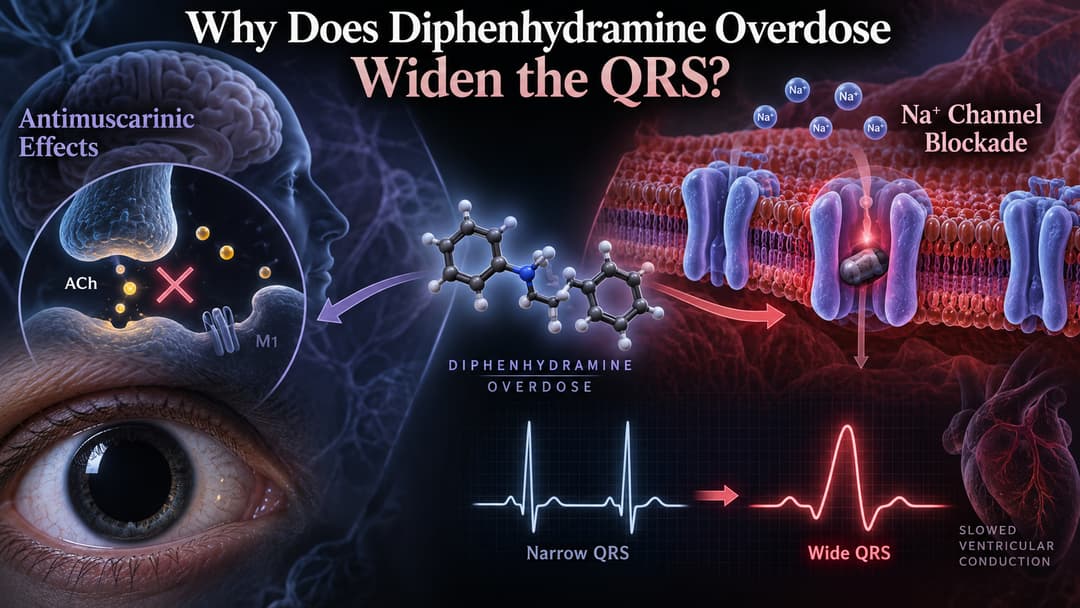
Diphenhydramine overdose can look like a classic anticholinergic poisoning—but a wide QRS signals a second toxic mechanism: cardiac sodium-channel blockade.
Diphenhydramine does more than block histamine and muscarinic receptors. At sufficiently high concentrations, it can also inhibit fast sodium channels, slowing depolarization and electrical conduction through the myocardium. [1] [2]
That additional mechanism explains why a patient with delirium, mydriasis, dry skin, and tachycardia can simultaneously develop QRS widening or a wide-complex dysrhythmia.
The practical pearl is simple:
A wide QRS in suspected diphenhydramine poisoning is not just another anticholinergic finding—it suggests additional sodium-channel cardiotoxicity.
The familiar anticholinergic features of diphenhydramine overdose mainly reflect muscarinic receptor antagonism.
That mechanism can produce:
delirium;
hallucinations;
mydriasis;
dry mucosa;
urinary retention;
tachycardia;
hyperthermia.
But muscarinic blockade alone does not adequately explain a markedly widened QRS.
Diphenhydramine also has local-anesthetic-like sodium-channel effects. Experimental electrophysiology demonstrates that it inhibits sodium current and binds much more strongly to sodium channels in their inactivated state than in their resting state. [1]
At toxic concentrations, that channel blockade can become clinically important in cardiac tissue.
Rapid ventricular depolarization depends on the movement of sodium through fast voltage-gated sodium channels.
When enough of those channels are blocked, depolarization slows.
On the ECG, slower intraventricular conduction appears as QRS prolongation and may progress to wide-complex dysrhythmia in severe poisoning.
Published diphenhydramine overdose cases have also described a prominent terminal R wave in lead aVR alongside QRS widening, a pattern familiar from other sodium-channel-blocking poisonings. [3]
The ECG is therefore revealing a toxic mechanism that cannot be inferred from the anticholinergic physical examination alone.
Because the patient who looks “anticholinergic” may actually have more than one clinically important pharmacologic effect occurring at the same time.
A contemporary ToxIC registry analysis of acute pharmaceutical poisonings identified diphenhydramine as an independent predictor of QRS prolongation. In 2022, diphenhydramine accounted for a larger proportion of QRS-prolongation cases in that dataset than tricyclic antidepressants. [2]
That does not mean diphenhydramine is always more cardiotoxic than tricyclic antidepressants, nor does the registry establish population incidence.
It does show that modern drug-induced QRS widening is not limited to the classic TCA overdose.
A separate ToxIC analysis focused on diphenhydramine poisoning found that QRS prolongation—defined as greater than 120 ms for that study—was among the clinical findings most strongly associated with severe outcomes. [4]
That study threshold should not be treated as a universal treatment cutoff. The broader lesson is that conduction delay marks a more concerning toxicity phenotype.
Diphenhydramine can affect more than sodium channels.
At high concentrations, it can also inhibit cardiac potassium currents involved in repolarization, so QT prolongation may occur in overdose as well.
QRS and QT abnormalities therefore should not be treated as interchangeable:
QRS widening primarily raises concern for impaired ventricular conduction and sodium-channel blockade.
QT prolongation reflects abnormal repolarization and may involve potassium-channel effects.
The distinction matters because the ECG is helping identify the underlying toxic mechanism—not simply documenting that the heart rate is abnormal.
A patient with diphenhydramine poisoning can have obvious antimuscarinic delirium and significant cardiotoxicity at the same time.
Do not let dramatic hallucinations, agitation, or mydriasis distract from the ECG.
Likewise, a wide QRS should not automatically be attributed to diphenhydramine when the exposure is uncertain. Tricyclic antidepressants, bupropion, certain antidysrhythmics, propranolol, lamotrigine, and other xenobiotics can also produce conduction abnormalities. [2]
In an unknown or mixed overdose, the ECG should therefore be interpreted together with the exposure history, examination, hemodynamics, and overall toxicologic picture.
Diphenhydramine can produce two toxic syndromes at once: antimuscarinic delirium in the brain and sodium-channel blockade in the heart.
When the QRS widens, think beyond the anticholinergic toxidrome.
The pupils suggest the syndrome; the ECG may reveal the dangerous second mechanism.
Anticholinergic Toxidrome: Symptoms, ECG Clues, Physostigmine, Rivastigmine, and Emergency Treatment
Kuo CC, Huang RC, Lou BS. Inhibition of Na+ current by diphenhydramine and other diphenyl compounds: molecular determinants of selective binding to the inactivated channels. Molecular Pharmacology. 2000;57(1):135-143.
Tang KB, Simpson MD, Burns MM; Toxicology Investigators Consortium (ToxIC). Evolving trends of pharmaceutical poisonings associated with QRS complex prolongation. Clinical Toxicology. 2024;62(9):574-582. doi:10.1080/15563650.2024.2390138
Cole JB, Stellpflug SJ, Gross EA, Smith SW. Wide complex tachycardia in a pediatric diphenhydramine overdose treated with sodium bicarbonate. Pediatric Emergency Care. 2011;27(12):1175-1177. doi:10.1097/PEC.0b013e31823b0e47
Hughes AR, Lin A, Hendrickson RG; Toxicology Investigator’s Consortium (ToxIC). Clinical and patient characteristics associated with severe outcome in diphenhydramine toxicity. Clinical Toxicology. 2021;59(10):918-925. doi:10.1080/15563650.2021.1891244
As the Growth & Content Lead at MedicalToxic.com, I work on content strategy, development, and digital growth. My focus is on making MedicalToxic’s content clear, practical, and accessible, while helping expand the platform’s reach and strengthen its position as a trusted resource in clinical toxicology.
Keep reading
Clinical Toxicology
21 Sept 2026 · Updated 02 Oct 2026
Amirhosein Shabrang
Clinical Toxicology
16 Sept 2026 · Updated 26 Sept 2026
Amirhosein Shabrang