FDA Confirms Yimmugo C795314 Withdrawal After Safety Alert
post on 16 Aug 2026 · Updated 16 Oct 2026
post on 16 Aug 2026 · Updated 16 Oct 2026
 Medical Toxicologymedicaltoxic.com
https://medicaltoxic.com/news/immune-globulin-lot-withdrawals-hypersensitivity
FDA Confirms Yimmugo C795314 Withdrawal After Safety Alert
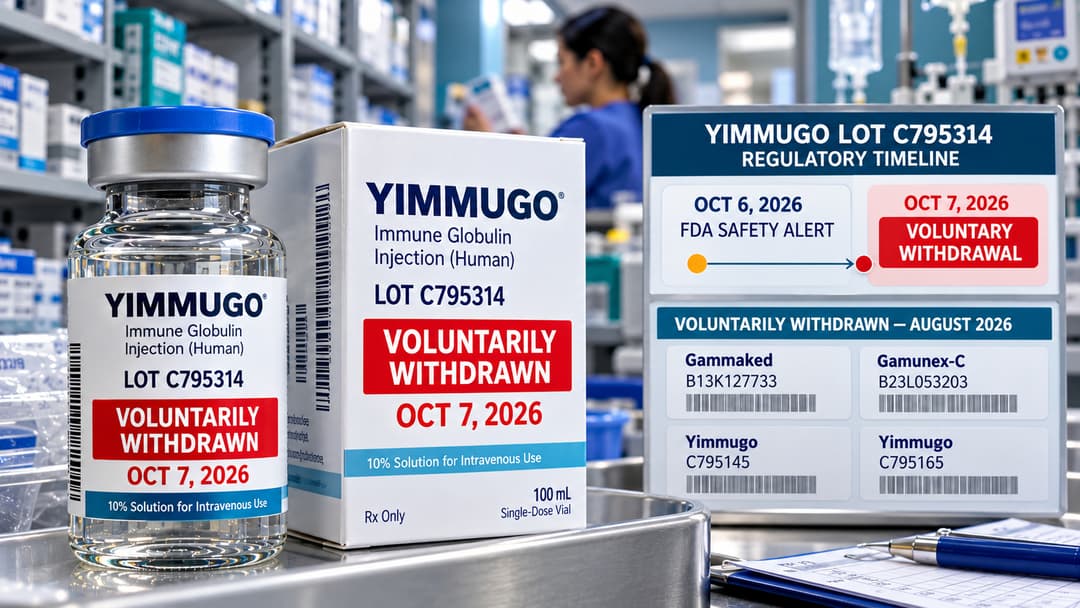
Biotest voluntarily withdrew Yimmugo lot C795314 on October 7, one day after FDA flagged increased hypersensitivity reporting and told facilities to stop use.
Yimmugo lot C795314 has moved from an FDA safety investigation to a confirmed voluntary manufacturer withdrawal.
FDA's current 2026 immune-globulin withdrawal register lists Biotest AG's voluntary withdrawal of C795314 on October 7, 2026. The lot expires April 30, 2027. FDA instructs facilities with affected stock to cease use immediately and return the product to the point of purchase for replacement. [1] U.S. Food and Drug Administration
The withdrawal followed an FDA safety communication issued one day earlier. On October 6, FDA reported increased allergic/hypersensitivity-type reaction reporting following infusion from C795314. Reports included serious adverse events, some considered severe, requiring epinephrine, steroids and/or emergency-department or hospital care. FDA initially told facilities to identify the lot and stop using it while the agency investigated. [2] [3] U.S. Food and Drug Administration
The sequence is important: October 6 was the safety-alert and cease-use phase; October 7 was the voluntary withdrawal.
FDA's October 6 communication identified C795314 as a lot-specific safety concern rather than a class-wide immune-globulin issue. The agency reported increased hypersensitivity reactions associated with this specific lot and noted that hypersensitivity and anaphylactic/anaphylactoid reactions are already recognized risks of immune-globulin products. [2] [3] www.aabb.org
On October 7, the regulatory status changed. Biotest AG voluntarily withdrew C795314. FDA's current register now places the lot among 2026 immune-globulin lots voluntarily withdrawn by manufacturers because of a higher rate of allergic/hypersensitivity-type reactions, some considered medically significant. [1] U.S. Food and Drug Administration
That current status supersedes earlier wording describing C795314 only as an active FDA investigation.
FDA's broader 2026 register includes additional immune-globulin withdrawals, including three Alyglo lots withdrawn in July. The table below covers the five lots central to this MedicalToxic News story, rather than every immune-globulin withdrawal recorded during 2026. U.S. Food and Drug Administration
Product and lot | Withdrawal date | Expiration date | Manufacturer | Current status |
|---|---|---|---|---|
Yimmugo C795314 | October 7, 2026 | April 30, 2027 | Biotest AG | Voluntarily withdrawn after October 6 FDA safety alert |
Gammaked B13K127733 | August 11, 2026 | October 19, 2028 | Grifols for Kedrion | Voluntarily withdrawn |
Gamunex-C B23L053203 | August 11, 2026 | April 30, 2029 | Grifols | Voluntarily withdrawn |
Yimmugo C795145 | August 13, 2026 | October 31, 2027 | Biotest AG | Voluntarily withdrawn |
Yimmugo C795165 | August 13, 2026 | September 30, 2027 | Biotest AG | Voluntarily withdrawn |
All five lot identifiers, withdrawal dates, expiration dates and manufacturers above match FDA's current Calendar Year 2026 register. [1] U.S. Food and Drug Administration
The October 6 communication described increased reporting of allergic/hypersensitivity reactions involving C795314.
That should not be converted into a percentage or incidence estimate.
The publicly available information does not provide the number of reports linked to the lot, the number of patients exposed to C795314 or a denominator from which a reaction rate can be calculated. [3] www.aabb.org
The subsequent voluntary withdrawal is an important regulatory action, but it does not supply those missing data.
MedicalToxic's What Is FAERS and Why It Matters in Medical Toxicology explains why spontaneous adverse-event reporting can identify meaningful pharmacovigilance signals without independently establishing incidence or proving causality. The existing article remains the appropriate general FAERS explainer. Medical Toxicology
C795314 is now withdrawn, but the action should not be generalized to all Yimmugo or all immune-globulin products.
FDA's current register identifies specific lots voluntarily withdrawn because of higher rates of allergic/hypersensitivity-type reactions. FDA also reiterates that hypersensitivity and anaphylactic/anaphylactoid reactions are known risks of immune-globulin therapy. [1] U.S. Food and Drug Administration
The practical identifier is therefore the lot number, not simply the Yimmugo brand name or the immune-globulin therapeutic class.
This is also a voluntary manufacturer withdrawal, not evidence of a new class-wide immune-globulin recall.
The October 6 alert provides important clinical context for why C795314 received urgent regulatory attention.
Reports included serious adverse events, some considered severe, requiring treatment with epinephrine, steroids and/or emergency-department or hospital care. [3] www.aabb.org
The available public information does not provide individual case narratives, the number of patients receiving each intervention, a complete clinical-outcome breakdown or a confirmed mechanism responsible for the reporting pattern.
Those details should not be inferred.
The narrower and supported conclusion is that FDA identified a concerning lot-specific reporting pattern on October 6 and Biotest AG voluntarily withdrew C795314 on October 7.
FDA's current withdrawal register gives the same practical instructions for affected lots:
Facilities should examine stock to determine whether affected vials are present, cease use immediately, and return affected product to the point of purchase for replacement. [1] U.S. Food and Drug Administration
That instruction now applies to C795314 as a voluntarily withdrawn lot.
It supersedes the earlier October 6 phase, when FDA had instructed facilities to stop using the lot while the agency investigated.
The withdrawal does not support discontinuing all Yimmugo or all immune-globulin therapy based solely on the brand or therapeutic class.
Four lots central to this story had already been voluntarily withdrawn in August:
Gammaked B13K127733, Gamunex-C B23L053203, Yimmugo C795145, and Yimmugo C795165. [1] U.S. Food and Drug Administration
C795314 followed a somewhat different public sequence.
For that lot, FDA first issued a specific safety communication on October 6 after increased hypersensitivity reporting and told facilities to stop use. The manufacturer then voluntarily withdrew the lot on October 7.
This distinction remains useful historically even though all five lots tracked in this article are now in voluntary-withdrawal status.
The earlier MedicalToxic Weekly Safety Pulse: FAERS & Recalls provides broader context on lot-specific immune-globulin pharmacovigilance and earlier FDA safety signals. Medical Toxicology
The material development is the October 7 voluntary withdrawal of Yimmugo C795314.
FDA first identified increased hypersensitivity reporting on October 6 and recommended immediate cessation of use while investigating. One day later, Biotest AG voluntarily withdrew the lot. [1] [2] [3] U.S. Food and Drug Administration
The regulatory sequence is now:
increased reporting → FDA cease-use alert → voluntary manufacturer withdrawal.
This progression makes C795314 the fifth lot tracked in this MedicalToxic News owner to reach voluntary-withdrawal status.
What has not changed is equally important: the available information does not establish an incidence rate, does not identify a class-wide Yimmugo problem and does not show that all immune-globulin products have a newly increased hypersensitivity risk.
FDA has confirmed the voluntary withdrawal of C795314, but important quantitative uncertainties remain.
The public sources do not provide the number of hypersensitivity reports associated with the lot, the total number of exposed patients, a denominator-controlled incidence rate or a confirmed manufacturing explanation. U.S. Food and Drug Administration
The C795314 reports therefore should not be combined numerically with events associated with the August lots.
Nor should the withdrawal be interpreted as evidence of a class-wide increase in immune-globulin hypersensitivity.
Yimmugo lot C795314 has progressed from an FDA safety investigation to a confirmed voluntary manufacturer withdrawal.
FDA identified increased hypersensitivity reporting on October 6 and advised facilities to stop using the lot. Biotest AG voluntarily withdrew C795314 on October 7, and FDA's current 2026 register instructs facilities to identify affected stock, cease use and return the product to the point of purchase for replacement. [1] [2] [3] U.S. Food and Drug Administration
The action remains lot-specific. It does not establish a class-wide increase in immune-globulin hypersensitivity and does not provide an incidence estimate from FAERS data.
For clinicians, pharmacists and infusion facilities, the practical message is precise:
Verify the lot number and remove affected product from use.
1. U.S. Food and Drug Administration. (2026). Calendar Year 2026 | Voluntary Lot Withdrawals of Immune Globulin Intravenous (IGIV) and Immune Globulin Subcutaneous (IGSC) for Increased Reports of Allergic/Hypersensitivity Reactions.
2. U.S. Food and Drug Administration. (2026). 2026 Safety and Availability Communications. October 6 entry: Immune Globulin Intravenous (IGIV) Lot with Increased Reports of Allergic/Hypersensitivity Reactions.
3. Association for the Advancement of Blood & Biotherapies. (2026, October 7). FDA Investigating Hypersensitivity Reports Tied to IGIV Lot.
Keep reading
Public Health Warnings and Recalls
17 Oct 2026
Public Health Warnings and Recalls
17 Oct 2026
Public Health Warnings and Recalls
09 Oct 2026
Public Health Warnings and Recalls
05 Oct 2026 · Updated 16 Oct 2026