Babies' Magic Tea Recalled After FDA Finds Three Alcohols
post on 17 Oct 2026
post on 17 Oct 2026
 Medical Toxicologymedicaltoxic.com
https://medicaltoxic.com/news/babies-magic-tea-recall-hidden-alcohols
Babies' Magic Tea Recalled After FDA Finds Three Alcohols
FDA testing found undeclared ethanol, methanol and isopropanol in one lot of a baby sleep and gripe water product, prompting a voluntary recall.
A product marketed as baby sleep and gripe water is being recalled after U.S. Food and Drug Administration testing found three alcohols that were not declared on its label.
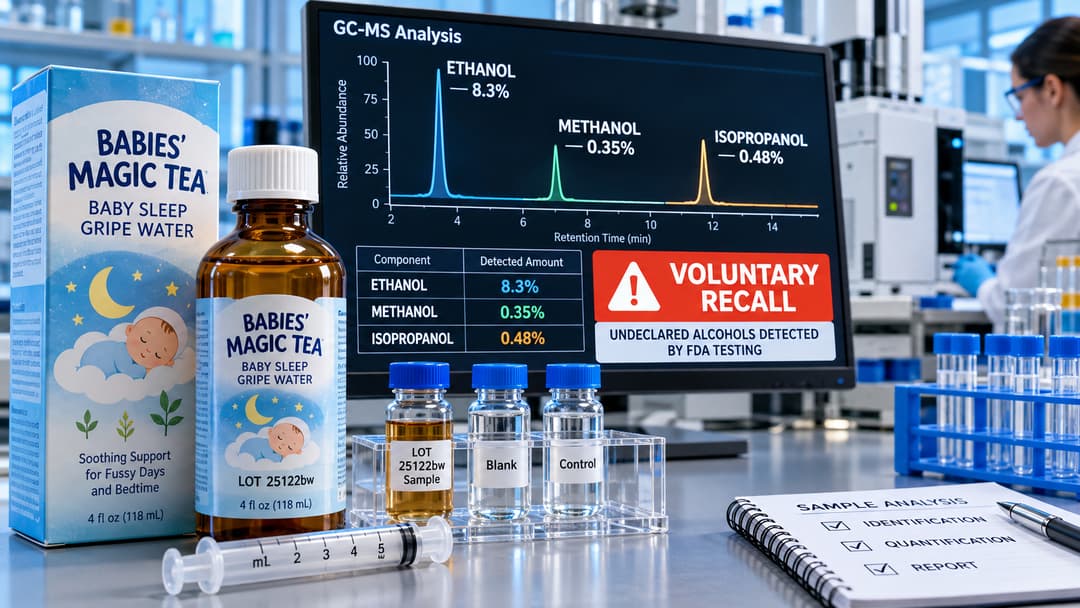
Pacific Health Sciences is voluntarily recalling one lot of Babies' Magic Tea brand Baby Sleep Gripe Water after FDA testing detected approximately 8.3% ethanol, 0.35% methanol and 0.48% isopropanol.
The affected product is lot 25122bw, with a best-before date of December 2028. [1]
The recall is especially notable because the product is marketed for babies, the undeclared substances were confirmed analytically, and the FDA-posted hazard statement says exposure even at amounts recommended on the packaging can produce clinically relevant symptoms.
No adverse events associated with the recalled lot had been reported to Pacific Health Sciences at the time of the announcement. [1]
The recall is lot-specific.
The affected product is:
Detail | Recalled product |
|---|---|
Brand | Babies' Magic Tea |
Product | Baby Sleep Gripe Water |
Lot | 25122bw |
Best Before | 12/2028 |
Package | 4 fl oz / approximately 118 mL |
Packaging | Amber bottle inside a blue cardboard box |
Included device | Oral syringe |
FDA states that the lot number can be found on the bottom of the box and on a side panel of the bottle. [1]
The affected product was distributed to Secrets of Tea for subsequent sale through online retailers, including the company's website and Amazon.
The recall does not state that every Babies' Magic Tea product or every gripe water product is affected.
FDA testing of lot 25122bw detected:
Ethanol: approximately 8.3%
Methanol: approximately 0.35%
Isopropanol: approximately 0.48%
None of the three substances was declared on the product label. [1]
These numbers are laboratory concentrations in the recalled product.
They should not be converted automatically into an infant toxic dose because the public recall does not provide enough information about individual body weight, actual volume consumed, repeated dosing, timing or systemic exposure to make that calculation reliably.
The current FDA-posted recall includes an unusually specific hazard statement.
It says organic alcohols such as ethanol, methanol and isopropanol can impair central nervous system function and that exposure to the amounts recommended on the product's packaging can induce:
drowsiness;
incoordination;
behavioral changes;
nausea;
vomiting; and
abdominal pain.
The recall further states that exposure to higher amounts may increase the risk of respiratory depression and other serious adverse health consequences. [1]
That is stronger than a generic undeclared-ingredient notice: FDA testing has established the presence and approximate concentrations of all three alcohols, and the posted recall directly identifies a potential hazard from product consumption.
Methanol deserves separate attention because clinically significant methanol poisoning differs from ordinary alcohol intoxication.
After absorption, methanol is metabolized to formate. In sufficiently significant poisoning, formate accumulation can produce high-anion-gap metabolic acidosis and ocular toxicity, with visual impairment among the characteristic severe manifestations. [2]
MedicalToxic discusses those mechanisms and clinical consequences in Methanol Poisoning: Clinical Recognition, Triage, and Treatment.
But the current recall should not be reported as evidence that Babies' Magic Tea has caused classic severe methanol poisoning.
The measured 0.35% methanol concentration establishes that methanol was present in the recalled product. It does not, by itself, establish that a labeled dose produces a toxic methanol burden, metabolic acidosis, optic neuropathy or another severe methanol syndrome in an infant.
FDA has not reported a methanol-poisoning outbreak associated with this product, and the company reported no adverse events linked to the recalled lot at the time of the announcement. [1]
The other two detected alcohols also matter.
The FDA-posted hazard statement groups ethanol, methanol and isopropanol as organic alcohols capable of impairing normal central nervous system functioning and specifically identifies drowsiness, coordination changes and behavioral effects among the possible findings at product-recommended exposures. [1]
For an infant product, undeclared CNS-active ingredients create a fundamental exposure problem: parents and clinicians may otherwise have no reason to suspect alcohol ingestion when evaluating unusual sleepiness, vomiting, behavioral change or impaired coordination.
This does not establish that every exposed infant will develop symptoms.
It does mean the actual chemical exposure does not match the label.
Many supplement recalls involve microbiological contamination, undeclared pharmaceutical ingredients or manufacturing defects.
This case has an additional pediatric toxicology concern.
The product is marketed specifically as Baby Sleep Gripe Water, comes with an oral syringe, and FDA testing identified three undeclared alcohols in the liquid.
The relevant question is therefore not simply whether the ingredient list was inaccurate.
It is whether caregivers may have intentionally administered a product to an infant without knowing that it contained measurable ethanol, methanol and isopropanol.
For broader prevention principles involving unexpected childhood exposures, MedicalToxic's How to Prevent Poisoning at Home: A Parent's Essential Safety Guide reviews practical ways families can reduce poisoning risks in the home.
FDA's instructions are straightforward.
Parents and caregivers should stop using any Babies' Magic Tea product from lot 25122bw.
Affected bottles should either be:
discarded; or
returned to the place of purchase for a refund.
Anyone who experiences symptoms after using the recalled product should seek medical attention and contact Pacific Health Sciences. Suspected adverse reactions may also be reported through FDA MedWatch. [1]
Because this is a lot-specific recall, checking the lot number is more useful than relying only on the product or brand name.
Pacific Health Sciences stated that it had received no reports of adverse events associated with lot 25122bw at the time of the recall. [1]
That wording is important.
It does not prove that no child was ever symptomatic after using the product, nor does it establish how many infants consumed the recalled lot.
The recall notice does not provide:
the total number of bottles distributed;
the number of exposed infants;
the amount consumed by individual users;
blood alcohol or methanol concentrations from exposed children; or
a denominator-controlled adverse-event rate.
Risk therefore cannot be quantified from the available recall data.
The central development is FDA-confirmed chemical exposure in an infant-marketed consumer product.
This is not simply an allegation based on a label review or an adverse-event report.
FDA testing identified three specific undeclared substances and provided approximate concentrations:
8.3% ethanol, 0.35% methanol and 0.48% isopropanol. [1]
Pacific Health Sciences subsequently voluntarily recalled lot 25122bw.
The FDA pediatric-safety database also lists the October 7 recall as a new safety communication relevant to children. U.S. Food and Drug Administration
The recall provides unusually useful analytical data, but it still leaves important questions unanswered.
FDA's public notice does not state how many bottles were sold, how much product individual infants consumed or whether repeated exposure occurred.
The reported concentrations also cannot be translated directly into a clinical prediction for an individual infant without reliable information on dose, weight, timing and other exposures.
Most importantly, detection of 0.35% methanol should not be transformed into a claim that the product caused severe methanol poisoning.
Severe methanol toxicity is a dose- and metabolism-dependent syndrome, and the current recall does not document metabolic acidosis, visual injury or a poisoning cluster among users. [2]
FDA testing found three undeclared alcohols in one lot of Babies' Magic Tea Baby Sleep Gripe Water: 8.3% ethanol, 0.35% methanol and 0.48% isopropanol.
Pacific Health Sciences has voluntarily recalled lot 25122bw, best before December 2028, and parents should stop using affected bottles and discard or return them. [1]
The product's intended pediatric use makes the finding especially important, but the evidence should remain precisely framed.
There is no reported outbreak of methanol poisoning, no company-reported adverse-event cluster and no basis for calculating an infant toxic dose from the recall alone.
The confirmed finding is narrower—and still clinically significant:
an orally administered baby product contained three pharmacologically active alcohols that were not disclosed on its label.
1. U.S. Food and Drug Administration. (2026, October 7).
Pacific Health Sciences Voluntarily Recalls One Lot of Babies' Magic Tea Brand Baby Sleep Gripe Water Dietary Supplement.
2. Barceloux, D. G., Bond, G. R., Krenzelok, E. P., Cooper, H., Vale, J. A., & American Academy of Clinical Toxicology Ad Hoc Committee on the Treatment Guidelines for Methanol Poisoning. (2002).
American Academy of Clinical Toxicology Practice Guidelines on the Treatment of Methanol Poisoning. Journal of Toxicology: Clinical Toxicology, 40(4), 415–446.
DOI: 10.1081/CLT-120006745
Keep reading
Public Health Warnings and Recalls
17 Oct 2026
Public Health Warnings and Recalls
09 Oct 2026
Public Health Warnings and Recalls
05 Oct 2026 · Updated 16 Oct 2026
Public Health Warnings and Recalls
03 Oct 2026