Colchicine Poisoning: Recognition, Decontamination, Multiorgan Toxicity, and Critical Care Management
Published on 09 Sept 2026 · Updated 05 Oct 2026
Published on 09 Sept 2026 · Updated 05 Oct 2026
 Medical Toxicologymedicaltoxic.com
https://medicaltoxic.com/guidelines/colchicine-poisoning
Colchicine poisoning is a potentially fatal toxicologic emergency with a narrow therapeutic index and no routinely available specific antidote. Toxicity can follow intentional pharmaceutical overdose, medication errors, accumulation during treatment, clinically important drug interactions, or ingestion of colchicine-containing plants such as Colchicum autumnale and Gloriosa superba. [1] [2] [3]
Early toxicity often resembles acute gastroenteritis, with abdominal pain, vomiting, and profuse diarrhea. This apparently gastrointestinal presentation can evolve into shock, dysrhythmias, respiratory failure, coagulopathy, hepatic and renal injury, bone-marrow suppression, neurologic toxicity, and multiorgan failure. The phases overlap, and severe poisoning can progress rapidly. [1] [2]
Management depends on early recognition, selected gastrointestinal decontamination, aggressive supportive critical care, serial laboratory surveillance, identification of CYP3A4/P-glycoprotein interactions, and early poison-center or medical-toxicology involvement. Hemodialysis and hemodiafiltration may be required for conventional organ-support indications, but they should not be presented as established methods for removing colchicine. [1]
Clinical warning
Colchicine poisoning can deteriorate after an initial gastrointestinal phase. A patient who initially appears to have gastroenteritis may progress to shock, dysrhythmias, respiratory failure, coagulopathy, cytopenias, renal/hepatic injury, and multiorgan failure. Do not use one reported dose or an initially normal laboratory panel to exclude severe toxicity. [1] [2]
For pharmaceutical overdose, current activated-charcoal recommendations are dose- and time-specific, but their evidence quality is low; plant exposures require individualized assessment. [4]
Hemodialysis/HDF should not be represented as effective colchicine clearance. Use kidney replacement therapy for conventional organ-support indications. [1] [8]
Colchicine has a narrow therapeutic index, and severe toxicity may result from acute overdose, repeated therapeutic error, impaired clearance, or CYP3A4/P-glycoprotein interactions. [1]
Early nausea, vomiting, abdominal pain, and diarrhea may precede 24–72-hour evolution toward life-threatening multiorgan toxicity. [1]
Do not rely on a single reported dose to determine prognosis. Historical mg/kg bands are approximate and should not become treatment or disposition thresholds. [1] [2]
Serial CBC, electrolytes, renal/hepatic studies, coagulation testing, lactate, ECG monitoring, and clinical reassessment are central because abnormalities may evolve after presentation.
For pharmaceutical colchicine ingestion around ≥0.4 mg/kg, the 2026 Clinical Toxicology Recommendations Collaborative recommends single-dose activated charcoal through 3 hours and suggests it through 4 hours; for ≥0.7 mg/kg, it suggests multiple-dose activated charcoal. These are charcoal decision thresholds, not validated toxicity thresholds, and the evidence is Grade D. [4]
The same workgroup reached no consensus on single-dose, additional-dose, or multiple-dose charcoal after colchicine-containing plant ingestion; individualized risk assessment is required. [4]
Review all medications for CYP3A4 and P-glycoprotein inhibition. Clinically important interactions can produce life-threatening toxicity even during therapeutic colchicine use. [1]
There is no commercially available established antidote. Colchicine-specific Fab remains investigational. [10]
Conventional hemodialysis is not an effective colchicine-removal strategy. Kidney replacement therapy should be used for conventional supportive indications rather than presumed toxin clearance. [1]
A recent case using MDAC, HD, and HDF cannot establish efficacy for any of those individual interventions because they were administered concurrently. [8]
Clinically significant colchicine poisoning occurs in several distinct settings.
Intentional self-poisoning and accidental ingestion may produce a large acute drug burden. Tablet strength, number potentially ingested, patient weight, timing, and co-ingestants should be established whenever possible.
Serious toxicity does not require one massive ingestion. Repeated excess dosing, misunderstanding of a dosing schedule, renal or hepatic dysfunction, and drug interactions may substantially increase colchicine exposure. Current US labeling documents fatalities after relatively small cumulative amounts and emphasizes that the exact dose producing major toxicity is unknown. [1]
Colchicine is a substrate for both CYP3A4 and P-glycoprotein. Inhibiting either pathway can increase systemic exposure.
Strong CYP3A4 inhibitors include agents such as clarithromycin, itraconazole, ketoconazole, and ritonavir-containing regimens. Important P-glycoprotein inhibitors include cyclosporine. Moderate CYP3A4 inhibitors include diltiazem, verapamil, erythromycin, and fluconazole. This is not an exhaustive list. [1]
Current US labeling contraindicates colchicine with a P-glycoprotein or strong CYP3A4 inhibitor in patients with renal or hepatic impairment because life-threatening and fatal toxicity has occurred at therapeutic colchicine doses. [1]
Colchicum autumnale—commonly called autumn crocus or meadow saffron—and Gloriosa superba—glory lily or flame lily—contain colchicine. Plant poisoning may be accidental, including misidentification of edible plants, or intentional. [3]
The amount of colchicine absorbed from a plant cannot be reliably inferred from a simple count or weight of plant material because concentration varies by species and plant part. Accordingly, pharmaceutical mg/kg thresholds should not be mechanically assigned to plant ingestion. The 2026 charcoal consensus requires individualized risk assessment for colchicine-containing plant exposures. [4]
Colchicine binds tubulin and disrupts microtubule polymerization. Toxicity therefore affects mitosis, intracellular transport, secretion, cell structure, and other microtubule-dependent processes. Rapidly dividing tissues such as gastrointestinal epithelium and bone marrow are particularly vulnerable, but severe poisoning can injure virtually every organ system. [2]
Colchicine is rapidly absorbed and distributes extensively into tissues. Current prescribing information reports an apparent volume of distribution of approximately 5–8 L/kg and low serum protein binding of approximately 39 ± 5%. CYP3A4 participates in metabolism, colchicine is a P-glycoprotein substrate, and enterohepatic recirculation and biliary excretion contribute to its disposition. [1]
Extensive tissue distribution helps explain why a falling serum concentration does not necessarily mean that clinically important tissue toxicity has resolved and why conventional dialysis is ineffective as a toxin-removal strategy. [1]
The exact dose that produces significant colchicine toxicity is unknown. Current prescribing information notes fatalities after as little as 7 mg taken over four days, while survival has been reported after ingestion exceeding 60 mg. [1]
Historical data from 150 overdose patients reported:
Reported acute dose | Historical pattern | How to use this information |
|---|---|---|
<0.5 mg/kg | Survivors generally had milder toxicity | Context only; does not define a safe dose |
0.5–0.8 mg/kg | More severe toxicity, including myelosuppression | High concern, but not a validated prognostic cutoff |
>0.8 mg/kg | 100% mortality in that historical cohort | Must not be interpreted as inevitable mortality today |
These figures remain in current prescribing information but derive from historical observational experience. Clear boundaries between nontoxic, toxic, and lethal doses do not exist. [1] [2]
Do not use 0.5 or 0.8 mg/kg as automatic discharge, ICU, futility, or extracorporeal-treatment thresholds.
The 2026 charcoal consensus uses 0.4 mg/kg and 0.7 mg/kg specifically to frame activated-charcoal decisions in pharmaceutical ingestion. These values do not redefine the toxic or lethal dose of colchicine. [4]
Risk assessment should include:
intentional ingestion;
uncertain or repeated dosing;
plant-derived exposure with unknown alkaloid content;
delayed presentation;
CYP3A4 or P-glycoprotein inhibitors;
renal or hepatic dysfunction;
older age or limited physiologic reserve;
pediatric exposure;
co-ingestants;
severe or persistent gastrointestinal symptoms;
hypotension or altered mental status;
evolving acidosis, organ injury, or hematologic abnormalities.
Colchicine poisoning is traditionally described in three overlapping, not rigid, phases. Massive poisoning may progress more rapidly than the classic timeline. [2]
Phase | Approximate timing | Important clinical features |
|---|---|---|
Early gastrointestinal toxicity | Usually within the first 24 h | Abdominal pain, nausea, vomiting, profuse diarrhea, fluid loss, volume depletion, possible leukocytosis |
Multiorgan toxicity | Often begins 24–72 h; may evolve over several days | Shock, dysrhythmias, myocardial dysfunction, respiratory failure, metabolic/lactic acidosis, AKI, hepatic injury, DIC/coagulopathy, leukopenia, thrombocytopenia, pancytopenia, neurologic deterioration |
Recovery | Commonly begins after approximately 1 week in survivors | Organ recovery, rebound leukocytosis, marrow recovery, alopecia; prolonged weakness or rehabilitation may follow severe illness |
Current labeling describes the first stage within 24 hours and life-threatening multiorgan complications particularly during 24–72 hours; broader clinical reviews describe the multiorgan phase extending through the first week. [1] [2]
Severe diarrhea and vomiting can produce substantial intravascular volume depletion and electrolyte abnormalities. However, GI symptoms should not be dismissed as uncomplicated gastroenteritis when colchicine exposure is possible.
An important diagnostic trap is that early leukocytosis can be followed by leukopenia and pancytopenia as bone-marrow toxicity evolves. Serial CBCs are therefore more informative than one normal or elevated initial white-cell count. [1]
Severe poisoning can produce hypotension, shock, dysrhythmias, impaired cardiac conduction, and cardiovascular collapse. These findings may coexist with major intravascular fluid losses.
Respiratory failure may reflect shock, pulmonary injury, aspiration, neuromuscular dysfunction, or multiorgan failure and may require mechanical ventilation.
Altered mental status, weakness, neuropathy, myopathy, and rhabdomyolysis can occur. Chronic therapeutic exposure and drug interactions can also produce neuromuscular toxicity without a classic acute overdose. Current labeling identifies renal dysfunction and older age as important risk factors for colchicine-associated neuromuscular toxicity. [1]
Determine:
formulation and tablet strength;
amount prescribed versus amount actually taken;
maximum possible dose;
patient weight;
single versus repeated ingestion;
time of the first and last doses;
indication for colchicine;
renal and hepatic history;
vomiting and diarrhea burden;
urine output;
cardiovascular or neurologic symptoms;
all prescription, nonprescription, and supplement exposures;
possible plant ingestion and available plant photographs/specimens;
intentional self-harm circumstances.
Immediately review for:
strong CYP3A4 inhibition;
moderate CYP3A4 inhibition;
P-glycoprotein inhibition;
concurrent drugs associated with myotoxicity.
Clarithromycin and cyclosporine are particularly important because fatal colchicine interactions are documented in current prescribing information. [1]
Statins, fibrates, and cyclosporine may also increase the risk of colchicine-associated myopathy or rhabdomyolysis. [1]
When toxicity is suspected, discontinue colchicine. Review interacting medications urgently and, where clinically feasible, hold or replace nonessential drugs that may further impair colchicine disposition. A 2026 severe therapeutic-error case illustrates the importance of explicitly managing CYP3A4/P-glycoprotein interactions but remains case-level evidence. [6]
Obtain:
continuous vital-sign and cardiac monitoring;
12-lead ECG;
CBC with differential;
sodium, potassium, chloride, bicarbonate;
magnesium, calcium, and phosphate;
BUN and creatinine;
glucose;
AST, ALT, bilirubin;
lactate;
venous or arterial blood gas when clinically significant toxicity is suspected;
PT/INR, aPTT, and fibrinogen in moderate/severe poisoning;
creatine kinase when muscle injury is suspected;
urinalysis and close urine-output monitoring.
Consider serial troponin and bedside echocardiography when shock, dysrhythmia, ECG abnormalities, or myocardial dysfunction is suspected.
A normal initial CBC, creatinine, coagulation profile, or liver panel does not exclude evolving severe toxicity. Laboratory testing should be repeated according to exposure severity and clinical trajectory.
Important trends include:
leukocytosis progressing toward leukopenia/pancytopenia;
falling platelet count;
worsening metabolic/lactic acidosis;
rising creatinine;
progressive hepatic injury;
evolving coagulopathy;
increasing CK;
new ECG or rhythm abnormalities.
Quantitative serum or plasma colchicine testing is not routinely available rapidly enough to guide initial emergency management.
A 2026 bicenter retrospective study developed an exploratory mortality nomogram using admission colchicine concentration together with time since ingestion. The training cohort contained only 52 patients, with small validation cohorts, and the authors explicitly describe the tool as exploratory. It should not be used as a validated treatment, ICU, extracorporeal-therapy, or discharge rule. [7]
If a concentration is available, interpret it with the time since ingestion and clinical trajectory, preferably with medical-toxicology input. Do not delay resuscitation or decontamination while waiting for a level.
Early colchicine poisoning may initially look like infectious gastroenteritis. Exposure history, severity of GI losses, unexplained leukocytosis, acidosis, hypotension, and subsequent organ abnormalities should raise concern.
It is not. Myelosuppression can develop later.
It is not a reliable rule. The precise toxic dose is unknown, and therapeutic toxicity may result from cumulative dosing, altered clearance, or drug interactions. [1]
It cannot. Colchicine content varies, and current charcoal guidance specifically recommends individualized assessment after colchicine-containing plant ingestion. [4]
Not necessarily. Redistribution, endogenous elimination, timing of sampling, and concurrent therapies can all change serum concentrations.
It does not provide established effective toxin clearance. Current prescribing information explicitly states that colchicine is not removed by hemodialysis. [1]
There is no routinely available specific antidote for colchicine poisoning. Management is based on:
Immediate stabilization
Early poison-center/medical-toxicology consultation
Selected gastrointestinal decontamination
Serial surveillance for evolving multiorgan toxicity
Aggressive organ-supportive critical care
Identification and management of drug interactions
Use of kidney replacement therapy only for appropriate supportive indications
Early critical-care escalation when organ dysfunction develops
For broader management principles in critically poisoned patients, see Comprehensive Guide to Managing Poisoning in the Intensive Care Unit: Best Practices and Protocols.
The 2026 Clinical Toxicology Recommendations Collaborative found no clinical outcome studies demonstrating activated-charcoal efficacy specifically in colchicine overdose. Its recommendations are based on experimental adsorption, the potential lethality of colchicine, lack of an available antidote, and consensus risk-benefit assessment. The colchicine-specific evidence grade is therefore low. [4]
Scenario | 2026 recommendation | Evidence |
|---|---|---|
Ingestion at the 0.4 mg/kg threshold, ≤3 h | Recommend single-dose activated charcoal | 1, D |
Ingestion at the 0.4 mg/kg threshold, ≤4 h | Suggest single-dose activated charcoal | 2, D |
Other doses/times | Individualized risk assessment | — |
Additional-dose charcoal | Individualized risk assessment | — |
Ingestion at the 0.7 mg/kg threshold | Suggest multiple-dose activated charcoal | 2, D |
Critical interpretation: 0.4 mg/kg and 0.7 mg/kg are charcoal-management thresholds from this consensus process. They are not validated definitions of “toxic,” “fatal,” or “safe” colchicine exposure.
Activated charcoal should only be given when its expected benefit exceeds aspiration and procedural risk. Airway status, ongoing vomiting, mental status, timing, clinical instability, and the feasibility of safe administration must be considered. Do not delay resuscitation to administer charcoal.
For Colchicum autumnale, Gloriosa superba, and other suspected colchicine-containing plant ingestions, the 2026 workgroup reached no consensus for single-dose activated charcoal, additional-dose charcoal, or MDAC because the ingested colchicine dose cannot be reliably estimated. Management should therefore be individualized with poison-center or medical-toxicology consultation. [4]
A 2026 Colchicum autumnale case administered activated charcoal beginning 27 hours after ingestion and subsequently used MDAC. The observed concentration changes are hypothesis-generating but cannot validate late MDAC for plant poisoning because multiple interventions were occurring simultaneously. [8]
Routine gastric lavage is not recommended in poisoned patients. The AACT/EAPCCT position-paper update found no evidence supporting routine use and emphasizes its potential complications. In the rare circumstance in which lavage is considered, it should be performed only by clinicians with appropriate expertise after a case-specific risk-benefit assessment. [5]
This contemporary toxicology recommendation should take precedence over product-label overdose language that recommends gastric lavage.
Assess airway protection and respiratory function repeatedly. Provide oxygenation and ventilation according to standard critical-care indications.
Endotracheal intubation and mechanical ventilation may become necessary with:
progressive altered mental status;
respiratory failure;
shock with loss of airway protection;
severe aspiration;
neuromuscular weakness.
Severe poisoning should be managed in a setting capable of rapid cardiopulmonary escalation.
Profuse vomiting and diarrhea can produce major intravascular losses. Restore perfusion with carefully reassessed IV fluid therapy.
Avoid assuming that all hypotension is caused solely by dehydration. Severe colchicine poisoning can produce cardiovascular dysfunction and multiorgan shock. If hypotension persists after appropriate volume resuscitation, use vasopressors according to the clinical hemodynamic phenotype and standard critical-care practice.
Bedside echocardiography can help evaluate cardiac function when shock is severe or refractory.
Use:
continuous telemetry;
serial ECGs when clinically indicated;
correction of clinically important electrolyte abnormalities;
standard resuscitation management for unstable dysrhythmias.
Cardiac deterioration in a patient with progressing systemic toxicity should prompt ICU-level management.
Repeated vomiting, diarrhea, renal injury, shock, and tissue hypoperfusion can produce significant electrolyte and acid-base disturbances.
Monitor and correct clinically important:
potassium abnormalities;
magnesium abnormalities;
calcium and phosphate abnormalities;
metabolic acidosis;
glucose abnormalities.
Treatment should target the underlying shock and organ dysfunction rather than laboratory values in isolation.
Colchicine can cause leukopenia, granulocytopenia, thrombocytopenia, pancytopenia, and severe marrow suppression. [1]
Management should include:
serial CBC with differential;
surveillance for bleeding;
surveillance for infection;
appropriate blood-product support when clinically indicated;
prompt evaluation and treatment of febrile neutropenia or sepsis according to established critical-care/hematology practice;
hematology consultation for profound or prolonged marrow suppression.
Do not interpret early leukocytosis as protection from later marrow failure.
Monitor:
creatinine and urine output;
AST, ALT, bilirubin, and coagulation parameters;
creatine kinase when weakness, muscle pain, dark urine, or interacting myotoxic medications are present.
Acute kidney injury may result from hypovolemia, shock, rhabdomyolysis, or multiorgan failure.
Hepatic dysfunction and coagulopathy may evolve during severe poisoning and should be followed serially.
Current US prescribing information states that colchicine is not removed by hemodialysis. Its extensive tissue distribution further limits the expectation that conventional extracorporeal therapy will substantially reduce total-body colchicine burden. [1]
Do not initiate HD, HDF, or CRRT solely on the assumption that it will effectively clear colchicine.
Kidney replacement therapy remains appropriate for conventional organ-support indications such as:
refractory severe electrolyte abnormalities;
severe acid-base disturbance;
clinically significant volume overload;
kidney failure with standard indications for dialysis.
For general principles of extracorporeal toxin removal, see Hemodialysis in Poisoning: A Comprehensive Guide for Healthcare Providers.
A September 2026 case measured serum and urinary colchicine concentrations while a patient simultaneously received activated charcoal/MDAC, high-volume IV fluid, HD, and HDF.
Serum colchicine changed from 12.16 to 5.46 ng/mL during the HD period, while other concentration changes also occurred outside dialysis sessions. The authors explicitly state that concurrent treatments prevent attribution of the observed changes to any single intervention. [8]
The correct interpretation is:
the case provides useful toxicokinetic observations;
it may generate hypotheses about endogenous renal elimination and interruption of recirculation by MDAC;
it does not demonstrate that hemodialysis or HDF effectively removes colchicine;
it does not establish an extracorporeal-treatment indication.
One pediatric case described survival after CVVHDF with single-pass albumin dialysis following an estimated 0.56 mg/kg ingestion. This is case-level evidence without a comparator and cannot establish that SPAD caused the favorable outcome. [9]
Current prescribing information reports serum protein binding of approximately 39 ± 5%, not universally “high protein binding,” and a large apparent volume of distribution. [1]
Accordingly, SPAD should be regarded as investigational in colchicine poisoning, and the published pediatric case should not be converted into a recommendation to initiate SPAD above 0.5 mg/kg.
In the 2026 retrospective pediatric cohort, 17 of 84 patients (20.2%) underwent rapid sequence apheresis. The intervention was used in selected severe cases within an observational study; there was no randomized comparison establishing that rapid sequence apheresis improved survival, reduced organ toxicity, or meaningfully enhanced colchicine elimination. Five patients died overall, including two with reported ingestions <0.5 mg/kg who received rapid sequence apheresis. 11
These data demonstrate clinical use of rapid sequence apheresis in severe pediatric colchicine poisoning but do not establish treatment efficacy or a dose-based indication. The study's ROC-derived dose cut points must not be used as triggers for apheresis or other extracorporeal treatment.
Rapid sequence apheresis should therefore remain investigational in colchicine poisoning. It should not replace established supportive critical care, and decisions about advanced organ support should continue to be driven by the patient's clinical trajectory and evolving organ dysfunction rather than a single reported mg/kg dose. 11
Once colchicine toxicity is suspected:
Stop further colchicine exposure.
Review all drugs for CYP3A4 and P-glycoprotein inhibition.
Identify medications that could worsen neuromuscular toxicity.
Where clinically safe, discontinue or substitute nonessential interacting drugs.
Involve pharmacy, poison-center, and medical-toxicology expertise when interactions are complex.
A 2026 case of accidental 11-mg cumulative exposure over two days illustrates how profound toxicity can coexist with drug-interaction concerns; the patient developed hemodynamic instability, altered consciousness, anuric renal failure, respiratory failure, cytopenias, GI paresis, and dysrhythmias and required prolonged ICU care. The report supports careful interaction management but does not establish a standalone treatment protocol. [6]
There is no routinely available approved specific antidote for colchicine poisoning.
A 1995 report described treatment of one severe overdose with experimental colchicine-specific Fab fragments and a rapid temporal clinical response. This remains a single human case, and colchicine-specific Fab is not commercially available for routine clinical treatment. [10]
Colchicine-specific Fab should therefore be described as an investigational antidotal strategy, not part of standard management, and no routine Fab dosing regimen should be included in the clinical algorithm.
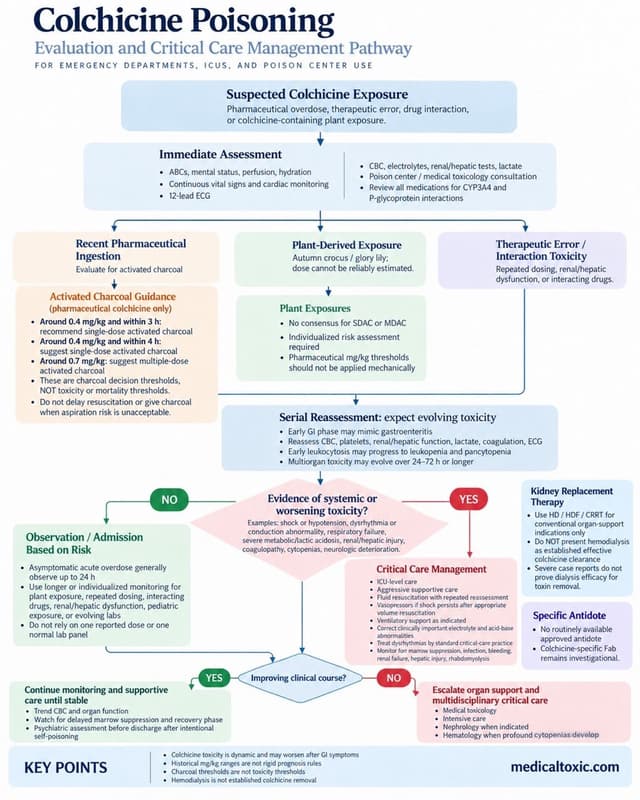
Identify source
→ pharmaceutical acute overdose
→ therapeutic error / accumulation
→ drug interaction
→ colchicine-containing plant
Immediately assess
→ vital signs and perfusion
→ GI losses
→ ECG
→ CBC
→ electrolytes/renal function
→ hepatic function
→ lactate/acid-base status when significant toxicity is suspected
→ coagulation profile in moderate/severe cases
→ Evaluate against the 2026 activated-charcoal recommendations
→ Do not confuse charcoal thresholds with toxicity thresholds
→ Assess airway and aspiration risk
→ continuous monitoring
→ serial CBC and metabolic/organ-function testing
→ aggressive supportive care
→ early poison-center/medical-toxicology involvement
→ ICU admission when organ dysfunction, shock, serious dysrhythmia, respiratory failure, major cytopenia, or severe metabolic disturbance develops
→ KRT for conventional indications when necessary
→ not as presumed effective colchicine clearance
→ multidisciplinary critical-care management
→ consideration of advanced organ support on a case-by-case basis
→ do not substitute experimental toxin-removal strategies for established supportive care
Admit patients with:
any systemic symptoms after a significant exposure;
persistent or severe vomiting/diarrhea;
hypotension or shock;
ECG or rhythm abnormality;
altered mental status;
metabolic/lactic acidosis;
abnormal or evolving CBC;
renal or hepatic injury;
coagulopathy;
clinically important drug-interaction toxicity;
uncertain significant plant exposure;
other evidence of evolving organ toxicity.
ICU-level care is appropriate for:
shock or vasopressor requirement;
significant dysrhythmia or myocardial dysfunction;
respiratory failure;
severe metabolic derangement;
substantial cytopenia with systemic illness;
coagulopathy with clinical instability;
progressive renal/hepatic injury with multiorgan involvement;
rapidly worsening clinical or laboratory trajectory.
A contemporary review recommends observation for the first 24 hours after a known or suspected acute colchicine overdose and notes that development of new symptoms becomes less likely if the patient remains completely asymptomatic during that period. This is a practical conservative approach, not a prospectively validated universal discharge rule. [3]
Longer or more individualized monitoring may be appropriate when there is:
uncertain exposure time;
uncertain dose;
repeated therapeutic error;
interacting medication use;
renal or hepatic dysfunction;
plant-derived exposure;
pediatric exposure;
evolving laboratory abnormalities;
unreliable history;
clinically important co-ingestion.
Before discharge after intentional self-poisoning, complete appropriate psychiatric and safety assessment.
Children require particular caution because a small number of tablets may represent a substantial weight-adjusted exposure.
Management principles remain:
immediate poison-center/medical-toxicology consultation after potentially significant exposure;
exact current weight for all calculations;
careful reconstruction of the maximum possible dose;
early assessment for gastrointestinal symptoms;
serial laboratory monitoring after significant exposure;
aggressive supportive care if systemic toxicity develops.
A 2026 retrospective cohort of 84 children admitted to a tertiary pediatric intensive care unit provides additional pediatric risk-assessment data. The median reported colchicine dose was 0.3 mg/kg. Cardiovascular involvement occurred in 20.6% of patients with reported doses <0.5 mg/kg, 50% at 0.5–0.8 mg/kg, and 71.4% at >0.8 mg/kg (P = 0.004). Diarrhea was associated with increased odds of cardiovascular complications on logistic regression (OR 3.24; P = 0.006). These findings support treating early gastrointestinal manifestations—particularly diarrhea—together with dose, laboratory trends, and the evolving clinical course as potential markers of increased risk rather than dismissing them as isolated gastrointestinal toxicity. 11
Importantly, clinically significant toxicity occurred below traditional historical high-risk dose bands. Five patients died in the cohort, including two with reported ingestions <0.5 mg/kg. The study's ROC analysis identified >0.39 mg/kg and >24 mg total dose as predictors of cardiovascular toxicity, but these are retrospective, cohort-specific statistical cut points and have not been prospectively validated. They must not be used as universal thresholds for treatment, ICU admission, extracorporeal therapy, prognosis, or discharge. 11
Historical adult-derived mg/kg mortality ranges therefore remain contextual rather than deterministic in children. Risk assessment should prioritize the overall trajectory, early gastrointestinal symptoms, serial laboratory abnormalities, cardiovascular findings, and evolving organ dysfunction rather than any single reported dose.
The previously published pediatric SPAD experience remains case-level evidence and does not establish a pediatric extracorporeal-treatment standard. [9]
Preventable colchicine toxicity can result from incorrect dosing, repeated courses given too closely together, drug interactions, and accidental pediatric access.
Important preventive measures include:
store colchicine securely away from children;
use only the prescribed dose and schedule;
avoid taking extra doses to compensate for missed doses;
reassess dosing when renal or hepatic function changes;
screen for CYP3A4 and P-glycoprotein interactions whenever medications are started or stopped;
educate patients to seek medical advice for severe diarrhea, vomiting, weakness, or other unexpected toxicity while taking colchicine.
Because clinically significant interactions may occur during otherwise therapeutic use, medication reconciliation is part of colchicine poisoning prevention as well as treatment. [1]
Colchicine poisoning is a dynamic multiorgan toxic syndrome, not simply severe gastroenteritis.
The exact toxic and lethal doses are uncertain; historical mg/kg ranges must not become rigid clinical thresholds.
Serious toxicity can result from acute overdose, repeated therapeutic errors, renal/hepatic impairment, or CYP3A4/P-glycoprotein interactions.
Colchicum autumnale and Gloriosa superba exposures require individualized assessment because plant colchicine content is difficult to quantify.
The 2026 charcoal guideline supports early single-dose charcoal for selected pharmaceutical exposures and suggests MDAC at a 0.7 mg/kg decision threshold, but the colchicine-specific evidence is low quality. [4]
The charcoal thresholds are not toxicity or mortality thresholds.
Serial CBC and organ-function testing are essential because early leukocytosis or normal laboratory values can precede cytopenias and multiorgan failure.
Supportive critical care remains the cornerstone of treatment.
Hemodialysis/HDF should not be presented as effective colchicine toxin removal.
KRT remains appropriate for conventional organ-support indications.
Current evidence does not establish SPAD as standard therapy or define an mg/kg threshold for its use.
Colchicine-specific Fab remains investigational and unavailable for routine care.
Severe or evolving poisoning warrants early poison-center/medical-toxicology and critical-care involvement.
Keep reading