Sodium Hypochlorite (Bleach) Exposure: Poison Center Triage and Clinical Management
Published on 19 Aug 2024 · Updated 01 Oct 2026

Published on 19 Aug 2024 · Updated 01 Oct 2026
 Medical Toxicologymedicaltoxic.com
https://medicaltoxic.com/guidelines/comprehensive-guide-to-the-initial-assessment-and-management
Most bleach exposures are unintentional tastes or swallows of dilute household product, and nearly all of them can be managed at home.
Serious injury comes from concentrated product, large or intentional ingestion, or chlorine and chloramine gas made by mixing bleach with acids or ammonia.
This guideline covers sodium hypochlorite exposure by ingestion, inhalation, eye and skin. It is written for poison center specialists (SPIs), emergency physicians and pediatricians. It does not cover hydrogen peroxide or persulfate “hair bleach”, or calcium hypochlorite pool tablets beyond a triage note.
Clinical warning
Concentration, intent and symptoms drive triage. Dose estimates for household bleach rarely change management.
An asymptomatic, unintentional ingestion of household bleach can be managed at home with poison center follow-up.
Drooling, vomiting, stridor, dysphagia, hematemesis, chest or abdominal pain, or respiratory distress means referral to an emergency department.
Intentional ingestion, or any ingestion of concentrated (commercial or pool) hypochlorite, means referral, even without symptoms.
Do not induce emesis, lavage, give activated charcoal, or try to neutralize with acid. Routine corticosteroids and prophylactic antibiotics are not recommended.
Strongly consider endoscopy after concentrated or intentional ingestion or persistent symptoms, ideally within 12 to 24 hours. It is not needed for asymptomatic unintentional household ingestions.
Mixing injuries are inhalation injuries: remove from exposure, give oxygen as needed, and watch for delayed lung injury after heavy exposure.
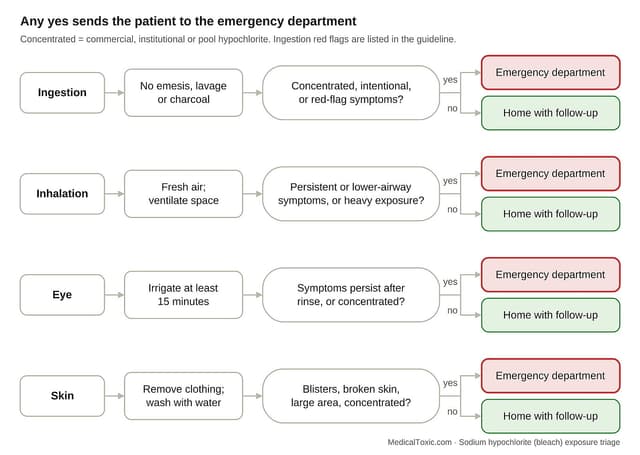
Bleach exposure triage algorithm: ingestion, inhalation, eye and skin
Each route has one first action and one referral question; any yes goes to the emergency department.
The label, not the word “bleach”, sets the risk.
Always ask for the product name and the percentage of sodium hypochlorite printed on it.
Product | Typical NaOCl | Triage category |
|---|---|---|
US household liquid bleach (regular and “concentrated”) | about 5 to 8% | Household |
Bleach-containing sprays, gels, toilet and mildew cleaners | usually under 5% — check label | Household |
Commercial, institutional and pool “liquid chlorine” | about 10 to 15% | Concentrated |
Calcium hypochlorite pool granules or tablets | solid, high available chlorine | Concentrated |
Hair bleach (peroxide developer with persulfate powder) | none: not hypochlorite | Not covered here |
Concentration percentages are approximate and vary by manufacturer; confirm on the label or safety data sheet. Household bleach is buffered with sodium hydroxide, so its pH is roughly 11 to 13 even though the hypochlorite itself is dilute. [1]
Older US formulations were about 5.25 to 6%. Current concentrated household products are higher, so confirm the figure on the label.
Hypochlorite injures tissue as an oxidant and, through its alkaline buffer, as a caustic. At household concentrations the injury is usually limited to mucosal irritation. Concentrated product can cause liquefactive necrosis of the esophagus and stomach, like other strong alkalis.
Gas generation. Mixing bleach with acids (toilet bowl, rust or descaling cleaners, vinegar) releases chlorine gas. Mixing with ammonia releases chloramines. Both are water-soluble irritants that act on upper and, with heavier exposure, lower airways.
Systemic effects. These are uncommon but can follow large-volume ingestion, particularly of concentrated product, and have been reported after household-strength bleach. Findings include hypernatremia, hyperchloremia and metabolic acidosis. [1,2]
Aspiration. Vomiting after ingestion can cause chemical pneumonitis, which is often a bigger risk than the gut injury in household exposures.
Unintentional ingestion of household bleach by a child rarely causes significant esophageal injury. [3]
The usual course is transient oral burning, nausea, one or two episodes of vomiting, or mild throat irritation.
Symptoms predict injury imperfectly. In caustic ingestions generally, drooling, vomiting and stridor are associated with serious esophageal injury, and two or more of them raise the risk further. [4]
The absence of symptoms does not fully exclude a lesion, particularly after concentrated alkali. [5]
That is why concentration and intent, not symptoms alone, decide referral.
The product is household-strength bleach, confirmed from the label where possible.
The ingestion was unintentional.
The patient has no symptoms beyond brief oral discomfort, or a single episode of vomiting that has settled.
The patient can swallow liquids comfortably, and a responsible adult can observe them.
Rinse the mouth and wipe any product from the lips and skin.
Offer a few sips of water if the patient is alert and swallowing normally. Do not force fluids, and do not give anything if there is vomiting, drooling or noisy breathing.
Do not induce vomiting or give “neutralizers” such as vinegar or juice, or activated charcoal.
Follow-up call from the poison center. The callback interval is set by local center practice.
Concentrated product: commercial, institutional or pool hypochlorite, or pool granules or tablets.
Intentional ingestion, including self-harm, at any concentration.
Drooling, stridor, hoarseness, refusal to swallow or painful swallowing.
Repeated or bloody vomiting, chest pain, or abdominal pain.
Cough, choking or breathing difficulty after the ingestion, which suggests aspiration.
The product or amount cannot be identified and the patient is symptomatic.
The airway comes first.
Stridor, hoarseness or voice change after a caustic ingestion signals laryngeal or epiglottic injury, and edema can progress over hours.
Secure the airway early by direct visualization if needed; avoid blind nasotracheal intubation.
Examine the oropharynx, but do not use the absence of oral burns to exclude esophageal injury.
Look for peritonism, subcutaneous emphysema and signs of shock, which suggest perforation.
Chest radiograph for respiratory symptoms or suspected aspiration. When perforation, transmural necrosis or mediastinal injury is suspected, obtain contrast-enhanced CT of the chest and abdomen; a normal plain film does not exclude serious injury.
For concentrated or intentional ingestions: electrolytes including sodium and chloride, venous blood gas with lactate, and a complete blood count.
Strongly consider endoscopy after concentrated hypochlorite ingestion, intentional ingestion, and household ingestion with persistent significant symptoms such as drooling, stridor, dysphagia, hematemesis, or persistent vomiting.
Intent independently predicted severe injury in a multicenter cohort where hypochlorite was the most common agent. [6]
A completely asymptomatic patient after a confirmed household-strength ingestion, including selected intentional ingestions, may be observed without endoscopy after discussion with medical toxicology and gastroenterology.
Endoscopy is not needed for asymptomatic unintentional household ingestions. [7]
Perform it ideally within 12 to 24 hours, and generally no later than 48 hours.
Avoid the period from about day 5 to day 15, when the healing wall is weakest and perforation risk is highest. [8]
Zargar grade | Endoscopic finding | Usual course |
|---|---|---|
0 | Normal mucosa | Discharge when eating and drinking |
1 | Edema and hyperemia | Good; early diet, short observation |
2a | Friable mucosa, erosions, superficial ulcers, exudate | Low stricture risk |
2b | 2a plus deep or circumferential ulceration | Substantial stricture risk; admit |
3a | Scattered small areas of necrosis | High stricture risk; admit, often ICU |
3b | Extensive necrosis | Risk of perforation and death; surgical team involved |
Grading is from Zargar et al. [9]
Endoscopy does not reliably show the depth of necrosis. Practice differs on how to fill that gap.
The Indian Society of Gastroenterology evidence-based guideline keeps endoscopy as the preferred initial evaluation and reserves contrast-enhanced CT for specific situations. [10]
A 2025 adult critical-care review favors CT-based assessment in severe cases, reporting fewer emergency esophagectomies than with endoscopy-based management. [11]
In adults with severe presentations, use contrast-enhanced CT to look for transmural necrosis and guide surgery, alongside endoscopy when it can be done safely.
Treatment is supportive; there is no antidote.
The main decisions are airway, whether to scope, and when to feed.
Keep the patient nil by mouth if symptomatic until the airway and swallowing are assessed.
Give IV fluids when oral intake is not possible or there is vomiting, hypotension or a large concentrated ingestion.
Give antiemetics to limit repeat caustic exposure and aspiration, and analgesia, opioids if needed, for mucosal pain.
Consider a proton pump inhibitor for grade 2 or higher injury. This is common practice, but evidence that it improves outcomes is limited.
Correct hypernatremia, hyperchloremia, and metabolic acidosis after large-volume ingestions, particularly of concentrated products.
Induce emesis or perform gastric lavage.
Give activated charcoal. It does not bind hypochlorite and obscures endoscopy.
Neutralize with acid; the reaction is exothermic and can release chlorine gas.
Give corticosteroids routinely to prevent stricture. A randomized trial in children showed no benefit. [12]
Give prophylactic antibiotics. Reserve them for perforation, aspiration pneumonia or proven infection.
Pass a blind nasogastric tube in grade 2b or higher injury; place feeding tubes under endoscopic guidance if needed.
Routine steroids are not recommended; an early randomized trial in children showed no benefit. [12]
Some pediatric gastroenterology guidance now recommends a short high-dose course for grade 2b esophageal injury in children, based on later trials. [13]
Evidence is limited and practice varies, so decide with gastroenterology.
Steroids may also be used for significant upper-airway edema.
Situation | Disposition |
|---|---|
Household, unintentional, asymptomatic or minimal transient symptoms | Home with poison center follow-up |
Household, symptoms settle in the ED and patient drinks without difficulty | Discharge after a period of observation set by local practice |
Persistent symptoms, concentrated product, or intentional ingestion | Admit; strongly consider endoscopy within 12 to 24 hours |
Airway compromise, grade 3 injury, perforation, shock or metabolic derangement | ICU; surgical and gastroenterology involvement |
Any intentional ingestion | Psychiatric assessment once medically cleared |
Patients with grade 2b or higher injury need follow-up for stricture, which usually appears within weeks to months.
Arrange a barium swallow or repeat endoscopy if dysphagia develops.
Long-term surveillance for esophageal carcinoma after severe caustic injury is recommended by some authorities, beginning years after the injury. [8]
Most household mixing exposures cause brief cough, throat and eye irritation, and chest tightness that resolve after moving to fresh air. [14]
Heavy exposure in a closed space can cause bronchospasm, laryngeal edema and, occasionally, delayed noncardiogenic pulmonary edema.
The patient has left the area and the space is being ventilated.
Symptoms are limited to mild cough or throat and eye irritation and are improving.
There is no shortness of breath, wheeze, stridor or chest pain.
Advise the caller not to re-enter until the area is aired out, and to rinse the eyes if they sting.
Call back if symptoms persist or breathing becomes difficult.
There is persistent cough, dyspnea, wheeze, stridor, hypoxia or chest pain.
The exposure was heavy or prolonged in an enclosed space.
The patient has asthma or COPD and has more than trivial symptoms.
Oxygen, and bronchodilators for bronchospasm.
Chest radiograph and pulse oximetry for anyone with lower-airway symptoms.
Observe patients with lower-airway symptoms after significant exposure for delayed pulmonary edema; the duration is set by clinical course and local practice.
Nebulized sodium bicarbonate, a dilute solution, has been used for chlorine inhalation. Evidence is limited to small studies, so treat it as optional. [15]
Household bleach usually causes transient pain, redness and superficial corneal injury that heals without sequelae.
Concentrated product is an alkali eye injury and is an emergency.
Irrigate immediately with lukewarm tap water or saline for at least 15 minutes, holding the lids open.
Remove contact lenses.
Home care is appropriate after household bleach if pain, redness and blurred vision resolve after irrigation.
Refer if pain, redness, tearing, light sensitivity or blurred vision persist after irrigation, or for any concentrated-product exposure.
In the ED, check conjunctival pH after irrigation and continue until it is near neutral; perform fluorescein examination and refer to ophthalmology for corneal or limbal injury.
Household bleach causes irritation or mild dermatitis; prolonged or concentrated contact can cause chemical burns.
Remove contaminated clothing and wash the skin with plenty of water.
Refer for blistering, broken skin, extensive area, or any concentrated-product burn.
Treat burns as thermal burns once decontaminated.
Treat as high risk whatever the stated product.
Volumes are larger and concentrated product is more likely.
Admit, check electrolytes and blood gas, and strongly consider endoscopy within 12 to 24 hours.
A completely asymptomatic patient with confirmed household-strength product may be observed without endoscopy after discussion with toxicology and gastroenterology.
Sodium hypochlorite used in root-canal treatment can be forced past the tooth apex into tissue.
This causes sudden severe pain, swelling, bruising and occasionally airway compromise. [16]
Management is supportive:
airway watch;
analgesia;
cold compresses;
maxillofacial review.
Intravenous injection is rare and described only in case reports, with hemolysis, acute kidney injury and electrolyte disturbance.
Manage supportively with toxicology consultation.
This guideline does not set a treatment protocol.
Management is unchanged.
Treat maternal hypoxia or hypotension promptly.
Keep reading