Foreign Body Ingestion in Children: Poison Center Triage Guideline
Published on 26 Sept 2026 · Updated 02 Oct 2026

Published on 26 Sept 2026 · Updated 02 Oct 2026
 Medical Toxicologymedicaltoxic.com
https://medicaltoxic.com/guidelines/non-toxic-foreign-body-ingestion-children
Most blunt, non-toxic foreign bodies pass spontaneously. The poison center's role is to exclude airway involvement, esophageal lodgement, and a hidden hazardous object before recommending home observation.
This guideline applies to a single, blunt, non-toxic object such as a coin, bead, button that is not a battery, marble, small plastic toy part, or stone in a child.
Management depends on the identity and dimensions of the object, the child's age and symptoms, whether ingestion was witnessed, relevant gastrointestinal history, and the object's location when imaging is required. Current pediatric guidance emphasizes object type, anatomic location, symptoms, and time since ingestion as the major determinants of intervention. [1] [2]
Clinical warning
This pathway applies only to a single blunt, non-toxic foreign body.
Do not use the home-observation pathway for:
button or coin batteries;
magnets;
sharp or pointed objects;
superabsorbent polymer/water beads;
possible lead-containing objects;
drug packets or objects with toxic contents;
food bolus impaction;
more than one swallowed object.
Airway symptoms take priority over ingestion management. Choking, gagging or coughing at the event, stridor, wheeze, persistent cough, or respiratory distress requires immediate EMS/ED evaluation because aspiration must be excluded before the event is managed as a gastrointestinal ingestion.
A single, blunt, non-toxic object such as:
coin;
bead;
button that is not a battery;
marble;
small plastic toy part;
stone.
Button or coin batteries — see Battery Ingestion and Exposure: A Comprehensive Guide.
Magnets, regardless of the reported number.
Sharp or pointed objects such as pins, needles, glass, toothpicks, or bones — see Sharp or Pointed Objects below.
Superabsorbent polymer/water beads — see Expanding Water Beads Ingestion: Diagnosis and Management guideline.
Possible lead-containing objects such as jewelry, curtain or fishing weights, or old toys.
Drug packets or any object with toxic contents.
Food bolus impaction.
More than one object.
Call 911 or refer to the ED immediately if there is:
choking;
gagging or coughing at the time of the event;
stridor;
wheeze;
persistent cough;
any respiratory distress.
Aspiration must be excluded before the event is managed as an ingestion.
A history of choking or inhalation can be clinically important even when the child subsequently appears well; normal examination or chest radiography does not reliably exclude an inhaled foreign body. [2]
Refer for radiographs if ANY of the following apply.
Drooling
Dysphagia
Food or fluid refusal
Vomiting
Neck or chest pain
Abdominal pain or distension
Gastrointestinal bleeding
Fever
Refer for imaging after any coin ingestion, regardless of symptoms or reported size.
Current U.S. circulating-coin diameters include:
Coin | Diameter |
|---|---|
Dime | 17.91 mm |
Penny | 19.05 mm |
Nickel | 21.21 mm |
Quarter | 24.26 mm |
Asymptomatic esophageal coins are well documented. Approximately one quarter of esophageal coins in selected asymptomatic children passed spontaneously during an 8–16-hour observation period in a randomized study, demonstrating why absence of symptoms does not establish gastric passage. [5]
Refer if:
object identity is uncertain;
the object could be a battery;
the object could be a magnet.
Refer for imaging when the object is:
≥2 cm in diameter, or
≥6 cm in length.
These are conservative poison-center referral/imaging thresholds, not automatic endoscopic-removal criteria.
For infants and young children, approximately under 2 years, refer when the object is:
≥2 cm in diameter, or
≥4 cm in length.
Use a lower threshold when the object is large relative to the child or dimensions are uncertain.
Older pediatric literature indicates that objects wider than 2 cm or longer than 4 cm may fail to pass safely in young infants and children. [3]
Refer when there is:
unwitnessed ingestion with uncertain timing;
prior esophageal or gastrointestinal surgery;
congenital GI malformation, repaired or unrepaired;
known stricture;
eosinophilic esophagitis;
neuromuscular disease.
In smaller children, a single radiographic examination including the neck, chest, and abdomen may be used to locate a radiopaque object. [2]
Important: the size criteria above are poison-center referral and imaging thresholds only. They are not endoscopy criteria. Removal thresholds are addressed in Step 4.
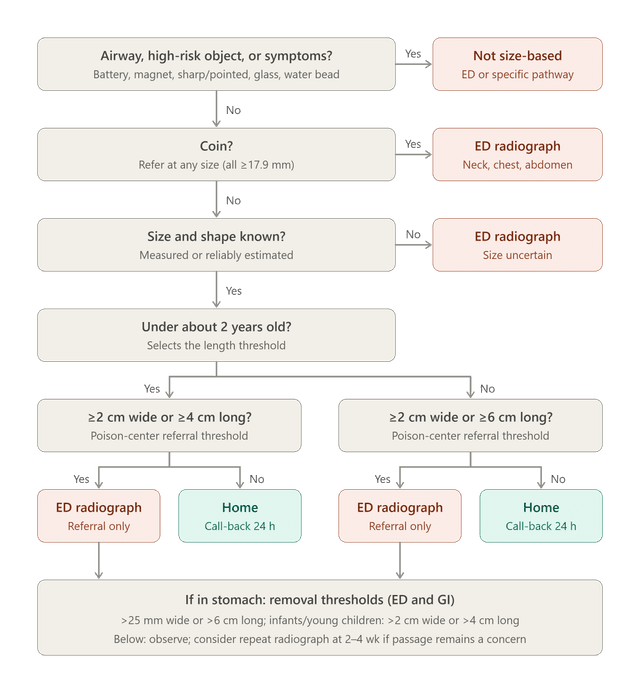
Home observation is appropriate only if ALL criteria are met:
The object is identified and smooth.
It is not a coin.
Diameter is <2 cm.
Length is <6 cm.
In infants and young children, length is <4 cm.
It is a single object.
The child is completely asymptomatic.
The child is eating and drinking normally.
There is no relevant gastrointestinal history.
The caregiver is reliable and able to return for care if needed.
The current Royal Children's Hospital guideline similarly permits omission of imaging in selected asymptomatic children with a normal examination, no GI abnormalities, and a known non-toxic, non-expandable, non-battery/non-magnet object measuring less than 2 cm in diameter and less than 6 cm in length. [2]
Continue a normal diet.
Do not induce vomiting.
Do not give laxatives.
Checking stools is optional and is not required.
Seek medical evaluation for:
breathing problems;
drooling;
dysphagia;
refusal of food or fluids;
vomiting;
neck or chest pain;
abdominal pain or distension;
fever;
GI bleeding.
Poison-center follow-up at approximately 24 hours is an operational approach.
Most blunt objects pass spontaneously. Refer for radiography and GI review if symptoms develop.
If passage remains a concern, consider repeat radiography at approximately 2–4 weeks, or earlier if symptoms develop.
The 2–4-week window reflects the range used in pediatric guidance for asymptomatic blunt gastric objects and is not a prospectively validated universal cutoff. [1] [4]
Location / clinical situation | Management |
|---|---|
Esophagus — symptomatic or unable to handle secretions | |
Esophagus — asymptomatic blunt object | Endoscopic removal within 24 hours. If asymptomatic and managing secretions, removal may be delayed up to approximately 12–24 hours. Repeat radiograph immediately before endoscopy because spontaneous passage can occur. [1] [4] [5] |
Esophagus — ingestion >24 h ago or timing unknown | Remove; prolonged esophageal retention increases complication risk. [1] |
Stomach — asymptomatic and below applicable age/size removal threshold | Observation. Consider repeat radiograph in 2–4 weeks. If the object remains in the stomach, discuss elective removal with GI. [1] [4] |
Stomach — above removal threshold | GI consultation for consideration of elective endoscopic removal. |
Stomach — symptomatic | GI consultation. |
Beyond the stomach — asymptomatic | Outpatient observation; surgical consultation for obstruction signs or failure to progress. |
Consider GI consultation for elective removal when the gastric object is:
>25 mm in diameter, or
>6 cm in length.
In infants and young children:
>2 cm wide, or
>4 cm long.
The 2026 ESPGHAN position paper recommends elective removal of large benign foreign bodies and specifically identifies objects >25 mm wide and/or >6 cm long as higher-risk for passage, while emphasizing the child's size and clinical context. [1] The lower 2-cm/4-cm young-child threshold derives from pediatric endoscopy literature. [3]
Radiolucent objects may not be visible on plain films.
If suspicion persists despite normal radiography, discuss further imaging or endoscopy with pediatric GI or the appropriate specialist.
This section is an exception pathway. Home observation does not apply.
Every known or suspected sharp or pointed foreign-body ingestion should be referred to the ED for evaluation, regardless of symptoms or size.
Examples include:
pins;
needles;
broken glass;
toothpicks;
bones;
other sharp or pointed objects.
Refer all known or suspected sharp-object ingestions.
Current European pediatric endoscopy guidance recommends emergent removal within approximately 2 hours for sharp-pointed objects in the esophagus, stomach, or proximal duodenum, even when the child is asymptomatic. [1]
NASPGHAN 2015 classifies asymptomatic esophageal and gastric sharp objects as urgent and allows consideration of observation for selected short gastric objects with a heavier blunt end. [4]
If asymptomatic:
observe with serial imaging;
obtain surgical consultation for pain, fever, peritoneal signs, or GI bleeding;
consider enteroscopy or surgical removal if symptoms develop or the object does not progress after approximately 3 days.
Suspected oropharyngeal impaction, such as a fish bone causing throat symptoms, requires urgent ENT evaluation. [2]
Some sharp objects are poorly visible on plain radiographs.
NASPGHAN reports substantially better radiographic detection for metallic objects than for glass, fish bones, or wood. A normal film therefore does not exclude a sharp foreign body when clinical suspicion remains high. [4]
No source identified for this guideline defines a validated size below which glass ingestion can safely be managed at home.
Therefore, this guideline refers all known or suspected glass ingestions rather than creating an unsupported size threshold.
Every numerical threshold in this guideline should be interpreted as expert-consensus or operational guidance rather than a prospectively validated cutoff.
Two sets of dimensions are intentionally used.
This guideline uses conservative referral thresholds derived principally from Royal Children's Hospital guidance:
home/no-imaging pathway requires an identified low-risk object <2 cm in diameter and <6 cm long;
in younger children, a lower long-object threshold is used;
symptoms, uncertainty, high-risk objects, or relevant GI disease override dimensions. [2]
Removal thresholds are separate:
>25 mm wide or >6 cm long for a large gastric object under current ESPGHAN guidance; [1]
>2 cm wide or >4 cm long in young infants and children based on earlier pediatric endoscopy evidence. [3]
Do not turn a referral threshold into an automatic removal threshold.
All common U.S. coins are approximately 17.9 mm or larger in diameter. [6]
The “image every coin” rule in this poison-center guideline is intentionally conservative. It should be understood as an operational triage rule rather than a universal international endoscopy guideline.
Most single blunt, non-toxic foreign bodies pass spontaneously.
Airway symptoms override ingestion management; exclude aspiration first.
Batteries, magnets, sharp objects, water beads, toxic objects, food boluses, lead-containing objects, and multiple-object ingestions require separate pathways.
Refer symptomatic children and children with uncertain object identity.
In this poison-center pathway, any coin is referred for imaging.
Objects ≥2 cm in diameter or ≥6 cm long meet conservative referral/imaging criteria; use a shorter ≥4 cm length threshold in infants and young children.
Home observation applies only to a known, smooth, single, non-coin, low-risk object in a completely asymptomatic child with reliable follow-up.
Esophageal blunt foreign bodies require removal within 24 hours, sooner when symptomatic.
Gastric removal thresholds are distinct from poison-center imaging thresholds.
Every known or suspected sharp or pointed object should be referred to the ED.
A normal radiograph does not exclude a radiolucent foreign body.
Numerical size and timing thresholds are clinical guidance, not prospectively validated universal cutoffs.
Keep reading