Substance Abuse and Addiction
Synthetic Opioids: Fentanyl, Nitazenes, and Overdose Care
Omid Mehrpour
Post on 31 May 2024 · Updated 06 Nov 2026 · 14 min read
Omid Mehrpour
Post on 31 May 2024 · Updated 06 Nov 2026 · 14 min read
 Medical Toxicologymedicaltoxic.com
https://medicaltoxic.com/blogs/synthetic-opioids-fentanyl-nitazenes-overdose-care
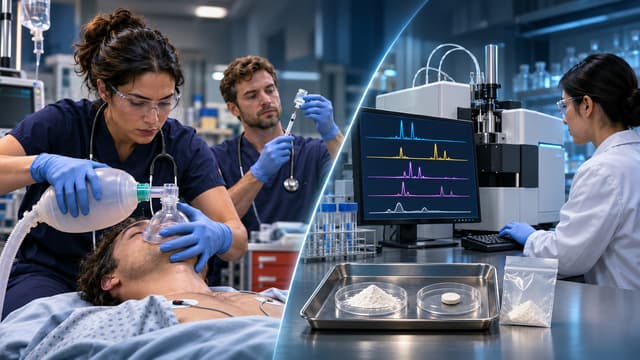
Synthetic opioids remain at the center of the U.S. overdose crisis, but the clinical landscape in 2026 is more complicated than “fentanyl is increasing.”
National mortality has moved in a favorable direction. Final CDC data show that U.S. overdose deaths involving synthetic opioids other than methadone fell from 72,776 in 2023 to 47,735 in 2024. [1] Provisional CDC estimates for 2025 reported approximately 38,084 deaths involving synthetic opioids, including fentanyl, down from an estimated 48,913 in 2024. [2]
That decline is important.
It does not mean the synthetic-opioid problem is over.
Illegally manufactured fentanyl remains deeply embedded in the drug supply, while nitazenes, carfentanil, cychlorphine, counterfeit pills, and mixtures containing non-opioid sedatives such as xylazine and medetomidine create increasingly unpredictable exposures.
For healthcare professionals, the key shift is this:
Modern opioid overdose care increasingly requires treating the patient's physiology while accepting that the reported drug, routine toxicology screen, and actual exposure may not match.
U.S. overdose mortality involving synthetic opioids has declined substantially from its recent peak, but fentanyl remains a leading driver of fatal overdose.
Pharmaceutical fentanyl and illegally manufactured fentanyl are both synthetic opioids, but most current fentanyl-related harm is associated with the illegal drug supply.
Nitazenes are potent synthetic opioids that are chemically distinct from fentanyl, not fentanyl analogues.
Carfentanil is a fentanyl analogue that re-emerged in U.S. overdose deaths during 2023–2024.
Cychlorphine is an emerging non-fentanyl synthetic opioid with direct clinical confirmation in a 2026 naloxone-responsive overdose case.
Xylazine and medetomidine are not opioids. They are alpha-2 adrenergic sedatives that may be mixed with fentanyl and can cause persistent sedation or bradycardia despite naloxone.
Airway support and ventilation remain central in life-threatening opioid poisoning; naloxone should be used when opioid-mediated respiratory depression is suspected.
Current evidence does not support a universal rule that every fentanyl or nitazene overdose requires a fixed high starting dose of naloxone.
Routine urine drug screens can miss fentanyl and emerging synthetic opioids depending on the assays included.
Surviving an overdose should trigger assessment for opioid use disorder and linkage to evidence-based treatment.
“Synthetic opioid” describes how a drug is produced, not whether it is medically legitimate or illicit.
Examples include:
fentanyl;
methadone;
carfentanil;
U-47700;
nitazenes;
cychlorphine.
These substances should not all be discussed as though they represent the same public-health problem.
Fentanyl, for example, has legitimate medical uses in anesthesia and severe pain treatment. CDC distinguishes pharmaceutical fentanyl from illegally manufactured fentanyl and notes that the majority of current fentanyl-related overdose harm is associated with illegally made fentanyl. [3]
Methadone is also a synthetic opioid and is an evidence-based treatment for opioid use disorder.
By contrast, nitazenes and cychlorphine have emerged primarily as unregulated opioids in illicit drug markets.
Buprenorphine, which was incorrectly grouped with synthetic opioids in the previous version of this article, is better described as a semisynthetic opioid and is an established medication for opioid use disorder.
The clinically useful distinction is therefore not simply:
synthetic versus natural
but rather:
known pharmaceutical exposure versus unpredictable illicit synthetic-opioid exposure.
Fentanyl is a potent mu-opioid receptor agonist.
In overdose, its most important acute toxic effect is respiratory depression.
Patients may present with:
reduced level of consciousness;
slow or absent breathing;
hypoxemia;
miosis, although pupil size is not always diagnostic;
bradycardia or hypotension in severe poisoning;
cardiac arrest after prolonged hypoxia.
Illegally manufactured fentanyl is frequently sold as powder, mixed into heroin or stimulants, or pressed into counterfeit tablets resembling prescription drugs. [3]
The person exposed may therefore not know that fentanyl was present.
This uncertainty is one reason the bedside toxidrome and respiratory status matter more than the street name supplied by a patient or bystander.
Carfentanil is an extremely potent fentanyl analogue with no approved routine human therapeutic role.
CDC surveillance documented a sharp re-emergence in U.S. overdose deaths.
Carfentanil was detected in 29 overdose deaths during January–June 2023, increasing to at least 238 deaths during January–June 2024. Among deaths with carfentanil detected during July 2023–June 2024, 86.9% also had illegally manufactured fentanyl detected. [4]
This finding should not be interpreted as evidence that every fentanyl exposure contains carfentanil.
It shows how quickly the illicit opioid supply can change even while overall overdose mortality is declining.
A dedicated MedicalToxic carfentanil article exists, but it currently requires separate rehabilitation before it should be used as a clinical internal-link destination.
Nitazenes are benzimidazole-derived synthetic opioids.
They were initially developed decades ago during pharmaceutical research but were not approved for routine medical use.
Importantly, they are chemically distinct from fentanyl.
DEA's 2025 National Drug Threat Assessment reported multiple nitazene analogues in the U.S. illicit drug supply, including metonitazene, protonitazene, N-pyrrolidino etonitazene, N-desethyl isotonitazene, and isotonitazene. Nitazenes have appeared in powders, counterfeit tablets, and mixtures containing fentanyl, heroin, or cocaine. [5]
A 2026 national forensic analysis identified 7,117 nitazene reports in the United States from 2019 through 2024, increasing from 43 reports in 2019 to 1,905 in 2024. Among 361 nitazene-positive biospecimens in the NPS Discovery dataset, 98.3% contained at least one additional substance, most commonly fentanyl. [6]
Those numbers describe forensic and toxicology detections.
They are not population prevalence estimates.
For the dedicated nitazene evidence review, see Nitazenes: The Hidden Opioid Crisis That's Deadlier Than Fentanyl.
Cychlorphine, also called N-propionitrile chlorphine, is an emerging non-fentanyl synthetic opioid.
A 2026 Journal of Medical Toxicology case report provided direct biological confirmation of cychlorphine in a woman who developed unresponsiveness and respiratory depression after believing she had taken alprazolam.
She received intranasal naloxone before emergency-department arrival. Advanced serum toxicology later detected cychlorphine, while the initial routine opiate and fentanyl screens had been negative. [7]
The report is a single case and cannot establish a cychlorphine-specific naloxone requirement or population incidence.
Its clinical significance is different:
an opioid toxidrome can occur even when the reported drug and routine opioid testing do not identify the actual synthetic opioid.
For a detailed review of this emerging exposure, see Cychlorphine Emerges in the Illicit Opioid Supply as Toxicology Testing Finds Unrecognized Exposure.
This distinction is essential.
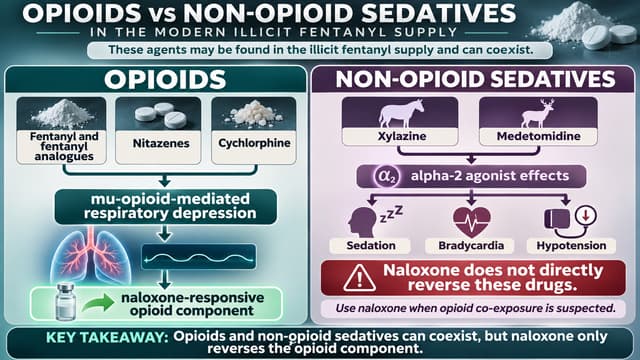
Xylazine and medetomidine are not synthetic opioids.
They are alpha-2 adrenergic agonist sedatives that increasingly appear in the illicit fentanyl environment.
DEA's May 2026 public-safety advisory specifically identified fentanyl mixtures involving xylazine, medetomidine, nitazenes, and cychlorphine. [8]
CDC reported that medetomidine detections expanded markedly in the U.S. illicit supply during 2025. In sentinel drug-product testing, fentanyl was co-detected in the great majority of medetomidine-positive product samples. CDC also warned about severe autonomic withdrawal in people with repeated medetomidine exposure. [9]
This matters at the bedside because naloxone reverses opioid effects.
It does not reverse xylazine or medetomidine themselves.
A patient may therefore improve in ventilation after naloxone while remaining deeply sedated, bradycardic, or hypotensive because a non-opioid sedative is also present.
For the xylazine-specific clinical approach, see Fentanyl + Xylazine (‘Tranq’): Why Naloxone Alone Isn’t Enough.
The critical physiologic problem in opioid overdose is inadequate ventilation.
Do not wait for every element of the “classic triad” before treating a patient with:
depressed consciousness;
slow, shallow, or absent breathing;
hypoxemia;
a plausible opioid exposure.
Miosis can support the diagnosis, but its absence does not exclude opioid poisoning.
Polysubstance exposures can also alter the presentation.
A patient exposed to fentanyl plus a stimulant may not initially appear profoundly sedated. A patient exposed to fentanyl plus medetomidine, xylazine, or a benzodiazepine may remain sedated even after the opioid component is reversed.
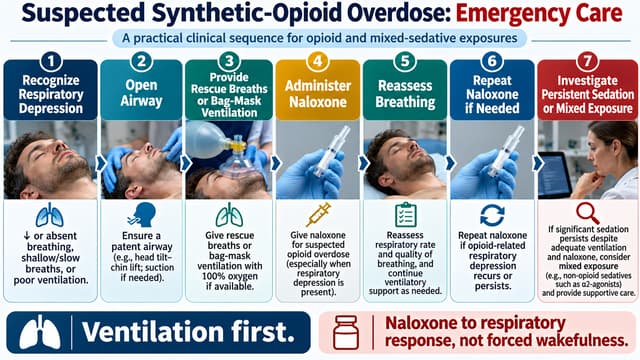
The 2025 American Heart Association guidelines emphasize that opioid poisoning can progress from respiratory depression to respiratory arrest and then cardiac arrest.
For patients with a definite pulse and respiratory depression or respiratory arrest, trained rescuers should provide breaths or bag-mask ventilation and administer an opioid antagonist such as naloxone. Resuscitation and emergency-system activation should not be delayed while waiting for naloxone to work. [10]
This is particularly important in the fentanyl era.
Naloxone may reverse the opioid receptor effect.
It cannot immediately correct the hypoxemia that has already developed if ventilation is not restored.
No universal rule supports that approach.
The previous version of this article recommended starting synthetic-opioid overdose treatment with a fixed 2 mg dose of naloxone.
That statement should be removed.
Naloxone dosing depends on the clinical situation, route, available formulation, severity of respiratory depression, prior opioid dependence, and response to treatment.
Some potent synthetic-opioid overdoses require repeated naloxone doses or greater cumulative amounts.
That does not establish that every fentanyl or nitazene exposure requires an arbitrarily high initial dose.
A 2026 evidence review evaluating nitazene overdoses found naloxone requirements across included reports in the range of 0.4–4.4 mg and concluded that the available evidence did not support routinely using higher doses. The authors also emphasized the small evidence base and need for further research. [11]
For healthcare professionals, the safer principle is:
Support ventilation and titrate/repeat naloxone according to the patient's respiratory response and the formulation being used rather than to the name or presumed potency of the street drug alone.
Do not assume naloxone has “failed.”
Ask a different question:
Has opioid-mediated respiratory depression improved?
If ventilation improves but substantial sedation remains, consider:
xylazine;
medetomidine;
benzodiazepines;
alcohol;
other sedatives;
neurologic illness;
hypoxic injury;
mixed poisoning.
Additional naloxone should not be given simply to force full wakefulness when adequate ventilation has already been restored and non-opioid co-exposure is likely.
Continue supportive care and reassessment.
Naloxone may wear off before the opioid effect resolves.
The AHA recommends observation after successful opioid-antagonist response until the patient has:
a low risk of recurrent respiratory depression;
normal consciousness;
normal vital signs. [10]
Repeated naloxone doses can be beneficial when respiratory depression recurs.
Longer-acting opioids, uncertain exposures, repeated naloxone requirements, significant co-intoxication, or persistent abnormal physiology may require prolonged monitoring or more intensive care.
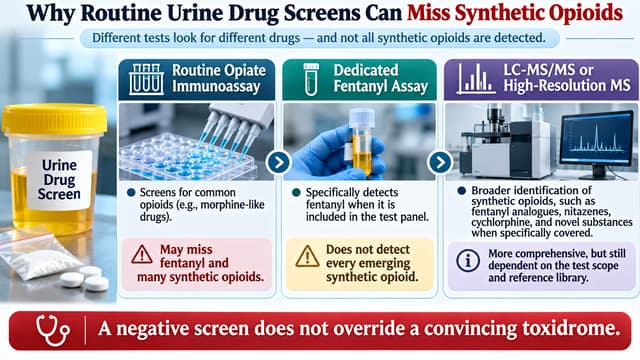
Routine toxicology testing has important limitations.
Many conventional “opiate” immunoassays are optimized for morphine-class compounds and do not automatically identify fentanyl.
Even when a separate fentanyl immunoassay exists, it must actually be ordered or incorporated into the panel.
A 2026 study of 2,052 clinical urine specimens in Indiana found that fentanyl testing was initially ordered in only 1.6% of specimens. When the remaining samples were systematically screened, substantial additional fentanyl exposure was identified. The study concluded that routine panels can lag behind changing drug trends. [12]
Novel opioids such as nitazenes or cychlorphine may require targeted or high-resolution mass-spectrometry methods.
Therefore:
Do not use a negative routine urine drug screen to overrule a convincing opioid toxidrome.
Laboratory testing should support clinical interpretation, not replace it.
Definitive methods such as:
LC-MS/MS;
LC-HRMS;
broader mass-spectrometry screening;
can identify substances that routine immunoassays miss.
These methods are especially valuable for:
unexplained overdose clusters;
unusual or prolonged opioid toxidromes;
negative routine screens despite convincing opioid physiology;
public-health surveillance;
forensic investigation;
suspected novel psychoactive substances.
However, emergency treatment should not wait for definitive analytical confirmation when a patient has life-threatening respiratory depression.
The national decline in overdose deaths is encouraging.
It should reinforce—not replace—effective overdose-prevention measures.
Key strategies include:
broad access to naloxone;
overdose-response training;
avoiding solitary drug use when possible;
awareness of counterfeit tablets;
drug-checking services where available;
fentanyl test strips where appropriate;
linkage to evidence-based substance-use treatment.
Fentanyl test strips can identify fentanyl in many drug products, but a negative result does not guarantee that a product is safe. They may not identify every fentanyl analogue or other synthetic opioid. [3]
No test strip can convert an unregulated drug supply into a known-dose pharmaceutical product.
Resuscitation is only the first phase.
An opioid overdose can be an important opportunity to identify opioid use disorder and connect a patient with evidence-based treatment.
FDA identifies three approved medications for opioid use disorder:
buprenorphine;
methadone;
naltrexone. [13]
These medications have different mechanisms, indications, initiation requirements, and treatment settings.
Their existence is also a reminder that it is clinically misleading to describe all synthetic or semisynthetic opioids as part of the illicit overdose threat.
Opioids can be both lifesaving medications and lethal poisons depending on the drug, dose, route, context, and exposure.
The reported product may be wrong.
Counterfeit tablets and mixed powders can contain unexpected opioids and non-opioid sedatives.
In severe opioid poisoning, oxygenation and ventilation should not be delayed while waiting for naloxone.
Dose and repeat naloxone according to respiratory response and the product/formulation available.
Persistent sedation after opioid reversal should trigger consideration of xylazine, medetomidine, benzodiazepines, and other sedatives.
“UDS negative” is not a meaningful statement unless the clinician knows which assays were included.
Nitazene analogues, cychlorphine, fentanyl analogues, and sedative adulterants can change quickly.
Survival without follow-up leaves the underlying risk unaddressed.
Xylazine and medetomidine are not opioids.
Naloxone can reverse an accompanying fentanyl exposure but not the alpha-2 agonist itself.
Nitazenes are not fentanyl analogues.
They are a chemically distinct class of synthetic opioids.
A negative opiate screen does not exclude fentanyl or an emerging opioid.
Know the actual assay panel.
Naloxone should target respiratory physiology.
Full wakefulness is not required to demonstrate successful reversal of opioid-mediated respiratory depression.
High potency does not automatically mean high initial naloxone dosing.
Some patients need repeated doses, but current evidence does not support a universal “synthetic opioid = high-dose naloxone” rule.
Falling mortality does not mean a predictable drug supply.
The number of deaths can decline while the composition of illicit products becomes more pharmacologically complex.
Potency varies substantially by nitazene analogue and by the experimental model used. Some nitazenes can equal or exceed fentanyl potency, but it is inaccurate to assign one potency figure to the entire class.
No. Xylazine is a non-opioid alpha-2 adrenergic agonist sedative. It is clinically important because it is frequently encountered with fentanyl.
Yes. Nitazenes are opioid agonists, so opioid-mediated respiratory depression can respond to naloxone. Evidence is still limited regarding optimal dose requirements for individual analogues.
No universal fixed-dose rule is supported simply because fentanyl or another potent synthetic opioid is suspected. Airway and ventilation support are critical, and naloxone should be administered and repeated according to the patient's respiratory response and available formulation.
Usually not unless a specific assay or broad definitive analytical method includes them. Many emerging synthetic opioids require targeted or high-resolution mass spectrometry.
The synthetic-opioid crisis is changing rather than disappearing.
U.S. overdose deaths have declined markedly, which is an important public-health achievement. But fentanyl remains a dominant cause of opioid overdose, while nitazenes, carfentanil, cychlorphine, and non-opioid sedatives continue to make the unregulated drug supply unpredictable.
The clinical response does not require guessing every molecule at the bedside.
It requires getting the fundamentals right:
recognize respiratory depression, support ventilation, use naloxone when opioid toxicity is suspected, reassess for co-intoxicants, understand the limitations of routine toxicology testing, monitor for recurrent toxicity, and connect survivors with evidence-based treatment.
For healthcare professionals, the most important lesson of the current synthetic-opioid era is simple:
Treat the patient in front of you—not the label on the drug, the street name, or a negative screening test.
© All copyright of this material is absolute to Medical toxicology
Dr. Omid Mehrpour (MD, FACMT) is a senior medical toxicologist and physician-scientist with over 15 years of clinical and academic experience in emergency medicine and toxicology. He founded Medical Toxicology LLC in Arizona and created several AI-powered tools designed to advance poisoning diagnosis, clinical decision-making, and public health education. Dr. Mehrpour has authored over 250 peer-reviewed publications and is ranked among the top 2% of scientists worldwide. He serves as an associate editor for several leading toxicology journals and holds multiple U.S. patents for AI-based diagnostic systems in toxicology. His work brings together cutting-edge research, digital innovation, and global health advocacy to transform the future of medical toxicology.
Keep reading
 Substance Abuse and Addiction

Amirhosein Shabrang
 Substance Abuse and Addiction
Omid Mehrpour
 Substance Abuse and Addiction
Omid Mehrpour
 Substance Abuse and Addiction
Omid Mehrpour