Regulations in Toxicology
Is Sunscreen Safe? Ingredients, SPF, and Health Risks
Omid Mehrpour
Post on 27 Jun 2024 · Updated 25 Nov 2026 · 13 min read
Omid Mehrpour
Post on 27 Jun 2024 · Updated 25 Nov 2026 · 13 min read
 Medical Toxicologymedicaltoxic.com
https://medicaltoxic.com/blogs/is-sunscreen-safe-ingredients-spf-and-health-risks
Sunscreen is an important part of protecting the skin from ultraviolet (UV) radiation, but questions about ingredients, absorption, hormone-related risks, and product safety can make choosing one confusing.
For most people, using an appropriately formulated sunscreen as directed is beneficial. Sunscreens help prevent sunburn, while broad-spectrum products used alongside other sun-protection measures can reduce UV-related skin damage and the risk of certain skin cancers.
The key is to distinguish established benefits, demonstrated harms, incomplete safety evidence, and unsupported marketing claims. [1]
Choose a broad-spectrum, water-resistant sunscreen with SPF 30 or higher, consistent with American Academy of Dermatology recommendations.
Mineral filters such as zinc oxide and titanium dioxide and organic UV filters can both provide effective protection when properly formulated and tested.
Detecting a sunscreen ingredient in blood does not establish that it causes cancer, hormonal disease, or reproductive harm.
FDA's sunscreen regulatory framework changed in 2026, including the addition of bemotrizinol and a separate final order concerning PABA and trolamine salicylate.
Pure botanical oils, including red raspberry seed oil, should not replace a sunscreen with validated SPF and broad-spectrum protection.
Apply enough sunscreen, reapply as directed, and combine it with shade and protective clothing.
Avoid treating claims such as "natural," "non-toxic," or "reef-safe" as proof of product safety or effectiveness.
Sunlight contains ultraviolet radiation that can injure skin cells and contribute to premature aging and skin cancer.
UVA radiation penetrates more deeply into the skin and contributes to photoaging, pigmentation changes, and skin damage associated with cancer risk.
UVB radiation is particularly important in sunburn and directly contributes to DNA damage.
Both types of radiation are relevant to long-term skin health.
UVC radiation from sunlight is effectively blocked by the atmosphere and does not ordinarily reach Earth's surface.
A sunscreen labeled "broad spectrum" provides protection against both UVA and UVB radiation. SPF alone primarily measures protection against sunburn-producing radiation. [1]
Clinical trials and follow-up studies support important benefits from regular sunscreen use.
A long-term follow-up of an Australian randomized sunscreen trial found significantly fewer cutaneous squamous cell carcinomas among participants originally assigned to daily sunscreen use. A similarly clear reduction in basal cell carcinoma was not established. [2]
A separate follow-up analysis found fewer new primary melanomas in the daily-sunscreen group than in the discretionary-use group. The findings supported a possible preventive benefit, although the number of melanoma events was relatively small and uncertainty remained in the overall estimate. [3]
These studies are more informative than claims based solely on individual ingredient properties. However, sunscreen does not eliminate all skin-cancer risk and should be combined with other protective measures.
Sunscreen active ingredients are often classified into two groups:
Mineral or inorganic UV filters: Primarily zinc oxide and titanium dioxide.
Organic UV filters: Examples include avobenzone, octinoxate, octocrylene, and oxybenzone.
These categories refer to chemical composition rather than a simple division between safe and unsafe ingredients.
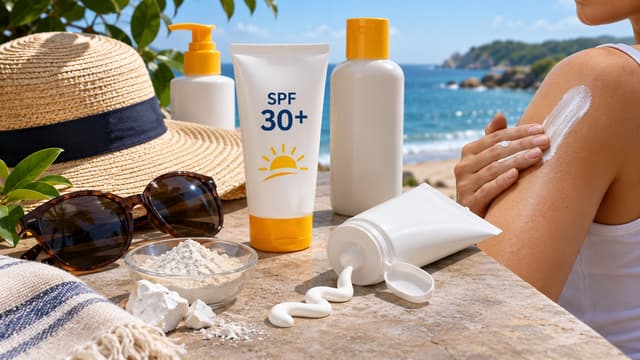
Mineral sunscreens are often described as physical shields that simply reflect sunlight.
This explanation is incomplete.
Experimental optical measurements show that zinc oxide and titanium dioxide protect against UV radiation primarily through absorption, with a smaller contribution from reflection and scattering. Their visible-light scattering can contribute to a white appearance on the skin. [4]
Mineral formulations can be useful for people who prefer these filters or have experienced irritation with certain alternatives. However, effectiveness also depends on the finished product, its testing, and how it is applied.
A product is not automatically effective merely because zinc oxide or titanium dioxide appears on the ingredient list.
Organic sunscreen filters absorb ultraviolet radiation through molecular processes that help prevent damaging UV exposure.
Different filters protect against different portions of the UV spectrum. Manufacturers may combine filters to achieve suitable broad-spectrum performance.
Some organic filters can be absorbed systemically, but absorption alone does not establish clinical toxicity.
The safety of an ingredient must be assessed using relevant exposure, toxicology, and clinical evidence rather than assuming that all synthetic ingredients are harmful.
In the United States, sunscreens are regulated as over-the-counter drug products.
The FDA distinguishes between ingredients with sufficient evidence supporting a generally recognized as safe and effective (GRASE) determination, ingredients requiring additional data, and ingredients for which safety concerns justify a different regulatory decision.
FDA's sunscreen review identified sufficient safety and effectiveness evidence to support proposed GRASE status for zinc oxide and titanium dioxide at concentrations up to 25%.
This is a regulatory evidence assessment. It does not mean every product containing these ingredients has automatically passed all relevant finished-formulation tests. [5]
In its 2021 proposed order, FDA requested more evidence for several organic sunscreen ingredients, including oxybenzone, octinoxate, homosalate, avobenzone, and octocrylene.
Insufficient data for a positive GRASE determination does not mean FDA has established that these ingredients are unsafe or that consumers should stop using sunscreen.
The regulatory review includes questions about systemic exposure and long-term safety under conditions of widespread use. [5]
Two distinct FDA regulatory actions are particularly relevant.
June 2026 — Bemotrizinol
FDA issued a final order adding bemotrizinol as an active sunscreen ingredient under specified conditions, including concentrations up to 6%.
This addition expanded the permitted UV-filter options under the U.S. OTC sunscreen monograph.
September 2026 — PABA and Trolamine Salicylate
FDA issued a separate final administrative order removing aminobenzoic acid (PABA) and trolamine salicylate from the OTC sunscreen monograph because the agency concluded that the risks associated with their use as sunscreen active ingredients outweighed their benefits.
The final order has an implementation timeline and should not be confused with an immediate recall of every sunscreen product. FDA stated that it was not aware of currently marketed U.S. sunscreen products containing these ingredients.
Other aspects of FDA's broader sunscreen proposal remain subject to additional regulatory action. [5]
These ingredients have been discussed in research involving systemic exposure, laboratory endocrine activity, animal toxicology, and environmental effects.
However, different types of evidence answer different questions.
A substance showing hormone-related activity in a laboratory experiment does not automatically establish that normal use of sunscreen containing that ingredient causes clinically important endocrine disease in humans.
A randomized clinical pharmacology study published in JAMA in 2020 evaluated six sunscreen active ingredients in 48 healthy participants using four sunscreen formulations.
All six tested ingredients were detected systemically at concentrations exceeding FDA's threshold for potentially waiving certain additional safety studies.
That threshold is a regulatory testing trigger, not a demonstrated human toxicity threshold.
The trial measured absorption and pharmacokinetics. It did not demonstrate that sunscreen use causes hormonal disease, cancer, infertility, or other long-term clinical harm.
The investigators specifically cautioned that their results should not be interpreted as a reason to stop using sunscreen. [6]
Laboratory and animal findings have raised questions about the biological activity of oxybenzone and some other sunscreen filters.
These findings warrant appropriate evaluation, but claims that ordinary sunscreen use has been proven to cause endocrine disorders or reproductive damage in humans are not supported by the absorption study alone.
People who prefer to avoid particular ingredients can choose an alternative sunscreen with adequate validated UV protection rather than abandoning sun protection altogether.
Certain sunscreen ingredients, fragrances, or other formulation components can cause irritation or allergic contact dermatitis in susceptible individuals.
A reaction to one product does not necessarily mean that all sunscreens are unsafe.
People with persistent reactions may benefit from dermatologic assessment and, when appropriate, patch testing to identify the responsible ingredient.
The terms "natural," "organic," and "plant-based" do not establish that a product offers adequate UV protection.
A botanical ingredient may have interesting antioxidant or laboratory UV-absorption properties without functioning as a validated sunscreen.
Luminance Skincare markets a product described as containing 100% red raspberry seed oil.
However, published research on raspberry seed oil does not support relying on pure raspberry seed oil as a substitute for conventional tested sunscreen.
A 2021 study evaluating vegetable oils reported an in-vivo SPF of approximately 2.6 for raspberry seed oil, far below commonly recommended levels for sun protection. [7]
A 2026 study directly evaluated plant oils and commercially marketed natural cosmetic products. Raspberry seed oil showed negligible photoprotective performance in the study's in-vitro testing conditions. The authors also emphasized that in-vitro measurements are not interchangeable with validated human SPF measurements. [8]
Neither of these studies directly establishes the SPF of every commercial product containing raspberry seed oil, and neither should be misrepresented as a completed independent clinical SPF test of the exact Luminance formulation.
For the ingredient-specific evidence and manufacturer's claims, see Luminance Red Raspberry Seed Oil Sunscreen: Does It Work?.
The concern is inadequate demonstrated UV protection—not evidence that raspberry seed oil is inherently poisonous.
The most useful selection criteria are based on demonstrated UV protection and suitability for the individual rather than unsupported rankings of supposedly "toxic" and "non-toxic" brands.
Choose a sunscreen labeled broad spectrum to obtain protection against both UVA and UVB radiation.
A high SPF value without appropriate UVA protection does not provide a complete sun-protection strategy.
The American Academy of Dermatology recommends SPF 30 or higher.
FDA consumer guidance recommends broad-spectrum sunscreen of at least SPF 15 as directed, alongside other sun-protection measures. Selecting SPF 30 or higher is a practical approach for routine outdoor protection. [9] [1]
SPF should not be interpreted as a guarantee that a person can remain in the sun a fixed multiple of their usual exposure time.
For swimming or activities involving substantial sweating, look for a product labeled water resistant for 40 or 80 minutes.
No sunscreen is waterproof.
Follow the product's instructions for reapplication after swimming, sweating, or towel drying. [1]
People with sensitive skin may prefer a fragrance-free sunscreen or a suitable mineral formulation.
Other considerations include skin feel, appearance, ease of application, and whether the product is comfortable enough for consistent use.
For acne-prone skin, an appropriately labeled noncomedogenic formulation may be preferable.
Product tolerability should be assessed individually rather than through universal rankings of brands.
Terms such as "clean," "chemical-free," "natural," "non-toxic," and "dermatologist-tested" do not replace evidence of appropriate SPF, broad-spectrum protection, formulation safety, or regulatory compliance.
Even an effective product may provide inadequate protection if too little is applied or it is not reapplied appropriately.
Apply sunscreen before going outdoors, following the label instructions. Dermatologists commonly advise applying sunscreen approximately 15 minutes before sun exposure.
Most adults need approximately one ounce—about a shot-glass amount—to cover the exposed body when wearing minimal clothing, although the amount needed varies with body size and uncovered skin.
Remember commonly missed areas such as the ears, neck, backs of the hands, tops of the feet, exposed scalp, and lips.
Reapply at least every two hours outdoors and after swimming or heavy sweating as directed.
Water-resistant labeling does not eliminate the need for reapplication. [9]
Wear suitable protective clothing, seek shade, use a broad-brimmed hat, and limit unnecessary exposure during high-UV periods.
Sunscreen should not be used as permission to remain in intense sunlight indefinitely.
For infants younger than six months, FDA recommends keeping them out of direct sun whenever possible and using shade and protective clothing. Consult a healthcare professional before applying sunscreen to an infant in this age group.
For children aged six months and older, follow the sunscreen product's labeling and use suitable sun-protection measures. [1]
Avoid inhaling sunscreen sprays and do not spray them directly onto the face.
Some spray formulations are flammable. Follow label warnings and avoid use near flames or other ignition sources.
Do not use sunscreen after its expiration date.
Protect containers from prolonged excessive heat and direct sunlight, and follow FDA guidance when a product does not display an expiration date. [1]
No standardized U.S. regulatory definition guarantees that a sunscreen marketed as "reef-safe" has no impact on aquatic ecosystems.
Environmental concerns should be evaluated through evidence of exposure and ecological effects, rather than assuming that all mineral sunscreens are harmless or that all organic sunscreens are environmentally damaging. [10]
Avoid treating environmental marketing claims as proof of human toxicity or product safety.
Sunscreen is primarily preventive; it is not a treatment for an established sunburn.
Mild sunburn usually calls for supportive measures and protection from further UV exposure, while extensive blistering, dehydration, or systemic symptoms may require medical assessment.
For evidence-based management of a significant sunburn, see Sun Poisoning: Severe Sunburn Symptoms and Treatment.
For most people, regular use of an appropriately formulated sunscreen as directed is beneficial. Sunscreen helps protect against UV-related damage and should be combined with shade and protective clothing.
Not necessarily. Mineral filters have a favorable FDA safety assessment, but the safety and effectiveness of any sunscreen depend on its ingredients, formulation, intended use, and evidence.
Some organic sunscreen filters can be absorbed systemically. Detectable absorption does not automatically mean that the exposure causes harm.
FDA has requested additional safety data for several organic sunscreen filters. This is not equivalent to a determination that ordinary use of all products containing those ingredients has been proven harmful.
People who prefer other filters can select a suitable broad-spectrum sunscreen.
No. Available direct testing does not support relying on pure raspberry seed oil for adequate sun protection. Choose a product with validated SPF and broad-spectrum performance.
No. SPF protection is not linear in that way. Higher SPF generally offers greater protection against sunburn-producing radiation under standardized testing, but correct application and reapplication remain essential.
No. Sunscreen reduces UV exposure but does not prevent dangerous overheating. Heat-related illness requires separate preventive measures, including cooling, rest, and appropriate hydration.
There is no universal evidence-based ranking identifying one brand as safest for everyone. Choose an appropriately regulated, broad-spectrum, water-resistant product with suitable SPF and a formulation you can tolerate.
Yes. Some people experience irritation or allergy to particular active or inactive ingredients. Persistent or significant reactions should be assessed by a healthcare professional.
For most people, using a properly formulated sunscreen is an important part of preventing UV-related skin damage.
FDA continues to evaluate ingredient safety and update its regulatory framework, but a need for additional evidence should not be confused with proof of human toxicity.
Mineral and organic sunscreen filters can both play roles in effective sun protection. Claims about "natural" ingredients or supposedly toxic brands should be supported by direct, relevant evidence.
The most practical choice is a broad-spectrum, water-resistant sunscreen with adequate SPF, applied correctly and combined with shade, protective clothing, and sensible sun-exposure habits.
© All copyright of this material is absolute to Medical toxicology
Dr. Omid Mehrpour (MD, FACMT) is a senior medical toxicologist and physician-scientist with over 15 years of clinical and academic experience in emergency medicine and toxicology. He founded Medical Toxicology LLC in Arizona and created several AI-powered tools designed to advance poisoning diagnosis, clinical decision-making, and public health education. Dr. Mehrpour has authored over 250 peer-reviewed publications and is ranked among the top 2% of scientists worldwide. He serves as an associate editor for several leading toxicology journals and holds multiple U.S. patents for AI-based diagnostic systems in toxicology. His work brings together cutting-edge research, digital innovation, and global health advocacy to transform the future of medical toxicology.
Keep reading
 Regulations in Toxicology

Amir Mohammad Mottaghi
 Regulations in Toxicology
Omid Mehrpour
 Regulations in Toxicology
Omid Mehrpour
 Regulations in Toxicology
Omid Mehrpour
We would like to use analytics and session-replay tools to understand how this site is used. They are optional and the site works fully without them. Signing in still needs its own cookie either way. Our Privacy Policy names each one.