Regulations in Toxicology
How Much Plastic Does a Researcher Produce Compared with an Ordinary Person?
Amir Mohammad Mottaghi
Post on 16 Aug 2026 · Updated 28 Sept 2026 · 4 min read

Amir Mohammad Mottaghi
Post on 16 Aug 2026 · Updated 28 Sept 2026 · 4 min read
 Medical Toxicologymedicaltoxic.com
https://medicaltoxic.com/blogs/researcher-plastic-waste-vs-ordinary-person
When we think about plastic pollution, we usually think about plastic bottles, food packaging, shopping bags, and other household products. But there is another source of plastic waste that receives far less attention: scientific research laboratories.
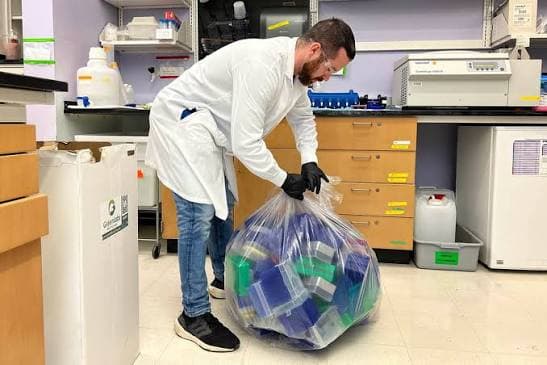
Modern biological and biomedical research relies heavily on disposable plastic equipment. Pipette tips, microcentrifuge tubes, cell-culture plates, serological pipettes, gloves, and other single-use items are essential for maintaining sterility and preventing contamination. As a result, researchers can generate surprisingly large amounts of plastic waste.
A recent study that directly measured plastic waste from seven research laboratories estimated that an average researcher generated approximately 116 kg of laboratory plastic waste per year. However, the amount varied substantially between laboratories, ranging from approximately 32 kg to 237 kg per researcher per year.
This means that the type of research and laboratory practices can have a major influence on plastic consumption.
The main sources of laboratory plastic included:
Serological pipettes
Pipette-tip boxes
Multiwell plates
Disposable gloves
Pipette tips
Falcon tubes
Microcentrifuge tubes
Plastic packaging
Unlike household plastic waste, much of this material cannot simply be placed in a recycling bin. Plastic that has been in contact with biological samples, chemicals, or other laboratory materials may require specialized waste treatment, including autoclaving or incineration.
The difference becomes more striking when laboratory waste is compared with municipal plastic waste.
Global estimates indicate that an average person in Asia generates approximately 28 kg of plastic waste per year, while the estimated figure for Azerbaijan is around 34 kg per person per year.
Compared with these figures, a researcher generating 116 kg of laboratory plastic waste per year produces approximately:
3–4 times as much plastic waste as an average person.
Group | Approximate plastic waste per year |
|---|---|
Average person in Asia | ~28 kg |
Average person in Azerbaijan | ~34 kg |
Average wet-lab researcher | ~116 kg |
Another way to visualize this is that 116 kg per year corresponds to approximately 9.7 kg per month, or about 2.2 kg per week of laboratory plastic waste per researcher.
The answer is largely related to single-use culture and molecular biology consumables.
In a typical biological laboratory, a researcher may use dozens or even hundreds of pipette tips in a single experiment. Cell-culture experiments can require disposable flasks, plates, pipettes, tubes, filters, and reservoirs. Molecular biology experiments add additional tubes, tips, PCR plates, and other consumables.
Single-use plastics are popular because they reduce the risk of contamination and make experiments more standardized and reproducible. However, this convenience comes with an environmental cost.
For example, a single experiment involving cell culture may generate plastic waste from the culture vessel itself, pipettes, centrifuge tubes, pipette tips, gloves, and packaging—even before considering the plastic used to transport and package the reagents.
Laboratory plastic has an environmental footprint throughout its entire life cycle.
Plastic must first be manufactured, transported to laboratories, used during experiments, and eventually treated as waste. When contaminated laboratory plastics cannot be conventionally recycled, they may be sterilized and sent for disposal or incineration.
This creates an important dilemma for modern science: the same disposable materials that help researchers produce reliable and safe scientific results can also contribute to environmental pollution.
Yes. Importantly, reducing laboratory plastic waste does not necessarily mean compromising experimental quality or biosafety.
Potential strategies include:
Reducing unnecessary consumables
Careful experimental planning can prevent researchers from opening or using more materials than necessary.
Using reusable alternatives where appropriate
Some glassware and durable laboratory equipment can replace disposable plastic products when contamination and safety requirements allow.
Improving pipette-tip practices
Researchers can avoid unnecessary tip changes when the experimental protocol does not require them.
Reducing packaging waste
Purchasing products with less packaging or using bulk packaging can reduce the amount of plastic entering laboratories.
Recycling uncontaminated laboratory plastics
Clean plastics that meet institutional safety requirements may sometimes be separated for recycling.
Tracking laboratory plastic consumption
Researchers cannot manage what they do not measure. Recording plastic consumption can help laboratories identify the largest sources of waste.
The comparison between researchers and ordinary citizens should be interpreted carefully because laboratory and household plastic-waste datasets are not perfectly equivalent. Nevertheless, the numbers highlight an important point.
A single wet-laboratory researcher can generate more than 100 kg of plastic waste in a year, largely from materials that are used for only minutes or even seconds.
Scientific research is essential for improving human health and understanding the environment. But if science is going to contribute to a more sustainable future, laboratories themselves need to become more sustainable.
Reducing unnecessary single-use plastic does not mean reducing scientific quality. Instead, it means asking an important question about every experiment:
“Do we really need to use this piece of plastic, and is there a safer, reusable, or less wasteful alternative?”
That question could be the starting point for making scientific research significantly more environmentally responsible.
© All copyright of this material is absolute to Medical toxicology
Master’s student in Toxicology at Tarbiat Modares University (TMU), focusing on toxicodynamics, environmental toxicants, and human health risk assessment.
Keep reading
 Regulations in Toxicology
Omid Mehrpour
 Regulations in Toxicology
Omid Mehrpour
 Regulations in Toxicology
Omid Mehrpour
 Regulations in Toxicology
Omid Mehrpour