Pediatric and adolescent Toxicology
My Child Bit a Squishy Toy: Is the Gel Toxic?
Amirhosein Shabrang
Post on 03 Nov 2026 · Updated 08 Nov 2026 · 20 min read

Amirhosein Shabrang
Post on 03 Nov 2026 · Updated 08 Nov 2026 · 20 min read
 Medical Toxicologymedicaltoxic.com
https://medicaltoxic.com/blogs/child-bit-squishy-toy-gel-toxic
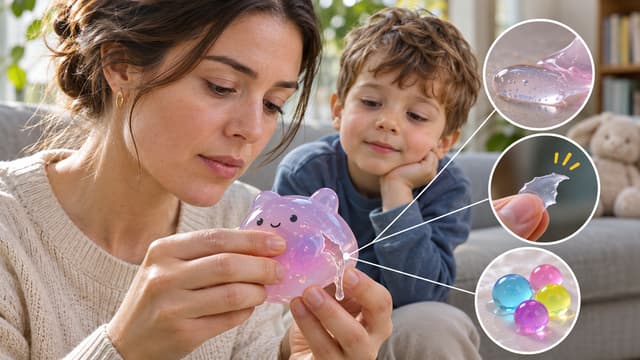
Your child bites into a squishy toy. The outer skin breaks, sticky gel gets into the mouth, and suddenly the toy's ingredient list—if it even has one—becomes very important.
For most ordinary squishy toys, a small, one-time exposure to typical gel filling is unlikely to cause serious poisoning. Poison Control describes many common squishy-toy fillings as minimally toxic when a child bites into the toy or swallows a small amount. Mild nausea, an unpleasant taste, or minor stomach upset may occur. [1]
But that reassurance has limits.
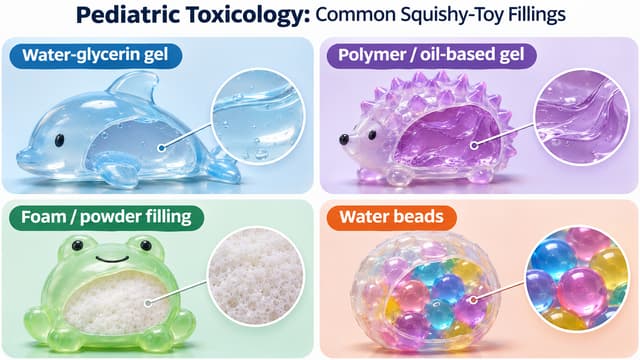
“Squishy toy” describes a product category, not a single chemical formulation. Some toys contain water-based gels, while others contain oils, polymers, powders, foam, sand, or small water-absorbing beads. The German Federal Institute for Risk Assessment (BfR) emphasized this variability in an October 2026 product-safety assessment. [2]
The most useful question is therefore not simply:
“Is squishy-toy gel toxic?”
It is:
“What material escaped from this particular toy, how much was swallowed, and does the exposure involve ordinary gel, a foreign body, or potentially expanding water beads?”
Small, one-time exposures to ordinary squishy-toy gel are generally expected to cause little or no systemic toxicity.
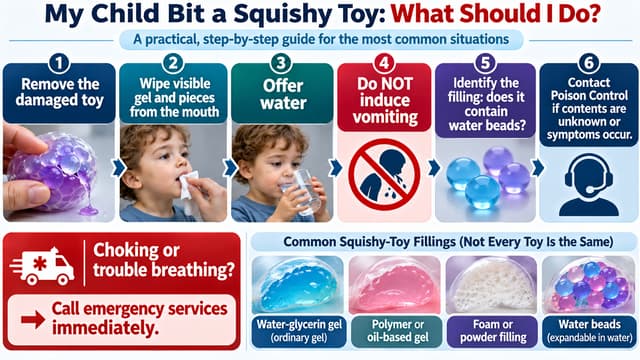
Remove the damaged toy, clear visible material from the mouth, and do not induce vomiting.
Offer a small amount of water only when the child is fully alert, breathing normally, able to swallow, and not choking.
Water beads require a different risk assessment because they may cause gastrointestinal obstruction rather than conventional chemical poisoning.
Dry or incompletely hydrated water beads may expand significantly after ingestion. Prehydrated beads generally have less remaining expansion potential but are not automatically harmless.
Symptoms of water-bead obstruction can develop after an initially symptom-free period. An early normal abdominal X-ray does not reliably exclude ingestion or subsequent obstruction.
Unknown products, significant symptoms, suspected water-bead ingestion, or concerning foreign-body exposure warrant prompt professional advice.
Minor eye splashes and small gel exposures do not automatically require an emergency-department visit, but persistent pain, visual changes, breathing difficulty, or obstructive symptoms demand escalation.
Never microwave or intentionally heat a squishy toy. Hot filling can rupture through the shell and cause serious burns.
There is no universal squishy-toy formula.
The outer shell may contain rubber, polyurethane, thermoplastic elastomers, silicone-like materials, or polyvinyl alcohol.
The filling varies substantially.
Poison Control identifies several substances used in gel-filled or solid-filled squishy toys, including:
water and glycerin;
polyvinyl alcohol;
maltose or corn syrup;
mineral oil;
other polymers and water-soluble dyes;
foam, flour, sand, or clay;
grains, seeds, or plastic beads;
water-absorbing polymer beads.
These substances have different physical and toxicological properties. [1]
This helps explain why a small taste of ordinary filling usually does not behave like ingestion of a highly toxic household chemical.
However, product labeling may be incomplete, and a toy's appearance cannot always establish what it contains.
Importantly, an ordinary gel is not the same as an individual expandable water bead, even though both may feel soft and jelly-like.
For a broader discussion of why marketing labels do not guarantee safety, see The Hidden Dangers of "Non-Toxic" Labels on Children's Toys.
First, assess the child—not just the toy.
If the child is awake, breathing normally, swallowing comfortably, and not choking:
Remove the damaged toy and prevent further exposure.
Remove visible loose material from the mouth, provided it can be reached safely. Do not perform a blind finger sweep.
Wipe the mouth with a damp cloth.
Offer a small sip of water only if the child is alert and swallowing normally. Do not force oral fluids. If water beads may have been swallowed, seek professional advice rather than trying to manage the exposure by giving fluids.
Keep the toy and packaging for product identification.
Do not induce vomiting.
Contact Poison Control if the filling is unknown, a substantial amount may have been swallowed, water beads are suspected, or symptoms develop.
Poison Control provides individualized first-aid advice based on the child's age, the product, the amount involved, and the symptoms. [3]
If the child is choking, struggling to breathe, unable to swallow, or becoming unresponsive, call emergency services immediately. Do not attempt oral fluids.
Small exposures to typical gel fillings may produce no symptoms.
Possible mild effects include:
an unpleasant taste;
temporary nausea;
minor stomach discomfort;
occasional vomiting;
mild mouth or throat irritation.
Poison Control considers the ingredients usually found in these products minimally toxic after a small, one-time ingestion. [1]
However, that assessment applies to typical formulations and limited exposures, not every toy sold under the squishy-toy label.
Direct clinical studies of swallowing finished squishy-toy gel formulations remain limited. Risk assessment must account for the product involved, possible contaminants, the amount swallowed, and the child's symptoms.
Some squishy toys contain separate, round water-absorbing polymer beads inside a flexible shell.
Water beads are usually made from superabsorbent polymers. They take up liquid and may increase substantially in size.
Their primary ingestion hazard is mechanical obstruction, rather than systemic poisoning from the polymer itself.
The extent of that hazard depends partly on whether the bead is dry, partially hydrated, or already expanded.
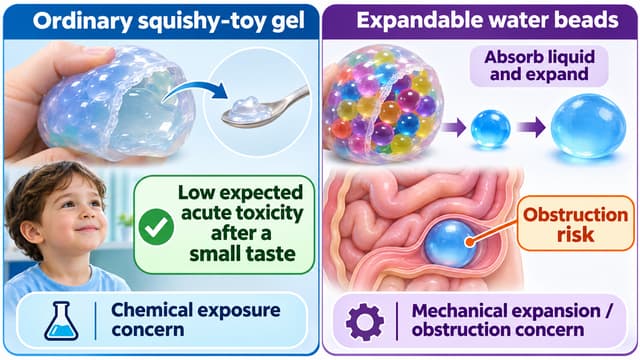
Dry beads may be very small when swallowed.
After exposure to liquid, they can expand considerably. If they become large enough to obstruct the gastrointestinal tract, symptoms may develop only after some time has passed.
A child who appears well immediately after ingestion may therefore develop vomiting, abdominal distension, or other obstructive symptoms later.
Some squishy toys contain water beads that are already expanded before the toy breaks.
These generally have less remaining expansion potential than dry beads, but they are not automatically safe to swallow.
The risk still depends on:
the actual bead size;
its remaining capacity to absorb liquid;
the number swallowed;
the child's age and gastrointestinal anatomy;
whether symptoms are present;
the time since ingestion.
Large prehydrated beads may present a foreign-body hazard even without dramatic additional expansion.
Neither the appearance nor the hydration state alone establishes that a swallowed bead is safe.
For a more detailed review of the ingestion hazard, see Understanding the Risk of Water bead (Orbeez) Ingestion in Children.
No. Water beads have not been universally banned from every product or toy in the United States.
On March 12, 2026, the U.S. Consumer Product Safety Commission (CPSC) implemented a mandatory federal safety standard for water-bead toys.
The standard establishes requirements involving:
maximum expansion size;
limits on extractable acrylamide;
product testing and certification;
prominent safety warnings.
It applies to covered water-bead toys manufactured after the effective date. Products that fail applicable requirements cannot legally be sold. [4]
Some large retailers previously stopped selling water beads marketed to children, but a retailer's decision to discontinue a product is not the same as a nationwide prohibition.
The federal standard is also not a guarantee that every water bead already in a home meets the updated requirements.
CPSC warns that products outside the scope of the toy standard, including some decorative or other non-toy water-bead products, may still be accessible to children.
This is why parents may continue encountering water beads in sensory products, crafts, decorations, and some squishy toys.
The best available evidence is mixed and needs careful interpretation.
Some poison-center and hospital studies have found that many reported ingestions produce few or no symptoms.
At the same time, published clinical cases show that severe obstruction and surgery can occur.
These findings are not contradictory. They describe different populations and different forms of evidence.
A 2025 retrospective study reviewed 217 water-bead ingestion cases reported to a regional poison center.
Among those cases:
84% involved children younger than six;
54.8% had no reported clinical effects;
no bowel obstruction was documented;
no patient was reported to require hospitalization or removal of a retained bead.
These findings are reassuring, but the study has an important limitation.
Follow-up was attempted in only 53% of cases, with an average follow-up duration of approximately 45 hours among those followed. [5]
Therefore, the absence of documented obstruction cannot establish that the true risk was zero.
Retrospective poison-center records may miss complications that developed after contact ended or were treated elsewhere.
The study also cannot define the true incidence of obstruction among all children who ingest water beads.
A 2026 study by Denton and colleagues reviewed 36 pediatric encounters involving 35 children at a quaternary children's hospital between 2015 and 2024.
The median patient age was two years.
The researchers reported:
28 of 36 encounters (78%) were asymptomatic;
52 imaging examinations were performed, four of which were abnormal;
six encounters involved endoscopy, but no water beads were successfully retrieved;
no intestinal obstruction or associated complication was documented in the series.
The authors proposed a management algorithm informed by their institutional experience and the published literature. [6]
However, this is not a validated universal decision rule.
The study was retrospective, involved a relatively small number of encounters, and came from a single specialist hospital.
Its proposed algorithm requires further validation before being treated as a standard of care or used to justify a fixed observation duration for every child.
A 2026 scoping review examined pediatric reports of superabsorbent polymer bead ingestion.
It identified two case series describing 131 predominantly asymptomatic or mildly symptomatic patients, alongside 22 symptomatic patients described in individual case reports.
Among the selected symptomatic case reports, most required surgery. The review also documented serious complications and one death. [7]
That proportion must not be interpreted as the probability that any child swallowing a water bead will require surgery.
Severe cases are more likely to be published as individual case reports.
The review therefore supports recognition of a potentially serious complication—not a reliable population-level estimate of its frequency.
The practical conclusion is:
Many reported water-bead ingestions are uncomplicated, but potentially serious obstruction can occur, and the actual risk for a particular child remains uncertain without assessment of the exposure.
Yes.
Water beads may continue absorbing liquid after ingestion, and the initial examination may occur before a clinically significant obstruction develops.
The onset of symptoms can therefore be delayed.
In a 2026 case series, four children younger than five years presented with intestinal obstruction after ingesting water-absorbing beads. Plain radiographs showed signs of obstruction but did not directly visualize the beads. Ultrasound identified suspicious intraluminal lesions, and all four children required surgical removal. [8]
These cases demonstrate why an initially reassuring assessment does not always exclude an evolving problem.
Water beads are generally radiolucent.
This means that the beads themselves may not be visible on standard abdominal radiographs.
An X-ray can sometimes reveal indirect evidence of obstruction, such as dilated bowel loops, even when it does not show the swallowed bead.
Ultrasound may identify hydrated beads as rounded, fluid-like structures. However, ultrasound performance depends on bead location, timing, bowel contents, and the experience of the examiner.
A normal early X-ray—or another initially unrevealing imaging examination—does not by itself exclude a retained water bead or later obstruction. [6] [8]
Seek urgent medical evaluation if suspected water-bead ingestion is followed by:
repeated vomiting;
green or bilious vomiting;
worsening abdominal pain;
abdominal swelling or distension;
inability to tolerate fluids;
persistent constipation or failure to pass stool with other concerning symptoms;
unusual lethargy or progressive illness.
Bilious vomiting, marked abdominal distension, or signs of significant obstruction require emergency assessment.
Do not rely on a fixed number of symptom-free hours to declare an exposure safe.
When ingestion is known or strongly suspected, obtain prompt Poison Control or pediatric advice even if the child initially appears well.
Yes.
On October 1, 2026, CPSC announced the recall of approximately 37,000 Squishy Dumpling and Crazy Squib Ball toys.
The products contained water beads that could expand beyond the permitted federal limit, creating ingestion, choking, and intestinal-obstruction hazards. [9]
This was a specific product recall, not evidence that every squishy toy contains noncompliant beads.
However, it demonstrates why parents should identify the actual filling when a transparent toy ruptures and releases small round beads.
Unknown products require more caution because their contents and safety testing may be uncertain.
In August 2026, CPSC warned about fake and counterfeit squishy toys that did not comply with federal requirements addressing water beads, small parts, lead, phthalates, and other hazards.
The agency reported identifying 55 shipments of noncompliant squishy toys and preventing more than 355,000 units from entering the United States. [10]
Warning signs include missing manufacturer information, absent age grading, damaged packaging, strong chemical odors, unusual stickiness, leaking material, and toys that tear apart easily.
These features do not independently diagnose poisoning.
They indicate that the product should not be assumed to contain an ordinary, well-characterized filling.
Keep the packaging and contact Poison Control when the contents cannot be identified.
Yes, but the evidence is product-specific.
In August 2026, UK product-safety authorities reported that a Glitter Ice Cube Squeezy Toy contained excessive aerobic microorganisms, yeast, and mold in its liquid filling. The import was rejected at the border. [11]
In a separate June 2026 recall, a Squeezy Dumplings toy was found to have an excessive concentration of benzene in its outer layer, not specifically in the liquid filling. [12]
A European Commission scientific opinion also examined organic chemicals emitted from certain squishy toys and emphasized that exposure assessment should consider the possibility of children biting or sucking on toys—not only inhaling emitted chemicals. [13]
These examples show that product composition and compliance matter.
However, three important distinctions must be preserved:
A chemical identified in one recalled product is not automatically present in other squishy toys.
A regulatory exceedance does not establish that a child who swallowed a small amount developed clinical poisoning.
Evidence of a hazardous substance is not the same as evidence of illness at a particular exposure dose.
Parents should follow product-specific recall instructions and seek advice for exposures involving known recalled products.
Begin rinsing immediately with plenty of room-temperature running water.
Continue irrigation for approximately 15–20 minutes, allowing the child to blink when possible. Remove contact lenses if present and easily removable. [3]
A minor splash that causes brief irritation and resolves completely after irrigation does not automatically require an emergency-department visit.
However, urgent assessment is appropriate if there is:
significant or persistent eye pain;
blurred vision or other visual change;
inability to open the eye;
marked redness or swelling that persists;
suspected injury from hot gel;
concern for an irritating or unknown chemical filling.
Contact Poison Control if the product is unknown or irritation persists.
For ordinary unheated gel, remove contaminated clothing and rinse affected skin with running water.
Mild soap may help remove sticky residue.
Seek advice if the child develops persistent redness, a spreading rash, significant irritation, swelling, pain, or blistering. [3]
Simple contact with a small amount of ordinary, unheated gel does not necessarily require emergency care when the skin remains normal and the child is otherwise well.
Hot filling is a different situation.
CPSC warns that heated squishy toys can rupture and release extremely hot, sticky material.
The filling may adhere to skin and continue transferring heat, causing severe thermal burns.
Dangerous heating can occur after deliberate microwaving or prolonged exposure to hot environments such as parked vehicles or direct sunlight. [10]
If hot filling contacts the skin:
immediately cool the burn under cool running water for approximately 20 minutes;
do not apply ice directly;
do not forcibly remove material stuck to burned skin;
seek prompt medical assessment for burns in young children, particularly those involving the face, hands, eyes, large areas, or blistering.
The burn hazard is separate from the toxicity of swallowing a small amount of ordinary gel.
The appropriate response depends on the filling, amount, age, symptoms, and whether a physical foreign body may have been swallowed.
Situation | Recommended response |
|---|---|
Tiny taste of known ordinary gel; child alert and well | Mouth cleaning; home observation may be appropriate |
Small soft toy-shell fragment swallowed, no choking or symptoms | Contact Poison Control for individualized foreign-body advice; ED is not automatic |
Unknown gel, uncertain amount, or questionable product | Contact Poison Control promptly |
Possible dry or prehydrated water-bead ingestion | Prompt Poison Control/pediatric assessment, even without symptoms |
Minor eye splash with complete improvement after irrigation | Home care may be appropriate; seek advice if uncertainty remains |
Persistent eye pain, visual change, or significant injury | Urgent medical assessment |
Repeated vomiting, abdominal distension, or significant abdominal pain after possible bead ingestion | Urgent medical evaluation |
Choking, breathing difficulty, unresponsiveness, seizure, or severe obstructive symptoms | Emergency services |
Home observation is appropriate only when the exposure is reasonably characterized as low-risk and the child remains well.
No universal observation period has been validated for swallowed water beads.
The need for imaging, observation, endoscopy, or surgery should be determined by the treating team, not by a single unvalidated risk score or a fixed number of hours.
No.
“Non-toxic” is not equivalent to “edible,” and it does not address every possible hazard.
Even a filling with relatively low systemic toxicity can cause problems through:
choking;
foreign-body injury;
intestinal obstruction;
skin or eye irritation;
thermal burns after heating;
contamination in a noncompliant product.
A water bead illustrates this distinction clearly: the polymer's principal acute danger may be physical expansion and obstruction, not classic chemical poisoning.
Keep the damaged toy and any packaging available.
Useful information includes:
the child's age and approximate weight;
the product name or manufacturer;
the time of exposure;
whether gel, powder, foam, beads, or shell pieces were swallowed;
whether beads appeared dry or already hydrated;
the approximate amount or number involved;
any symptoms;
product warnings or recall information;
whether the toy was heated;
whether the filling has an unusual odor or appearance.
In the United States, Poison Control can be reached at 1-800-222-1222.
Outside the United States, contact your local poison information service or emergency medical provider.
Inspect squishy toys for tears, punctures, leaking seams, stickiness, unusual smells, or other deterioration.
Discard damaged toys instead of attempting to repair them for continued play.
Follow age restrictions and keep products containing small parts or loose filling away from young children.
Discourage biting, chewing, and sleeping with squishy toys.
Be especially cautious with toys containing water beads. Loose beads should not be accessible to young children.
Never microwave, heat, puncture, or deliberately alter squishy toys.
For broader prevention advice, see How to Prevent Poisoning at Home: A Parent's Essential Safety Guide.
Most ordinary gel exposures are low-risk.
A small, one-time taste or ingestion commonly causes no symptoms or mild gastrointestinal effects.
Identify the actual filling.
Ordinary gel, foam, powder, shell fragments, and water beads do not create identical hazards.
Dry and prehydrated water beads are not interchangeable.
Dry beads have greater potential for further swelling. Already expanded beads may still pose a foreign-body risk depending on size and other factors.
No obstruction in a cohort does not mean no risk.
Retrospective poison-center and hospital studies have limitations, including incomplete outcome capture.
Severe case reports do not establish population incidence.
Published surgical cases demonstrate possible severity but cannot estimate the probability of surgery after every ingestion.
An early normal X-ray does not rule out water beads.
Many beads are radiolucent, and obstructive symptoms may develop later.
Regulatory noncompliance is not automatically clinical poisoning.
Hazard identification, actual exposure, and demonstrated clinical effects are different questions.
Avoid unnecessary emergency referrals for minor exposures.
At the same time, choking, suspected obstruction, significant burns, and persistent eye injury warrant prompt escalation.
Typical squishy-toy gel ingredients are generally expected to have low acute toxicity after a small, one-time ingestion. However, formulations vary, and some products contain water beads or other materials that require a different assessment.
Remove the toy, wipe the mouth, and observe the child. A small drink of water is reasonable only if the child is fully alert and swallowing normally. Do not induce vomiting. Contact Poison Control if the product is unknown or symptoms develop.
Dry or incompletely hydrated beads may expand substantially after ingestion. Prehydrated beads generally have less remaining expansion potential but can still present a mechanical risk depending on their size, number, and the child's age.
Yes. Symptoms may develop after a symptom-free interval. Obtain prompt professional advice after suspected ingestion rather than assuming that the absence of immediate symptoms guarantees safety.
No. Water beads are generally radiolucent and may not be visible on plain radiographs. Imaging findings must be interpreted alongside the exposure history, examination, and symptom progression.
No. Minor, well-characterized ordinary gel exposures in an asymptomatic child can often be managed conservatively. Unknown materials, suspected water beads, important symptoms, choking, or significant eye or burn injuries may require more urgent evaluation.
If your child bites into a squishy toy and swallows a small amount of ordinary gel, serious poisoning is usually unlikely.
But not every squishy toy contains ordinary gel.
Some products contain individual water beads, and their risk depends on size, hydration state, number swallowed, age, and symptoms. Dry beads may expand after ingestion, while already hydrated beads can still present a foreign-body hazard.
The available poison-center and hospital studies are reassuring for many reported ingestions, but their limitations mean that serious complications cannot be ruled out universally. Published surgical cases confirm that delayed intestinal obstruction can occur, sometimes without the swallowed beads being visible on early X-rays.
The safest response is to identify the filling, remove accessible material from the mouth, avoid inducing vomiting, and seek appropriate guidance for uncertain or concerning exposures.
The key question is not simply whether the toy is labeled “non-toxic,” but whether the exposure presents a chemical, choking, obstruction, eye, or burn hazard.
© All copyright of this material is absolute to Medical toxicology
As the Growth & Content Lead at MedicalToxic.com, I work on content strategy, development, and digital growth. My focus is on making MedicalToxic’s content clear, practical, and accessible, while helping expand the platform’s reach and strengthen its position as a trusted resource in clinical toxicology.
Keep reading
 Pediatric and adolescent Toxicology
Amirhosein Shabrang
 Pediatric and adolescent Toxicology
Amirhosein Shabrang
 Pediatric and adolescent Toxicology

Omid Mehrpour
 Pediatric and adolescent Toxicology
Omid Mehrpour