Pediatric and adolescent Toxicology
Pediatric Cannabis and Hemp-Derived Cannabinoid Poisoning: Symptoms, Management, and Prevention
Amirhosein Shabrang
Post on 20 Sept 2026 · Updated 01 Oct 2026 · 15 min read
Amirhosein Shabrang
Post on 20 Sept 2026 · Updated 01 Oct 2026 · 15 min read
 Medical Toxicologymedicaltoxic.com
https://medicaltoxic.com/blogs/pediatric-cannabis-poisoning
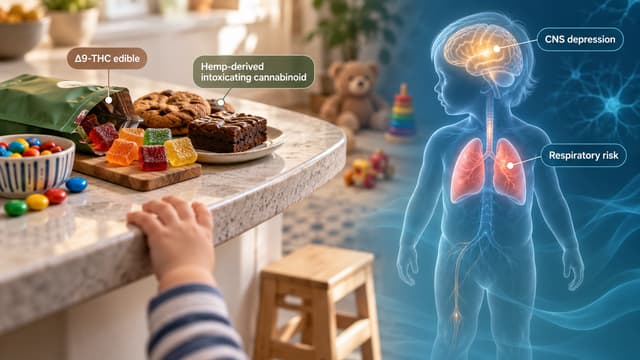
Accidental cannabis ingestion in a young child can begin with a deceptively simple event: a toddler finds a gummy, chocolate, baked good, or drink that looks like ordinary food.
Hours later, the child may be unusually sleepy, unsteady, hypotonic, difficult to arouse, or less interactive than normal. More significant exposures can produce respiratory depression, hypotension, seizures, or profound CNS depression.
U.S. poison-center data identified 7,043 edible cannabis exposures in children younger than six years from 2017 through 2021. Among cases followed to a known outcome, CNS depression was reported in 70%, and 22.7% of all reported cases resulted in hospital admission. [1]
The product landscape has also changed. An exposure may involve conventional Δ9-tetrahydrocannabinol (Δ9-THC), but edible products may also contain intoxicating hemp-derived cannabinoids such as Δ8-THC, Δ10-THC, or THC-O.
A 2026 Journal of Pediatrics study compared 9,667 Δ9-THC edible exposures with 2,169 hemp-derived cannabinoid exposures in children five years or younger. The hemp-derived group had somewhat higher reported rates of respiratory depression, hypotension, vasopressor use, critical-care admission, and overall hospital admission. [2]
Those findings are clinically important, but they do not prove that every hemp-derived cannabinoid is intrinsically more toxic than Δ9-THC. The study was retrospective, relied on poison-center reports, and lacked prospective dose data. Poison-center datasets also incompletely capture hospital-treated cases: a 2025 multicenter study identified 296 symptomatic pediatric edible-cannabinoid cases in hospital records, but only 180 had been reported to the regional poison center. [3]
The most useful clinical approach is therefore to identify what product was involved, how much may have been ingested, what the child is doing physiologically, and whether the course fits isolated cannabinoid toxicity.
Accidental cannabis-edible ingestion can cause clinically important poisoning in infants and young children.
Somnolence, lethargy, ataxia, hypotonia, and altered mental status are characteristic findings.
Severe poisoning may include respiratory depression, hypotension, seizure, profound unresponsiveness, or need for ventilatory support.
Δ9-THC, intoxicating hemp-derived cannabinoids, CBD, and K2/Spice should not be treated as one toxicologic category.
The 2026 national poison-center study found somewhat greater respiratory and hemodynamic morbidity in reported hemp-derived cannabinoid exposures, but the data show association, not intrinsic comparative toxicity.
No specific antidote is established for acute THC intoxication; treatment is primarily supportive.
Urine cannabinoid testing can support an exposure diagnosis in selected cases but does not determine dose, timing, exact product, or clinical severity.
Published dose-response studies can help estimate risk when the Δ9-THC dose is reliable, but they should not become universal admission or discharge thresholds.
There is no single validated observation period for every pediatric cannabis ingestion.
Prevention depends on original packaging, locked storage, separation from ordinary food, and early poison-center consultation after suspected exposure.
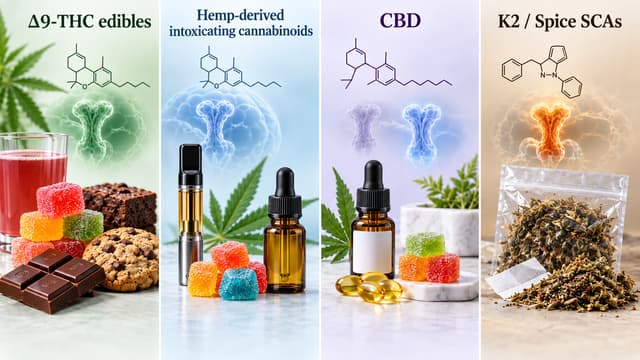
Product identification is central to assessment because several very different substances may be described casually as “cannabis,” “hemp,” or “THC.”
Product category | Examples | Clinical interpretation |
|---|---|---|
Conventional cannabis / Δ9-THC | THC gummies, chocolates, baked goods, drinks | Best-characterized cause of accidental pediatric cannabis-edible poisoning |
Hemp-derived intoxicating cannabinoids | Δ8-THC, Δ10-THC, THC-O | Psychoactive compounds with a smaller pediatric evidence base and variable product formulation |
CBD products | Cannabidiol oils, gummies, other preparations | CBD is pharmacologically distinct from intoxicating THC; product contents and co-ingredients still matter |
Synthetic cannabinoid receptor agonists | K2, Spice, related compounds | A separate drug class with a broader and often more unpredictable toxic syndrome |
Commercial Δ8-THC deserves particular attention. FDA notes that naturally occurring concentrations of Δ8-THC are low and that concentrated commercial Δ8 products are commonly manufactured from hemp-derived CBD. FDA has also raised concerns about variable formulations, labeling, concentrations, manufacturing processes, and contaminants. [4]
“CBD” should not be used as a synonym for “THC.” FDA distinguishes CBD from Δ9-THC and notes that nonprescription CBD products may vary in quality and content; some tested products have not contained the labeled amount of CBD and may contain other cannabinoids or contaminants. [5]
Classic synthetic cannabinoid receptor agonists such as K2 and Spice are a different clinical problem. For that topic, see Synthetic Marijuana Unmasked: The Deadly Truth Behind K2, Spice, and Paper Dope.
A single edible intended for an adult can represent a substantial weight-adjusted dose in a toddler.
Young children also cannot reliably distinguish a THC gummy, chocolate, or cookie from ordinary food. The ingestion may be unwitnessed, so the first clue may be sudden somnolence, ataxia, or abnormal behavior rather than a known exposure.
A 2023 retrospective study of 80 children younger than six with known Δ9-THC edible doses found that THC dose was strongly associated with severe and prolonged toxicity. A threshold of 1.7 mg/kg had high sensitivity for severe toxicity in that cohort. [6]
That number is useful for risk stratification, not as a universal admission or discharge rule. The study was retrospective, relatively small, and involved known Δ9-THC edible doses. The threshold should not automatically be extrapolated to Δ8-THC, Δ10-THC, THC-O, or products with uncertain labeling.
A separate Oregon Poison Center study evaluated 132 single-substance edible THC ingestions in children younger than six. Among children reported to have ingested more than 30 mg THC, 28% developed severe symptoms, 66% had CNS depression, and 17% had respiratory depression. [7]
Again, this is dose-response evidence—not a universal treatment threshold.
The dominant pattern of pediatric cannabis intoxication is neurological.
A systematic review of unintentional pediatric cannabis ingestion found lethargy to be the most common presenting sign, followed by ataxia. Tachycardia, mydriasis, hypotonia, and respiratory depression were also reported. [8]
Children may present with:
unusual sleepiness or lethargy;
difficulty being awakened;
decreased interaction;
hypotonia;
confusion;
impaired coordination;
inability to sit, stand, or walk normally for age.
Profound unresponsiveness is less common but can occur.
Because this presentation overlaps with many other pediatric emergencies, cannabis should be considered without becoming a premature diagnostic conclusion.
Ataxia can be a particularly useful clue in a child who remains awake enough to move. Sudden loss of age-appropriate coordination in a previously well child should raise concern for poisoning as well as neurological, metabolic, and infectious causes.
Vomiting may occur but is nonspecific. A sleepy child who vomits still requires assessment for other ingestions, metabolic illness, infection, trauma, and other causes of altered consciousness.
Tachycardia is commonly reported. Hypotension is less common but clinically important.
In the 2026 national study, hypotension was reported in 3.87% of hemp-derived cannabinoid exposures versus 2.97% of Δ9-THC exposures. [2]
Most pediatric cannabis poisonings do not progress to respiratory failure, but significant CNS depression can impair ventilation or airway protection.
In the 2026 study, respiratory depression was reported in 5.9% of hemp-derived cannabinoid cases compared with 4.6% of Δ9-THC cases. Vasopressor use was 0.37% versus 0.13%, critical-care admission was 11.3% versus 8.58%, and overall admission was 28.35% versus 26.13%. Rates of CNS depression, seizures, and intubation were similar between groups, and no deaths were reported. [2]
These differences should be interpreted carefully.
The study shows that reported hemp-derived edible exposures were associated with similar or somewhat greater healthcare utilization and selected adverse effects. It does not establish that Δ8-THC or another specific hemp-derived cannabinoid is inherently more toxic molecule-for-molecule than Δ9-THC.
Weigel and Wahl analyzed National Poison Data System cases from January 2023 through December 2024 involving children five years or younger with unintentional single-substance edible exposures.
The study included:
9,667 Δ9-THC cases
2,169 hemp-derived cannabinoid cases
The hemp-derived category included reported products containing compounds such as Δ8-THC, Δ10-THC, and THC-O. [2]
The study strengthens the evidence that pediatric exposure to hemp-derived intoxicating cannabinoids is not simply a theoretical extension of conventional cannabis toxicity. These products are producing clinically meaningful pediatric exposures.
What it cannot establish is equally important. It did not prospectively verify the dose or chemical contents of every product, and poison-center reporting does not capture every exposure treated in a hospital. [3]
A child with significant altered mental status should first be managed according to basic pediatric resuscitation principles.
Assessment should prioritize:
airway protection;
breathing and ventilation;
oxygenation;
circulation;
neurological status;
glucose;
exposure history and possible co-ingestants.
A detailed, nonjudgmental history should clarify the product, formulation, labeled THC content, number of pieces that may be missing, timing, whether the package was already open, and whether other medications or substances were accessible.
When possible, caregivers should bring the original package.
No single test should replace clinical assessment.
A point-of-care glucose is appropriate in a young child with otherwise unexplained lethargy, seizure, or altered mental status because hypoglycemia is an important alternative diagnosis. More extensive laboratory testing should be guided by the presentation. [9]
A urine cannabinoid immunoassay may support the diagnosis when exposure history is unclear, but it has limitations.
A positive result does not by itself establish:
the ingested dose;
exact timing;
which modern cannabinoid product was involved;
severity;
whether cannabis fully explains all clinical findings.
Immunoassays can also produce false-positive results, while confirmatory testing may take longer than is useful for immediate clinical management. [9]
A profoundly obtunded, hypotensive, seizing, or hypoventilating child should therefore continue to be evaluated for co-ingestants and alternative diagnoses even when cannabinoid exposure is suspected.
There is no established specific antidote for acute Δ9-THC or intoxicating cannabinoid poisoning. Management is primarily supportive and directed by the child's physiology and clinical course. [9]
A sleepy child who remains adequately ventilated and protects the airway requires close monitoring and reassessment.
A child with clinically important hypoventilation, loss of airway protection, hypoxemia, or respiratory failure requires standard pediatric respiratory and airway support.
There is no validated cannabis-specific respiratory rate, oxygen saturation, consciousness score, or THC concentration that functions as a universal intubation threshold.
Clinically important hypotension may require IV access, fluids, and additional hemodynamic support according to the child's physiology.
Persistent hypotension should also broaden the differential diagnosis and increase concern for co-ingestants or another medical condition.
Seizures are uncommon but have been reported. Active seizures should be managed using standard pediatric and toxicologic seizure treatment while clinicians continue evaluating for alternative causes and co-exposures.
Naloxone does not reverse cannabis toxicity.
However, an opioid exposure should be considered in a child with profound CNS depression or respiratory depression. If opioid ingestion or co-ingestion is clinically plausible, naloxone remains appropriate for the opioid component. [9]
A response to naloxone does not exclude a mixed exposure.
There is no universally validated observation period for every pediatric cannabis ingestion.
The updated ACMT position statement specifically identifies the dose at which a child can safely be observed at home as an area where additional research is still needed. [10]
Disposition should therefore account for:
return toward neurological baseline;
adequate spontaneous ventilation and airway protection;
hemodynamic stability;
age-appropriate coordination and function;
reliability of the product and dose history;
possible co-ingestants;
symptom trajectory;
caregiver reliability and safe supervision;
poison-center or medical-toxicology recommendations when applicable.
A research dose threshold such as 1.7 mg/kg should not substitute for this clinical assessment.
Prevention is particularly important because many pediatric cannabis exposures involve products that look like ordinary food.
The updated ACMT position statement recommends child-resistant, opaque packaging that does not resemble familiar commercial candy or snacks. It also recommends clear THC labeling and Poison Center information. [10]
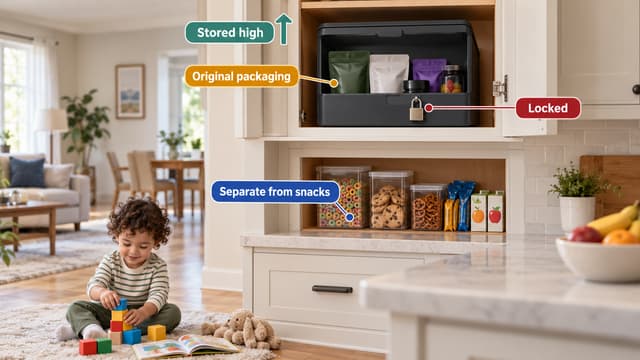
ACMT recommends that cannabis products be stored:
high, out of reach, and out of sight of children;
in their original packaging;
inside a locked container at home or during transport. [10]
Height alone is not sufficient protection.
For broader household prevention guidance, see How to Prevent Poisoning at Home: A Parent's Essential Safety Guide.
Cannabis gummies, chocolates, baked products, and drinks should not be stored beside ordinary snacks.
A child-resistant package is a protective layer, not a guarantee that a child cannot gain access.
ACMT also recommends that adults not consume cannabis products where young children can see them. [10]
This matters particularly for edible products because young children learn by imitation and may interpret the product as ordinary food.
Safe-storage practices should extend beyond parents to grandparents, relatives, babysitters, older siblings, and visitors.
Healthcare providers can also use routine injury-prevention counseling to ask whether cannabis is present in the home and how it is stored.
Poison-center studies are central to understanding pediatric cannabis exposure, but they should not be interpreted as complete national incidence.
A 2025 multicenter study identified 296 symptomatic pediatric edible-cannabinoid cases across three hospitals, while only 180 had been reported to the regional poison center. [3]
America's Poison Centers similarly emphasizes that NPDS cases are based on self-reported calls, not all exposures are reported, and exposure counts should not be interpreted as complete national incidence. [11]
For a deeper discussion of toxicovigilance limitations, see Hidden Patterns in National Poison Data System: Early Signals You're Missing.
Do not wait for severe sedation to develop before seeking advice.
In the United States, Poison Help at 1-800-222-1222 connects callers with their regional poison center.
America's Poison Centers advises immediate emergency escalation when a person is having difficulty breathing, is unresponsive, or is having a seizure. [11]
For more on how poison-center specialists evaluate an exposure, see The Role of Poison Center Calls: Managing Poisoning Cases from Emergency Calls to Critical Decisions.
Readers outside the United States should use their local poison-information service or emergency medical system.
A product may contain conventional Δ9-THC, Δ8-THC, Δ10-THC, THC-O, CBD, a mixture, or a completely different synthetic cannabinoid receptor agonist.
Clarify the product whenever possible.
It does not.
Δ8-THC is psychoactive, and concentrated commercial products may be produced from hemp-derived CBD. [4]
It did not.
The study found differences in reported outcomes and utilization; it did not establish the causal explanation for those differences. [2]
Cannabinoid detection can support exposure, but it does not explain every possible cause of coma, seizure, hypotension, or respiratory depression.
The 1.7 mg/kg finding is useful research-based risk information, not a universal disposition rule. [6]
Sudden unexplained somnolence or ataxia in a previously well toddler should raise suspicion for cannabis exposure.
The package is clinical information—bring it to the emergency department when possible.
Dose per kilogram matters only when product strength and amount are reasonably reliable.
Hemp-derived does not mean non-intoxicating.
Respiratory depression is uncommon compared with uncomplicated sedation, but it changes urgency.
A positive cannabinoid screen supports exposure; it does not grade severity.
Prevention works best as layers: child-resistant packaging, separation from food, original packaging, locked storage, and caregiver education.
Somnolence, lethargy, ataxia, altered mental status, and hypotonia are characteristic. Tachycardia and vomiting may occur. More severe poisoning can involve respiratory depression, hypotension, seizure, profound unresponsiveness, or need for ventilatory support. [1] [8]
Yes, depending on the THC content and the child's weight. An adult-sized edible can represent a substantial mg/kg exposure in a small child. The package label and number of missing pieces are therefore clinically useful when reliable.
Current evidence does not support a simple “safer” or “more dangerous” conclusion. In the 2026 NPDS study, some adverse outcomes were somewhat more frequent among reported hemp-derived cannabinoid exposures, but differences in dose, formulation, labeling, and product composition may contribute. [2]
No established specific antidote exists. Management is supportive and directed by airway, breathing, circulation, neurological status, and complications. [9]
There is no universal validated observation period. Clinical recovery, respiratory and cardiovascular stability, product and dose certainty, possible co-ingestants, and poison-center guidance should determine disposition. [10]
Pediatric cannabis poisoning is increasingly shaped by two realities: edible products can deliver substantial THC doses to very small children, and the modern cannabinoid marketplace includes more than conventional Δ9-THC.
The typical presentation remains neurological—somnolence, lethargy, ataxia, hypotonia, or altered mental status—but clinically important respiratory depression, hypotension, seizure, and profound CNS depression can occur.
The 2026 national poison-center study provides important new evidence that reported hemp-derived cannabinoid edible exposures can be associated with similar or somewhat greater acute morbidity and healthcare utilization than conventional Δ9-THC exposures. That finding should increase clinical attention to these products without being converted into an unsupported claim that all hemp-derived cannabinoids are inherently more toxic.
For clinicians, management remains grounded in fundamentals: stabilize the child, assess the broader differential diagnosis, identify co-ingestants, use testing as supportive evidence rather than a substitute for clinical reasoning, and let the child's physiology and trajectory determine treatment and disposition.
For families and caregivers, prevention remains the highest-value intervention. Cannabis edibles should be treated like potentially dangerous medications—not ordinary food—kept in their original packaging, separated from snacks, and stored in a locked location inaccessible to children.
© All copyright of this material is absolute to Medical toxicology
As the Growth & Content Lead at MedicalToxic.com, I work on content strategy, development, and digital growth. My focus is on making MedicalToxic’s content clear, practical, and accessible, while helping expand the platform’s reach and strengthen its position as a trusted resource in clinical toxicology.
Keep reading
 Pediatric and adolescent Toxicology
Amirhosein Shabrang
 Pediatric and adolescent Toxicology
Omid Mehrpour
 Pediatric and adolescent Toxicology
Omid Mehrpour
 Pediatric and adolescent Toxicology
Omid Mehrpour