Why Can Water Beads Be Missed on X-Ray?

Amirhosein Shabrang
Post on 27 Oct 2026

Amirhosein Shabrang
Post on 27 Oct 2026
 Medical Toxicologymedicaltoxic.com
https://medicaltoxic.com/tox-spotlight/water-beads-missed-on-xray
Why Can Water Beads Be Missed on X-Ray?
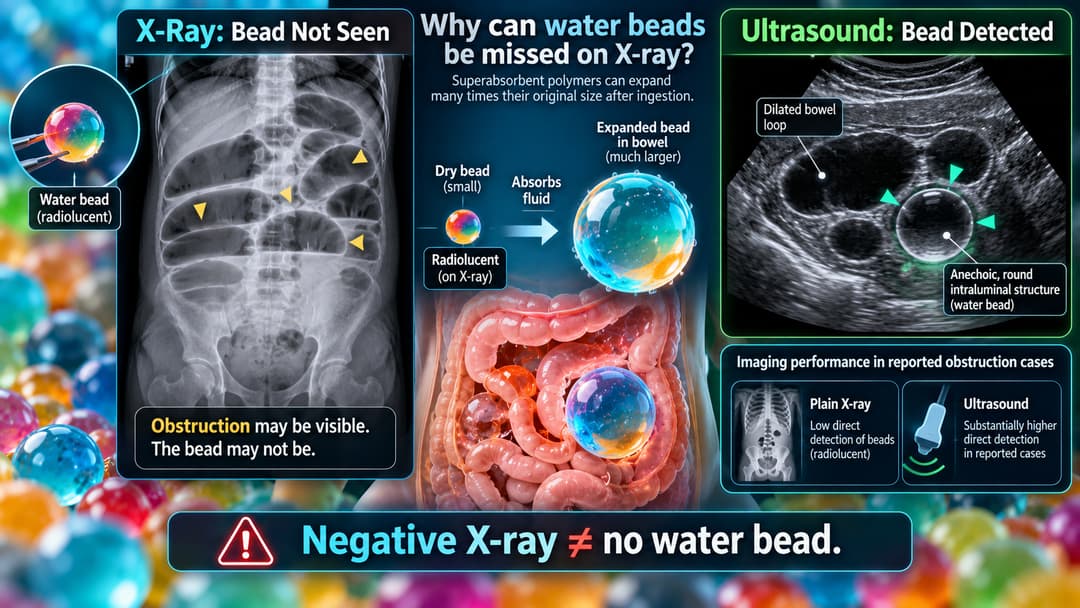
A normal plain radiograph does not reliably exclude ingested water beads because the beads themselves are radiolucent. The X-ray may show the obstruction without showing the object causing it.
Superabsorbent polymer water beads are usually not directly visible on plain X-ray. Radiography may reveal secondary signs of bowel obstruction, such as dilated loops or air-fluid levels, while the bead itself remains unseen. [1]
A negative X-ray therefore does not rule out water-bead ingestion or obstruction when the history and clinical picture remain concerning.
Water beads are made from superabsorbent hydrogel polymers rather than dense radiopaque material.
As they absorb fluid, they can expand inside the gastrointestinal tract but still blend radiographically with surrounding soft tissue and fluid.
In a review of 87 reported children with water-bead bowel obstruction, abdominal radiography visualized the bead itself in only 5.6% of cases in which radiography was used. Ultrasound identified the bead in 85.7% of cases in which ultrasound was performed. [1]
The important distinction is:
the complication may be visible even when the foreign body is not.
Ultrasound can detect expanded water beads as rounded fluid-filled or anechoic intraluminal structures and can also demonstrate associated bowel obstruction.
A 2026 report of two children with water-bead obstruction illustrates the diagnostic trap: plain radiography showed signs of obstruction without a visible radiopaque foreign body, while ultrasound demonstrated the obstructing bead-like lesions. [2]
Ultrasound is not infallible, and further imaging may be needed when findings remain uncertain or complications are suspected.
For the complete exposure-specific assessment and imaging pathway, see Expanding Water Beads Ingestion: Diagnosis and Management guideline.
Water beads should also not be managed as an ordinary blunt foreign body; Foreign Body Ingestion in Children: Poison Center Triage Guideline specifically excludes superabsorbent polymer beads from its routine pathway.
Water beads can obstruct the bowel without ever appearing as a bead on plain X-ray.
When suspicion remains high, a normal X-ray should not close the case.
Sandifer SP, Greene AC, Erturk Q, et al. The Hidden Dangers: Superabsorbent Polymer Beads as a Cause of Bowel Obstruction in Children. Journal of Surgical Research. 2025;315:113–120. doi:10.1016/j.jss.2025.08.016
Shahid S, Khayer BL, Dsouza AP, et al. Acute Small Bowel Obstruction Secondary to Hygroscopic Water Beads Ingestion: A Report of Two Pediatric Cases. Cureus. 2026;18(7). doi:10.7759/cureus.112657
As the Growth & Content Lead at MedicalToxic.com, I work on content strategy, development, and digital growth. My focus is on making MedicalToxic’s content clear, practical, and accessible, while helping expand the platform’s reach and strengthen its position as a trusted resource in clinical toxicology.