Why Can Routine Opioid Screens Miss Nitazenes?

Amirhosein Shabrang
Post on 11 Nov 2026
Amirhosein Shabrang
Post on 11 Nov 2026
 Medical Toxicologymedicaltoxic.com
https://medicaltoxic.com/tox-spotlight/nitazene-negative-urine-opioid-screen
Why Can Routine Opioid Screens Miss Nitazenes?
A negative routine urine opioid screen does not exclude nitazene poisoning. The result may reflect what the assay cannot detect, rather than the absence of a potent synthetic opioid.
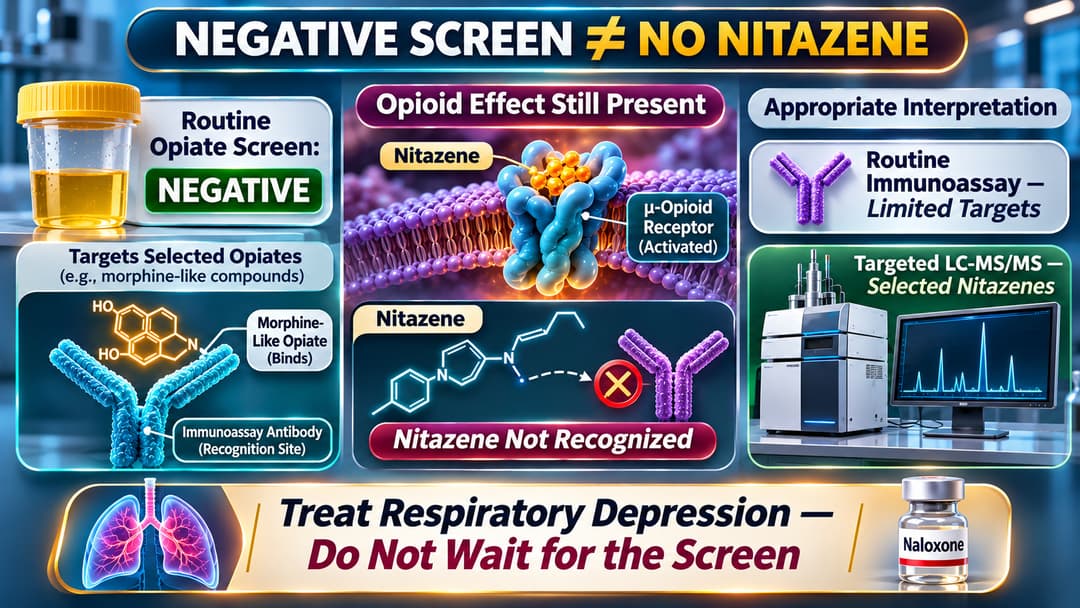
Routine urine opiate immunoassays primarily detect morphine-related compounds. They are not universal tests for all opioid agonists, and conventional opiate screens generally do not detect nitazenes. [1] [2]
A negative opiate screen—and even a negative fentanyl-specific screen—cannot reliably exclude nitazene exposure.
When the clinical picture suggests opioid poisoning, airway support and naloxone should not be delayed while awaiting toxicology results. [1]
Urine immunoassays recognize selected chemical structures or drug metabolites.
Most routine opiate assays are designed around morphine-related compounds. Nitazenes are structurally different synthetic opioids, even though they can activate the same μ-opioid receptor and produce severe respiratory depression.
A fentanyl-specific immunoassay is also not automatically a nitazene assay.
The result is a predictable diagnostic mismatch: the patient's opioid receptors can be activated by a drug that the laboratory's screening antibodies do not recognize. [1] [2]
It means that the substances detected by that particular assay were not found above its reporting threshold.
It does not establish that every possible opioid was absent.
When nitazene identification would be clinically or epidemiologically important, specialized laboratory analysis may be needed. Liquid chromatography–mass spectrometry methods can identify selected nitazenes and metabolites, but detection depends on the compounds included in the testing panel and the method's sensitivity. [2]
Not every definitive toxicology panel automatically includes every emerging nitazene analogue.
The immediate clinical decision remains separate from laboratory confirmation: recognize and manage opioid-type respiratory depression, support ventilation, and use naloxone when opioid poisoning is suspected.
For the broader clinical approach to opioid reversal, recurrent respiratory depression, and mixed emerging-drug exposures, see Naloxone in Xylazine, Nitazenes, and Fentanyl Analogue Overdose.
A negative opioid screen tests the assay's limits—not the patient's opioid receptors.
Treat the toxidrome, and use targeted testing when identification matters.
Stolbach A, Connors N, Nelson L, Kulig K. ACMT Position Statement: Interpretation of Urine Opiate and Opioid Tests. Journal of Medical Toxicology. 2022;18(2):176–179. doi:10.1007/s13181-021-00864-1
Verbeek J, Brinkman DJ. A Comprehensive Narrative Review of Protonitazene: Pharmacological Characteristics, Detection Techniques, and Toxicology. Basic & Clinical Pharmacology & Toxicology. 2025;137(2). doi:10.1111/bcpt.70078
As the Growth & Content Lead at MedicalToxic.com, I work on content strategy, development, and digital growth. My focus is on making MedicalToxic’s content clear, practical, and accessible, while helping expand the platform’s reach and strengthen its position as a trusted resource in clinical toxicology.
Keep reading