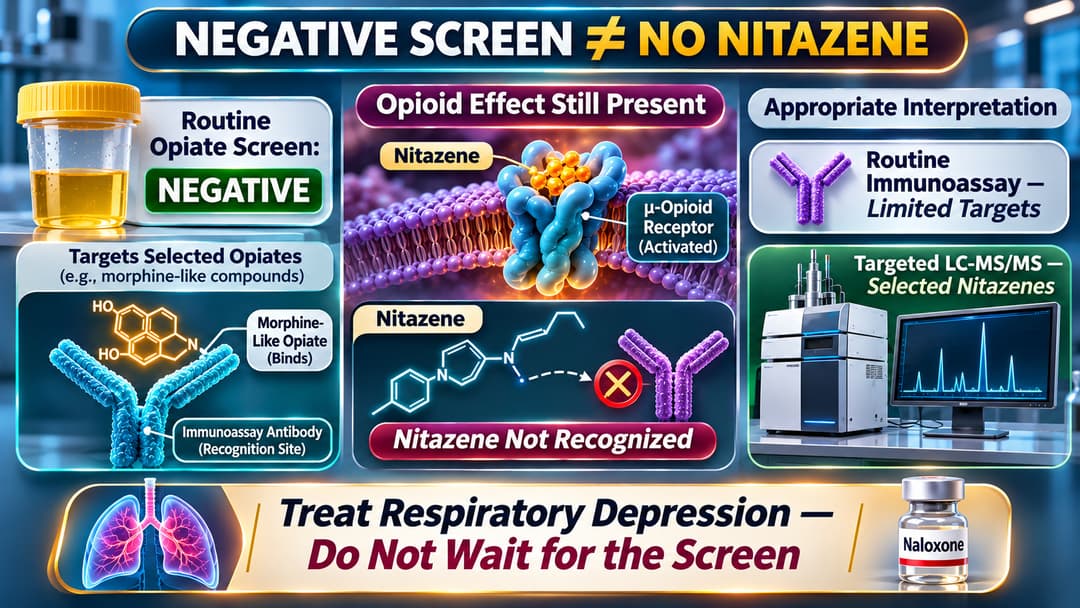
Why Isn’t 7-OH Clinically Interchangeable With Kratom?

Amirhosein Shabrang
Post on 30 Oct 2026
Amirhosein Shabrang
Post on 30 Oct 2026
 Medical Toxicologymedicaltoxic.com
https://medicaltoxic.com/tox-spotlight/7-oh-not-interchangeable-with-kratom
Why Isn’t 7-OH Clinically Interchangeable With Kratom?
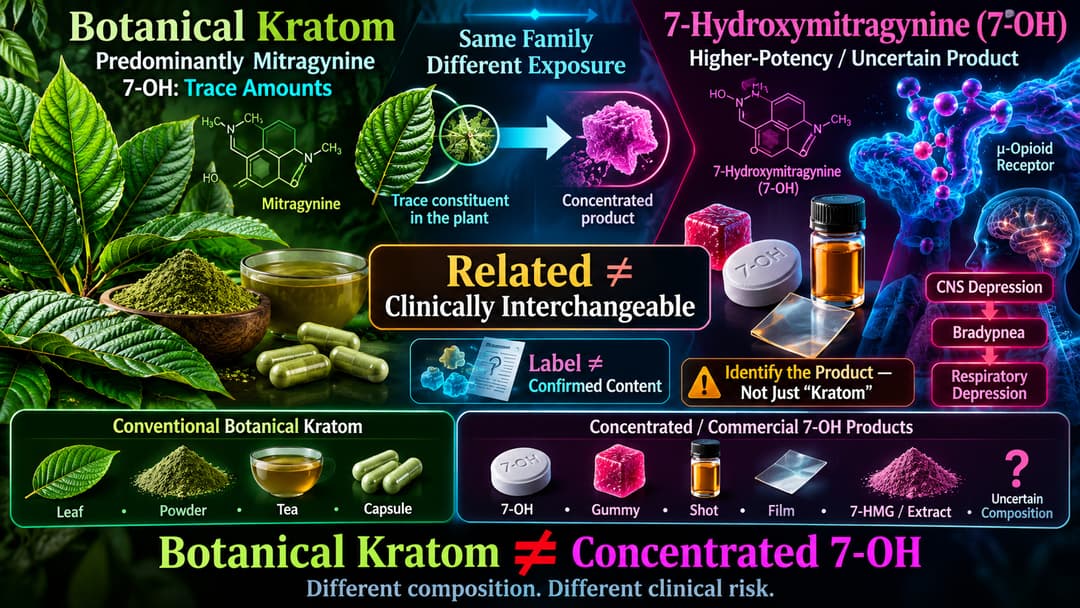
Concentrated 7-hydroxymitragynine (7-OH) products should not be treated as equivalent to conventional botanical kratom. The product may share a kratom-derived name while representing a very different opioid exposure.
Conventional botanical kratom is predominantly mitragynine-containing, with only trace amounts of 7-OH. Commercial concentrated 7-OH products can contain far higher amounts of this potent μ-opioid agonist and may produce a more conventional opioid phenotype, including profound sedation, respiratory depression, dependence, and withdrawal. [1]
“Kratom” on the label does not establish that the exposure is botanical kratom.
The exact formulation matters.
7-OH is related to kratom, but concentrated commercial 7-OH is not simply a stronger serving of ordinary leaf.
A 2026 analysis of commercially available products found major discrepancies between labeled and measured 7-OH content. More than 98% of the analyzed 7-OH-labeled products showed chemical findings consistent with semisynthetic origin rather than ordinary kratom leaf composition. [2]
This matters clinically because 7-OH has substantially greater μ-opioid activity than mitragynine. Severe human toxicity has also been reported, including cardiopulmonary arrest after reported 7-OH use with recovery following naloxone administration. [3]
That case-level evidence does not define incidence or a toxic-dose threshold, but it confirms that concentrated 7-OH exposure can produce clinically important opioid-type toxicity.
Products may be sold as tablets, gummies, shots, films, extracts, or “enhanced” kratom.
Some products marketed as kratom extracts have contained very high 7-OH concentrations with chemical profiles inconsistent with authentic kratom leaf. Product labels may also differ from measured contents. [2]
When evaluating an exposure, do not stop at the word kratom.
Look for:
7-OH, 7-HMG, or 7-hydroxymitragynine on the label;
“enhanced,” “fortified,” or concentrated formulations;
tablets, gummies, shots, films, or extracts rather than identifiable leaf, powder, or tea;
other modified alkaloids or uncertain ingredients.
If the product cannot be reliably identified, the uncertainty itself matters.
For the full product-classification, poison-center triage, respiratory-depression, naloxone, observation, dependence, and withdrawal framework, see Kratom and 7-Hydroxymitragynine Poisoning.
Do not classify the exposure by the word “kratom.” Classify the product.
Botanical leaf and concentrated 7-OH may share an origin story, but they should not share the same clinical assumptions.
Moss MJ, Altholz J, Babu K, Perrone J, Stolbach A. ACMT Position Statement: Public Health Risks of 7-Hydroxymitragynine and Other Kratom-Associated Compounds. Journal of Medical Toxicology. 2026;22(4):513–516. doi:10.1007/s13181-026-01154-4
Avula B, Ali SK, Tatapudi KK, et al. Quantitative analysis of 7-hydroxymitragynine in commercial kratom products and its stability under chemical and physiological conditions. Phytochemistry. 2026;247:114871. doi:10.1016/j.phytochem.2026.114871
Pullman MK, Kanumuri SRR, Leon JF, et al. Cardio-pulmonary arrest in a patient revived with naloxone following reported use of 7-hydroxymitragynine. Clinical Toxicology. 2026;64(1):65–66. doi:10.1080/15563650.2025.2565428
As the Growth & Content Lead at MedicalToxic.com, I work on content strategy, development, and digital growth. My focus is on making MedicalToxic’s content clear, practical, and accessible, while helping expand the platform’s reach and strengthen its position as a trusted resource in clinical toxicology.
Keep reading