Why Is Severe Hypoglycemia Uncommon in GLP-1 Overdose?

Amirhosein Shabrang
Post on 28 Nov 2026
Amirhosein Shabrang
Post on 28 Nov 2026
 Medical Toxicologymedicaltoxic.com
https://medicaltoxic.com/tox-spotlight/glp1-overdose-hypoglycemia-risk
Why Is Severe Hypoglycemia Uncommon in GLP-1 Overdose?
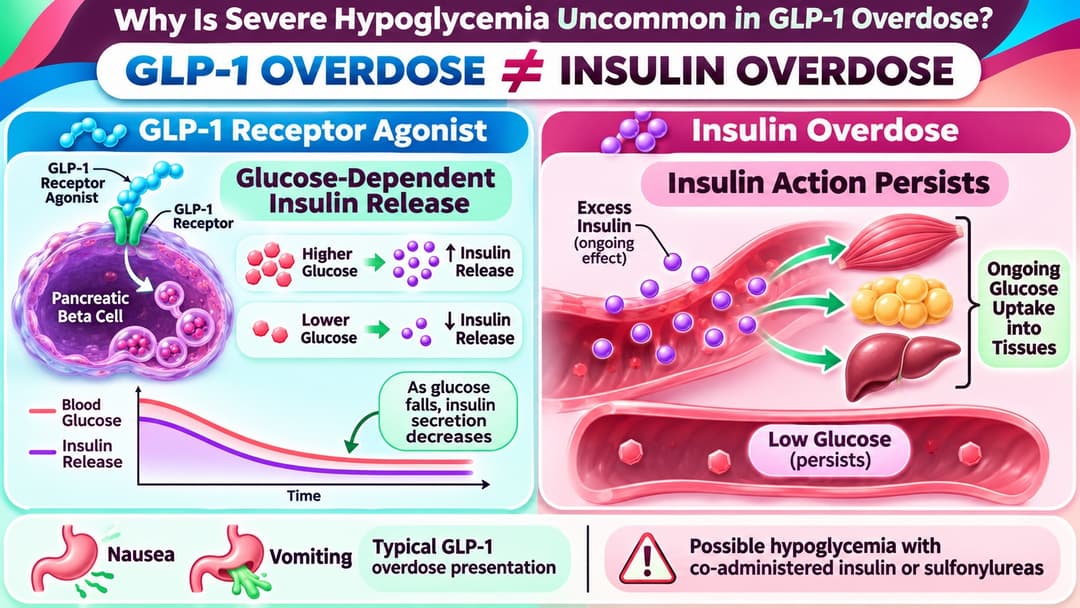
An overdose of a GLP-1 receptor agonist does not usually behave like an insulin overdose. Nausea and vomiting are more typical than severe hypoglycemia when the GLP-1 drug is the only exposure.
GLP-1 receptor agonists stimulate insulin secretion in a glucose-dependent manner. Their insulin-releasing effect decreases as blood glucose falls, limiting the tendency toward profound hypoglycemia seen with excess insulin or sulfonylureas. [1]
Poison-center studies suggest that gastrointestinal symptoms predominate and severe hypoglycemia is uncommon in isolated GLP-1 receptor agonist exposures.
Uncommon does not mean impossible, particularly when other glucose-lowering medications or inadequate intake are involved. [2]
Insulin overdose supplies excess insulin activity regardless of the patient's current glucose concentration.
GLP-1 receptor agonists instead enhance endogenous insulin secretion primarily in response to elevated glucose.
This distinction helps explain why many reported GLP-1 overdose presentations involve nausea, vomiting, or abdominal discomfort rather than profound hypoglycemia. [1]
However, poison-center series are observational and may not fully capture severe or unreported cases.
Co-exposure to insulin or sulfonylureas can substantially alter the clinical picture.
Prolonged vomiting, reduced food intake, and other patient-specific factors may also contribute to low glucose or dehydration.
Therefore, blood glucose still requires assessment when symptoms, co-medications, or the exposure history make hypoglycemia plausible. A reassuring glucose concentration does not exclude clinically important gastrointestinal toxicity or dehydration.
For the full formulation, dosing-error, observation, glucose-monitoring, and disposition framework, see GLP-1 Receptor Agonist Toxicity: Semaglutide, Tirzepatide, and Related Agents.
GLP-1 overdose is not insulin overdose.
The glucose-dependent mechanism makes severe isolated hypoglycemia less typical—but the clinical context still decides what must be monitored.
GLP-1 Receptor Agonist Exposures Are Increasingly Common and Generally Associated with Mild Symptoms: A Single Poison Center Experience. Journal of Medical Toxicology. 2024. doi:10.1007/s13181-024-01008-x
Characterization of Glucagon-like Peptide-1 (GLP-1) Agonist Exposures Reported to a Single United States Poison Center. Clinical Toxicology. 2025. doi:10.1080/15563650.2024.2444642
As the Growth & Content Lead at MedicalToxic.com, I work on content strategy, development, and digital growth. My focus is on making MedicalToxic’s content clear, practical, and accessible, while helping expand the platform’s reach and strengthen its position as a trusted resource in clinical toxicology.
Keep reading
Food and Drug Toxicology
27 Nov 2026
Amirhosein Shabrang
Food and Drug Toxicology
12 Nov 2026
Amirhosein Shabrang
Food and Drug Toxicology
27 Oct 2026
Amirhosein Shabrang
We would like to use analytics and session-replay tools to understand how this site is used. They are optional and the site works fully without them. Signing in still needs its own cookie either way. Our Privacy Policy names each one.