Why Can Clarithromycin Make Colchicine Toxic at Normal Doses?

Amirhosein Shabrang
Post on 12 Nov 2026

Amirhosein Shabrang
Post on 12 Nov 2026
 Medical Toxicologymedicaltoxic.com
https://medicaltoxic.com/tox-spotlight/clarithromycin-colchicine-toxic-interaction
Why Can Clarithromycin Make Colchicine Toxic at Normal Doses?
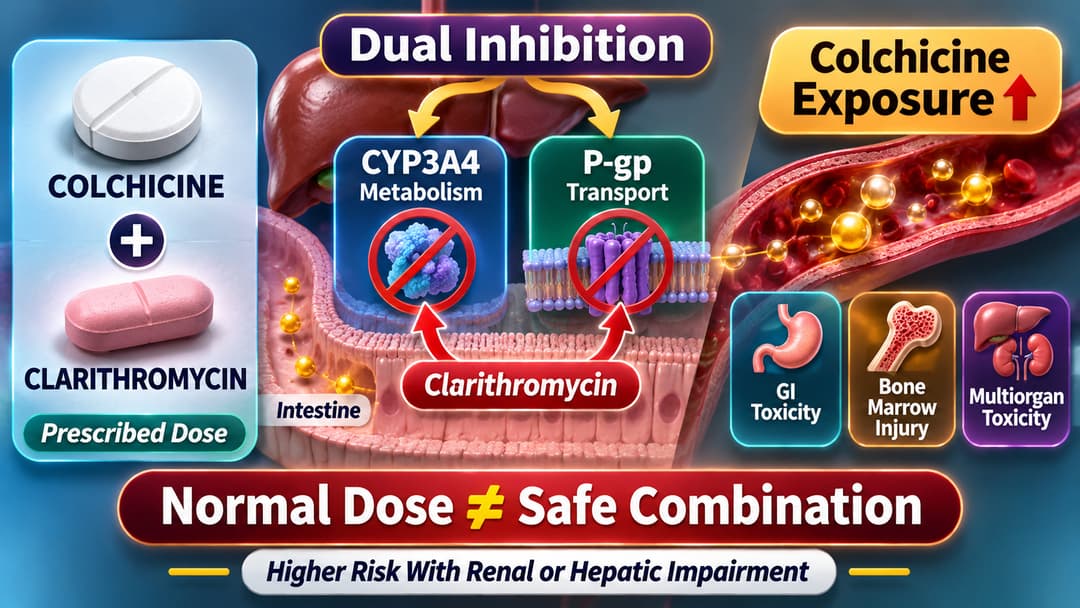
Clarithromycin can turn an otherwise prescribed colchicine dose into a dangerous exposure by inhibiting two pathways that normally limit colchicine concentrations.
Clarithromycin inhibits both CYP3A4 and P-glycoprotein (P-gp), which are important for colchicine metabolism and transport. Combining these drugs can substantially increase colchicine exposure and has caused life-threatening and fatal toxicity. [1]
A correct colchicine prescription does not make the combination safe.
The interaction is particularly dangerous in patients with impaired kidney or liver function. Current U.S. labeling contraindicates colchicine with dual P-gp/CYP3A4 inhibitors in patients with renal or hepatic impairment. [1]
Colchicine depends on CYP3A4-mediated metabolism and P-glycoprotein transport to limit systemic exposure.
Clarithromycin inhibits both pathways.
The result can be greater colchicine absorption and reduced drug elimination, allowing clinically important accumulation without an intentional overdose or an obvious prescribing error.
This is not merely a theoretical interaction. In a retrospective study of 116 hospitalized patients receiving colchicine and clarithromycin, concurrent exposure was associated with fatal outcomes, particularly among patients with renal impairment. The study was observational and cannot establish an individual patient's probability of death. [2]
Early symptoms may look like ordinary gastrointestinal intolerance.
New diarrhea, nausea, vomiting, or abdominal pain after clarithromycin is added to colchicine should prompt concern, particularly when accompanied by worsening kidney function or systemic illness.
Severe toxicity can progress to cytopenias, infection, neuromuscular injury, shock, and multiorgan failure. [1]
Do not wait for profound cytopenia or organ failure before recognizing a potentially dangerous interaction.
Avoid co-prescribing when possible, and urgently reassess the medications and clinical condition if overlapping exposure has occurred. Suspected toxicity requires prompt colchicine discontinuation and medical evaluation.
For the broader interaction checklist, evaluation, serial laboratory monitoring, and management of established toxicity, see Colchicine Poisoning: Recognition, Decontamination, Multiorgan Toxicity, and Critical Care Management.
With colchicine and clarithromycin, the interaction itself can create the toxic exposure.
Always check the medication list before assuming a prescribed colchicine dose is safe.
DailyMed, U.S. National Library of Medicine. COLCHICINE Capsules: Prescribing Information. Revised September 2025. Sections 4, 5.3, and 7.
Hung IFN, Wu AKL, Cheng VCC, et al. Fatal Interaction between Clarithromycin and Colchicine in Patients with Renal Insufficiency: A Retrospective Study. Clinical Infectious Diseases. 2005;41(3):291–300. doi:10.1086/431592
As the Growth & Content Lead at MedicalToxic.com, I work on content strategy, development, and digital growth. My focus is on making MedicalToxic’s content clear, practical, and accessible, while helping expand the platform’s reach and strengthen its position as a trusted resource in clinical toxicology.
Keep reading
Food and Drug Toxicology
27 Oct 2026
Amirhosein Shabrang