Does High Lactate Prove Cyanide Poisoning After a Fire?

Amirhosein Shabrang
Post on 25 Nov 2026
Amirhosein Shabrang
Post on 25 Nov 2026
 Medical Toxicologymedicaltoxic.com
https://medicaltoxic.com/tox-spotlight/cyanide-lactate-smoke-inhalation
Does High Lactate Prove Cyanide Poisoning After a Fire?
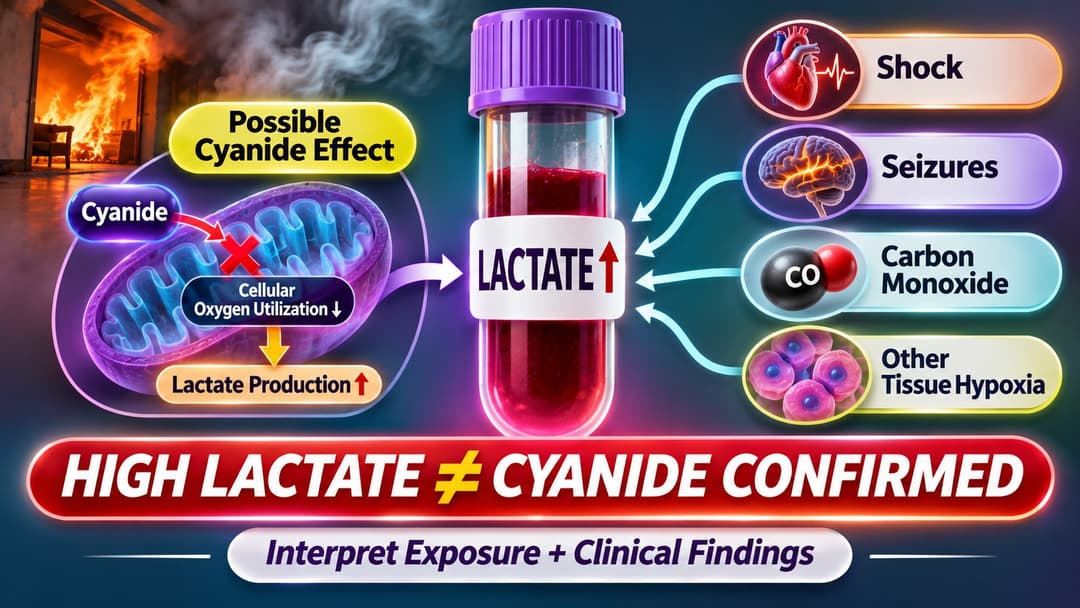
Markedly elevated lactate after smoke inhalation is an important clue to possible cyanide poisoning—but it is not a cyanide assay and cannot establish the diagnosis by itself.
Cyanide impairs mitochondrial oxygen utilization, promoting anaerobic metabolism and lactate accumulation. In patients exposed to smoke from an enclosed-space fire, severe lactic acidosis can substantially strengthen suspicion for cyanide toxicity. [1]
A high lactate is supportive evidence, not definitive proof. Shock, seizures, carbon monoxide poisoning, and other causes of tissue hypoxia may also increase lactate.
Clinical assessment must integrate exposure circumstances, neurologic findings, circulation, and acid-base status. [2]
Cyanide inhibits cellular respiration even when oxygen is present in the circulation.
When oxidative energy production is impaired, cells increasingly rely on anaerobic pathways, producing lactate.
A classic study of smoke-inhalation victims without severe burns found a relationship between elevated plasma lactate and toxic blood cyanide concentrations. [1]
That evidence supports lactate as a useful clue in an appropriate exposure context, not as a universal diagnostic cutoff applicable to every fire victim.
Fire victims may have several simultaneous causes of metabolic stress.
Carbon monoxide exposure, circulatory shock, severe burns, and seizures can contribute to lactic acidosis. Therefore, one lactate measurement cannot identify cyanide as the sole cause.
Likewise, a single relatively reassuring early lactate should not override a strongly concerning exposure history with rapidly progressive coma or cardiovascular collapse.
When life-threatening cyanide poisoning is strongly suspected, emergency treatment decisions should not wait for confirmatory cyanide assays, which are rarely available quickly enough to guide initial care. [2]
For the full smoke-inhalation assessment, antidote-selection, airway, and resuscitation pathway, see Cyanide Poisoning: Hydroxocobalamin, Antidotes, and Emergency Management.
Lactate can strengthen the cyanide hypothesis, but it cannot identify the poison by itself.
Interpret the number in the context of the fire and the patient's physiology.
Baud FJ, Barriot P, Toffis V, et al. Elevated Blood Cyanide Concentrations in Victims of Smoke Inhalation. New England Journal of Medicine. 1991;325:1761–1766. doi:10.1056/NEJM199112193252502
Anseeuw K, Delvau N, Burillo-Putze G, et al. Cyanide poisoning by fire smoke inhalation: a European expert consensus. European Journal of Emergency Medicine. 2013;20(1):2–9.
As the Growth & Content Lead at MedicalToxic.com, I work on content strategy, development, and digital growth. My focus is on making MedicalToxic’s content clear, practical, and accessible, while helping expand the platform’s reach and strengthen its position as a trusted resource in clinical toxicology.
Keep reading
Clinical Toxicology
26 Nov 2026
Amirhosein Shabrang
Clinical Toxicology
09 Nov 2026
Amirhosein Shabrang
Clinical Toxicology
29 Oct 2026
Amirhosein Shabrang
Clinical Toxicology
24 Oct 2026 · Updated 15 Nov 2026
Amirhosein Shabrang
We would like to use analytics and session-replay tools to understand how this site is used. They are optional and the site works fully without them. Signing in still needs its own cookie either way. Our Privacy Policy names each one.