TGA Posts Andrographis Product Recalls as Anaphylaxis Safety Action Escalates
post on 05 Oct 2026

post on 05 Oct 2026
 Medical Toxicologymedicaltoxic.com
https://medicaltoxic.com/news/tga-andrographis-recalls-anaphylaxis
TGA Posts Andrographis Product Recalls as Anaphylaxis Safety Action Escalates
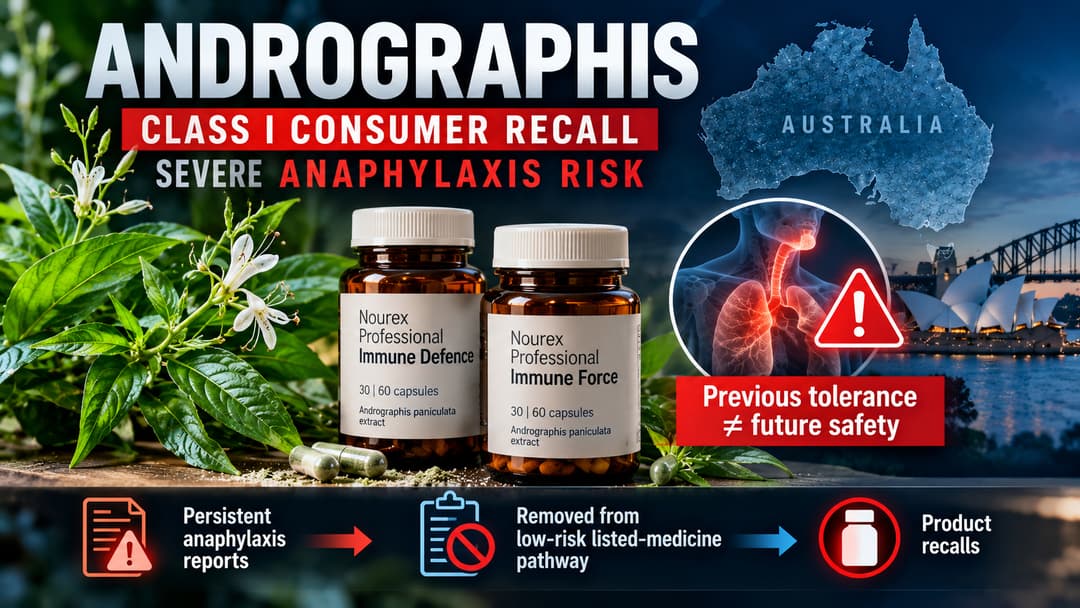
Australia’s TGA has published Class I consumer recalls for two Andrographis medicines after concluding that unpredictable, potentially fatal anaphylaxis can no longer be adequately managed under the low-risk listed-medicines framework.
Australia’s Therapeutic Goods Administration has moved from ingredient-level regulatory restrictions to product-level recalls as concern continues over severe allergic reactions associated with Andrographis paniculata.
On October 1, TGA published a market-action notice advising consumers that specified Andrographis-containing medicines were being recalled because of the risk of severe allergic reactions, including anaphylaxis. [1]
The current recall covers Nourex Professional Immune Defence 30 and 60 and Nourex Professional Immune Force 30 and 60, sponsored by PBA Wholesale Pty Ltd.
The underlying TGA recall database classifies the action as a consumer-level Class I recall and records a commencement date of September 28, 2026. [2]
The October recalls are therefore the latest stage of a safety issue that Australia had already escalated at the ingredient level in September.
TGA’s October 1 consumer notice lists:
Product | ARTG | Current TGA scope |
|---|---|---|
Nourex Professional Immune Defence 30 and 60 | AUST L 314703 | All unexpired batches |
Nourex Professional Immune Force 30 and 60 | AUST L 365278 | All unexpired batches |
The detailed DRAC record identifies the current affected stock as:
Nourex Professional Immune Defence 30 & 60
Batch 194576
Batch 197886
Batch 194828
Batch 198848
Batch 201158
Nourex Professional Immune Force 30 & 60
Batch 147285
Batch 147286
The DRAC record also shows that ARTG entries 314703 and 365278 are cancelled. [2]
Consumers who have the recalled products are advised not to use them and to return them to the place of purchase. [1]
The distinction between the September regulatory decision and the October recalls is important.
On September 17, Andrographis was removed from the Therapeutic Goods (Permissible Ingredients) Determination, meaning that new medicines containing Andrographis can no longer enter the Australian Register of Therapeutic Goods through the lower-risk listed-medicines pathway. [3]
That change did not automatically remove every existing Andrographis product from the market.
TGA explicitly said existing listed medicines could remain available while sponsors considered voluntary cancellation, cessation of supply or consumer-level recall. If sponsors did not act in a timely manner, TGA said further regulatory action could begin from mid-October. [3]
The current October recall page should therefore not be rewritten as:
“Australia has recalled all Andrographis medicines.”
At present, TGA’s public recall table identifies the two Nourex products above.
The regulatory action follows years of adverse-event monitoring and increasingly strong risk-management measures.
Andrographis-containing listed medicines have carried an allergy warning in Australia since 2019. A stronger warning was added to one product in 2024.
TGA concluded that these measures did not produce a meaningful reduction in anaphylaxis reporting. [4]
By December 31, 2025, TGA had received 287 reports of anaphylaxis associated with Andrographis-containing medicines since the first reports in 2005. [4]
The regulator’s supplementary analysis found that reporting had remained persistently high since 2019 and concluded that the risk was not compatible with the framework intended for lower-risk medicines available for self-selection. [4]
Those reports represent pharmacovigilance data.
They should not be interpreted as an incidence rate, and an adverse-event report does not by itself prove causality in every individual case.
TGA’s regulatory conclusion instead reflects its assessment of the overall safety signal, expert advice, adverse-event data, product formulations and published evidence. [4]
TGA’s current regulatory material refers to a fatal case associated with Andrographis that was reported in June 2024. [3]
This is an important date distinction.
The October 2026 recalls do not announce a new fatality.
Rather, the earlier fatal report forms part of the evidence considered during the regulator’s broader safety review.
One of the most clinically important findings is the unpredictability of Andrographis-associated anaphylaxis.
TGA says reactions can occur:
on the first known exposure
or
after a person has previously taken Andrographis without a problem. [4]
Most people described in the reports did not have a prior history of allergy or asthma, and symptoms generally began within about 30 minutes of taking the product. [4]
That means prior uneventful use should not be presented as evidence that future exposure is safe.
The mechanism remains incompletely understood.
TGA identifies possible warning signs including:
difficult or noisy breathing;
swelling of the tongue;
swelling or tightness in the throat;
wheezing or persistent coughing;
difficulty speaking or a hoarse voice;
persistent dizziness or collapse;
becoming pale and floppy in a young child; and
abdominal pain or vomiting. [4]
Anaphylaxis is a medical emergency.
TGA advises calling 000 immediately when anaphylaxis is suspected and states that anaphylaxis requires immediate treatment with adrenaline, or epinephrine. [1] [4]
This News does not expand that regulator advice into a treatment protocol.
For the currently recalled Nourex products, TGA advises consumers:
do not use the product;
return it to the place of purchase, or follow sponsor/supplier instructions;
speak with a health professional if concerned about a medicine they have been taking; and
seek emergency medical help immediately if anaphylaxis is suspected. [1]
For other Andrographis-containing medicines that are not currently listed on the recall page, TGA’s broader advice is to check labels, reconsider the need for continued use and discuss individual circumstances with a health professional. [3]
Health professionals should not assume that a patient who previously tolerated an Andrographis product is protected from a future severe reaction.
TGA specifically advises clinicians that reactions can occur on first use or after previous uneventful use and that reactions commonly begin rapidly. [3]
Suspected adverse reactions should be reported to TGA.
From a medical-toxicology and medication-safety perspective, this is also another reminder that products marketed as herbal, traditional or “natural” should not automatically be treated as pharmacologically low risk.
MedicalToxic discusses that broader principle in Vitamin Toxicity: When “Natural” Isn’t Safe.
The product recall is the immediate consumer action.
The more consequential regulatory development is the loss of Andrographis’s place in the low-risk listed-medicines pathway.
TGA concluded that stronger warning labels, formulation restrictions and education were not sufficient to manage the anaphylaxis risk within that framework. [3] [4]
This does not amount to an absolute ban on Andrographis.
TGA notes that an Andrographis medicine could instead proceed through the registered medicines pathway, under which individual products undergo pre-market assessment for safety, quality and efficacy and can carry more extensive risk information. [3]
The regulatory message is therefore more precise:
TGA no longer considers Andrographis appropriate for automatic use in medicines regulated as low risk.
The underlying anaphylaxis signal is not new.
What changed in September and October 2026 is the regulatory response.
First, Australia removed Andrographis from the list of permissible ingredients for new listed medicines.
Then sponsors began moving to product-level action.
The current TGA public recall page now identifies two Nourex products in a Class I consumer recall, covering all unexpired batches. [1] [2]
That progression—from warning labels, to a safety review, to removal from the low-risk ingredient framework, and now to individual product recalls—is the central news development.
Several points should remain clear.
The TGA adverse-event reports do not establish anaphylaxis incidence because the total number of exposed users and reporting completeness are uncertain.
Not every reported case independently proves causation by Andrographis.
The current product recall does not cover every Andrographis-containing medicine previously listed in Australia.
The ingredient-level decision does not mean every existing product disappeared from shelves on September 17.
And the fatal case cited in the current regulatory material dates to June 2024, not October 2026.
Australia’s Andrographis safety response has moved into a new phase.
TGA has published Class I consumer recalls for Nourex Professional Immune Defence 30 and 60 and Nourex Professional Immune Force 30 and 60, while the ingredient itself has already been removed from the pathway used for new low-risk listed medicines. [1] [3]
The decision follows persistent reports of potentially life-threatening anaphylaxis despite years of warning labels and other risk-management efforts.
For patients and clinicians, the most important clinical message is simple:
Previous tolerance does not guarantee that a future exposure will be safe.
Therapeutic Goods Administration. (2026, October 1). Andrographis recalls: Concerns over allergy risk.
Therapeutic Goods Administration. (2026). Database of Recalls, Product Alerts and Product Corrections — RC-2026-RN-00747-1.
Therapeutic Goods Administration. (2026, September 18). High-moderate risk changes to permissible ingredients - Andrographis paniculata 2026.
Therapeutic Goods Administration. (2026, April 8). Andrographis paniculata (Andrographis) and anaphylaxis - updated safety review and supplementary report.
Keep reading
Public Health Warnings and Recalls
03 Oct 2026
Public Health Warnings and Recalls
03 Oct 2026
Public Health Warnings and Recalls
25 Sept 2026
Public Health Warnings and Recalls
02 Sept 2026