FDA Classifies Superpotent Thyroid Tablet Recall as Class I
post on 03 Oct 2026

post on 03 Oct 2026
 Medical Toxicologymedicaltoxic.com
https://medicaltoxic.com/news/fda-class-i-superpotent-thyroid-tablet-recall
FDA Classifies Superpotent Thyroid Tablet Recall as Class I
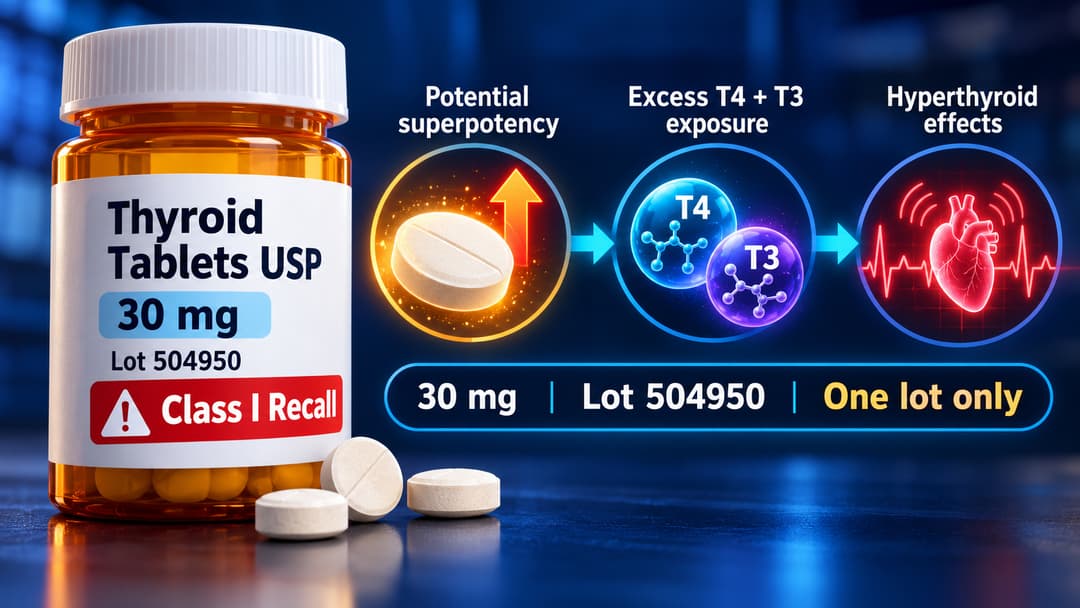
FDA has assigned its highest-risk recall classification to one lot of Vitruvias Thyroid Tablets USP 30 mg over potential superpotency, raising concern for unintended excess thyroid-hormone exposure.
A nationwide thyroid-medication recall first announced in August has received a more serious regulatory designation.
The U.S. Food and Drug Administration has classified the recall of one lot of Vitruvias Therapeutics Thyroid Tablets, USP 30 mg as Class I, FDA's highest recall classification.
The affected product is Lot 504950, NDC 69680-166-00, with an expiration date of September 30, 2026.
Vitruvias initiated the voluntary consumer-level recall on August 21 after testing confirmed the potential for the product to be superpotent. FDA posted the company announcement on August 24. [1]
The newer development is the FDA risk classification.
FDA's Enforcement Report lists the recall as D-0866-2026 and Class I, with a classification date of September 22 and an Enforcement Report date of September 23. [2]
That distinction matters: the recall itself is not new—the Class I classification is.
Vitruvias already removed the affected lot from distribution in August because of potential superpotency.
FDA subsequently completed its hazard classification.
FDA explains that recalls may be initiated and publicly announced before the agency completes its health-hazard assessment and assigns Class I, II or III status. The later classification therefore should not be interpreted as a second recall or as evidence that the affected product population has expanded. [3]
What has changed is FDA's formal assessment of the potential health hazard presented by the recalled lot.
FDA defines a Class I recall as a situation in which there is a reasonable probability that use of or exposure to a violative product will cause serious adverse health consequences or death. [3]
That is FDA's most serious recall category.
But Class I does not mean that every patient exposed to the product will experience serious toxicity.
It also does not mean that deaths, poisonings or a cluster of adverse events have already occurred.
In the original August recall notice, Vitruvias said it had received no reports of adverse events known to be related to the recall at that time. [1]
The classification reflects the potential consequences of the potency defect, not proof that those outcomes have occurred.
The recall remains highly specific.
Product detail | Recalled product |
|---|---|
Product | Thyroid Tablets, USP |
Strength | 30 mg / ½ grain |
NDC | 69680-166-00 |
Lot | 504950 |
Expiration | September 30, 2026 |
Bottle size | 100 tablets |
Distribution | U.S. nationwide |
Distribution period | January 31–September 30, 2025 |
Recall reason | Potential superpotency |
FDA recall number | D-0866-2026 |
FDA classification | Class I |
The August company announcement listed 3,655 units released and 1,955 units sold. [1]
The recall does not apply to every thyroid-replacement medication, every Vitruvias strength or all porcine-derived thyroid products.
The identified problem is limited to the specified 30-mg lot 504950.
The toxicology issue is unusually straightforward:
the concern is unintended excess pharmacologic exposure.
FDA's recall reason is superpotency.
This is not being described as bacterial contamination, particulate contamination, a wrong-drug packaging error or an undeclared ingredient problem.
Thyroid Tablets, USP are a porcine-derived thyroid preparation containing two active thyroid hormones:
levothyroxine, or T4
liothyronine, or T3
The labeled 30-mg tablet contains 19 micrograms of levothyroxine and 4.5 micrograms of liothyronine. [4]
FDA has not publicly provided a percentage or measured magnitude of superpotency for lot 504950.
MedicalToxic therefore does not infer how far above specification the tablets may be.
Thyroid hormone replacement is intended to restore physiologic hormone activity in people with hypothyroidism.
A superpotent preparation can shift exposure in the opposite direction, producing effects consistent with thyroid-hormone excess or iatrogenic hyperthyroidism.
The Vitruvias recall lists possible manifestations including:
weight loss;
heat intolerance;
fatigue;
nervousness;
muscle weakness;
hypertension;
chest pain;
rapid heart rate; and
heart-rhythm disturbances. [1]
The current product labeling similarly warns patients to report symptoms of thyroid-hormone toxicity such as chest pain, increased pulse rate, palpitations, excessive sweating, heat intolerance and nervousness. [4]
From a toxicology perspective, the cardiovascular effects deserve particular attention.
Excess thyroid-hormone activity increases metabolic and adrenergic stress and can aggravate underlying cardiac disease. The product labeling specifically advises caution in older adults and in patients with suspected coronary disease. [4]
The recalled preparation is not levothyroxine alone.
It contains both T4 and T3.
According to the product labeling, liothyronine is approximately four times as potent as levothyroxine on a microgram-for-microgram basis. [4]
That does not allow the degree of clinical risk from this particular lot to be calculated because FDA has not published the actual assay excess.
But it explains why a potency defect in a combination thyroid preparation is clinically meaningful.
The relevant toxicologic question is not simply whether a tablet contains “more thyroid medicine.”
It is whether repeated dosing produces more biologically active thyroid-hormone exposure than intended.
Vitruvias specifically identified three populations as being at greater risk from superpotent thyroid tablets, particularly with extended exposure:
Older adults
Excess thyroid hormone can be particularly concerning in patients with underlying or unrecognized cardiovascular disease. The recall highlights adverse cardiac outcomes as an important concern in older adults. [1]
Pregnant patients
The recall states that overtreatment of hypothyroidism during pregnancy has been associated with increased maternal and fetal complications, including premature delivery and low birth weight. [1]
Infants
Excessive thyroid-hormone exposure may negatively affect growth and development. The product labeling also warns that excessive doses in infants may produce craniosynostosis. [1] [4]
These higher-risk groups are one reason the potency defect has greater significance than a simple manufacturing specification deviation.
This is one of the most important practical points in the recall.
Vitruvias specifically advises patients currently taking Thyroid, USP from Lot 504950 not to discontinue the medication without contacting their healthcare provider for further guidance or a replacement prescription. [1]
Patients should therefore:
Check the medication bottle for 30 mg, NDC 69680-166-00, and Lot 504950.
Contact their prescriber or pharmacist if the bottle matches the recalled lot.
Follow clinician guidance regarding replacement or modification of therapy.
Contact a healthcare professional if symptoms potentially related to excess thyroid hormone have occurred.
Report suspected adverse reactions or product-quality problems to FDA MedWatch when appropriate.
The fact that the lot's labeled expiration date was September 30 does not make the recall irrelevant for patients who still have affected bottles in their possession.
Thyroid replacement is often long-term or lifelong therapy.
Suddenly stopping treatment can leave a patient undertreated for hypothyroidism, while continuing a potentially superpotent lot without evaluation could produce excessive hormone exposure.
That is why the official recall does not tell patients simply to stop therapy independently.
The appropriate response is lot verification plus clinician-guided replacement, not unsupervised discontinuation.
The Class I designation provides important information about the potential severity of the defect.
It does not tell us:
that every tablet in lot 504950 contains the same excess hormone amount;
the exact percentage of superpotency;
that every exposed patient received a clinically excessive dose;
that adverse-event incidence increased;
that serious cardiac events actually occurred;
that deaths were reported; or
that other Vitruvias strengths or unrelated thyroid products are affected.
Those distinctions are essential for accurate recall reporting.
The August 21 action established the manufacturing and patient-safety problem:
one lot of Thyroid Tablets USP 30 mg was recalled because of potential superpotency.
The September development establishes FDA's formal risk classification:
Class I—the agency's highest recall category.
That is the information gain.
FDA's classification indicates that the potential consequences of exposure satisfy the agency's highest health-hazard category, but it does not transform the August recall into a new recall and does not demonstrate that serious clinical events have occurred.
For medical toxicology, this recall is best understood as an unintentional excess-dose problem created by product potency.
The tablets contain active T4 and T3.
If the product delivers more thyroid hormone than intended, repeated exposure can produce a hypermetabolic state and clinically important sympathetic and cardiovascular effects.
Particular attention is warranted for symptoms such as significant palpitations, rapid heart rate, chest pain, hypertension or rhythm disturbance, especially in older adults or patients with cardiovascular disease.
But the available FDA information does not establish the actual excess hormone content of lot 504950 or an observed toxicity rate.
FDA's Class I classification materially raises the regulatory significance of the Vitruvias thyroid-tablet recall.
The recall itself began August 21.
The new development is FDA's September classification of Thyroid Tablets USP 30 mg, lot 504950, as Class I—the agency's highest health-hazard category.
The clinical concern is excess exposure to a preparation containing levothyroxine and liothyronine, with potential hyperthyroid effects including cardiovascular toxicity.
But the scope remains narrow.
The recall applies to one identified lot, and the Class I designation does not mean deaths, poisoning cases or an adverse-event cluster have occurred.
Patients with the affected lot should not abruptly discontinue thyroid replacement on their own. They should contact their healthcare provider or pharmacist for guidance and, when appropriate, a replacement prescription.
1. U.S. Food and Drug Administration. (2026, August 24). Vitruvias Therapeutics, Inc Issues Nationwide Recall of One Lot of Thyroid Tablets, USP 30 mg Due to Potential Super Potency.
2. U.S. Food and Drug Administration. (2026). FDA Enforcement Report — Recall Information Search. Recall No. D-0866-2026; Vitruvias Therapeutics Inc.; classification date September 22, 2026; Enforcement Report date September 23, 2026.
3. U.S. Food and Drug Administration. Recalls Background and Definitions.
4. National Library of Medicine. Thyroid Tablets, USP — Vitruvias Therapeutics. DailyMed.
Keep reading
Public Health Warnings and Recalls
17 Oct 2026

Public Health Warnings and Recalls
17 Oct 2026

Public Health Warnings and Recalls
09 Oct 2026
Public Health Warnings and Recalls
03 Oct 2026