California Amatoxin Outbreak: 50 Poisonings, Four Deaths Reported
post on 27 Jul 2026 · Updated 01 Oct 2026
post on 27 Jul 2026 · Updated 01 Oct 2026
 Medical Toxicologymedicaltoxic.com
https://medicaltoxic.com/news/california-amatoxin-outbreak-50-cases
California Amatoxin Outbreak: 50 Poisonings, Four Deaths Reported
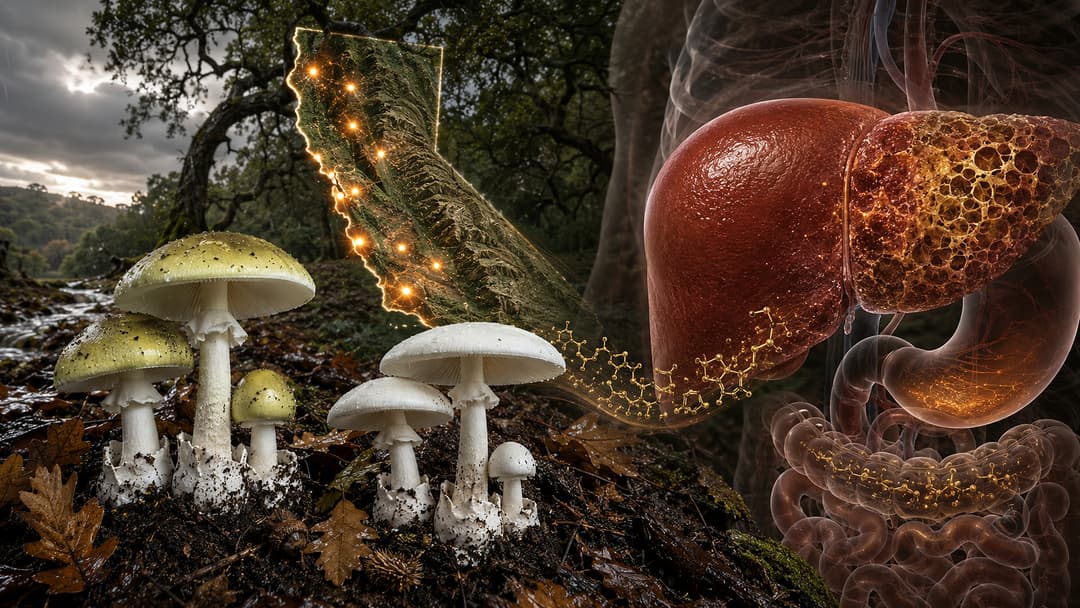
California public health officials have reported 50 mushroom-related poisonings since November 2025 during an unprecedented outbreak linked primarily to accidentally foraged Death Cap and Western Destroying Angel mushrooms.
As of May 22, 2026, the outbreak had caused four deaths and four liver transplants. Twelve additional cases were reported after mid-April, extending the outbreak beyond California’s usual peak mushroom season. In a typical year, the state receives fewer than five reports of this type of poisoning. A
The California Department of Public Health warned that recent rainfall appeared to support an unusually prolonged bloom of highly toxic mushrooms across Northern California and the Central Coast.
A CDC investigation published in the Morbidity and Mortality Weekly Report described 39 suspected amatoxin poisonings reported between November 18, 2025, and March 17, 2026.
Among those 39 patients:
32 recovered;
three required liver transplantation;
four died.
CDC described the event as the largest reported outbreak of mushroom-associated hepatotoxic poisoning in California history and the largest in the United States in several decades. B
The state’s later total of 50 cases covers a longer reporting period through May 22 and includes additional mushroom-related poisonings identified after the CDC investigation window. The figures therefore describe different stages of the same prolonged public health event.
The outbreak was associated mainly with two highly toxic Amanita species:
Death Cap mushrooms — Amanita phalloides
Western Destroying Angels — Amanita ocreata
Death Caps are an introduced species in California, while Western Destroying Angels are native to the state. Both can grow near oak trees, although Death Caps have also been found near other hardwoods and some pines.
The mushrooms were collected from neighborhoods, local and regional parks, nature preserves and national parks. Cases occurred across Northern California and the Central Coast, including areas where these mushrooms had not historically been considered common. C
Death Caps and Western Destroying Angels can resemble edible mushrooms at different stages of growth. Several affected patients had previously foraged similar-looking edible species in other countries.
This risk is explored more broadly in Mushroom Poisoning in the TikTok Era: When Foraging Goes Wrong, which explains why mobile applications, online photographs and short social-media videos cannot reliably establish mushroom safety.
Amatoxin poisoning often begins differently from ordinary food poisoning.
Symptoms commonly start more than six hours after ingestion and may include:
severe abdominal pain;
vomiting;
watery diarrhea;
weakness and dehydration.
During this initial phase, liver-test results can still appear normal.
A temporary improvement may then occur even as liver injury continues. Between approximately 12 and 36 hours after ingestion, laboratory testing may reveal rising aminotransferases, impaired blood clotting and kidney injury.
During the following two to six days, some patients develop rapidly worsening liver failure, kidney failure, encephalopathy, bleeding or multiorgan dysfunction. A minority require emergency liver transplantation. B
One patient in the CDC report was initially discharged with a diagnosis of gastroenteritis after eating foraged mushrooms. The patient returned the following day and later died, illustrating how the delayed toxic pattern can produce false reassurance.
Amatoxins are not reliably destroyed by:
cooking;
boiling;
frying;
freezing;
drying.
Taste is also not a reliable warning. A poisonous mushroom can reportedly taste similar to an edible variety.
The safest public health recommendation is therefore not to rely on preparation methods or personal experience. California officials have advised the public to avoid picking and eating wild mushrooms during periods of heightened risk and to purchase mushrooms only from trusted retailers. A
The affected population included people who spoke Spanish, Mixteco, Mam, Mandarin Chinese, Ukrainian and Russian in addition to English.
Some patients reported that the mushrooms resembled edible varieties they had collected in their countries of origin. Two affected people were unhoused, and one person reportedly ate wild mushrooms because of food insecurity.
CDPH and the California Poison Control System developed multilingual warnings, public-service announcements and educational posters. Materials were distributed through parks, community organizations, mycological societies, social media and Spanish-language television and radio.
The response shows that mushroom-poisoning prevention cannot depend only on English-language warnings or assume that every forager uses the same visual standards for identifying edible species.
CDC states that there is no standardized treatment regimen and no FDA-approved therapy specifically for amatoxin poisoning.
Management may include aggressive supportive care and close monitoring for liver and kidney failure. Treatments such as N-acetylcysteine, penicillin G and silibinin have been used, but the quality of evidence varies and several therapies remain off-label or investigational.
Silibinin is not routinely stocked in many US hospitals and may require access through the FDA Emergency Investigational New Drug process. A review of four decades of reported cases found that treatment comparisons are limited by observational data, inconsistent regimens and differences in illness severity. D
For this reason, suspected amatoxin poisoning requires immediate consultation with a poison center or medical toxicologist rather than reliance on a single universal protocol.
The Role of Poison Center Calls: Managing Poisoning Cases from Emergency Calls to Critical Decisions explains how poison centers help clinicians interpret exposure histories, coordinate specialized testing and identify emerging clusters.
A person who has eaten a wild mushroom should not wait for symptoms to appear before seeking expert advice.
The California Department of Public Health recommends:
seeking medical care immediately;
contacting Poison Control at 1-800-222-1222;
keeping any remaining mushroom specimens or photographs available;
not inducing vomiting unless specifically instructed;
not assuming that the absence of early symptoms means the mushroom was safe.
Call emergency services immediately if the person develops repeated vomiting, severe diarrhea, abdominal pain, confusion, collapse, seizures or signs of serious illness.
Poison Control: Your Lifeline in Emergencies provides additional guidance on obtaining free, confidential poisoning advice in the United States.
Healthcare professionals should ask specifically about wild-mushroom consumption in patients with delayed gastrointestinal symptoms or unexplained liver injury.
Important clues include:
symptom onset more than six hours after a mushroom meal;
several ill family members;
mushrooms collected from parks or woodland;
apparent improvement after severe gastrointestinal symptoms;
rising AST, ALT or INR;
evolving acute kidney injury.
A history of cooking, freezing or drying the mushrooms does not exclude amatoxin exposure.
Early poison-center consultation is important because mushroom identification, urine amatoxin testing, access to investigational treatment and transplant-center referral may require regional coordination.
The official totals should be interpreted carefully.
The CDC’s 39-case cohort consisted primarily of suspected poisonings defined by compatible exposure, hospitalization and liver injury. Only selected cases had laboratory confirmation or expert identification of the mushroom species.
Milder cases were probably underreported, and information about the quantity eaten, exact species and complete clinical course was missing for some patients.
The later state total of 50 “mushroom-related poisonings” covers a longer period and is not identical to the narrower 39-case CDC investigation cohort. Neither figure should be interpreted as the true incidence of all wild-mushroom exposures in California.
California’s 2025–2026 wild-mushroom outbreak caused an exceptional number of severe poisonings, liver transplants and deaths.
The most dangerous feature of amatoxin poisoning is its delayed course. A person may initially appear to have routine gastroenteritis or may temporarily feel better while potentially fatal liver injury continues.
Death Caps and Western Destroying Angels cannot be made safe through cooking, freezing or drying, and visual identification remains unreliable—even for experienced foragers.
After any uncertain wild-mushroom ingestion, the safest response is immediate poison-center consultation and medical assessment rather than waiting for symptoms.
California reported 50 mushroom-related poisonings through May 22, 2026. Four people died and four underwent liver transplantation.
The CDC report covered cases identified through March 17, 2026. California’s later total included additional cases reported through May 22.
No. Amatoxins can remain toxic after cooking, boiling, freezing or drying.
Gastrointestinal symptoms often begin more than six hours after ingestion. Serious liver injury may become evident later, sometimes after a period of apparent improvement.
A. California Department of Public Health. (2026, May 22). CDPH warns of rising illnesses from ongoing unseasonal bloom of poisonous wild mushrooms.
B. Brandecker, K. J., Hayman, C., LeSaint, K. T., et al. (2026). Amanita species mushroom poisonings—Northern California, November 2025–March 2026. Morbidity and Mortality Weekly Report, 75(20), 258–263. https://doi.org/10.15585/mmwr.mm7520a2
C. California Department of Public Health. (2026, May 14). Outbreak of severe illness and deaths linked to ingestion of poisonous wild mushrooms—May 2026 update.
D. Tan, J. L., Stam, J., van den Berg, A. P., van Rheenen, P. F., Dekkers, B. G. J., & Touw, D. J. (2022). Amanitin intoxication: Effects of therapies on clinical outcomes—A review of 40 years of reported cases. Clinical Toxicology, 60(12), 1251–1265.
Keep reading
Public Health Warnings and Recalls
17 Oct 2026
Public Health Warnings and Recalls
17 Oct 2026

Public Health Warnings and Recalls
09 Oct 2026
Public Health Warnings and Recalls
05 Oct 2026 · Updated 16 Oct 2026