Methanol Poisoning: Clinical Recognition, Triage, and Treatment
Published on 05 Oct 2026

Published on 05 Oct 2026
 Medical Toxicologymedicaltoxic.com
https://medicaltoxic.com/guidelines/methanol-poisoning
Methanol itself is a relatively mild intoxicant. Toxicity develops primarily after alcohol dehydrogenase converts methanol to formaldehyde and subsequent metabolism produces formic acid/formate. Formate causes high-anion-gap metabolic acidosis, mitochondrial dysfunction, visual injury, basal ganglia injury, and death. [1,2]
Because toxicity depends on metabolite formation, early treatment matters. Alcohol dehydrogenase blockade should begin when clinically important methanol poisoning is credibly suspected rather than waiting for a definitive methanol concentration or for metabolic acidosis to appear. Fomepizole is preferred when available; ethanol remains an effective alternative when fomepizole is unavailable. [1,2,5]
This guideline covers recognition, poison-center triage, diagnosis, antidotal therapy, acid–base management, folate, extracorporeal treatment (ECTR), disposition, and prognosis after acute methanol exposure by ingestion, inhalation, or clinically significant dermal exposure. Ophthalmic assessment and ocular-directed therapy are addressed separately in the companion guideline on methanol-induced optic neuropathy. [1–4,7]
Clinical warning
Suspected methanol poisoning is a toxicologic emergency. Start alcohol dehydrogenase blockade promptly when poisoning is clinically credible; do not wait for a methanol concentration or for acidosis to develop. Fomepizole is preferred when available. Correct clinically important acidemia and give folate as an adjunct. A new visual deficit, coma, seizures, pH ≤7.15, persistent metabolic acidosis, anion gap >24 mmol/L, specified methanol concentrations, or impaired kidney function can independently meet EXTRIP criteria for extracorporeal treatment. Intermittent hemodialysis is preferred when ECTR is indicated. Continue ADH blockade during ECTR. Do not delay antidote or dialysis for ophthalmic testing. Treatment and discharge decisions must not rely on a normal early anion gap or osmolal gap. [1–5]
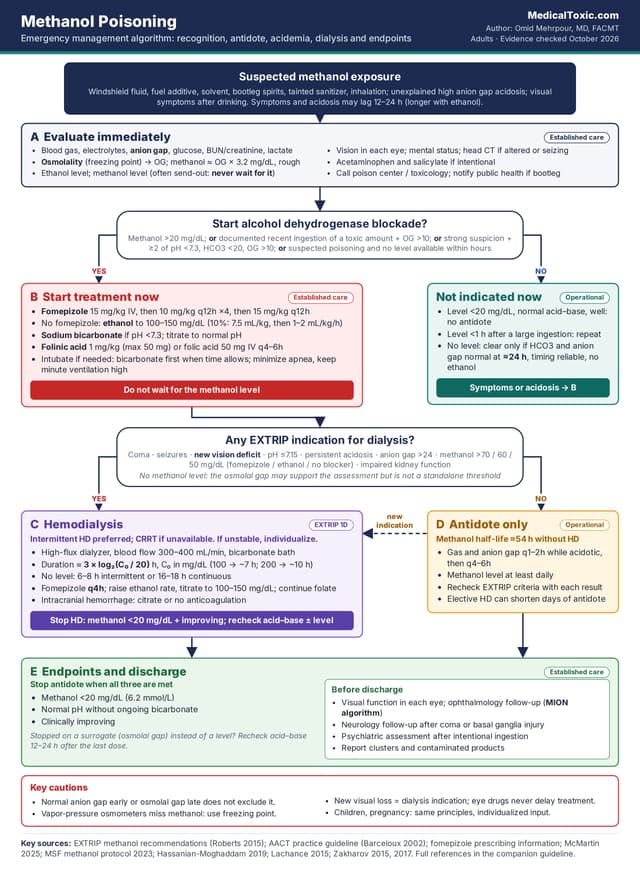
Clinical Issue | Recommendation | Evidence |
|---|---|---|
Start treatment | Begin ADH blockade when clinically important methanol poisoning is credibly suspected. Do not wait for a methanol level or acidosis to develop. [1,2,5] | Established care |
Antidote | Fomepizole is preferred. Use ethanol when fomepizole is unavailable or under specific outbreak/resource-limited protocols. [1,2,5,6] | Established care |
Diagnosis | A normal early anion gap or osmolal gap does not exclude poisoning. Interpret both in relation to timing and ethanol co-exposure. [1,8] | Established principle |
Acidemia | Give IV sodium bicarbonate for clinically important acidemia; pH <7.3 is a practical trigger. Titrate to serial blood gases while arranging definitive treatment when indicated. [1,6] | Established care; dosing operational |
Folate | Give folinic acid 1 mg/kg IV, maximum 50 mg, every 4–6 h. Folic acid is an acceptable alternative when folinic acid is unavailable. [1,6] | Accepted adjunct; limited human outcome evidence |
ECTR | Use EXTRIP indications. A new visual deficit alone is an indication for ECTR. [3,4] | EXTRIP Grade 1D |
ECTR modality | Intermittent hemodialysis is preferred. Continuous modalities are acceptable if IHD is unavailable or impractical. [3,4] | EXTRIP Grade 1D |
Stop ECTR | Stop when methanol is <20 mg/dL (200 mg/L; 6.2 mmol/L) and the patient is clinically improving. [3,4] | EXTRIP Grade 1D |
Stop ADH blockade | Continue until methanol is <20 mg/dL, pH is normal, and the patient is asymptomatic or clinically improving. [5] | Product labeling / established care |
Vision | Treat new visual symptoms as an emergency. Systemic rescue proceeds immediately; ophthalmic assessment runs in parallel. [3,4,7] | Established care |
Outbreaks | Notify poison-center/public-health systems early and use outbreak-specific resource-allocation protocols. [16] | Expert consensus |
Severe methanol poisoning most often follows ingestion. Important exposure settings include:
Setting | Typical Sources | Key History |
|---|---|---|
Adulterated or illicit alcohol | Counterfeit spirits, home-distilled alcohol, unlabeled beverages | Ask whether other people drank the same product and are ill |
Automotive/household products | Windshield-washer fluid, fuel additives, gas-line antifreeze, solvents, model-engine or racing fuels | Confirm the methanol concentration from the label or safety data sheet |
Contaminated consumer products | Improperly manufactured alcohol-containing products | Identify exact product, manufacturer, lot if available |
Occupational/inhalational exposure | Solvents, cleaners, industrial methanol | An absent ingestion history does not exclude poisoning |
Dermal exposure | Prolonged/high-concentration occupational contact | Brief splashes are usually much lower risk than prolonged exposure |
Clusters after adulterated alcohol ingestion are particularly important because one patient may represent a larger outbreak. [6,16]
Historically, approximately 10 mL of pure methanol has been associated with blindness and approximately 30 mL with death, but these are crude historical estimates rather than validated toxicity thresholds. Actual risk depends on concentration, amount absorbed, treatment delay, ethanol co-ingestion, and individual metabolism. [6]
Do not base antidote or dialysis decisions on reported volume alone.
For poison-center risk assessment, an estimated peak methanol concentration can be calculated when the volume, concentration, and weight are reasonably reliable:
Estimated peak methanol (mg/dL) ≈ volume (mL) × methanol fraction × 79 ÷ [0.6 × weight (kg)]
This assumes complete absorption, no metabolism, and a volume of distribution of 0.6 L/kg. It is deliberately conservative.
An estimated peak ≥20 mg/dL supports healthcare-facility evaluation. This is operational triage guidance, not a validated toxicity threshold.
Methanol is rapidly absorbed after ingestion and can also be absorbed by inhalation and through prolonged dermal exposure. It distributes mainly in total body water and has minimal protein binding, which contributes to its dialyzability. [1,2]
Step | Process | Clinical Consequence |
|---|---|---|
Methanol → formaldehyde | Alcohol dehydrogenase | Blocked by fomepizole or ethanol |
Formaldehyde → formic acid | Aldehyde dehydrogenase | Formaldehyde does not substantially accumulate |
Formate → CO₂ + water | Folate-dependent metabolism | Relatively slow in humans; folate is used as an adjunct |
Formate inhibits mitochondrial cytochrome-c oxidase and impairs oxidative phosphorylation. The optic nerve, retina, and basal ganglia are particularly vulnerable. Acidemia increases the fraction of undissociated formic acid and may facilitate tissue penetration, creating a cycle of worsening acidosis and cellular toxicity. [1,2,7]
When ADH is blocked and ECTR is not used, methanol elimination becomes slow. EXTRIP reports an average apparent half-life of approximately 54 hours, with substantial interpatient variability. Intermittent hemodialysis reduces the apparent methanol half-life to approximately 3 hours. [3,4]
Ethanol co-ingestion delays methanol metabolism and can substantially lengthen the asymptomatic period.
Symptoms commonly emerge 12–24 hours after ingestion, and may be delayed further when ethanol is co-ingested. [1,6]
Phase | Typical Findings |
|---|---|
Early | Mild CNS depression or minimal symptoms; acid–base status may initially be normal |
Latent period | Few or no symptoms while formate accumulates |
Established toxicity | Headache, dizziness, nausea, vomiting, abdominal pain, tachypnea/hyperventilation, blurred or “snowfield” vision, photophobia, scotoma |
Severe toxicity | Confusion, coma, seizures, hypotension, bradycardia, severe visual loss, cerebral edema, basal ganglia injury, cardiac arrest |
A patient with severe metabolic acidosis who is no longer mounting appropriate respiratory compensation is clinically concerning.
Important mimics include ethanol intoxication, alcoholic ketoacidosis, diabetic ketoacidosis, lactic acidosis, renal failure, salicylate poisoning, sepsis, ethylene glycol poisoning, and metformin-associated lactic acidosis.
Because methanol toxicity is delayed, an initially asymptomatic patient may still require urgent evaluation.
Situation | Disposition |
|---|---|
Intentional methanol ingestion/inhalation | ED evaluation |
Visual symptoms, altered mental status, repeated vomiting, significant abdominal pain, or abnormal deep/rapid breathing | ED immediately; EMS for significant symptoms |
Known or suspected adulterated/bootleg alcohol with other affected individuals | ED and public-health/poison-center notification |
Estimated peak methanol ≥20 mg/dL | ED evaluation |
Unknown significant amount | ED evaluation |
Small exploratory pediatric taste/lick, exact product known, estimated peak clearly <20 mg/dL, completely asymptomatic, reliable caregiver | Poison-center-directed home observation may be appropriate [9] |
Brief dermal splash or minor household inhalation without symptoms | Decontamination/fresh air and poison-center-directed observation |
Home management of a child is an operational poison-center decision, not a general public rule. Any uncertainty about product, amount, timing, symptoms, or caregiver reliability should lower the threshold for healthcare-facility evaluation.
For referred patients, give the first dose of fomepizole before transfer when treatment is indicated and doing so will not delay emergency transport.
Obtain:
blood gas;
serum electrolytes and calculated anion gap;
measured serum osmolality;
glucose;
BUN and creatinine;
lactate;
ethanol concentration;
methanol concentration.
Depending on the exposure and clinical condition, also consider:
ethylene glycol concentration when product identity is uncertain;
acetaminophen and salicylate concentrations after intentional overdose;
lipase for significant abdominal symptoms;
CK when muscle injury/seizure is suspected;
ECG;
pregnancy testing when relevant;
formate concentration when locally available.
Do not delay antidote treatment while awaiting a send-out methanol concentration. [1,2,5]
Measured osmolality should preferably be obtained using freezing-point depression. Vapor-pressure methods can underestimate volatile alcohol contributions. [6,8]
Use the laboratory's validated calculated-osmolality equation. One commonly used equation that includes ethanol is:
Calculated osmolality = 2 × Na + glucose/18 + BUN/2.8 + ethanol/3.7
Then:
Osmolal gap = measured osmolality − calculated osmolality
Methanol contributes approximately 3.1 mOsm/kg per 10 mg/dL.
If methanol is assumed to be the principal unexplained osmole:
Estimated methanol (mg/dL) ≈ unexplained osmolal gap × 3.2
This estimate is approximate and must not substitute for a measured concentration when one becomes available.
Stage | Osmolal Gap | Anion Gap / pH |
|---|---|---|
Early | Often increased | May be normal |
Intermediate | Falling | Anion gap rising |
Late | May normalize | Marked high-anion-gap acidosis |
As methanol is metabolized into formate, the osmolal gap may fall while the anion gap and clinical toxicity worsen. [1,8]
An anion gap >24 mmol/L attributable to methanol is itself an EXTRIP indication for ECTR. [3,4]
Brain CT is appropriate when there is:
altered consciousness;
seizure;
focal neurologic deficit;
concern for hemorrhage or cerebral edema.
Severe methanol poisoning may cause bilateral putaminal injury, white-matter abnormalities, cerebral edema, or intracranial hemorrhage.
Begin ADH blockade promptly when methanol poisoning is clinically credible. [1,5]
The classic AACT criteria support treatment when any of the following is present:
Plasma methanol concentration >20 mg/dL (6.2 mmol/L).
Documented recent ingestion of a toxic amount plus an osmolal gap >10 mOsm/kg.
Strong clinical suspicion plus at least two of:
arterial pH <7.3;
serum bicarbonate <20 mmol/L;
osmolal gap >10 mOsm/kg. [1]
These criteria support decision-making but must be interpreted with timing. Late severe poisoning may have a low osmolal gap because methanol has already been converted to formate.
When a methanol concentration will not return promptly, do not delay treatment in a credible clinically important exposure.
Fomepizole is the preferred ADH inhibitor because its dosing is predictable and it does not produce the CNS depression, hypoglycemia, or complex concentration monitoring associated with ethanol. [1,2,5,10]
Phase | Fomepizole Dose |
|---|---|
Loading | 15 mg/kg IV over 30 min |
Maintenance | 10 mg/kg IV every 12 h for 4 doses |
Thereafter | 15 mg/kg IV every 12 h |
Start of hemodialysis | <6 h since last dose: no extra dose; ≥6 h: give next scheduled dose |
During IHD | Dose every 4 h |
End of IHD | <1 h since last dose: none; 1–3 h: half next dose; >3 h: next scheduled dose |
Off dialysis | Next dose 12 h after the last administered dose |
These recommendations follow current U.S. prescribing information. [5]
For continuous extracorporeal modalities, U.S. labeling does not provide a regimen. The MSF protocol uses 10 mg/kg every 8 hours during CRRT as operational guidance; use local toxicology/pharmacy protocols. [6]
Fomepizole can crystallize/solidify below approximately 25°C; liquefy the vial according to product instructions before preparation. [5]
Ethanol remains an effective ADH inhibitor but is more difficult to administer safely.
Target serum ethanol: 100–150 mg/dL. [1,2,6]
The following is a protocol-specific operational regimen, not a universal order set:
Phase | 10% Ethanol | 40% Ethanol, Oral/NG |
|---|---|---|
Loading | 7.5 mL/kg over ~1 h | 2 mL/kg |
Maintenance, non-regular drinker | 1 mL/kg/h | 0.25 mL/kg/h |
Maintenance, regular drinker | 2 mL/kg/h | 0.5 mL/kg/h |
During IHD, non-regular drinker | 2 mL/kg/h | 0.5 mL/kg/h |
During IHD, regular drinker | 3 mL/kg/h | 0.8 mL/kg/h |
These concentration-specific doses are adapted from the MSF protocol and require poison-center/toxicology and pharmacy oversight. [6]
During ethanol treatment, monitor:
serum ethanol frequently until stable;
glucose closely;
mental status and airway;
infusion site when IV ethanol is used.
Ethanol requirements increase during hemodialysis and under-dosing is common. [6]
Stop fomepizole or therapeutic ethanol when:
methanol is <20 mg/dL (6.2 mmol/L) or undetectable;
pH is normal;
the patient is asymptomatic or clinically improving. [5]
Without ECTR, ADH blockade can be required for several days because methanol elimination becomes very slow.
Acidemia is both a marker and contributor to severe methanol toxicity.
Give IV sodium bicarbonate when clinically important acidemia is present; a pH <7.3 is a practical treatment trigger from traditional toxicology guidance. [1]
Bicarbonate is a bridge, not a substitute for ECTR when an EXTRIP indication is present.
A practical base-deficit estimate is:
Bicarbonate requirement (mmol) ≈ 0.3 × weight (kg) × base deficit (mmol/L) [6]
Use this as an initial estimate only. Severe methanol acidosis may require substantial bicarbonate administration.
Titrate treatment using:
serial blood gases;
serum sodium;
potassium;
ionized calcium when indicated;
volume status.
Avoid prescribing a fixed cumulative bicarbonate dose independent of the patient's acid–base response.
Intubation can be physiologically hazardous in severe methanol poisoning because profound hyperventilation may be maintaining pH.
When intubation is unavoidable:
correct severe acidemia as much as circumstances allow before induction;
minimize apnea time;
anticipate hemodynamic instability;
immediately provide high minute ventilation approximating the patient's pre-intubation compensatory ventilation;
obtain a blood gas shortly after intubation and rapidly adjust ventilation.
Do not use a single fixed respiratory rate for every patient. Minute ventilation must be individualized to acid production and pre-intubation compensation.
Treat seizures with benzodiazepines.
Check glucose promptly in altered or seizing patients.
Treat hypotension with appropriate fluids and vasopressors.
Correct clinically important potassium, magnesium, phosphate, and ionized-calcium abnormalities.
Give thiamine when appropriate in malnourished patients or those with alcohol-use disorder, but never delay treatment of hypoglycemia.
Activated charcoal is ineffective for meaningful methanol adsorption and is not routinely recommended. [1,6]
Formate elimination depends partly on folate-mediated metabolism.
Folinic acid (leucovorin): 1 mg/kg IV, maximum 50 mg, every 4–6 hours. [1,6]
Folic acid is an acceptable alternative when folinic acid is unavailable. The MSF protocol uses folic or folinic acid 1 mg/kg, usually maximum 50 mg, every 4–6 hours. [6]
Folate is widely recommended as an adjunct, but human outcome evidence is limited; its rationale derives substantially from biochemical, animal, and kinetic data. [1,2]
Continue folate during active toxicity and during ECTR. The exact optimal duration is not established; protocols commonly continue for at least 24–48 hours while formate burden is being treated. [3,4,6]
Folate does not replace ADH blockade, correction of acidemia, or indicated ECTR.
EXTRIP recommends ECTR for severe methanol poisoning. [3,4]
ECTR is recommended when any of the following is present and attributable to methanol:
Category | Indication |
|---|---|
Neurologic | Coma |
Neurologic | Seizures |
Visual | New visual deficit |
Acid–base | pH ≤7.15 |
Acid–base | Persistent metabolic acidosis despite adequate supportive care and antidote |
Acid–base | Anion gap >24 mmol/L |
Methanol level with fomepizole | >70 mg/dL (700 mg/L) |
Methanol level with ethanol | >60 mg/dL (600 mg/L) |
Methanol level without ADH blocker | >50 mg/dL (500 mg/L) |
Methanol level unavailable | Osmolal gap may help risk assessment |
Renal | Impaired kidney function |
All are EXTRIP Grade 1D recommendations. [3,4]
For poison-clearance decisions, impaired kidney function includes:
eGFR <45 mL/min/1.73 m²;
KDIGO stage 2 or 3 AKI;
without a known baseline creatinine, creatinine ≥2 mg/dL in adults or ≥1.5 mg/dL in older adults/low-muscle-mass patients;
pediatric creatinine >2 times the upper limit of normal for age/sex when no baseline exists;
oliguria or anuria. [4]
These are operational EXTRIP definitions for toxicant clearance and should not be interpreted as a universal definition of kidney disease.
Intermittent hemodialysis is the preferred modality. Continuous modalities are acceptable when IHD is unavailable or when patient-specific circumstances make IHD impractical. [3,4]
Observational outbreak data show substantially faster methanol and formate clearance with IHD than continuous modalities, but comparisons are confounded because sicker and less stable patients were more likely to receive continuous treatment. [15]
High-efficiency IHD protocols typically use:
high-efficiency/high-flux dialysis;
high blood flow;
high dialysate flow;
treatment longer than a routine 4-hour dialysis session.
The MSF protocol uses blood flow 300–400 mL/min and dialysate flow 750–1000 mL/min as one operational model. [6]
Prescription must be individualized with nephrology according to the machine, dialyzer, hemodynamics, acid–base status, and measured methanol kinetics.
Anticoagulation should be individualized, particularly if intracranial hemorrhage is suspected.
ECTR can be stopped when:
methanol is <20 mg/dL (200 mg/L; 6.2 mmol/L); and
the patient is clinically improving. [3,4]
Corrected acid–base status should also be confirmed before final disposition.
These equations may help plan a session but do not replace clinical/laboratory stopping criteria.
Assuming an IHD methanol half-life of approximately 3 hours:
Duration (h) ≈ 3 × log₂[initial methanol (mg/dL) ÷ 20]
Examples:
100 mg/dL → approximately 7 h
200 mg/dL → approximately 10 h
[3,4]
For high-efficiency hemodialysis after metabolic acidosis has been corrected:
Women:
Duration (h) = 3.390 × ln(MCi ÷ 4)
Men:
Duration (h) = 3.534 × ln(MCi ÷ 4)
MCi is the initial methanol concentration in mmol/L. [11]
The target of 4 mmol/L in the model is deliberately conservative so patients are expected to finish below approximately 6 mmol/L.
Duration (h) = −V × ln(5 ÷ A) ÷ (0.06 × k)
Where:
V = Watson estimate of total body water in liters;
A = starting methanol concentration in mmol/L;
k = 80% of the manufacturer's dialyzer urea clearance at the delivered blood flow in mL/min. [12,13]
These models are approximations. External data have shown imperfect performance across methanol concentrations; do not use a predicted duration as the sole reason to terminate ECTR. [14]
Continue ADH blockade and folate during ECTR. [3,4]
Fomepizole must be dosed more frequently during IHD because it is dialyzable; use the dosing schedule above. [5]
Ethanol is also removed during dialysis and requires increased administration with frequent concentration monitoring. [6]
A new visual deficit during active methanol poisoning is a medical emergency and independently satisfies an EXTRIP indication for ECTR. [3,4]
Ask about:
blurred or dim vision;
“snowfield” or “snowstorm” vision;
dyschromatopsia/color change;
photophobia;
scotoma.
A normal funduscopic examination does not exclude methanol-induced optic neuropathy. [7]
Ophthalmology/neuro-ophthalmology evaluation should proceed in parallel with systemic treatment and must never delay antidote, bicarbonate, or indicated ECTR.
Erythropoietin and high-dose corticosteroids remain investigational ocular adjuncts and must not delay systemic rescue.
Detailed examination, OCT surveillance, investigational adjunct evidence, prognosis, and visual rehabilitation are addressed in Methanol-Induced Optic Neuropathy Guideline.
Fomepizole is generally preferred over ethanol when an antidote is required because dosing is more predictable and it avoids ethanol-related CNS depression and hypoglycemia.
The U.S. label does not establish pediatric safety and effectiveness, so treatment requires individualized poison-center/medical-toxicology input. Published pediatric experience supports weight-based use in clinically significant poisoning. [5,22]
Most small exploratory childhood exposures are low risk, but uncertainty about dose, product concentration, or timing should lower the threshold for evaluation. [9]
Treat clinically significant maternal methanol poisoning aggressively. Maternal formate toxicity and severe acidemia also threaten the fetus.
Pregnancy is not a reason to withhold indicated ADH blockade or ECTR. Human fomepizole pregnancy data remain limited, so involve medical toxicology, nephrology, and obstetrics.
Impaired kidney function decreases non-metabolic methanol/formate elimination after ADH blockade and is independently included in EXTRIP indications for ECTR. [3,4]
One credible methanol case associated with illicit or unlabeled alcohol may represent a sentinel public-health event.
Notify:
poison-center systems;
local/regional public-health authorities;
appropriate product-safety authorities when contaminated commercial products are suspected.
Outbreaks can rapidly exhaust antidote, laboratory, ICU, and dialysis capacity. International expert consensus therefore supports structured resource triage rather than simply applying ordinary single-patient workflows. [16]
Observational outbreak data have associated medically supervised prehospital ethanol administration with improved outcomes. [17]
However, this must not be interpreted as general advice for patients to self-treat with alcohol.
Out-of-hospital ethanol should be considered only within poison-center, EMS, medical, or public-health protocols when credible methanol poisoning exists and timely fomepizole is unavailable.
Fomepizole remains preferred when available. Resource-limited protocols may transition selected patients to ethanol to conserve stock after initial treatment or ECTR. [6,16]
During a mass outbreak, dialysis allocation should be based on expected clinical benefit and structured outbreak protocols. [16]
Recent outbreak evidence reinforces that severe acidemia—particularly arterial pH—is strongly associated with mortality, but prognostic values must not be converted into futility thresholds. [19]
Admit patients receiving an antidote for clinically important methanol poisoning.
Use ICU or equivalent critical-care monitoring for:
coma;
seizures;
visual deficit;
significant acidemia;
hemodynamic instability;
ethanol antidote therapy requiring intensive monitoring;
ECTR.
Parameter | Suggested Frequency During Active Treatment |
|---|---|
Blood gas, electrolytes, anion gap | Every 1–2 h while severely acidotic, receiving intensive bicarbonate, or undergoing ECTR; extend when stable |
Methanol concentration | At presentation; around ECTR when available; to confirm stopping threshold |
Osmolal gap | Useful as a trend when methanol measurement is delayed/unavailable |
Ethanol concentration | Frequently during therapeutic ethanol, especially after rate changes or starting ECTR |
Glucose | Frequent during ethanol therapy |
Mental status, pupils, visual symptoms | Serial reassessment; immediately for any deterioration |
These intervals are operational guidance rather than prospectively validated universal schedules.
Systemic treatment is complete when:
methanol is <20 mg/dL (6.2 mmol/L);
acid–base status is normal without ongoing intensive correction;
the patient is asymptomatic or clinically improving. [5]
When a measured methanol concentration cannot be obtained and treatment decisions depend on surrogate markers, use conservative observation and poison-center/medical-toxicology input.
In an untreated patient with a reliable ingestion time, no ethanol co-ingestion, and no ADH blocker, persistently normal bicarbonate and anion gap at approximately 24 hours make clinically important poisoning unlikely; this is operational guidance rather than a validated universal clearance rule.
Confirm:
stable acid–base status;
no ongoing indication for antidote or ECTR;
stable neurologic condition;
documented visual function;
ophthalmology follow-up when visual symptoms or significant poisoning occurred;
assessment for neurologic/cognitive sequelae after severe poisoning;
psychiatric/safety evaluation after intentional exposure;
public-health reporting when a contaminated product or cluster is suspected.
Severity of metabolic acidosis is one of the strongest predictors of poor outcome, whereas the methanol concentration alone is a relatively poor prognostic marker because it reflects remaining parent compound rather than accumulated formate burden. [1,19]
A 2026 outbreak cohort of 55 adults found arterial pH to be the strongest measured predictor of in-hospital mortality; lower bicarbonate, greater base deficit, higher lactate, larger anion gap, and lower GCS were also associated with death. [19]
The study identified a pH cutoff around 6.89 with high discrimination within that cohort, but this is an observational outbreak-derived prognostic threshold, not a treatment-withholding or futility threshold.
Do not use any single pH, lactate, methanol level, or neurologic finding to declare treatment futile.
Survivors of significant methanol poisoning may develop:
persistent or delayed visual impairment;
optic atrophy;
basal-ganglia-related movement disorders;
parkinsonism;
cognitive impairment;
peripheral neurologic deficits.
Long-term sequelae may be underestimated at discharge. In a 50-patient Czech follow-up cohort, approximately 40% had long-term visual damage. [20]
In a six-year Estonian follow-up, visual and neurologic abnormalities were identified in some survivors who had initially been discharged without recognized sequelae. [21]
Arrange long-term follow-up after severe poisoning rather than assuming that hospital discharge represents complete recovery.
Major uncertainties remain:
no randomized trial directly compares fomepizole with ethanol for clinical outcomes;
optimal bicarbonate strategy has not been established in randomized studies;
the point at which ECTR adds benefit in moderate poisoning despite effective ADH blockade remains uncertain;
formate-guided initiation and cessation strategies require further validation;
dialysis-duration equations are based on relatively small cohorts and specific high-efficiency techniques;
evidence supporting folate for human clinical outcomes is limited;
pediatric and pregnancy evidence remains sparse;
outbreak triage and resource-allocation approaches have not been prospectively validated.
This guideline is a clinical evidence synthesis rather than a de novo systematic review or new GRADE exercise.
Recommendations were checked against EXTRIP methanol guidance and its supplement, the AACT methanol practice guideline, current fomepizole prescribing information, contemporary toxic-alcohol review evidence, the MSF methanol protocol, outbreak consensus guidance, and relevant pharmacokinetic and outcome studies.
Published EXTRIP grades are retained. Recommendations labeled operational guidance reflect practical poison-center or clinical approaches that have not been validated as universal thresholds.
Keep reading