Pediatric Oral Magnesium Poisoning: Triage, Hypermagnesemia, and Treatment
Published on 10 Sept 2026 · Updated 02 Oct 2026

Published on 10 Sept 2026 · Updated 02 Oct 2026
 Medical Toxicologymedicaltoxic.com
https://medicaltoxic.com/guidelines/pediatric-magnesium-ingestion
Oral magnesium exposures in children range from trivial contact with supplements to severe, potentially life-threatening hypermagnesemia after repeated laxative administration, impaired renal elimination, or prolonged gastrointestinal retention. Clinically important toxicity can produce weakness, hyporeflexia, altered consciousness, respiratory depression, hypotension, bradycardia, conduction abnormalities, and cardiovascular collapse. [1]
Severe pediatric toxicity is uncommon, and the available evidence does not support a single universal acute oral magnesium dose that reliably separates safe from toxic exposures. Serious hypermagnesemia has been reported in children without known renal dysfunction, including in association with repeated magnesium-containing laxative use and severe constipation or fecal retention. [2] [3]
Conversely, therapeutic pediatric cohorts demonstrate that biochemical magnesium elevation may occur without clinical toxicity. These observations emphasize that formulation, exposure pattern, renal function, bowel transit, symptoms, and serum magnesium trajectory are more informative than a single calculated dose or laboratory value. [4]
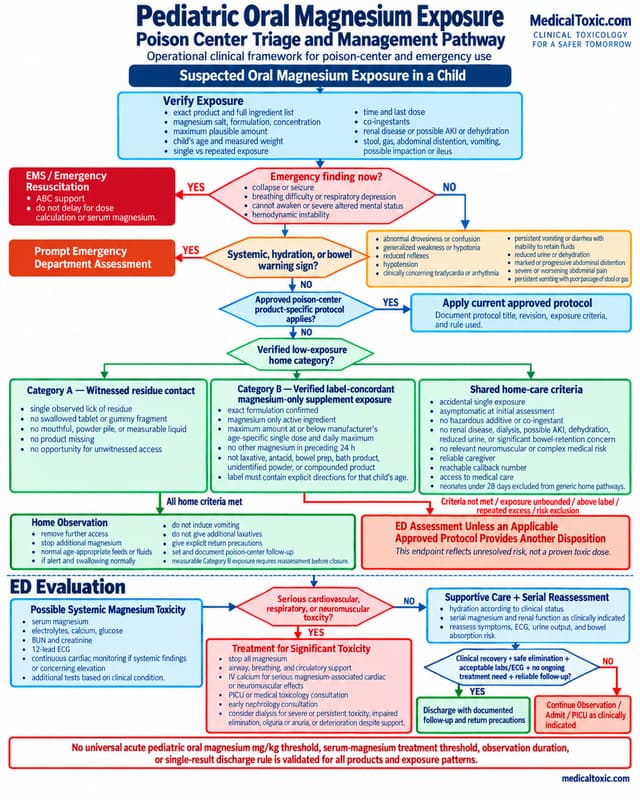
This guideline provides an operational framework for Specialists in Poison Information (SPIs), poison centers, emergency clinicians, pediatric teams, and medical toxicologists assessing pediatric oral magnesium exposures. The home-care branches are intentionally narrow and are clinical extrapolations rather than prospectively validated poisoning thresholds. An applicable approved poison-center protocol takes precedence within its defined scope.
Do not use a universal acute pediatric oral magnesium mg/kg threshold to determine disposition.
Verify the exact product, formulation, elemental magnesium content, maximum plausible exposure, timing, repeated dosing, co-ingestants, renal function, and bowel history.
A U.S. Supplement Facts panel reports elemental magnesium, not the total mass of the magnesium salt. [5]
Renal dysfunction substantially increases risk, but severe toxicity has also been reported in children without known renal impairment when repeated exposure and impaired bowel transit were present. [2] [3]
Symptoms and clinical trajectory matter more than one serum magnesium concentration.
Stop magnesium exposure immediately in clinically significant hypermagnesemia.
Serious cardiovascular, respiratory, or neuromuscular toxicity requires resuscitation, IV calcium consideration, critical-care involvement, and early assessment of magnesium elimination. [1]
Hemodialysis should be considered early when severe toxicity coexists with impaired elimination or when serious toxicity persists or worsens despite supportive treatment.
Neonates younger than 28 days are excluded from the generic home-care pathways in this framework.
Clinical warning
Do not use a single ingested dose, serum magnesium concentration, elapsed observation period, or normal early laboratory result as a universal pediatric clearance rule. Severe hypermagnesemia may occur after repeated magnesium administration, especially with renal impairment or impaired gastrointestinal transit, and serious cases have occurred without known pre-existing renal dysfunction. Any respiratory depression, severe altered consciousness, hypotension, clinically significant bradycardia or dysrhythmia, marked weakness/hyporeflexia, or cardiovascular collapse requires immediate emergency assessment and treatment.
The home-care branches in this guideline are proposed operational criteria, not validated pediatric toxic-dose thresholds. Use an applicable current poison-center protocol when available.
Document:
Product and quantity: exact product name, magnesium salt, formulation, full ingredient list, label photograph when available, concentration, serving size, and maximum plausible amount. Assess additives and co-ingestants separately.
Exposure pattern: age and measured weight; time of ingestion; single event versus repeated doses; dose frequency and last dose; accidental, therapeutic-error, or intentional exposure.
Current condition: alertness, breathing, strength, vomiting, diarrhea, abdominal pain or distention, fluid intake, and urine output.
Renal history: known kidney disease, dialysis, possible acute kidney injury, dehydration, reduced urine output, and relevant baseline renal function.
Bowel history: last stool, passage of gas, usual bowel pattern, failed laxative effect, suspected fecal impaction, ileus, or obstruction.
Disposition context: caregiver reliability, callback number, ability to observe the child, and access to emergency medical care.
Renal dysfunction is an established risk for magnesium accumulation. Impaired bowel transit may also prolong magnesium availability for absorption. Pediatric case reports describe severe toxicity associated with repeated magnesium-containing laxatives and constipation or ileus, including in children without previously recognized renal dysfunction. [1] [2] [3]
Follow the first applicable branch and the detailed criteria below. Home care requires a verified exposure category plus all applicable clinical and caregiver criteria.
The home categories are operational clinical extrapolations, not validated magnesium poisoning thresholds. An applicable approved center protocol governs its own scope.
A label-concordant amount means that the verified exposure falls within manufacturer directions for that child and that exact product. It does not establish a toxic threshold for larger exposures.
A Supplement Facts magnesium amount is already elemental magnesium.
For example, if a U.S. Supplement Facts panel states:
Magnesium 200 mg (as magnesium oxide)
the 200 mg is elemental magnesium per the stated serving. Do not multiply the labeled 200 mg by the elemental fraction of magnesium oxide. Confirm how many tablets, capsules, or gummies constitute one serving. [5]
Drug Facts labels can be different. A current Milk of Magnesia label, for example, lists magnesium hydroxide 1,200 mg per 15 mL as the active ingredient and separately states that each 15 mL contains 500 mg magnesium. Product concentrations and labeling can differ, so use the actual verified product label whenever possible. [6]
The following are approximate stoichiometric elemental magnesium fractions for the specified pure compounds. They describe chemical composition, not gastrointestinal absorption.
Compound | Approximate elemental magnesium by mass |
|---|---|
Magnesium oxide, MgO | 60.3% |
Magnesium hydroxide, Mg(OH)₂ | 41.7% |
Magnesium sulfate, anhydrous MgSO₄ | 20.2% |
Epsom salt, magnesium sulfate heptahydrate, MgSO₄·7H₂O | 9.86% |
Anhydrous trimagnesium dicitrate, Mg₃(C₆H₅O₇)₂ | 16.2% |
Commercial citrate products may differ in chemical form, hydration, concentration, or labeling. Prefer the stated elemental magnesium content or verified manufacturer information.
Apply the Epsom-salt conversion only when the substance is confirmed to be magnesium sulfate heptahydrate; do not apply it to an unidentified bath mixture.
Elemental magnesium (mg) = magnesium salt mass (mg) × elemental mass fraction
Elemental dose (mg/kg) = total elemental magnesium (mg) ÷ weight (kg)
For liquids:
Total amount = volume ingested × verified concentration
For repeated dosing, document:
each dose;
timing;
elemental amount per dose;
total daily elemental exposure;
cumulative exposure.
Do not describe a multiday mg/kg/day estimate as though it were a single acute ingestion.
Supplement: A label lists 200 mg magnesium per two gummies. Four gummies contain 400 mg elemental magnesium. In a 20-kg child:
400 mg ÷ 20 kg = 20 mg/kg elemental magnesium
No magnesium-salt conversion is required because the Supplement Facts value already represents elemental magnesium. [5]
Milk of Magnesia: A verified product contains 1,200 mg magnesium hydroxide per 15 mL and approximately 500 mg elemental magnesium per 15 mL. In a 10-kg child who ingested 15 mL:
500 mg ÷ 10 kg = approximately 50 mg/kg elemental magnesium [6]
Confirmed Epsom salt: For 5 g magnesium sulfate heptahydrate:
5 g × 1,000 mg/g × 0.0986 ≈ 493 mg elemental magnesium
A household spoonful does not reliably establish mass in grams.
These examples demonstrate calculation only. They are not safe doses, toxic thresholds, or referral cutoffs. Nutritional recommended intakes and tolerable upper intake levels address routine intake and should not be converted into overdose-disposition thresholds. [5]
A measurable quantity or a missing gummy is not by itself an ED indication. Determine the maximum plausible amount, symptoms, product, exposure pattern, medical risk, and whether an approved poison-center protocol applies.
Exceeding a label dose is not synonymous with toxicity. It does, however, fall outside the generic label-concordant home branch described below.
Activate EMS immediately for:
collapse;
seizure;
breathing difficulty or respiratory depression;
inability to awaken;
severe hemodynamic instability.
In a healthcare setting, begin resuscitation immediately. Do not wait for dose calculation or a serum magnesium result. Severe hypermagnesemia can cause decreased consciousness, respiratory compromise, loss of reflexes, hypotension, and cardiac abnormalities. [1]
Refer for prompt emergency-department assessment for any of the following:
Systemic findings
new abnormal drowsiness or confusion;
generalized weakness or hypotonia;
reduced deep tendon reflexes;
hypotension;
clinically concerning bradycardia;
abnormal cardiac rhythm.
One concerning systemic finding is enough to justify ED evaluation. Use EMS if the child is unstable or safe private transport is doubtful. [1]
Gastrointestinal losses affecting hydration
persistent vomiting or diarrhea with inability to retain fluids;
clearly reduced urine output;
clinically important dehydration.
These children require assessment even when systemic magnesium toxicity has not been established.
Possible fecal impaction, ileus, or obstruction
marked or progressive abdominal distention;
severe or worsening abdominal pain;
persistent vomiting with poor passage of stool or gas.
Arrange ED assessment rather than continuing empiric home laxative treatment. Severe pediatric hypermagnesemia has been reported in association with constipation, fecal retention, and ileus. [2] [3]
Other independent indications for referral include intentional self-harm, suspected malicious administration, a clinically important co-ingestant, or inability to provide reliable observation and access to medical care.
Brief mild cramping, nausea, or limited loose stools do not independently establish systemic magnesium toxicity.
Reassess:
exact product;
maximum possible exposure;
hydration;
urine output;
bowel history;
co-ingestants;
renal risk.
Home observation may continue only when an applicable approved protocol or verified generic home category remains satisfied, symptoms are mild and improving, oral intake and urine output are preserved, and there are no systemic or bowel warning signs.
Persistent or worsening symptoms, inability to retain fluids, uncertain exposure, or loss of home eligibility requires reassessment and usually ED evaluation unless an approved protocol establishes another disposition.
Use the poison center’s current approved product-specific oral magnesium protocol when the:
magnesium salt;
formulation;
concentration;
age;
maximum plausible exposure;
exposure pattern;
exclusions
all match the protocol.
Document the protocol title, revision, and specific rule applied.
A verified age-specific labeled dose can establish that an exposure remains within ordinary manufacturer directions. It must not be relabeled as a validated poisoning threshold.
Nutritional upper intake levels and adult dosing instructions do not substitute for pediatric poisoning criteria.
Do not use the generic home branches when any of the following is present:
known renal disease or dialysis;
suspected acute kidney injury;
reduced urine output;
clinically important dehydration;
significant bowel-retention concern;
suspected impaction, ileus, or obstruction;
relevant neuromuscular disease;
medically complex circumstances that substantially alter absorption, elimination, or reliable assessment;
recent repeated magnesium administration with poor bowel response.
Kidney function is central to magnesium homeostasis, and children with advanced CKD or dialysis have greater risk of accumulation from exogenous magnesium. [7]
Normal-appearing urine output alone does not prove normal renal function.
No age-derived universal acute oral magnesium mg/kg cutoff is supplied.
Neonates younger than 28 days are excluded from both generic home-care branches.
Older infants may qualify for Category A residue contact when every criterion is fulfilled.
A measurable supplement exposure in an older infant may enter Category B only when:
the exact formulation is verified;
the manufacturer explicitly provides dosing directions for that infant’s age;
the exposure does not exceed those directions;
all clinical and risk exclusions are absent.
A label stating only “ask a doctor”, an adult dose, or an unsupported age extrapolation does not qualify.
Magnesium laxatives, antacids, bowel preparations, and bath products cannot use the generic label-concordant supplement branch.
Historical reports describe clinically important magnesium poisoning in young infants and neonates after magnesium-containing laxatives; these reports support a conservative neonatal approach but do not provide a validated acute dose threshold. [13] [14] [15]
All of the following must be true:
single observed lick of residual material from a finger, utensil, or exterior surface;
no swallowed tablet or gummy fragment;
no mouthful;
no loose powder pile;
no measurable liquid exposure;
no product missing;
no opportunity for additional unwitnessed access.
The description “a taste” alone does not establish this category.
All of the following must be true:
exact manufacturer and formulation confirmed;
magnesium is the only pharmacologically active ingredient;
maximum plausible amount is no greater than the manufacturer’s recommended single dose for that child’s age;
any stated daily maximum is also respected;
no other magnesium-containing medicine or supplement was administered during the preceding 24 hours;
no further access occurred;
the manufacturer provides explicit directions for that child’s age.
This category excludes:
laxatives;
antacids;
bowel preparations;
bath products;
unidentified powders;
compounded products;
products whose pediatric directions state only “ask a doctor.”
This is an ordinary-use comparison plus clinical assessment, not a validated safe-overdose dose. The Supplement Facts panel should be interpreted using the declared elemental magnesium content. [5]
For either generic home category:
accidental single exposure;
asymptomatic at initial assessment;
exact product and full ingredient list confirmed;
no clinically important co-ingestant or hazardous additive;
no systemic warning signs;
no hydration warning signs;
no bowel warning signs;
no significant renal disease or suspected AKI;
no relevant neuromuscular or complex medical risk;
reliably assessable baseline;
neonate younger than 28 days excluded.
Home care also requires:
reliable adult observation;
accurate teach-back of warning signs;
reachable callback number;
access to medical care.
If a required fact is missing, resolve it during the call. Do not treat missing information as reassuring.
When neither a current approved protocol nor Category A/B can safely establish home eligibility, refer for ED assessment based on the unresolved risk—not because the amount has been proven toxic.
A verified magnesium-only supplement directs one gummy for the child’s age. No more than one gummy is missing, no other magnesium product was administered during the preceding 24 hours, and every shared clinical and caregiver criterion is met.
Under this operational framework, home observation may be appropriate.
If that same product provides only adult directions, says “ask a doctor,” or the quantity cannot be bounded, Category B does not apply.
This example does not establish a brand-specific or mg/kg toxicity threshold.
For a child meeting an approved home-care pathway:
remove the remaining product;
gently wipe or rinse the mouth after residue contact;
offer usual age-appropriate feeds or fluids if alert and swallowing normally;
stop additional magnesium;
do not induce vomiting;
do not give additional laxatives.
Reassessment is required for:
persistent vomiting or diarrhea;
inability to maintain intake;
reduced urine output;
progressive abdominal distention;
significant abdominal pain;
abnormal sleepiness;
weakness.
Systemic or significant hydration findings require ED assessment. Emergency findings require EMS.
The SPI should set and document the next contact time according to:
verified product;
exposure time;
exposure pattern;
symptoms;
renal and bowel context;
caregiver reliability.
There is no validated universal callback or clearance interval for all pediatric oral magnesium exposures.
A callback confirms the child’s current status; elapsed time alone does not establish recovery.
For a secure Category A residue-only contact, closure may occur after satisfactory assessment and caregiver teach-back when no unresolved concern or follow-up need remains.
For a measurable Category B exposure, arrange follow-up and reassess the clinical course before closure.
At follow-up confirm:
baseline behavior;
normal breathing;
adequate fluid intake;
adequate urine output;
absence of clinically important symptoms;
no further access to magnesium;
continued caregiver reliability.
Failure to reach a caregiver is not evidence of recovery. Follow the center’s failed-contact policy.
Exposure | SPI action under this framework |
|---|---|
Witnessed lick of residue from a caregiver’s finger; product verified; no missing amount; child well; all home criteria confirmed | Home advice; document follow-up or closure decision and return precautions |
One missing magnesium-only supplement gummy; age-specific label permits one gummy; quantity bounded; no other magnesium in 24 h; all shared criteria met | Home observation under Category B; a measurable amount alone does not mandate ED assessment |
Ordinary functional constipation with baseline stool/gas pattern and otherwise complete Category A criteria | Constipation alone does not equal obstruction; assess for changes from baseline before excluding the home pathway |
Repeated magnesium doses with poor bowel response, or abnormal drowsiness/weakness | ED assessment; EMS for collapse, respiratory compromise, or inability to awaken |
Amount exceeds age-specific directions, amount remains unbounded, laxative/bath-product exposure exceeds residue contact, or a risk exclusion exists and no approved protocol applies | ED assessment because risk remains unresolved; do not describe the amount as a proven toxic dose |
ED Diagnosis and Initial Evaluation
Biochemical hypermagnesemia means serum magnesium above the reporting laboratory’s age-appropriate upper reference limit.
A value around 2.6 mg/dL (approximately 1.07 mmol/L) is often cited as an upper reference boundary in pediatric literature, but reference intervals vary. Use the reporting laboratory’s pediatric range, especially in neonates. [4] [7]
Clinical magnesium toxicity requires interpretation of the magnesium concentration together with compatible findings, the exposure history, renal function, bowel context, and alternative diagnoses.
Mild biochemical elevation can be asymptomatic. [1] [7]
Assess:
airway and ventilation;
mental status;
age-appropriate vital signs;
perfusion;
muscle strength and tone;
deep tendon reflexes;
hydration;
urine output;
abdominal findings.
Stabilize an unstable child while investigations are obtained.
Order magnesium explicitly. It might not be part of a routine chemistry panel.
Record:
sample time;
units;
local reference interval.
Obtain as clinically appropriate:
sodium;
potassium;
chloride;
bicarbonate;
calcium;
glucose;
BUN;
creatinine.
Interpret renal function according to age, baseline values, hydration status, and urine output.
Obtain a 12-lead ECG in clinically significant suspected toxicity.
Assess:
rhythm;
heart rate;
PR interval;
QRS duration;
conduction abnormalities.
Use continuous cardiac monitoring when systemic findings, ECG abnormalities, or a clinically concerning magnesium elevation are present. [1] [7]
Consider:
ionized calcium in severe illness and during substantial IV calcium treatment;
blood gas when hypoventilation or significant acid-base disturbance is suspected;
lactate when poor perfusion is suspected;
testing for relevant co-ingestants or alternative diagnoses.
A well child referred for an unrelated co-ingestant or social concern does not automatically require the entire magnesium-toxicity laboratory panel.
The following ranges describe overlapping clinical associations. They are not validated pediatric onset, treatment, admission, dialysis, or discharge thresholds. Significant toxicity can occur outside the listed bands. [1] [2] [7]
Serum magnesium | Approx. mmol/L | Clinical interpretation |
|---|---|---|
Above local pediatric upper limit; often >2.6 mg/dL | Often >1.07 | Biochemical hypermagnesemia; symptoms may be absent |
About 4–5 mg/dL and above | About 1.6–2.1 and above | Nonspecific symptoms may emerge; do not use as an onset threshold |
About 6–12 mg/dL | About 2.5–4.9 | Weakness, reduced reflexes and ECG abnormalities are described; clinical overlap is substantial |
Around 12 mg/dL and above | Around 4.9 and above | Severe neuromuscular, respiratory, and cardiovascular depression becomes increasingly concerning |
Above approximately 15 mg/dL | Above approximately 6.2 | Cardiac arrest has been reported; serious toxicity can occur at lower concentrations |
The 20-month-old case developed coma and decreased reflexes with magnesium 11.0 mg/dL. [2]
A 14-year-old with repeated magnesium hydroxide exposure had lethargy, hypotension, and first-degree AV block with magnesium 14.9 mg/dL. [3]
Magnesium mg/dL × 0.4114 = mmol/L
Magnesium mmol/L × 2.43 = mg/dL
Magnesium mmol/L × 2 = mEq/L
An early normal magnesium result does not prove clearance if ongoing gastrointestinal absorption or impaired elimination remains plausible.
No cited pediatric evidence establishes one universal laboratory sampling interval after oral magnesium exposure.
Repeat testing should answer a clinical question:
Is magnesium still rising?
Is elimination adequate?
Has treatment worked?
Is toxicity recurring?
Obtain an initial magnesium, renal function, and relevant electrolytes.
Repeat testing when:
the first sample may have preceded substantial absorption;
magnesium is elevated;
symptoms develop or persist;
renal function is impaired;
bowel retention remains possible;
repeated administration has occurred.
The treating clinician should choose an interval short enough to identify clinically meaningful deterioration before the next management decision.
Use:
continuous ECG monitoring;
respiratory monitoring;
frequent bedside reassessment;
clinician-selected serial magnesium and electrolyte testing.
Check ionized calcium when clinically appropriate during IV calcium treatment.
Reassess immediately for:
declining alertness;
worsening weakness;
reduced reflexes;
slow or shallow breathing;
falling oxygenation;
hypotension;
new bradycardia or arrhythmia;
reduced urine output;
worsening abdominal findings;
rising magnesium.
Do not wait for a scheduled laboratory interval when clinical deterioration occurs.
For general principles in critically poisoned patients, see Comprehensive Guide to Managing Poisoning in the Intensive Care Unit: Best Practices and Protocols.
Stop all magnesium-containing:
medicines;
supplements;
laxatives;
other relevant products.
Provide airway, breathing, and circulatory support as required.
Systemic toxicity should prompt early involvement of:
pediatric critical care;
poison center/medical toxicology;
nephrology when impaired elimination or dialysis may become relevant.
Respiratory depression, shock, or serious conduction disturbance requires treatment while laboratory confirmation is pending. [1]
Do not induce emesis.
Routine activated charcoal is not recommended for an isolated magnesium salt exposure. Activated charcoal should not be used reflexively after poisoning; if a clinically important co-ingestant is present, assess that substance under its own decontamination criteria. [11]
Do not administer additional magnesium-containing cathartics.
Gastric lavage and whole-bowel irrigation are not routine treatments for magnesium poisoning.
Suspected fecal impaction, ileus, or obstruction requires clinical evaluation rather than empiric gastrointestinal decontamination.
For mild gastrointestinal effects with preserved oral intake, use age-appropriate oral hydration.
When clinically significant volume depletion or inability to hydrate orally is present, use magnesium-free isotonic IV fluid according to:
examination;
ongoing losses;
renal function;
cardiovascular status.
Monitor:
intake/output;
perfusion;
lung examination;
weight when useful;
electrolytes.
For hypovolemic shock in children, the Royal Children’s Hospital guideline uses 0.9% sodium chloride 10–20 mL/kg as a bolus followed by immediate reassessment. [10]
This is a volume-resuscitation regimen, not routine forced diuresis for hypermagnesemia.
Renal dysfunction, cardiac impairment, fluid overload, and neonatal age require individualized management.
Persistent hypotension associated with severe hypermagnesemia may require IV calcium, vasoactive support, and/or enhanced magnesium elimination rather than repeated indiscriminate fluid loading.
IV calcium antagonizes the physiologic effects of excess magnesium but does not remove magnesium from the body.
Consider IV calcium when hypermagnesemia is associated with serious:
hypotension;
conduction disturbance or dysrhythmia;
neuromuscular depression;
respiratory depression.
An isolated mild magnesium elevation is not by itself an indication for IV calcium. [1]
A current CHEO pediatric parenteral monograph lists calcium gluconate 60–100 mg/kg/dose in its emergency cardiopulmonary-resuscitation section for conditions including magnesium toxicity, with a maximum of 3,000 mg/dose. [8]
An American Academy of Pediatrics emergency-drug guideline similarly lists calcium for hypermagnesemia and states that calcium gluconate 60 mg/kg may substitute for calcium chloride in the relevant emergency context. [9]
Because source-specific dose, concentration, rate, and repeat instructions occur in different clinical contexts, do not convert these references into an automatic repeat-dose protocol for every child with hypermagnesemia.
For infants and children outside cardiac arrest, the treating clinician should prescribe a complete indication-specific regimen after considering urgency, vascular access, formulation, concentration, monitoring capability, calcium status, and local pediatric medication guidance.
A 10% calcium gluconate solution contains:
100 mg/mL calcium gluconate
approximately 9.3 mg/mL elemental calcium. [8]
Calcium chloride and calcium gluconate are not interchangeable volume-for-volume.
During calcium administration monitor:
ECG;
heart rate;
blood pressure;
perfusion;
ventilation;
IV site.
Rapid administration can cause bradycardia, dysrhythmia, and hypotension, and extravasation can cause tissue injury. [8]
Reassess the clinical response before additional calcium is given.
Calcium response does not prove magnesium clearance or establish readiness for discharge.
Furosemide may be considered with toxicology/nephrology input when:
kidney function is adequate;
urine production is preserved;
volume status can be maintained.
It is not routine therapy for a well child and is not a substitute for dialysis in anuric renal failure. The RCH guideline lists furosemide among therapies that may be considered in symptomatic hypermagnesemia. [1]
Monitor:
urine output;
blood pressure;
volume status;
magnesium;
potassium;
calcium;
renal function.
Stop and reassess if hypovolemia, electrolyte disturbance, or worsening renal function develops.
Obtain early nephrology consultation for:
severe or persistent systemic toxicity;
respiratory compromise;
cardiovascular instability;
serious dysrhythmia or conduction disturbance;
impaired renal elimination with a concerning magnesium trajectory;
oliguria or anuria;
recurrent serious effects after calcium;
continued deterioration despite supportive treatment.
Hemodialysis can remove magnesium and may be necessary when severe toxicity coexists with inadequate renal elimination. Pediatric renal guidance recognizes hemodialysis as effective for acute magnesium toxicity, while pediatric case literature demonstrates rapid biochemical improvement after dialysis in severe cases. [7] [12]
No universal pediatric serum magnesium concentration mandates dialysis in every patient.
The decision should incorporate:
clinical severity;
cardiovascular and respiratory status;
renal function;
magnesium trajectory;
ongoing absorption;
response to supportive therapy.
For general extracorporeal-treatment principles, see Hemodialysis in Poisoning: A Comprehensive Guide for Healthcare Providers.
Assess for:
fecal impaction;
ileus;
bowel obstruction;
repeated magnesium administration.
Do not prescribe additional magnesium laxatives.
When obstruction or significant retention is suspected, involve pediatrics, gastroenterology, or surgery according to the findings.
In the reported 20-month-old case, severe constipation and fecal retention were considered clinically relevant contributors to prolonged magnesium exposure, although retained magnesium and absorption were not directly quantified. [2]
The following disposition framework requires local clinical review and has not undergone prospective validation.
Continue hospital care when there is:
persistent systemic toxicity;
gastrointestinal symptoms preventing adequate hydration;
abnormal vital signs;
clinically important ECG abnormalities;
magnesium that is rising or concerning in clinical context;
impaired renal clearance requiring monitoring;
need for IV hydration;
concern for ongoing intestinal absorption or bowel retention;
need for serial assessment that cannot be safely performed outside hospital.
A mild isolated magnesium elevation without compatible toxicity does not automatically require admission. [1] [7]
Escalate for:
respiratory depression or ventilatory support;
shock;
serious arrhythmia or conduction disturbance;
severe weakness;
significant altered consciousness;
recurrent serious toxicity requiring calcium;
dialysis or other organ support;
monitoring needs unavailable locally.
Arrange transfer early when the current facility cannot provide the required level of care.
Confirm:
baseline alertness;
baseline strength and function;
no concerning respiratory findings;
no concerning neurological findings;
stable age-appropriate vital signs;
no ongoing rescue treatment requirement.
Confirm:
adequate oral fluid intake;
manageable gastrointestinal losses;
appropriate urine output;
satisfactory renal function or explicit specialist plan.
Relevant abnormalities should be:
resolved; or
accepted under a documented specialist plan.
When magnesium was elevated or ongoing absorption/poor clearance was suspected, the treating team should review serial results and the clinical course before discharge.
Residual biochemical elevation requires an explicit rationale and appropriate follow-up plan.
Confirm:
magnesium exposure has stopped;
suspected bowel retention has been evaluated and addressed;
no ongoing IV calcium requirement;
no ongoing IV hydration requirement;
no organ-support requirement;
no ongoing inpatient-monitoring requirement.
A falling serum magnesium alone does not prove that absorption has ended.
A responsible caregiver should understand:
return precautions;
any repeat laboratory plan;
who is responsible for reviewing results;
exact follow-up timing when needed.
Intentional ingestion, safeguarding concerns, and clinically significant co-ingestants require their own appropriate pathways.
Neither a fixed number of observation hours nor one normal or falling magnesium concentration is a universal discharge rule.
Pediatric Evidence and Its Limits
Araki and colleagues reported a previously healthy 20-month-old, 10.3-kg girl who had received 200 mg magnesium oxide daily in divided doses for four days for constipation.
Magnesium oxide is approximately 60.3% elemental magnesium, corresponding to approximately:
121 mg elemental magnesium/day
or
11.7 mg/kg/day elemental magnesium
in this child.
She had passed no stool for five days and developed vomiting, generalized weakness, decreased reflexes, and coma. The abdomen was distended with palpable stool and serum magnesium was 11.0 mg/dL. [2]
This case demonstrates that severe toxicity can occur without previously recognized renal dysfunction. It does not establish 11.7 mg/kg/day as a toxic threshold.
Kutsal and colleagues separately reported a 14-year-old girl who received magnesium hydroxide for seven days for constipation. She developed lethargy, hypotension, first-degree AV block, and serum magnesium 14.9 mg/dL without reported renal dysfunction. Hemodialysis was used. [3]
Again, this repeated-exposure case cannot define a safe or toxic one-time oral dose.
Tatsuki and colleagues studied 120 children aged 1–14 years receiving daily magnesium oxide for functional constipation.
Thirty children (25%) had serum magnesium above the study’s stated upper reference value of 2.6 mg/dL, but none had clinical effects attributed to hypermagnesemia.
The highest magnesium concentration was 3.2 mg/dL in a child receiving 88 mg/kg/day magnesium oxide for 2.8 years. This corresponds to approximately 53 mg/kg/day elemental magnesium based on magnesium oxide stoichiometry. [4]
The study excluded renal dysfunction, severe neurologic disability, and several organic causes of constipation.
The contrast between this therapeutic cohort and severe case reports illustrates biological and clinical variability. It does not create a pediatric acute dose-response curve and cannot validate a home-observation cutoff. [2] [4]
Renal dysfunction is a major established risk factor because magnesium is primarily regulated through renal elimination. Advanced kidney dysfunction and dialysis alter magnesium handling and increase susceptibility to accumulation from exogenous sources. [7]
Impaired gastrointestinal transit is also clinically important. Severe pediatric reports associate toxicity with constipation, fecal retention, or ileus, although case reports cannot quantify the independent contribution of bowel retention. [2] [3]
McGuire and colleagues reported fatal hypermagnesemia following unsupervised high-dose oral magnesium oxide as part of megavitamin/megamineral therapy in a child with severe neurologic disability. The report reinforces the danger of uncontrolled repeated magnesium exposure but cannot provide a universal acute referral threshold. [13]
Jhang and colleagues reported an 11-year-old child receiving peritoneal dialysis who developed symptomatic hypermagnesemia after magnesium oxide was added for constipation. Magnesium reached 8.9 mg/dL. Hyperkalemia also coexisted, so the ECG abnormalities cannot be attributed solely to magnesium. Hemodialysis improved the biochemical and ECG findings. Recurrent magnesium elevation later prompted additional dialysis. [12]
This case supports renal-risk assessment and post-treatment surveillance but does not define a universal dialysis threshold or observation interval.
Alison and Bulugahapitiya reported laxative-induced magnesium poisoning in a 6-week-old infant. The brief published report supports recognition of serious infant exposure but does not provide evidence for a universal pediatric toxic-dose cutoff. [14]
Mofenson and Caraccio described neonatal magnesium intoxication after oral magnesium hydroxide and emphasized the lack of an established safe neonatal cathartic dose. [15]
Versteegh and colleagues reported a 3-week-old girl with magnesium 7.94 mmol/L after magnesium oxide had been prescribed as a laxative. Historical treatments used in that case should not be converted into contemporary treatment recommendations. [16]
Together, these reports support excluding neonates from generic home-care pathways.
Turner and colleagues randomized 83 children undergoing bowel preparation: 43 received sodium picosulfate with magnesium citrate and 40 received polyethylene glycol with electrolytes.
Biochemical hypermagnesemia occurred more often with the magnesium-containing preparation, but no clinically significant magnesium toxicity was reported; one child in that group developed mild dehydration. [17]
These were selected children receiving supervised bowel preparation. The study cannot validate poison-center home-care categories or an acute overdose threshold.
Recommendation or finding | Evidence basis | Important limitation |
|---|---|---|
Avoid a universal acute pediatric mg/kg cutoff | Pediatric severe case reports plus therapeutic cohort [2] [3] [4] | Existing studies do not validate an oral poisoning cutoff |
Consider renal function, repeated dosing, and bowel retention | Pediatric cases and pediatric renal guidance [2] [3] [7] [12] | Case reports cannot quantify each factor independently |
Differentiate minor GI effects from systemic toxicity | Symptoms require interpretation in context | |
Use IV calcium for serious symptomatic toxicity | Pediatric clinical guidance and emergency-drug references [1] [8] [9] | Source-specific dosing contexts differ; no automatic repeat regimen is established |
Consider dialysis for severe/persistent toxicity with impaired elimination | No universal pediatric serum threshold | |
Home care for residue contact or verified label-concordant supplement exposure | Author-proposed operational framework informed by verified labeling and clinical exclusions [5] [6] | Not prospectively validated and not a poisoning threshold |
Individualized callback and laboratory scheduling | Clinical monitoring guidance plus recurrence evidence [1] [12] | No universal pediatric sampling or clearance interval |
Discharge based on clinical recovery plus relevant serial findings | Proposed checklist has not been prospectively validated |
Evidence is substantially stronger for recognizing and treating established hypermagnesemia than for predicting toxicity after a single exploratory pediatric ingestion.
The generic label-concordant supplement branch is intended to avoid automatic ED referral for clearly bounded ordinary-use exposures, but it remains an unvalidated operational extrapolation.
It must not be presented as a new acute mg/kg toxicity cutoff.
Current evidence does not establish one universal:
acute pediatric oral toxic dose;
serum magnesium treatment threshold;
dialysis threshold;
observation period;
repeat laboratory interval;
discharge concentration.
Clinical decisions should integrate exposure history, symptoms, renal function, bowel transit, magnesium trend, ECG findings, treatment response, and caregiver reliability.
Pediatric oral magnesium toxicity cannot be reliably triaged using one universal mg/kg cutoff.
Confirm whether the reported amount represents elemental magnesium or magnesium-salt mass before calculating dose.
Renal impairment, repeated dosing, and impaired bowel transit can substantially increase risk.
Severe toxicity can occur without known pre-existing renal disease.
Weakness, hyporeflexia, altered consciousness, respiratory depression, hypotension, bradycardia, and conduction disturbance are important systemic warning signs.
A serum magnesium concentration must be interpreted with the clinical course; biochemical hypermagnesemia alone does not establish severe toxicity.
Stop magnesium exposure and provide supportive care immediately in symptomatic toxicity.
IV calcium can temporarily antagonize serious magnesium effects but does not eliminate magnesium.
Severe or persistent toxicity with impaired elimination warrants early nephrology involvement and consideration of dialysis.
Generic home-care branches in this guideline are operational choices, not validated poisoning thresholds.
Neonates younger than 28 days should not enter the generic home-care pathways.
No fixed elapsed time or single normal/falling magnesium result is a universal discharge rule.
Keep reading