Benzodiazepine Poisoning: Airway Support, Flumazenil Selection, Mixed Overdose, and Monitoring
Published on 08 Oct 2026 · Updated 20 Oct 2026

Published on 08 Oct 2026 · Updated 20 Oct 2026
 Medical Toxicologymedicaltoxic.com
https://medicaltoxic.com/guidelines/benzodiazepine-z-drug-poisoning
MedicalToxic.com | Evidence-informed clinical guideline | Revised October 19, 2026
Author: Omid Mehrpour, MD, FACMT
This guideline provides a practical bedside reference for suspected benzodiazepine or Z-drug poisoning in adults and children. It focuses on initial assessment, airway and ventilation support, evaluation of mixed overdose, selective flumazenil use, monitoring, and disposition.
The central management principle is simple: supportive care comes first. Most isolated benzodiazepine and Z-drug poisonings are managed without antidote therapy. Flumazenil may be useful in a small, carefully selected subgroup, but it can also precipitate seizures, withdrawal, agitation, or dysrhythmias when used in the wrong patient. The key toxicology decision is therefore not whether flumazenil exists, but whether reversal is likely to provide meaningful benefit and whether major risks have been reliably excluded.
This is an evidence-informed clinical reference, not a substitute for local resuscitation protocols, poison-center/medical-toxicology consultation, or institutional approval. Recommendations derived from formal labeling are distinguished from off-label practice and observational evidence.
Clinical warning
Airway and ventilation come first in suspected benzodiazepine or Z-drug poisoning. Use naloxone first when opioid co-exposure with respiratory depression or arrest is plausible. Do not use flumazenil routinely in undifferentiated, mixed, or intentional overdose, or in patients with physiological dependence, seizure risk, suspected proconvulsant or cardiotoxic co-exposure, or unexplained ECG abnormalities. A negative urine benzodiazepine screen does not exclude poisoning. Any flumazenil use requires a monitored setting with readiness for airway support, seizure treatment, and reassessment for resedation, withdrawal, or dysrhythmia.
Airway and ventilation come first; flumazenil cannot substitute for assisted ventilation or airway management. Severe respiratory compromise or unusual findings should broaden the differential. [1,2]
With suspected opioid co-exposure and respiratory depression/arrest, support ventilation and give naloxone first; adequate breathing, not complete awakening, is the endpoint. [1]
Consider flumazenil only when reversal offers meaningful clinical benefit and major risks can be excluded. The strongest situations are observed iatrogenic oversedation and selected well-characterized, isolated accidental exposures with clinically important respiratory compromise. [1,2]
Avoid routine flumazenil in undifferentiated, mixed, or intentional overdose and with physiological dependence, seizure risk, or cardiotoxic co-exposure. It has no role during cardiac arrest. [1,2]
Use separate adult overdose and procedural-sedation regimens; anticipate resedation, seizures, withdrawal, or dysrhythmias and treat in a monitored setting. [2,3]
A negative urine benzodiazepine screen does not exclude exposure. Z-drugs share a predominantly supportive-care pathway. Discharge depends on clinical recovery, not a universal clock. [4–6]
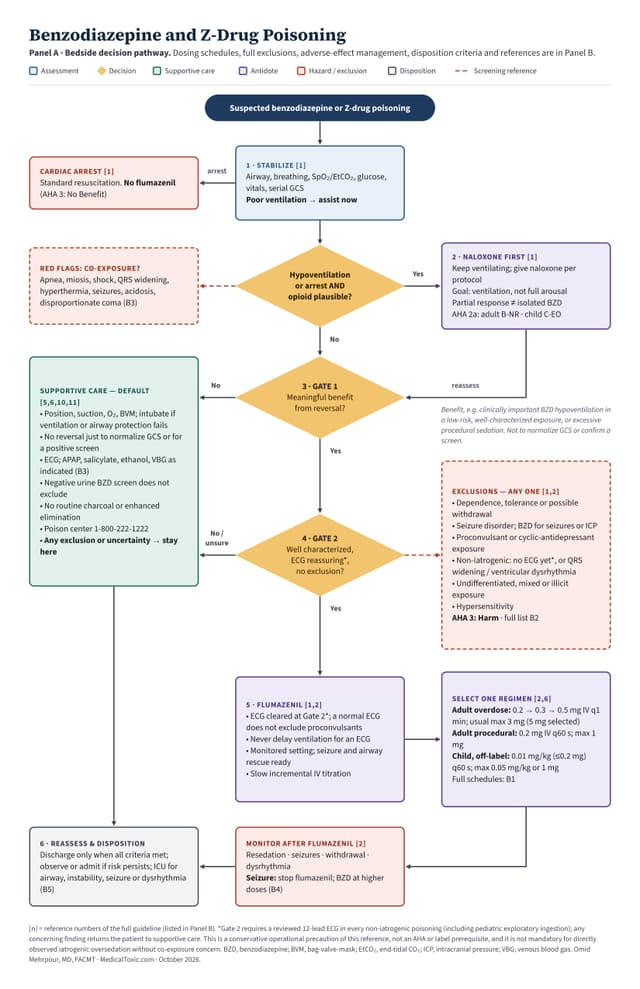
1. Stabilize: Assess airway, respiratory rate and effort, SpO2, ventilation/capnography if available, glucose, vital signs, and neurological trend. Support ventilation immediately when inadequate.
2. Consider opioids: If respiratory depression or arrest and opioid exposure is plausible, administer naloxone while maintaining ventilation, then reassess. A partial naloxone response does not establish isolated benzodiazepine poisoning.
3. Gate 1 — Is meaningful reversal needed? If ventilation and airway protection are adequate and the patient is improving, continue supportive care. Do not use flumazenil solely to normalize GCS or confirm a diagnosis.
4. Gate 2 — Is flumazenil safe? Establish a well-characterized exposure and exclude labeled contraindications, dependence, seizure/proconvulsant risk, and cardiotoxicity. In non-iatrogenic poisoning, an ECG must be obtained and reviewed before Gate 2 clearance in this conservative pathway; concerning findings, an unavailable ECG, or unresolved risk should direct the patient to supportive care and poison-center/medical-toxicology consultation. Do not delay lifesaving ventilation for an ECG.
5. If benefit is meaningful and safety is established: Consider flumazenil using the correct indication-specific regimen, incremental IV dosing, continuous clinical reassessment, and seizure/airway rescue readiness.
6. Reassess disposition: Observe for resedation, ventilation failure, withdrawal, and evolving co-ingestant toxicity; admit or escalate if clinical concerns persist.
Operational rule: a reassuring eligibility checklist cannot cancel an individual contraindication or a major unresolved risk. There is no automatic flumazenil pathway for undifferentiated coma. [1,2]
Exposure context | Examples | Clinical relevance |
|---|---|---|
Accidental therapeutic error | Duplicate dose, medication mix-up | Often low risk, but age, frailty, co-medications, and formulation matter |
Intentional overdose | Alprazolam, diazepam, clonazepam, lorazepam, temazepam | Mixed ingestion is common; do not assume a pure benzodiazepine overdose |
Pediatric ingestion | Access to family medication | Often isolated; observation and poison-center input are appropriate |
Iatrogenic oversedation | Midazolam or another benzodiazepine during procedural sedation | One of the clearest low-risk settings for selective flumazenil use |
Illicit/designer benzodiazepines | Bromazolam, clonazolam, flualprazolam and related compounds | Potency, duration, identity, and co-exposures may be uncertain |
Z-drugs | Zolpidem, zopiclone/eszopiclone, zaleplon | Similar GABA-A–mediated sedation; usually managed supportively |
Counterfeit or designer benzodiazepines and fentanyl combinations can obscure exposure identity, dose, physiological dependence, and coexposures; they are not routine flumazenil candidates. Persistent sedation after naloxone may also involve alcohol, xylazine, or medetomidine. Marked bradycardia or hypotension raises concern for an alpha-2 agonist. Flumazenil does not reverse alpha-2 agonists; naloxone remains indicated when an opioid component is plausible. [7,8]
Benzodiazepines enhance GABA-A receptor signaling and can cause sedation, ataxia, amnesia, and impaired airway protection at high exposures. Z-drugs act at related receptor complexes. Effects may be prolonged by long-acting agents, active metabolites, repeated dosing, hepatic dysfunction, older age/frailty, or co-ingestants. [4,9]
Typical isolated toxicity includes somnolence, slurred speech, ataxia, impaired coordination, nystagmus, confusion, hypotonia, and sometimes profound unconsciousness.
Clinically important respiratory compromise is more likely with opioids, alcohol/other sedatives, aspiration, older age/frailty, large or parenteral exposure, or chronic pulmonary disease/obstructive sleep apnea.
Hypotension is usually mild or absent in isolated poisoning. Persistent severe hypotension should prompt reassessment for another toxin or medical condition.
Respiratory/toxidrome: apnea or marked bradypnea, pinpoint pupils with respiratory depression, or unexpectedly deep coma
Cardiovascular/metabolic: severe hypotension, QRS widening or ventricular/QT-related dysrhythmia, unexplained acidosis, or marked bradycardia/hypotension after illicit opioid exposure
Neurologic/systemic: hyperthermia, anticholinergic findings, clonus, severe neuromuscular hyperactivity, or seizures
These findings should broaden the differential and substantially lower enthusiasm for flumazenil. They do not independently prove benzodiazepines are absent.
Obtain a focused history of:
drug, formulation, strength, maximum possible dose, route, timing, repeated exposure, and whether ingestion was intentional;
regular benzodiazepine use/dependence, withdrawal history, seizure disorder, or benzodiazepine treatment for seizures;
opioids, ethanol, antidepressants/bupropion and other co-ingestants, illicit/counterfeit source, procedural sedation, and relevant hepatic, respiratory, or neurologic disease.
Do not judge flumazenil safety by tablet count alone: a small ingestion with dependence or a dangerous co-ingestant can carry more reversal risk than a larger reliably isolated exposure.
Assess airway patency, cough/protective reflexes, respiratory rate and depth, effort, and ability to clear secretions.
Obtain SpO2 and assess ventilation; capnography is especially useful in significant sedation because supplemental oxygen can conceal hypoventilation.
Record blood pressure, heart rate, temperature, GCS or equivalent serial mental-status assessments, and point-of-care glucose.
Consider trauma, head injury, hypoglycemia, stroke, and other causes of altered mental status when the exposure history does not account for the presentation.
Uncomplicated isolated accidental exposures often require little testing. For intentional, severe, prolonged, or uncertain exposures, select studies based on history and examination:
glucose, electrolytes, renal function;
acetaminophen level for intentional or uncertain pharmaceutical overdose;
salicylate and ethanol when clinically indicated;
blood gas when ventilation or acid-base status is abnormal;
pregnancy testing when relevant;
additional studies guided by suspected co-ingestants, aspiration, trauma, or rhabdomyolysis.
Obtain a 12-lead ECG for intentional or undifferentiated overdose, unexplained marked CNS depression, or suspected cardiotoxic co-exposure. For any non-iatrogenic poisoning, including pediatric exploratory ingestion, obtain and review an ECG as part of Gate 2 before clearing a patient for flumazenil in this conservative pathway. QRS widening, a concerning ventricular dysrhythmia, or another unexplained cardiotoxic sign should direct the patient to supportive care and toxicology consultation. Directly observed iatrogenic oversedation without co-exposure concerns need not trigger an ECG solely to permit reversal. Never delay ventilation or airway management for ECG acquisition. [1,2]
ECG screening reduces uncertainty, but a normal ECG cannot rule out all proconvulsant drugs or future toxicity. Repeat assessment if the toxidrome or exposure suggests evolving risk.
Routine urine benzodiazepine immunoassays are screening tests, not exclusion tests. Sensitivity differs by assay, drug/metabolite cross-reactivity, and glucuronide hydrolysis; some clinically important agents are missed. [5]
A negative result cannot exclude poisoning.
A positive result does not establish that benzodiazepines caused the coma.
Neither screen result should determine airway/naloxone decisions or justify flumazenil. [5]
Serum concentrations seldom correlate with acute severity or disposition. [6]
For respiratory depression or arrest with plausible combined opioid–benzodiazepine poisoning:
Open the airway and assist ventilation without delay; use bag-mask ventilation when indicated.
Give naloxone according to the local opioid protocol, then reassess respiratory rate, depth, SpO2, capnography when available, and consciousness. Aim for adequate ventilation, not full awakening.
Recurrent opioid toxicity may require repeat naloxone, further observation, or infusion under an opioid protocol.
Persistent sedation may involve benzodiazepines, alcohol, nonbenzodiazepine sedatives including alpha-2 agonists, or another diagnosis. Partial naloxone response neither excludes an opioid component nor proves a pure benzodiazepine exposure.
Do not automatically advance to flumazenil after naloxone: unknown illicit or mixed exposures rarely meet a high-confidence isolated-exposure criterion. [1,7,8]
AHA 2025: naloxone-first sequencing in combined exposure with respiratory depression or arrest is Class 2a (adults B-NR; children C-EO). [1]
Prioritize positioning, suction, oxygen for hypoxemia, assisted bag-mask ventilation for hypoventilation, and intubation when airway protection or adequate ventilation cannot otherwise be maintained.
Do not use GCS alone as an automatic intubation threshold: assess ventilation, airway protection, aspiration risk, hemodynamics, co-ingestants, and clinical trajectory. In the NICO trial of selected poisoning-related coma, a closely monitored conservative airway strategy reduced intubation compared with routine care; this does not justify withholding a necessary airway intervention. [10]
Severe shock is uncommon in isolated benzodiazepine poisoning. Provide standard supportive treatment while checking for cardiotoxic or sedative co-ingestion, trauma/hemorrhage, sepsis, and other causes.
Routine activated charcoal is not recommended for isolated benzodiazepine poisoning, especially when sedation increases aspiration risk. Pediatric guidance specifically advises against gastrointestinal decontamination. [6,11]
For a dangerous, very recent co-ingestion, charcoal may be considered selectively if the airway is intact or protected; the co-ingested toxin determines that decision. Gastric lavage, whole-bowel irrigation, multiple-dose charcoal, and enhanced elimination are not routine treatments for isolated benzodiazepine poisoning. [11]
Flumazenil competitively antagonizes benzodiazepine recognition sites on GABA-A receptors. It can reverse benzodiazepine-mediated sedation and some Z-drug effects, but it does not treat opioid, ethanol, alpha-2 agonist, or other nonbenzodiazepine sedation. Its short half-life, commonly about 40–80 minutes, makes resedation possible when the agonist effect lasts longer. [2,4]
The clinical endpoint is adequate ventilation and clinically useful arousal, not obligatory complete wakefulness. Use flumazenil only if expected benefit justifies the risks of seizure, withdrawal, agitation, and potentially destabilizing a mixed overdose.
The clearest indication is directly observed, isolated iatrogenic benzodiazepine oversedation causing meaningful hypoventilation or delaying necessary recovery.
Another reasonable scenario is a benzodiazepine-naïve child with a reliably identified, isolated accidental ingestion and clinically important respiratory depression, when reversal may avert an otherwise necessary airway intervention and all exclusions have been checked. Such pediatric overdose use remains off-label and warrants specialist input. [1,2,6]
A well-characterized adult accidental exposure can be considered under the same two gates. Frailty may increase potential benefit from avoiding invasive ventilation, but it also increases competing airway, comorbidity, and co-exposure risks; it does not independently establish candidacy. [1,2,9]
Gate 1 — Is reversal likely to yield meaningful clinical benefit?
Consider flumazenil for clinically important hypoventilation plausibly attributable to a known isolated benzodiazepine or excessive observed procedural sedation. Determine plausibility from timing and identity of exposure, a compatible sedative toxidrome, serial assessment, and the absence of red flags or competing causes. A flumazenil response is not required as a diagnostic test. If breathing and airway protection are adequate and recovery is progressing, observe instead. [1,2,9]
Gate 2 — Can the exposure and major risks be reliably characterized?
All clinically important exclusions must be absent. For non-iatrogenic poisoning, an ECG must also be reviewed before Gate 2 clearance under this conservative pathway.
Favorable context | Finding that blocks routine flumazenil use |
|---|---|
Clearly known, isolated benzodiazepine or responsive Z-drug exposure | Undifferentiated coma, unreliable exposure history, suspected dangerous co-ingestants |
Known iatrogenic oversedation or well-characterized accidental ingestion | Significant benzodiazepine dependence/tolerance or possible withdrawal |
No seizure history or suppressive use of benzodiazepines | Seizure disorder treated with benzodiazepines; benzodiazepines used for status epilepticus or raised intracranial pressure |
No evidence of proconvulsant/cardiotoxic exposure | Suspected bupropion, tricyclic/cyclic antidepressants, or other proconvulsant exposure; pretreatment seizures or myoclonus |
Reassuring appropriate ECG/clinical assessment | QRS widening, concerning ventricular dysrhythmia, unexplained cardiotoxic signs, or non-iatrogenic poisoning without an ECG reviewed before flumazenil clearance |
Clinically useful anticipated reversal | Purely diagnostic curiosity, a positive urine test, or a desire to normalize GCS without physiologic benefit |
A contraindication or unresolved major risk defeats an otherwise favorable checklist: continue supportive care and obtain poison-center/medical-toxicology input. [1,2]
Formal U.S. labeling contraindications include known hypersensitivity to flumazenil or benzodiazepines, benzodiazepine treatment of a potentially life-threatening condition such as status epilepticus or intracranial-pressure control, and signs of serious cyclic-antidepressant overdose. [2]
Other strong reasons to avoid routine use include chronic dependence; significant recent repeated high-dose IV benzodiazepine exposure; intentional or uncharacterized mixed overdose; proconvulsant drug exposure; seizure/myoclonus preceding treatment; undifferentiated coma; and QRS widening or concerning ventricular dysrhythmias. [1–3]
The 2025 AHA assigns Class 3: Harm to flumazenil in patients at increased risk of seizures or arrhythmias: Level B-R in adults and Level C-LD in children. [1]
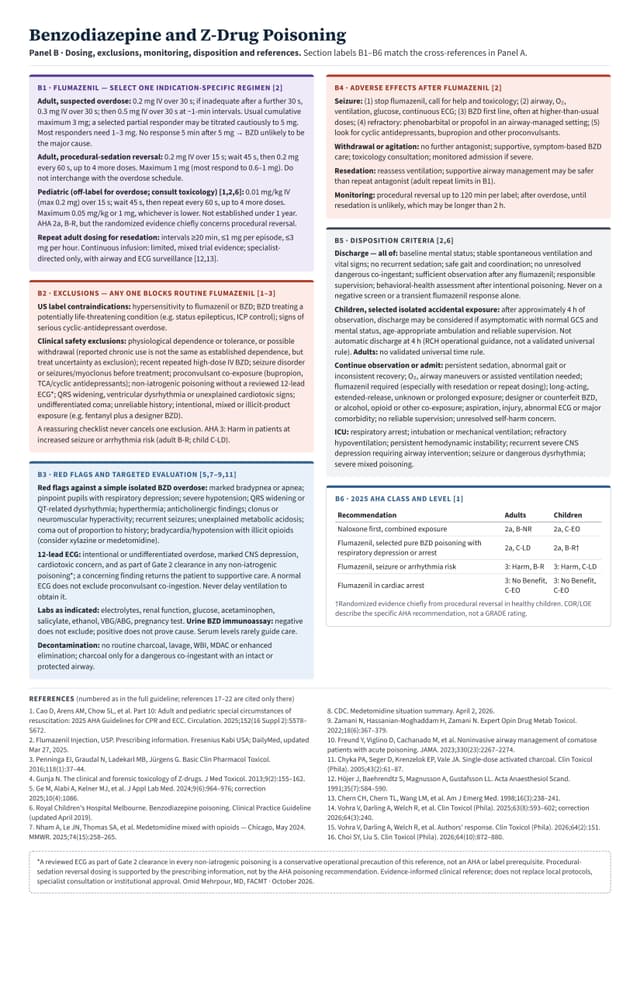
For carefully selected adult poisoning with no high-risk exclusion, administer in a resuscitation-capable, monitored setting:
Sequence | Dose and interval |
|---|---|
Initial | 0.2 mg IV over 30 seconds |
If inadequate response after another 30 seconds | 0.3 mg IV over 30 seconds |
Further titration | 0.5 mg IV over 30 seconds at approximately 1-minute intervals |
Cumulative dosing | Usually 3 mg; exceptionally, a selected partial responder may be titrated cautiously to 5 mg total |
In labeling studies, most overdose responders received a cumulative 1–3 mg, not necessarily ≤1 mg. If no meaningful response is present 5 minutes after a cumulative 5 mg, benzodiazepines are unlikely to be the major cause of sedation and further flumazenil is unlikely to help. Avoid rushing dosing or using an isolated large bolus. [2]
Do not automatically apply the overdose titration schedule to procedural sedation.
Sequence | Dose and interval |
|---|---|
Initial | 0.2 mg IV over 15 seconds |
If inadequate response | Wait 45 seconds, then give 0.2 mg IV |
Further titration | Repeat 0.2 mg IV at approximately 60-second intervals as needed, up to four additional doses |
Maximum cumulative dose | 1 mg |
Most procedural-sedation responders require 0.6–1 mg. General-anesthesia reversal uses a similar labeled adult titration scheme and is a distinct peri-anesthetic context. [2]
Many benzodiazepines outlast flumazenil. If clinically meaningful resedation occurs, reassess ventilation and reconsider whether supportive airway management is safer than additional antagonist. U.S. labeling permits repeat adult treatment at intervals no shorter than 20 minutes, no more than 1 mg in one repeat episode, and no more than 3 mg in one hour. Repeat-titration speed should follow the relevant indication-specific label. [2]
Continuous flumazenil infusion has been investigated in small controlled studies of selected responders with prolonged sedation. One trial found less recurrent coma, while another did not establish a reduction in clinical complications; infusion is therefore not a routine FDA-labeled poisoning regimen. Consider it only after specialist assessment with ongoing airway and ECG surveillance; no default infusion dose is specified in this general pathway. [12,13]
Monitor for recurrent sedation, respiratory depression, withdrawal/agitation, seizures, and arrhythmias. U.S. labeling describes monitoring up to 120 minutes after procedural reversal according to drug and dose; poisoning cases require monitoring until resedation is unlikely, which may be longer than two hours. A fixed two-hour discharge rule is not validated for all overdoses. [2]
The 2025 AHA supports flumazenil in selected children with pure benzodiazepine poisoning causing respiratory depression or respiratory arrest when contraindications are absent (Class 2a, Level B-R). The pediatric B-R rating includes randomized studies of benzodiazepine reversal after procedures in healthy children, not randomized trials establishing safety in pediatric overdose or mixed poisoning. The U.S. label establishes pediatric dosing for conscious-sedation reversal ages 1–17, not for acute pediatric overdose treatment. Applying the following regimen to poisoning is therefore off-label extrapolation and warrants poison-center/medical-toxicology consultation. [1,2,6]
Initial 0.01 mg/kg IV (maximum 0.2 mg) over 15 seconds
If needed, after an additional 45-second wait, repeat 0.01 mg/kg (maximum 0.2 mg per dose) at approximately 60-second intervals, up to four additional doses
Maximum labeled pediatric procedural-reversal exposure: 0.05 mg/kg or 1 mg total, whichever is lower
The label does not establish safety and efficacy for procedural reversal in children younger than 1 year or for pediatric overdose management at any age
Monitor carefully for resedation; the safety and effectiveness of repeat pediatric treatment for resedation are not established in the label [2]
Routine empiric flumazenil remains inappropriate for pediatric undifferentiated coma, suspected mixed ingestion, or any seizure-risk circumstance.
Prevention remains the most important intervention: when a benzodiazepine may be suppressing seizures from another toxin, leave that protective effect unopposed and provide airway and ventilatory support while clarifying the diagnosis.
Stop flumazenil immediately; do not repeat doses. Activate resuscitation support and contact a poison center/medical toxicologist promptly.
Protect the airway, provide oxygen and assisted ventilation as needed, correct immediate reversible contributors including hypoglycemia, and institute continuous cardiorespiratory/ECG monitoring.
Treat convulsions urgently using local seizure/status-epilepticus protocols. Benzodiazepines remain appropriate first-line agents, but receptor antagonism may necessitate higher-than-usual doses. [2]
If seizures are refractory, escalate under emergency/critical-care and toxicology direction. Barbiturates such as phenobarbital or an anesthetic such as propofol may be considered in an appropriately airway-managed setting. These are escalation strategies, not routine preemptive treatment.
Investigate co-ingestants, especially cyclic antidepressants, bupropion, and other proconvulsants, along with withdrawal, trauma, and other precipitants. Treat dysrhythmias according to the suspected toxin and advanced resuscitation protocols.
Evidence boundary: the FDA label identifies benzodiazepines and barbiturates among treatments used for post-flumazenil convulsions and cautions that benzodiazepine doses may need to be larger. Selection of phenobarbital or propofol for refractory poisoning-related seizures is an escalation strategy, not an FDA-approved flumazenil-specific rescue algorithm. [2]
Monitor for agitation, tremor, autonomic changes, perceptual disturbance, or recurrent seizures, especially after unsuspected chronic benzodiazepine exposure. Avoid further antagonist; use supportive care, symptom-based benzodiazepine management when appropriate, and toxicology consultation. Severe or evolving withdrawal may warrant monitored admission. [2]
Flumazenil has no role in benzodiazepine-associated cardiac arrest (AHA Class 3: No Benefit, C-EO in adults and children). Provide standard resuscitation and evaluate other causes. [1]
Recent observational data should be interpreted alongside randomized safety evidence and differences in airway-management practice; they refine patient selection rather than establish routine flumazenil use.
A systematic review/meta-analysis of 13 randomized trials included 990 evaluable patients treated for known or suspected benzodiazepine intoxication. Serious adverse events occurred in 12/498 (2.4%) receiving flumazenil versus 2/492 (0.4%) receiving placebo (RR 3.81, 95% CI 1.28–11.39); all adverse events were also more frequent (138/498 vs 47/492). No deaths occurred during the blinded trial phases. [3]
In those trial populations, the observed absolute excess of serious events was about 2 percentage points (approximate NNH 50). This should not be mechanically transferred to well-screened low-risk patients, whose baseline risks differ. [3]
A retrospective poison-center analysis included 286 flumazenil recipients, of whom 161 (56.3%) had reported chronic benzodiazepine or other sedative-hypnotic use. Flumazenil dosing data were available for only 115/286 (40.2%), limiting dose–response analysis. In a subsequent published reply, the investigators clarified that 23 adverse events occurred among all 286 recipients (8.0%), rather than 23/115 (20%): the smaller denominator in the original abstract reflected cases with known dosing and was not appropriate for calculating overall adverse-event frequency. Three seizures (3/286; about 1.0%) were reported; all three patients had documented proconvulsant co-exposure. Chronic sedative-hypnotic use was not statistically associated with seizures in this selected cohort. Agitation was the most commonly reported adverse event. [14,15]
These findings do not establish that flumazenil is safe in physiologically dependent patients. Drug labeling recognizes precipitated withdrawal seizures, and this retrospective study has treatment-selection bias, incomplete dosing data, no untreated comparison group, and limited power to assess rare harms. Distinguish reported chronic use from established physiological dependence when evaluating risk. A 2026 correction revised the article’s proconvulsant-exposure table; the authors clarified that 67, not 97, cases involved proconvulsant exposure after duplicate counting was corrected. [2,14,15]
This observational study included 599 adults with GCS ≤8 after benzodiazepine or nonbenzodiazepine hypnotic poisoning. [16] In the reported matched analysis, flumazenil was associated with:
ICU admission: 42.9% vs 69.4%
Mechanical ventilation: 35.7% vs 65.3%
Improved hierarchical composite clinical outcome: win ratio 1.68 (95% CI 1.17–2.41) [16]
Only three deaths occurred in the cohort; no mortality benefit was demonstrated. Residual confounding, indication bias, local ICU/airway practices, and differences in illicit drug supply limit causal inference and generalizability. [16]
A 2023 randomized trial (NICO; 225 selected patients with poisoning-related coma, GCS <9) showed that a conservative, closely monitored intubation strategy, independent of flumazenil, reduced intubation rates (16% vs 58%). Therefore, lower ventilation rates in observational flumazenil cohorts cannot automatically be attributed to antagonist efficacy. This trial does not imply that intubation can be withheld in patients unable to protect their airway or ventilate. [10]
Taken together, the data support individualized use in a small, carefully screened subgroup, not routine reversal in undifferentiated overdose. Observational reductions in intubation cannot be assumed causal, and the 2026 cohort does not supersede the AHA Class 3: Harm recommendation for high-risk patients. [1,3,10,14,16]
Zolpidem, zopiclone/eszopiclone, and zaleplon are nonbenzodiazepine hypnotics acting at GABA-A receptor complexes.
Typical Z-drug toxicity includes sedation, ataxia, confusion, amnesia, and sometimes coma. Isolated exposures generally resolve with supportive care; deaths occur mainly with mixed overdose. [4]
Flumazenil may reverse some Z-drug effects, but evidence is limited and the same exclusion screening applies. An uncertain mixed ingestion is not a safe candidate merely because zolpidem is suspected. [4]
Hemodialysis, hemoperfusion, forced diuresis, and urinary pH manipulation have no routine role in isolated benzodiazepine or Z-drug poisoning.
Propylene glycol in some intravenous benzodiazepine formulations can accumulate during prolonged high-dose administration and cause elevated osmol gap, high-anion-gap metabolic acidosis, hyperlactatemia, or kidney injury. This is excipient toxicity rather than isolated receptor-mediated sedation; flumazenil will not correct it. Review formulation and infusion history, check acid-base status, and consider an osmol gap and renal function when clinically indicated. [17]
Maternal airway, oxygenation, and ventilation remain the immediate priority. After stabilization, consider obstetric consultation and gestational-age-appropriate fetal assessment for clinically significant poisoning. Human pregnancy data for flumazenil are limited; weigh maternal benefit against potential fetal risk rather than treating pregnancy alone as an automatic indication or prohibition. [2,18]
Most isolated accidental pediatric exposures are managed with observation and supportive care; watch for ataxia, lethargy, dysarthria, hypotonia, altered consciousness, and less commonly respiratory compromise.
Home exposures may involve U.S. seizure-rescue formulations such as intranasal diazepam (VALTOCO), intranasal midazolam (NAYZILAM), or rectal diazepam. Buccal/oromucosal midazolam is also used internationally. Document the exact product, strength, delivery device, route, and possible delivered or missing amount rather than assuming an oral-tablet ingestion. [19–22]
For significant isolated accidental pediatric ingestion, the Royal Children’s Hospital Melbourne guideline allows consideration of discharge after approximately 4 hours if the child remains asymptomatic with a normal GCS, clinically appropriate coordination, and reliable supervision. This is operational guidance, not a validated universal rule. [6]
Extend observation for an unknown or long-acting drug, uncertain or large dose, persistent symptoms, possible co-ingestants, prior flumazenil administration, or unreliable supervision.
Any intentional pediatric or adolescent overdose requires medical and behavioral-health assessment irrespective of early symptom resolution.
Consider discharge only after an adequately observed, clearly isolated exposure with normal or baseline mental status, ventilation, vital signs, and age-appropriate gait/coordination.
Adults have no validated universal four-hour observation rule. Consider formulation, expected duration, frailty, co-ingestants, examination, and repeated assessments.
persistent or recurrent sedation, abnormal gait, or inconsistent recovery;
oxygen, airway maneuvers, or assisted ventilation required;
flumazenil use with potential resedation, long-acting/unknown/extended-release exposure, designer/counterfeit substances, or significant co-ingestion;
aspiration or trauma;
ECG abnormalities or major medical comorbidity;
unreliable supervision;
unresolved self-harm or psychiatric safety concerns.
After flumazenil, monitor clinical recovery, spontaneous ventilation, and recurrent sedation. Follow label-based postprocedural observation guidance, but poisoning observation must continue until resedation is unlikely and may be substantially longer with long-acting agents, co-ingestants, or repeat dosing. [2]
Use critical-care monitoring for respiratory arrest, intubation/mechanical ventilation, refractory hypoventilation, persistent hemodynamic instability, recurrent severe CNS depression requiring airway intervention, seizure or dangerous dysrhythmia, or severe mixed poisoning.
Before discharge confirm all of the following:
baseline-appropriate mental status;
stable spontaneous ventilation and vital signs;
no recurrent sedation or hazardous co-ingestant concern;
safe ambulation and coordination;
appropriate post-flumazenil observation when applicable;
reliable supervision;
behavioral-health evaluation after intentional poisoning.
Never discharge based only on a negative urine screen or a transient flumazenil response.
Pitfall | Correct approach |
|---|---|
“The benzodiazepine screen is negative, so this is not a benzodiazepine.” | Immunoassays can miss clinically relevant benzodiazepines; treat the patient, not the screen. |
“The patient is comatose, so give flumazenil.” | Undifferentiated coma is a poor flumazenil indication. Establish exposure and seizure/arrhythmia risk first. |
“Naloxone did not fully wake the patient, so opioids are excluded.” | Naloxone may reverse only the opioid component of a mixed sedative overdose. |
“Flumazenil worked, so the patient can leave.” | Resedation can occur after flumazenil wears off. |
“Intentional overdose means a benzodiazepine-only overdose because only benzodiazepine tablets are reported.” | Mixed ingestion is common; verify co-exposure risk before flumazenil. |
“A chronic benzodiazepine user is a good candidate because the diagnosis is known.” | Chronic use may indicate tolerance or dependence. Physiological dependence carries a recognized risk of precipitated withdrawal and seizures, although Vohra et al. did not find a seizure association with reported chronic use in their selected cohort. |
“Zolpidem is not a benzodiazepine, so flumazenil cannot work.” | Z-drugs act at related GABA-A sites and may respond, but the same contraindication logic applies. |
Related MedicalToxic resource: ToxiBenzo/CIWA-B addresses benzodiazepine withdrawal assessment, not acute poisoning or antidote selection.
AHA classes and levels refer to the specific 2025 guideline recommendation, not to an overall GRADE certainty rating or quantified risk-benefit estimate. [1]
Intervention / decision | Evidence position / clinical implication |
|---|---|
Airway and ventilation | Core first-line care; flumazenil cannot substitute |
Naloxone before other antidotes in suspected combined poisoning with respiratory depression/arrest — adults | AHA Class 2a; Level B-NR [1] |
Naloxone first — children | AHA Class 2a; Level C-EO [1] |
Flumazenil in selected pure benzodiazepine poisoning with respiratory depression or arrest — adults | AHA Class 2a; Level C-LD [1] |
Flumazenil in selected pure benzodiazepine poisoning with respiratory depression or arrest — children | AHA Class 2a; Level B-R [1]; randomized evidence chiefly concerns procedural reversal; pediatric overdose dosing remains extrapolated/off-label [2] |
Flumazenil with increased seizure/arrhythmia risk — adults | AHA Class 3: Harm; Level B-R [1] |
Flumazenil with increased seizure/arrhythmia risk — children | AHA Class 3: Harm; Level C-LD [1] |
Flumazenil during benzodiazepine-related cardiac arrest — adults and children | AHA Class 3: No Benefit; Level C-EO [1] |
Routine flumazenil in undifferentiated or mixed overdose | Not recommended; randomized safety evidence identifies serious adverse events [2,3] |
Adult overdose and adult procedural-reversal dosing | Separate U.S.-labeled schedules [2] |
Recurrent sedation after flumazenil | Monitored reassessment; adult repeat-dosing limits appear in the label [2] |
Continuous flumazenil infusion | Limited, mixed trial evidence; individualized specialist/off-label strategy, not routine [12,13] |
Flumazenil for Z-drug poisoning | Limited evidence, highly selected patients only [4] |
Pediatric uncomplicated observation at four hours | Pediatric operational pathway, not universal [6] |
Universal adult discharge time | Not established across all agents/exposures |
Negative routine urine benzodiazepine screen | Cannot exclude poisoning; assay-dependent false negatives [5] |
Serum benzodiazepine concentration | Rarely predicts bedside severity or disposition [6] |
Activated charcoal / enhanced elimination in isolated overdose | No routine role; aspiration risk and pharmacology dominate [6,11] |
Keep reading