Aripiprazole Poisoning: Poison-Center Triage, Pediatric Risk, ECG Monitoring, and Treatment
Published on 27 Jul 2024 · Updated 15 Nov 2026

Published on 27 Jul 2024 · Updated 15 Nov 2026
 Medical Toxicologymedicaltoxic.com
https://medicaltoxic.com/guidelines/aripiprazole-poisoning-triage-management
MedicalToxic.com | Evidence-informed clinical guideline | Evidence revision: November 14, 2026
Scope: Acute oral aripiprazole exposure (tablets, orally disintegrating tablets, oral solution), including unintentional ingestion, therapeutic dosing errors, and intentional overdose. Long-acting injectable formulations require a product-specific pathway.
Aripiprazole overdose most commonly produces somnolence or lethargy, tremor, gastrointestinal symptoms, and occasionally changes in heart rate or blood pressure. Young children may develop prolonged CNS depression after relatively small ingestions. Clinically important ECG changes are uncommon in isolated exposures but have been reported; serial assessment of mental status, heart rate, and blood pressure remains essential in higher-risk cases. Management is largely supportive. [1], [2], [3], [4], [5], [6], [7], [8], [9]
Clinical warning
Clinical Warning
Any patient with worsening sedation, impaired arousability, hypoventilation, seizure, significant movement disorder, syncope, hypotension, bradycardia, or abnormal ECG requires healthcare-facility assessment.
Intentional self-harm or possible clinically important co-ingestion requires emergency evaluation regardless of the reported aripiprazole dose.
A normal early ECG does not exclude delayed neurologic or hemodynamic toxicity. [1], [2], [10]
Stabilize and assess the whole exposure. Assess airway protection, ventilation, oxygenation, glucose, circulation, temperature, and serial neurologic findings. Identify all suspected co-ingestants. There is no specific antidote. [1], [2]
Apply historical referral thresholds only in their intended setting. In an isolated unintentional exposure with no more than mild drowsiness, the 2007 out-of-hospital consensus uses ≥15 mg for an antipsychotic-naïve child under 12 years, >50 mg for a naïve person aged 12 years or older, and >5 times the current single therapeutic dose (not daily dose) for a person taking aripiprazole chronically. They are referral screens, not biologic safety thresholds. [1]
Use a more cautious rule in young children. Refer an antipsychotic-naïve child under 6 years for ED assessment after a credible ≥10-mg ingestion, or when the ingested amount is unknown and accessible tablets are ≥10 mg each. This practical recommendation is informed by serious or prolonged effects at doses below the older consensus trigger; it is not a prospectively validated toxic-dose cutoff. [3], [4]
Refer intentional exposure, significant symptoms, or unreliable histories. More-than-mild sedation, difficult arousal, repeated vomiting, function-limiting extrapyramidal effects, seizure, cardiopulmonary abnormality, or unstable vital signs override any dose threshold. [1], [2]
Obtain an initial ECG in overdose and monitor according to risk. U.S. labeling recommends an ECG following overdose and cardiac monitoring if QT prolongation is identified. A clinically stable patient with an isolated exposure, normal ECG/QTc, and no additional risk may not need prolonged continuous telemetry, but still requires clinically appropriate neurologic and vital-sign reassessment. Repeat ECG or institute telemetry for QTc/QRS abnormalities, syncope, bradycardia/hypotension, electrolyte disturbance, or cardiotoxic co-ingestants. [2], [6], [7], [8], [10]
Use activated charcoal selectively. Consider a single dose after a recent, potentially important ingestion only when airway safety is assured; do not induce emesis or give routine home charcoal. Clinical outcome benefit has not been demonstrated. [1], [2]
Use a single operational observation rule for higher-risk asymptomatic ingestions. Around 6 hours is an initial follow-up/disposition assessment for carefully selected low-risk cases under the historical out-of-hospital guidance. For large, uncertain, or otherwise higher-risk oral ingestions referred to a facility, observe for at least 10 hours from a credible ingestion time, with serial mental-status and vital-sign assessments. This minimum is a conservative clinical recommendation, not a validated safe-discharge cutoff. Admit or extend observation for evolving or persistent clinically important findings. [1], [3], [4], [10], [11]
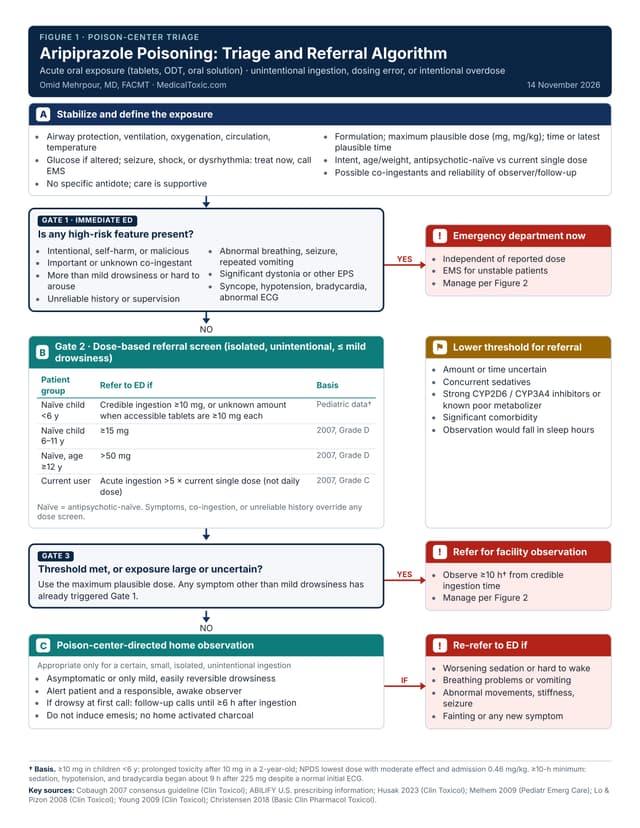
Step 1 — Stabilize. Address inadequate ventilation, airway compromise, seizure, shock, or a concerning dysrhythmia. Check bedside glucose in patients with altered mental status.
Step 2 — Define the exposure. Establish formulation, maximum plausible dose, time or latest plausible time of ingestion, intent, age/weight, current prescribed single dose, possible co-ingestants, and reliability of follow-up.
Step 3 — Immediate ED gate. Intentional ingestion or self-harm, concerning co-ingestants, abnormal mental status beyond mild drowsiness, respiratory compromise, seizure, hypotension/bradycardia, abnormal ECG, or unreliable supervision warrants ED assessment. Use EMS for an unstable patient. (Figure 1)
Step 4 — Pediatric dose gate. In an antipsychotic-naïve child under 6 years, refer after ≥10 mg, or an unknown amount from accessible ≥10-mg tablets. For antipsychotic-naïve children aged 6–11 years, ≥15 mg meets the 2007 historical referral trigger. A symptomatic child warrants referral at any dose. [1], [3], [4]
Step 5 — Older patient or chronic user. For antipsychotic-naïve individuals aged 12 years or older, the historical trigger is >50 mg. For a patient on chronic aripiprazole therapy, use >5 × current single dose, not 5 × the total daily dose; other risk factors and symptoms override the rule. [1]
Step 6 — Monitor and disposition. In the ED, obtain an ECG and reassess the neurologic state, airway, and vital signs. Low-risk cases can be reassessed at ≥6 hours after ingestion. For a higher-risk oral ingestion (dose screen met, amount or time uncertain, intentional or mixed ingestion, or a lower-threshold factor) that remains asymptomatic, complete ≥10 hours of observation, counted from a credible ingestion time, before considering medical clearance. If onset is uncertain, use the latest plausible ingestion time or individualize with poison-control consultation. Never clear an actively symptomatic patient on time alone. [1], [2], [10]
Scenario | Recommended disposition | Clinical rationale |
|---|---|---|
Intentional overdose, suspected self-harm, malicious administration, or clinically important co-ingestion | ED immediately, independent of dose | Historical consensus and combined-exposure risk [1] |
More than mild drowsiness, difficult arousal, abnormal breathing, seizure, recurrent vomiting, significant EPS, syncope, hypotension/bradycardia, or abnormal ECG | ED; EMS for instability | |
Age <6 years, antipsychotic-naïve: credible ingestion ≥10 mg, or unknown quantity when available tablets are ≥10 mg | ED | Conservative pediatric recommendation; a 10-mg case had prolonged toxicity [3], [4] |
Age 6–11 years, antipsychotic-naïve: ingestion ≥15 mg | ED | 2007 consensus threshold, Grade D [1] |
Age ≥12 years, antipsychotic-naïve: ingestion >50 mg | ED | 2007 consensus threshold, Grade D [1] |
Established aripiprazole user: acute ingestion >5 × current single therapeutic dose | ED | 2007 consensus, Grade C; not five times daily total [1] |
Known small isolated accidental exposure, at most mild drowsiness, appropriate to age/dose, with an alert patient and reliable awake observer | Poison-center-directed home observation may be appropriate | Active follow-up and strict return precautions; no elapsed-time-only guarantee [1] |
Amount/time uncertain, concurrent sedatives or CYP inhibitors, unreliable observer, significant comorbidity, or delayed symptoms | Lower threshold for facility observation |
The historical ≥15-mg threshold for children under 12 years remains an accurately cited 2007 consensus recommendation; for the under-6 antipsychotic-naïve subgroup, the more cautious ≥10-mg referral rule above takes precedence. Neither numerical rule excludes toxicity at lower doses. Repeated therapeutic doses and long-acting injectable errors require individualized assessment. [1], [3], [4]
The 2007 guideline states that an asymptomatic patient without self-harm, first assessed more than 6 hours after ingestion, is unlikely to develop new symptoms; its recommendation addresses out-of-hospital triage, not an absolute ED discharge guarantee. Patients with mild drowsiness managed at home should receive poison-center follow-up until at least 6 hours after ingestion. [1]
Lo and Pizon reported a 25-year-old, 50-kg woman prescribed aripiprazole for bipolar disorder who intentionally ingested fifteen 15-mg tablets (225 mg; 4.5 mg/kg). She was awake, with an initial QRS 73 ms and QTc 396 ms, and remained apparently well for approximately 6–8 hours. At about 9 hours, she became difficult to arouse, with blood pressure 80/40 mmHg and heart rate approximately 50/min. She required ICU observation, improved after IV fluids and supportive care, and had a normal repeat ECG. The patient was not antipsychotic-naïve. This is a single case report, not a validated prediction model. [10]
Patient / exposure profile | Clinical observation approach | Qualification |
|---|---|---|
Certain, small, isolated unintentional oral ingestion; asymptomatic or only mild easily reversible drowsiness; reliable supervision | Poison-center-directed home follow-up; assessment at approximately 6 hours may support disposition | Historical out-of-hospital guidance only [1] |
Large, uncertain, or otherwise higher-risk oral ingestion, currently asymptomatic, referred to a healthcare facility | At least 10 hours of serial mental-status, respiratory, heart-rate, and blood-pressure assessment from a credible ingestion time | Conservative minimum informed by the 9-hour delayed-onset case; not a validated safe-discharge cutoff [10] |
Persistent or new neurologic signs, abnormal respiration, bradycardia/hypotension, abnormal ECG, severe EPS, or concern for co-ingestion | Continue observation or admit until clinically safe, irrespective of elapsed hours | Do not medically clear symptomatic patients solely because 10 hours have passed [1], [2], [10] |
The FDA label recommends a 12-lead ECG in overdose and continuous cardiac monitoring when QT prolongation is present. For a stable, isolated exposure with normal ECG and no other QT-related concern, continuous telemetry may be avoided after clinical assessment; normal ECG does not replace serial pulse, blood-pressure, airway, and neurologic observation. Bradycardia and hypotension may emerge despite a normal initial ECG. [2], [8], [10]
Finding | Cardiac-monitoring decision |
|---|---|
Stable isolated exposure, normal initial ECG/QTc, no QT-risk factors or cardiotoxic co-ingestants | Serial clinical vital signs and mental-status reassessment; prolonged telemetry is not routinely mandated solely by exposure [2], [6], [8] |
New hypotension/bradycardia, syncope, evolving symptoms, or a symptomatic patient in early ED assessment | ECG reassessment and monitoring as dictated by clinical status; consider continuous monitoring for unstable findings [2], [10] |
QTc/QRS abnormality, dysrhythmia, persistent circulatory instability, significant electrolyte abnormality, or relevant co-ingestion | Continuous monitoring/telemetry, repeat ECG, targeted correction, and admission as indicated [2], [7], [8] |
Feature | Clinically relevant fact |
|---|---|
Mechanism | Partial agonism at dopamine D2 and serotonin 5-HT1A receptors and antagonism at 5-HT2A receptors; receptor effects do not independently predict overdose severity. [2] |
Receptor affinity clarification | U.S. labeling documents high affinity for serotonin 5-HT1A and 5-HT2A receptors and moderate affinity for alpha-1 adrenergic and histamine H1 receptors. Do not incorrectly describe aripiprazole as having universally low serotonin-receptor affinity. [2] |
Absorption | Oral bioavailability approximately 87%; plasma peak typically 3–5 hours after a tablet dose. These values describe routine pharmacokinetics, not a guarantee about symptom onset in overdose. [2] |
Distribution | Large apparent distribution volume (~4.9 L/kg) and >99% protein binding. [2] |
Metabolism | Mainly CYP2D6 and CYP3A4; active metabolite dehydro-aripiprazole. [2] |
Half-life | Approximately 75 h for aripiprazole and 94 h for the active metabolite in current U.S. product labeling; ~146 h for aripiprazole in CYP2D6 poor metabolizers. An older small volunteer study reported 47–68 h under its study conditions. [2], [12] |
Elimination | Predominantly hepatic metabolism; unchanged urinary excretion is <1% of dose. Hemodialysis is not expected to enhance clearance meaningfully. [2] |
Practical implication: The long elimination half-life helps explain prolonged symptoms once toxicity has developed; it does not justify admitting all asymptomatic patients for several half-lives. Interactions with strong CYP2D6/CYP3A4 inhibitors, prior steady-state exposure, and CYP2D6 poor-metabolizer status may increase or prolong drug exposure, although overdose-specific risk estimates are unavailable. [2], [7]
Clinical pattern | Typical manifestations | Practical action |
|---|---|---|
Mild | Sleepiness but readily arousable, nausea, isolated emesis, dizziness, mild tachycardia | Confirm exposure and trajectory; consider poison-center follow-up if otherwise low risk [1], [6], [13] |
Moderate | Sustained lethargy, ataxia, tremor, drooling, dystonia, agitation, repeated vomiting, impaired oral intake | Facility assessment and serial neurologic/airway monitoring [1], [3], [4], [5], [13] |
Severe or atypical | Difficult-to-arouse state, coma, aspiration, hypoventilation, seizure, bradycardia/hypotension (possibly delayed), marked ECG changes | Resuscitation/monitored care; actively reassess for co-ingestants and alternative diagnoses [2], [5], [7], [8] |
This severity table is a clinical description, not a validated aripiprazole outcome scale. In a retrospective study of 286 isolated exposures, 158 (55%) had reported symptoms; among symptomatic patients, somnolence was the leading manifestation (89/158, 56%, or 31% of all 286), followed by tachycardia, nausea/vomiting and dystonia. [9]
No intubations, deaths or ECG abnormalities were identified in that cohort, which does not mean those outcomes are impossible. CNS depression is especially important in young children; extrapyramidal symptoms may develop or persist as sedation improves. [3], [4], [5], [13]
Melhem et al. (2009): A 2-year-old with 10 mg developed marked lethargy, tremor, and tachycardia lasting more than 72 hours. This shows that 15 mg is not a reliable lower bound for clinical effects. [4]
Lofton and Klein-Schwartz (2005): In a five-case series, a 2-year-old with 40 mg had prominent lethargy for approximately 30 hours; one 6-year-old developed drooling and abnormal muscle findings after therapeutic dosing errors. [13]
Seifert, Schwartz, and Thomas (2005): A 2.5-year-old, after an estimated 195 mg (17.1 mg/kg), had CNS depression without major cardiovascular effects or respiratory support; CNS findings persisted for almost two weeks. This is an extreme case report, not evidence that all pediatric exposures require weeks of observation. [11]
Warstadt et al. (2022): A 21-month-old with reported 52 mg experienced approximately 60 hours of lethargy, followed by movement symptoms between 36 and 72 hours, with recovery before discharge at 72 hours. [5]
Husak et al. (2023): Among 2,390 pediatric aripiprazole exposures with known outcome in the analyzed NPDS subset (age 0–5 years), 16.6% were coded moderate and 0.6% major; the lowest reported dose resulting in at least moderate effect and facility admission was 0.46 mg/kg. Because of dose uncertainty, selection, outcome coding, and absence of prospective validation, these numbers must not be converted into universal ED referral cutoffs. [3]
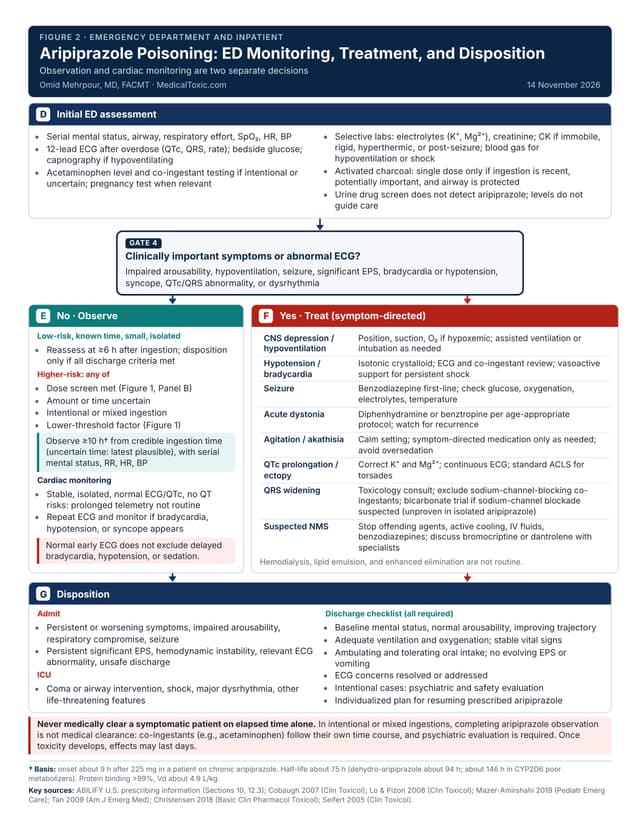
Immediately: Record repeated vital signs; assess alertness, airway protection, respiratory effort, oxygen saturation, and bedside glucose. Consider capnography when hypoventilation is a concern. Establish the ingestion timeline, identify possible co-ingestants, and document the maximum plausible dose.
ECG and cardiac monitoring: Obtain a 12-lead ECG following overdose, especially in intentional, substantial, uncertain, or symptomatic exposures. The FDA label advises continuous cardiac monitoring if QT prolongation is present.
Abnormal QRS/QTc, dysrhythmia, syncope, persistent bradycardia/hypotension, significant electrolyte abnormalities, or cardiotoxic co-ingestion warrants repeat ECG and monitoring as clinically indicated.
Prolonged continuous telemetry is not routinely mandated for a stable isolated exposure with normal initial ECG and no additional cardiac risks, but serial neurologic status, pulse, blood pressure, and respiratory assessments remain necessary during the designated observation period.
The Lo–Pizon case demonstrates delayed hypotension and bradycardia despite a normal initial ECG. [2], [6], [7], [8], [10]
Laboratory studies (selective): In patients with substantial vomiting, altered mental status, hemodynamic effects, or relevant co-ingestion, consider electrolytes (including potassium and magnesium when warranted), creatinine, and glucose.
Check acetaminophen concentration and appropriate co-ingestant testing after intentional or uncertain overdose; obtain pregnancy testing when relevant.
Measure CK/renal function when prolonged immobility, hyperthermia, severe rigidity, or seizure suggests rhabdomyolysis.
Blood gas is indicated for impaired ventilation, shock, or acid–base concerns. Do not delay emergency treatment for testing.
Drug assays: A standard urine immunoassay drug screen does not reliably establish or exclude aripiprazole ingestion; false-positive amphetamine immunoassay results have been reported after pediatric aripiprazole ingestion. [14]
Serum aripiprazole/dehydro-aripiprazole measurements are generally not timely or validated to guide routine acute management or discharge; reserve specialty testing for selected diagnostic or forensic questions.
Problem | Recommended management | Evidence / caveat |
|---|---|---|
Significant CNS depression or hypoventilation | Positioning, suction, supplemental oxygen if hypoxemic, assisted ventilation or airway intervention when needed; frequent reassessment | Core supportive management [2] |
Hypotension / symptomatic bradycardia | Reassess airway and circulation, provide isotonic crystalloid for hypotension when appropriate, check ECG and co-ingestants; persistent shock may require vasoactive support | Delayed BP 80/40 and HR ~50/min after 225 mg improved with IV fluids [10]; persistent shock needs individualized resuscitation [2] |
Seizure | Benzodiazepine first-line; assess glucose, oxygenation, temperature, electrolytes, and alternative causes | General seizure treatment; no aripiprazole-specific antidote [2] |
Acute dystonia | If clinically important, consider parenteral diphenhydramine or benztropine under institutional age-appropriate protocols; reassess for recurrent symptoms and anticholinergic adverse effects | Standard medication-induced dystonia management; do not treat nonspecific tremor automatically as dystonia [5], [13] |
Agitation / akathisia | Calm setting and supportive care; use monitored symptom-directed medication only as needed; distinguish from true dystonia, seizure, delirium, or serotonin toxicity | Avoid compounding excessive sedation |
QTc prolongation / ventricular ectopy | Review co-ingestants, correct hypokalemia/hypomagnesemia, monitor ECG; follow standard resuscitation protocol if torsades or sustained arrhythmia develops | Rare in isolated exposures; no prophylactic magnesium for all patients [2], [6], [8] |
QRS widening | Obtain toxicology consultation; exclude sodium-channel-blocking co-ingestants, metabolic causes, and baseline conduction disease. A targeted bicarbonate trial may be appropriate when sodium-channel blockade is clinically suspected, but benefit for isolated aripiprazole toxicity is unproven | A published 100-mg case had prolonged QRS widening despite bicarbonate [7] |
Suspected neuroleptic malignant syndrome (NMS) | Urgent hospital care: discontinue offending agents, secure airway as needed, provide active cooling, IV fluids, and benzodiazepines for agitation/rigidity; discuss bromocriptine or dantrolene in severe cases with specialists | Rare and often linked to therapeutic exposure rather than a single acute ingestion; exclude serotonin toxicity, infection, and malignant hyperthermia [15] |
Do not induce vomiting. Activated charcoal is not appropriate for routine home administration or for a patient with an unprotected airway.
When the ingestion is recent and potentially important, clinicians may consider a single dose in a healthcare setting after weighing aspiration risk and expected benefit.
FDA labeling reports that 50 g given one hour after a 15-mg therapeutic dose decreased exposure by approximately 50% in a volunteer pharmacokinetic experiment; this is not evidence of improved outcomes after overdose.
Routine gastric lavage or whole-bowel irrigation is not recommended for ordinary oral tablet ingestion. [1], [2]
There is no specific antidote.
Hemodialysis is not expected to be useful for toxin removal because of high protein binding and large distribution volume.
Lipid emulsion and extracorporeal clearance are not routine treatments for aripiprazole poisoning; manage unusual refractory cases with a medical toxicologist and the local critical-care team. [2]
If the poison center determines that home care is appropriate, ensure a responsible observer can assess normal arousability and breathing; give explicit instructions to seek care for new or worsening sedation, vomiting, breathing problems, abnormal movements, or other new symptoms.
Follow-up should extend at least through the risk period specified by the poison-center protocol, with at least 6 hours after ingestion for patients initially mildly drowsy under the 2007 consensus approach. Unreliable sleep-hour monitoring is a reason to refer. [1]
For a selected, known-time, isolated, low-risk, asymptomatic exposure, a reassessment at approximately 6 hours may support disposition based on the 2007 out-of-hospital consensus; this is not an automatic ED discharge rule.
For a large, uncertain, or otherwise higher-risk oral ingestion, use a minimum of 10 hours of clinical observation from a credible ingestion time, with serial mental status, respiratory, pulse and blood-pressure assessments.
This interval is a conservative minimum, informed by the 9-hour case of delayed depressed arousability, bradycardia and hypotension after 225 mg, not an evidence-validated guarantee.
Patients with clinically important or evolving symptoms require continued observation or admission regardless of time elapsed.
A normal initial ECG does not eliminate the need for serial vitals. [1], [2], [3], [4], [10], [11]
Admit for clinically significant symptoms that persist or worsen during observation, impaired arousability, respiratory compromise, persistent clinically important dystonia/EPS, hemodynamic instability including symptomatic bradycardia/hypotension, relevant ECG abnormalities, seizure, or unsafe discharge circumstances.
Select an ICU for coma/airway intervention, shock, major dysrhythmia or other life-threatening features.
A patient who remains only mildly drowsy but is clearly improving may be dispositioned individually if all discharge criteria are met; do not use the appearance of any symptom as an automatic ICU criterion.
Mental status back at baseline with normal arousability and a stable/improving trajectory.
Adequate spontaneous ventilation and oxygenation; stable vital signs.
Able to ambulate and take oral intake as age-appropriate, with no clinically important evolving EPS or vomiting.
ECG concerns, if present, resolved or explicitly addressed with a safe specialty plan.
Co-ingestant risk assessed; intentional cases receive appropriate psychiatric and safety evaluation.
Safe observation arrangements, poison-center instructions, and an individualized plan for holding/resuming prescribed aripiprazole.
Do not prescribe a uniform next-dose hold. Because aripiprazole has a long half-life, the next therapeutic dose after a dosing error should be decided with the treating clinician/poison center in light of the symptoms, timing, chronic regimen, co-medications, and psychiatric needs.
A one-time extra dose is not equivalent to an ingestion in an antipsychotic-naïve child. Review the current single dose, accumulated exposure, timing, symptoms, strong CYP2D6/CYP3A4 inhibitors, and concomitant sedatives. Use the 2007 fivefold criterion only within the circumstances for which it was developed. [1], [2]
Poor metabolism and strong inhibitors can increase exposure and may prolong effects. In one 100-mg case with protracted QRS widening, a CYP2D6 poor-metabolizer genotype was identified; that single case does not establish a genotype-specific bicarbonate or ECG treatment rule. [2], [7]
Do not extrapolate reassuring outcomes from isolated aripiprazole case series to patients who may also have taken opioids, benzodiazepines, antidepressants, QT-prolonging drugs, or sodium-channel blockers.
In a Texas series, 65% of 280 reported aripiprazole exposures involved additional substances.
Treat the combined toxidrome and screen for common dangerous co-ingestions. [1], [6], [8], [16]
Extended-release injectable aripiprazole (e.g., ABILIFY MAINTENA) and aripiprazole lauroxil (ARISTADA) have different absorption profiles and prolonged release.
Accidental injection errors or intravascular administration are outside this oral-ingestion pathway.
Refer to the product-specific labeling and consult poison control. [17], [18]
The recommendations combine the 2007 U.S. out-of-hospital consensus, U.S. prescribing information, retrospective poison-center data, and published case reports.
The historical dose triggers are graded consensus referral criteria, not prospectively established biologic toxicity thresholds.
The more cautious ≥10-mg referral criterion for antipsychotic-naïve children under 6 years is a clinical safety recommendation informed by pediatric case literature and newer surveillance; a universal safe-dose cutoff has not been established. [1], [2], [3], [4]
In the Lo–Pizon report, a woman prescribed aripiprazole developed impaired arousability, bradycardia and hypotension about 9 hours after an intentional 225-mg ingestion, despite a normal initial ECG.
The ≥10-hour minimum for substantial or uncertain asymptomatic exposures is deliberately conservative and has not been prospectively validated.
It should not be used to discharge a patient with ongoing symptoms or an unreliable ingestion timeline.
Pediatric cases also demonstrate that once symptoms occur, CNS effects may last several days or longer. [4], [5], [10], [11]
The FDA label advises ECG assessment in overdose and monitoring if QT prolongation is present.
Available observational studies suggest major dysrhythmias are infrequent in isolated exposure, but normal initial ECG/QTc is not a substitute for serial vital-sign assessment.
No high-quality study establishes a universal telemetry duration in aripiprazole poisoning. [2], [6], [7], [8], [10]
A Danish poison-center series of 239 exposures (including 86 single-drug exposures) suggested that higher admission thresholds might be reasonable in selected isolated cases with no more than light sedation.
Its proposed 300-mg figure is not a validated emergency-referral rule and must not supersede intent, age, symptoms, co-ingestion, or the conservative pediatric triage above. [6]
Prospective validation of age- and weight-specific pediatric risk, the time-to-onset distribution for significant neurologic and hemodynamic effects, effects of CYP inhibition/poor metabolism in overdose, and management of uncommon conduction abnormalities.
When an exposure is atypical, mixed, or evolving, consult the poison center or a medical toxicologist.
Keep reading