Substance Abuse and Addiction
“Space Oil” and Etomidate: Sedation, Hypokalemia, and Adrenal Toxicity
Omid Mehrpour
Post on 17 Dec 2025 · Updated 09 Oct 2026 · 16 min read
Omid Mehrpour
Post on 17 Dec 2025 · Updated 09 Oct 2026 · 16 min read
 Medical Toxicologymedicaltoxic.com
https://medicaltoxic.com/blogs/space-oil-and-etomidate-in-the-drug-supply-hidden-sedatio
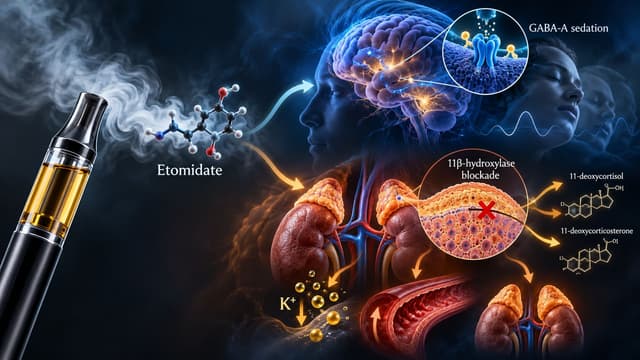
Etomidate is a short-acting intravenous anesthetic, but non-medical exposure now extends well beyond the operating room. In parts of Asia, etomidate and structurally related compounds have been detected in e-liquids and vaping products marketed under names such as “space oil.” Recreational exposure has been associated with clinically significant sedation, impaired consciousness, abnormal movements, accidents, dependence, and disruption of adrenal steroid synthesis. [1]
The endocrine toxicity requires particular care because it is easy to describe incorrectly.
A conventional single medical induction dose of etomidate can transiently suppress adrenal cortisol and aldosterone synthesis through inhibition of 11β-hydroxylase. The U.S. prescribing information describes suppression lasting approximately six to eight hours after an induction dose. [2]
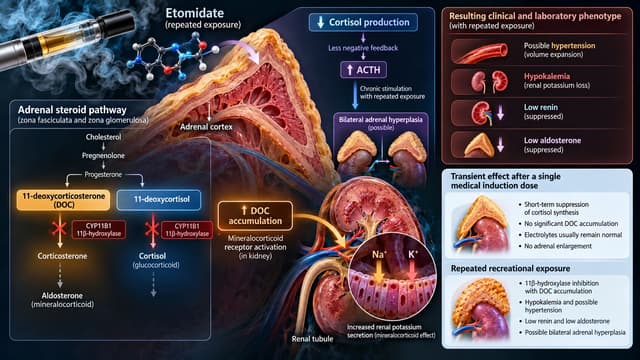
Repeated or recreational exposure is different. Chronic or frequent exposure to etomidate and some analogues can produce an acquired 11β-hydroxylase-deficiency phenotype characterized by accumulation of steroid precursors, suppression of renin and aldosterone, and—counterintuitively—hypokalemia and sometimes hypertension, particularly because 11-deoxycorticosterone has mineralocorticoid activity. This should not be simplified into “low aldosterone causes hyperkalemia.”
Etomidate is a GABA-A–modulating sedative-hypnotic. Recreational vaping can cause confusion, reduced consciousness, dizziness, unsteady gait, abnormal movements, and other CNS effects. [1]
Products sold as “space oil” are not standardized. Etomidate, propoxate, isopropoxate, metomidate, other analogues, and additional drugs may be detected in recreational-use settings.
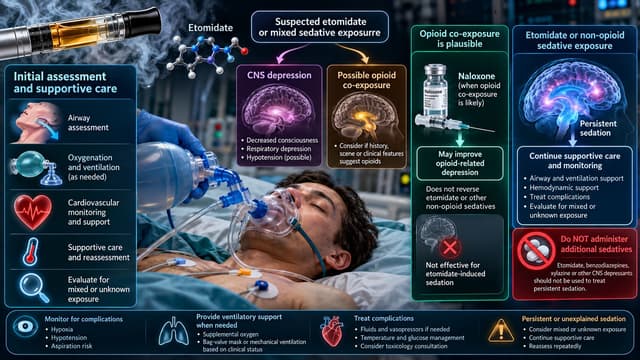
Do not administer additional CNS depressants simply because sedation persists after naloxone.
Naloxone should still be used when opioid co-exposure is plausible because it reverses the opioid component; it does not directly reverse etomidate.
A single clinical etomidate dose and repeated recreational exposure should not be treated as the same endocrine syndrome.
Repeated exposure can produce acquired 11β-hydroxylase inhibition with elevated steroid precursors, hypokalemia, low renin/aldosterone, hypertension, and—in some cases—adrenal hyperplasia.
Cortisol and ACTH findings vary with timing, severity, physiologic stress, and cumulative exposure. There is no valid rule that “high cortisol plus high ACTH means give hydrocortisone.”
A six-to-eight-hour biochemical suppression after a clinical induction dose is not evidence for a universal six-to-eight-hour observation rule after recreational vaping or repeated exposure.
Suspected endocrine toxicity should prompt individualized laboratory assessment and early medical-toxicology/endocrinology input.
“Space oil” is a street-market term rather than a pharmaceutical formulation.
Etomidate has been identified in vaping liquids in Hong Kong, mainland China, Taiwan, Singapore, and other parts of Asia and Oceania. Structurally related compounds—including propoxate, isopropoxate and metomidate—have also emerged. [1]
Not every product has the same composition.
This distinction matters clinically. In human case series, etomidate or its analogues have sometimes been detected alongside stimulants or other psychoactive substances. The ACMD review specifically cautions that co-detection does not necessarily prove that all substances were contained in the same vaping liquid; some patients may have used multiple products separately. [1]
The term “space oil” should therefore not be interpreted as meaning:
etomidate + fentanyl in every cartridge.
Composition can be uncertain, and mixed or sequential exposure is possible.
Hong Kong authorities moved away from the street-market terminology in July 2025 and adopted the drug's actual name, etomidate, in public messaging to avoid reinforcing a glamorized product identity.
Etomidate is a non-barbiturate imidazole anesthetic that positively modulates GABA-A receptors, producing rapid sedation and hypnosis. In legitimate clinical practice, it is administered intravenously for induction of anesthesia. [1]
Its cardiovascular stability is one reason it has historically been useful during anesthesia induction in selected high-risk patients.
Its major endocrine liability is inhibition of adrenal steroidogenesis.
Etomidate inhibits 11β-hydroxylase, or CYP11B1, and can also interfere with related adrenal steroidogenic pathways. The result is impaired conversion of:
11-deoxycortisol → cortisol
and:
11-deoxycorticosterone → corticosterone
with downstream effects on glucocorticoid and mineralocorticoid physiology.
After a medically administered induction dose, reduced cortisol and aldosterone concentrations have been documented. The current U.S. product labeling describes this effect as persisting for approximately six to eight hours and being relatively unresponsive to ACTH stimulation during that period. [2]
That is primarily a pharmacologic effect observed in a controlled medical setting.
It does not mean every patient receiving one clinical dose develops symptomatic adrenal crisis.
It also does not establish a six-to-eight-hour emergency-department observation requirement for recreational exposure.
Repeated vaping can create a different endocrine phenotype because enzyme inhibition may be recurrent or sustained and steroid precursors accumulate over time.
A 2025 study by Cheung and colleagues examined urine steroid profiles from 20 adult users with analytically confirmed etomidate and/or propoxate/isopropoxate exposure. Hypokalemia was present in the majority of cases, and steroid profiles showed accumulation of metabolites including tetrahydro-11-deoxycortisol and tetrahydro-deoxycorticosterone, consistent with acquired 11β-hydroxylase inhibition. [6]
This is a much better model for understanding chronic “space oil” endocrine toxicity than simply extrapolating from one anesthetic induction dose.
This is the central physiology correction.
11β-hydroxylase inhibition impairs normal adrenal steroid conversion and can increase 11-deoxycorticosterone (DOC).
DOC has mineralocorticoid activity.
When present in sufficient concentrations, it can promote sodium retention and renal potassium loss. The resulting mineralocorticoid effect can suppress both renin and aldosterone even while the patient develops:
hypokalemia;
hypertension;
metabolic alkalosis in some cases;
muscle weakness when potassium depletion is severe.
A detailed human case report of acquired 11β-hydroxylase deficiency after chronic etomidate/analogue vaping documented the expected steroid pattern and explained why hypertension can occur even when aldosterone itself is low. [7]
Two other published cases of etomidate-containing e-cigarette use developed severe hypokalemia with lower-extremity weakness; adrenal imaging showed adrenal thickening/hyperplasia, and one patient also had significant hypertension. [8]
Therefore, the previous MedicalToxic statement:
low aldosterone → hyponatremia and hyperkalemia
should not remain in this article as the expected phenotype of repeated recreational etomidate exposure.
There is no single cortisol/ACTH combination that identifies every recreational etomidate exposure.
When cortisol synthesis is substantially impaired, loss of negative feedback can increase ACTH. Patients can therefore develop:
low or inappropriately inadequate cortisol + elevated ACTH
with accumulation of 11-deoxycortisol and related precursors.
However, real-world measurements vary with:
timing since the last exposure;
frequency and duration of use;
physiologic stress;
severity of illness;
co-exposures;
whether a basal or stimulated cortisol measurement is used.
This variability is visible in a 2026 Hong Kong pediatric/adolescent cohort of 13 analytically confirmed cases. Among the patients who underwent endocrine testing, some had low morning cortisol, some had elevated ACTH, and three of six patients who underwent low-dose Synacthen testing met the study's definition of adrenal insufficiency. Renin and aldosterone were undetectable in six tested patients, while elevated 11-deoxycortisol and 17-hydroxyprogesterone were also observed. Mild hypokalemia occurred in two patients. [9]
This evidence directly contradicts a simplistic rule based on “cortisol and ACTH both remaining high.”
Chronic enzyme blockade can increase ACTH stimulation of the adrenal cortex.
Over time, this may contribute to bilateral adrenal enlargement or hyperplasia, a finding described in human recreational-use cases. [7] [8]
The phenotype may resemble congenital 11β-hydroxylase deficiency even though the underlying problem is acquired and drug-induced.
Other reported endocrine manifestations include:
hyperandrogenic features;
menstrual disturbance;
acne;
hirsutism;
deepening of the voice;
altered steroid precursor profiles.
Not every patient develops these manifestations, and adrenal imaging should not be treated as a routine screening test for every acute exposure.
On October 7, 2026, Liu and Tse published Acquired 11β-hydroxylase deficiency adrenal hyperplasia associated with the use of etomidate and/or its analogues through e-cigarettes — a review of 76 cases in Hong Kong in Clinical Toxicology. The publication represents the largest recent Hong Kong-focused clinical synthesis specifically addressing this acquired endocrine phenotype. [10]
The most important point for this Blog is not to over-extract a new percentage from a newly published dataset.
Instead, the 2026 publication strengthens a broader body of evidence already supported by steroid profiling, individual endocrine cases, severe hypokalemia reports, and pediatric/adolescent observations:
repeated recreational etomidate/analogue exposure can produce clinically significant acquired disruption of adrenal steroidogenesis.
That syndrome is more complex than transient low cortisol after a single anesthetic dose.
Recreational etomidate exposure can produce a range of CNS findings.
Across published case series reviewed by the UK Advisory Council on the Misuse of Drugs, reported manifestations included:
impaired cognition or confusion;
fluctuating or reduced consciousness;
tremor;
delirium;
emotional instability;
agitation;
unsteady gait;
dizziness;
myoclonus and other abnormal movements. [1]
The presence of co-intoxicants complicates attribution.
A deeply sedated patient who has used an unknown vape, powder, or illicit product should therefore be approached as a mixed or unknown exposure until the clinical picture is clearer.
For a broader discussion of emerging polysubstance threats, see Emerging Toxicological Threats in the U.S.: Xylazine, Nitazenes, Novel Sedatives, Synthetic Cannabinoids, Fentanyl Analogues, and Toxic Mushrooms.
Etomidate is a CNS depressant, but the respiratory picture in recreational exposures is not necessarily the same as an isolated clinical induction dose.
Unknown concentration, repeated inhalation and co-use of opioids or other sedatives can materially change risk.
If a patient presents with impaired consciousness and hypoventilation, clinicians should not assume that etomidate is the only exposure.
Likewise, persistent respiratory depression after naloxone should not be interpreted as proof of etomidate exposure.
Other possibilities include:
non-opioid sedatives;
xylazine or other alpha-2 agonists;
benzodiazepines;
alcohol;
other novel sedatives;
neurologic or metabolic causes;
residual opioid effect.
For comparison with another major non-opioid sedative adulterant, see Fentanyl + Xylazine (‘Tranq’): Why Naloxone Alone Isn’t Enough.
Naloxone reverses opioid receptor effects.
It does not directly reverse etomidate.
If fentanyl, heroin, nitazenes, or another opioid may be part of an unknown or mixed exposure, naloxone remains appropriate while airway and breathing are assessed. WHO guidance for suspected opioid overdose emphasizes airway management, assisted ventilation, and naloxone. [11]
If ventilation improves after naloxone but substantial sedation persists, that should prompt:
continued airway assessment;
oxygenation and ventilatory support as required;
cardiovascular monitoring;
reassessment for mixed or unknown sedative exposure;
supportive care;
poison-center or medical-toxicology consultation.
Do not treat persistent sedation by administering etomidate, xylazine, benzodiazepines, or another CNS depressant.
That recommendation in the previous version of this Blog was unsafe and has been removed.
For detailed clinician-level naloxone titration and infusion considerations, see Naloxone in Xylazine, Nitazenes, and Fentanyl Analogue Overdose.
Evaluation should reflect both acute CNS toxicity and possible endocrine complications.
A focused assessment may include:
airway, breathing, oxygenation and ventilation;
mental status;
blood pressure and heart rate;
ECG when clinically indicated;
blood glucose;
serum electrolytes, particularly potassium;
renal function and acid-base status when indicated;
exposure history, including frequency and duration of vaping;
assessment for opioid and other sedative co-exposures.
Repeated or long-duration use should raise the threshold for considering endocrine testing.
Routine hospital drug screens may not reliably identify etomidate or newer analogues. Specialized chromatographic or mass-spectrometric testing may be required.
For broader interpretation of toxicology testing, see Drug Screens Lie: A Clinician’s Guide to Interpreting Toxicology Tests Safely.
No single laboratory panel has been validated as a universal recreational-etomidate protocol.
When the history, symptoms, electrolyte abnormalities, blood pressure pattern, or repeated use raises concern for acquired 11β-hydroxylase inhibition, specialist-directed evaluation may include:
potassium and other relevant electrolytes;
cortisol interpreted in relation to timing and physiologic stress;
ACTH;
11-deoxycortisol;
17-hydroxyprogesterone;
renin and aldosterone;
DOC or broader steroid profiling when available;
dynamic adrenal testing when clinically appropriate.
Urine steroid profiling can provide particularly useful mechanistic evidence in specialized centers. [6]
The important point is that cortisol should not be interpreted in isolation.
A random cortisol obtained during critical illness cannot simply be converted into a chronic endocrine diagnosis, and ACTH may be elevated, normal, or otherwise difficult to interpret depending on timing and severity.
Clinically significant hypokalemia requires correction and appropriate cardiac/electrolyte monitoring according to standard medical practice.
The mechanism may persist while 11β-hydroxylase blockade and precursor excess continue.
Hypertension does not exclude adrenal steroid dysfunction.
In fact, hypertension together with:
low renin + low aldosterone + elevated 11-deoxycortisol/DOC-related metabolites
can support an acquired mineralocorticoid-excess phenotype caused by precursor accumulation.
Severe or recurrent abnormalities warrant endocrinology and medical-toxicology input.
No.
The previous Blog effectively created a rule linking a particular cortisol/ACTH pattern to hydrocortisone. That rule should be discarded.
Glucocorticoid decisions depend on the clinical context and evidence for impaired adrenal function.
Published recreational-use cohorts have used hydrocortisone in selected patients with demonstrated adrenal insufficiency, but current studies are small and do not establish a universal replacement protocol for every etomidate-positive patient. [9]
There is also an important distinction between:
suspected adrenal crisis
and:
biochemical steroid abnormalities in a stable recreational user.
If a true adrenal crisis is clinically suspected, established endocrine emergency guidance states that appropriate treatment should not be delayed while waiting for complete laboratory confirmation. [12]
For stable patients with repeated etomidate exposure, however, long-term or replacement glucocorticoid decisions should be individualized with endocrinology and medical-toxicology involvement.
There is no validated universal “six-to-eight-hour observation rule” for recreational etomidate exposure.
The six-to-eight-hour figure in the etomidate prescribing information refers to the approximate duration of biochemical adrenal suppression following a conventional clinical induction dose. [2]
It is not a validated disposition rule for:
repeated vaping;
unknown-dose exposure;
analogue exposure;
polysubstance intoxication;
persistent hypokalemia;
endocrine abnormalities;
ongoing altered mental status.
Observation and disposition should instead depend on clinical recovery, airway and ventilatory status, hemodynamics, co-exposures, electrolyte abnormalities, evidence of repeated use, endocrine findings, and specialist advice.
No fixed observation duration is recommended in this Blog.
Hong Kong remains one of the best-characterized settings for recreational etomidate exposure.
Official data for the first quarter of 2026 reported 266 young drug users aged under 21, of whom 115 were reported as using etomidate. Etomidate had become the most commonly reported drug among young drug users in the registry since 2025. [3]
These figures must be interpreted correctly.
They come from a drug-abuse reporting system, not a population survey. They do not mean that 115 of all Hong Kong young people used etomidate.
The broader trend is also not simply an uninterrupted rise. By the first half of 2026, the total number of reported young drug users had decreased from 458 to 404 compared with the same period of 2025, although etomidate remained among the main drugs involved in youth drug-related arrests. [4]
That makes language such as “an ever-expanding global crisis” unnecessarily broad.
The evidence supports an important emerging and internationally relevant problem, with its strongest documented clinical burden in parts of East and Southeast Asia.
Hong Kong placed etomidate, metomidate, propoxate, and isopropoxate under the Dangerous Drugs Ordinance in February 2025.
In July 2025, regulation was expanded to cover all analogues of etomidate through a generic legal definition. [5]
This matters clinically because the recreational market can shift from the parent drug to related compounds after regulatory control.
An analogue should not automatically be assumed to have identical sedative potency, toxicokinetics, or adrenal effects. The specific compound matters whenever analytical identification is possible.
Vaping appearance does not establish product safety.
An unregulated cartridge can contain an unexpected anesthetic, analogue, stimulant, opioid, or other psychoactive compound. Packaging, flavor, color, or a street-market name cannot identify dose or composition.
Clinicians evaluating unexplained sedation, abnormal movements, hypokalemia, or unusual endocrine findings should consider asking specifically about:
e-cigarette and vape use;
products sold as “space oil”;
frequency and duration of use;
other recreational drugs;
recent attempts to stop after frequent use.
Repeated use warrants particular attention because the major endocrine syndrome described in the recent literature reflects cumulative/recurrent enzyme inhibition, not simply the transient effect of one medically administered dose.
Persistent sedation after naloxone is a diagnostic clue, not an indication for more sedatives.
Hypokalemia can be a major endocrine clue. Repeated etomidate exposure can mimic acquired 11β-hydroxylase deficiency.
Low aldosterone does not guarantee hyperkalemia. DOC-mediated mineralocorticoid activity can suppress renin and aldosterone while driving potassium loss.
Hypertension does not rule out adrenal dysfunction. In this syndrome, hypertension may actually reflect steroid precursor accumulation.
Do not use “high ACTH + high cortisol” as a hydrocortisone rule. The biochemical phenotype is variable and requires context.
A six-to-eight-hour pharmacologic effect is not a six-to-eight-hour disposition rule.
Ask what was actually used. “Space oil” is a street-market label, not a standardized toxicologic exposure.
No. Naloxone reverses opioid receptor effects. It should still be used when opioid exposure is possible, but persistent etomidate-related sedation requires supportive assessment and management rather than additional naloxone solely to achieve wakefulness. [11]
Repeated recreational exposure has increasingly been associated with hypokalemia, sometimes severe. The mechanism is compatible with acquired 11β-hydroxylase inhibition and accumulation of DOC, which has mineralocorticoid activity and can promote renal potassium loss. [6] [8]
Yes. DOC accumulation can activate mineralocorticoid receptors and produce hypertension while renin and aldosterone are suppressed. [7]
No. A positive exposure history alone is not an indication for glucocorticoid replacement. Treatment depends on clinical condition and evidence of adrenal dysfunction. Suspected true adrenal crisis requires emergency endocrine management, while stable repeated-use cases should be assessed individually.
There is no validated universal observation duration. Clinical recovery, respiratory and cardiovascular status, co-exposures, electrolyte abnormalities, repeated-use history, and endocrine findings should guide monitoring and disposition.
Recreational etomidate exposure is no longer adequately described as a short-lived sedative effect followed by transient adrenal suppression.
The evidence now supports two clinically distinct contexts.
A conventional medical induction dose can transiently inhibit adrenal steroid synthesis. Repeated or recreational exposure—particularly through vaping—can produce a more complex acquired 11β-hydroxylase-deficiency phenotype with steroid precursor accumulation, hypokalemia, suppressed renin and aldosterone, hypertension, and, in some patients, adrenal hyperplasia and impaired cortisol responses.
Acute management should remain physiologic and supportive. Assess the airway, oxygenation, ventilation, circulation, and possible co-exposures. Use naloxone when opioid involvement is plausible, but recognize that naloxone does not reverse etomidate.
Persistent sedation is not an indication to administer additional CNS depressants.
Likewise, endocrine management should not rely on a single cortisol/ACTH shortcut. The patient's exposure pattern, potassium, blood pressure, steroid precursors, adrenal function testing, and overall clinical state matter.
The new 2026 Hong Kong evidence reinforces the importance of recognizing acquired adrenal steroid disruption while also illustrating why recreational etomidate should not simply be managed according to assumptions derived from one controlled anesthetic dose.
© All copyright of this material is absolute to Medical toxicology
Dr. Omid Mehrpour (MD, FACMT) is a senior medical toxicologist and physician-scientist with over 15 years of clinical and academic experience in emergency medicine and toxicology. He founded Medical Toxicology LLC in Arizona and created several AI-powered tools designed to advance poisoning diagnosis, clinical decision-making, and public health education. Dr. Mehrpour has authored over 250 peer-reviewed publications and is ranked among the top 2% of scientists worldwide. He serves as an associate editor for several leading toxicology journals and holds multiple U.S. patents for AI-based diagnostic systems in toxicology. His work brings together cutting-edge research, digital innovation, and global health advocacy to transform the future of medical toxicology.
Keep reading
 Substance Abuse and Addiction
Amirhosein Shabrang
 Substance Abuse and Addiction
Omid Mehrpour
 Substance Abuse and Addiction
Omid Mehrpour
 Substance Abuse and Addiction
Omid Mehrpour