Substance Abuse and Addiction
Poison Centers and the New Addiction Executive Order
Omid Mehrpour
Post on 30 Jan 2026 · Updated 24 Sept 2026 · 5 min read
Omid Mehrpour
Post on 30 Jan 2026 · Updated 24 Sept 2026 · 5 min read
 Medical Toxicologymedicaltoxic.com
https://medicaltoxic.com/blogs/poison-centers-and-the-new-addiction-executive-order
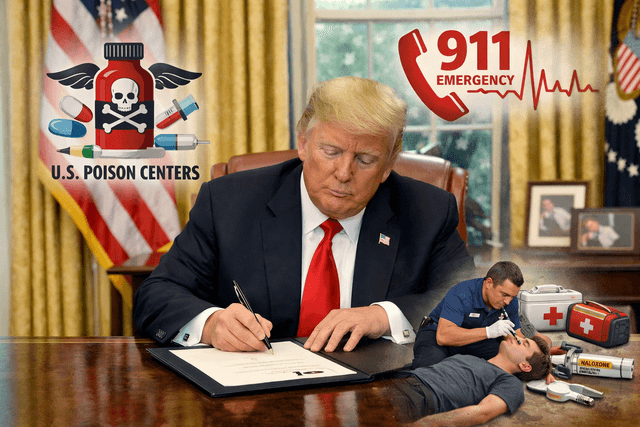
Donald Trump has repeatedly said that his older brother, Fred Trump Jr., died in his early 40s from complications of alcoholism, and that this experience shaped his own decision not to drink alcohol. The signing of the recent executive order tied to the “Great American Recovery Initiative” has once again placed addiction at the center of U.S. health policy discourse. On the surface, the initiative emphasizes coordination of federal efforts across prevention, treatment, and recovery. For the Medical Toxicology and public health community, however, it also signals something deeper:
A paradigm shift from framing addiction as a “moral failing” to recognizing it as a chronic, treatable disease.
If this shift is operationalized with real infrastructure and measurable deliverables, it could reshape how Emergency Departments (EDs), Poison Centers, and the broader healthcare system manage Substance Use Disorders (SUD) and overdose.
In Clinical Toxicology, language is not merely descriptive; it influences clinical pathways, funding priorities, and systems design. Defining addiction as a chronic disease (rather than a “choice”) supports at least two concrete outcomes:
Patients often delay seeking care until a crisis point, such as severe overdose or acute toxicity, due to fear of judgment and stigma. Policy-level language that reinforces addiction as a treatable condition can help lower barriers to earlier care-seeking and earlier intervention.
A disease-centered framework supports evidence-based interventions such as:
Naloxone distribution and training
Drug checking to identify dangerous contaminants
Medications for Opioid Use Disorder (MOUD)
These are not endorsements of drug use; they are clinical tools for reducing mortality and managing a chronic condition.
Executive orders do not treat patients; systems do. Front-line experience in the opioid crisis shows that the system’s Achilles’ heel is often not the absence of medication, but a fracture in the continuum of care.
The pivotal question is:
Does the healthcare system have the capacity to execute a true “Warm Handoff”?
In an effective model, a patient stabilized in the ED is not discharged with instructions alone. Instead, they are actively connected, through coordinated handoff processes, to long-term pathways such as detox, an SUD clinic, MOUD initiation/continuation, or recovery services. The success of any national strategy depends on strengthening this bridge between Acute Care and Long-term Recovery.
The role of Poison Center calls—from emergency calls to critical decisions—is crucial for addressing addiction, mitigating adverse effects, and preventing mortality. Poison Centers are uniquely positioned at the frontline of the opioid and alcohol crises because they operate 24/7 as a low-barrier clinical access point for both the public and clinicians. Many overdose and withdrawal events first surface as a phone call—often before a definitive diagnosis, confirmatory testing, or a clear treatment plan—allowing Poison Centers to guide time-sensitive decisions such as naloxone administration, ED referral versus home monitoring, withdrawal risk stratification, and escalation for respiratory depression, arrhythmias, or co-ingestant toxicity. Beyond individual case management, aggregated call data can reveal emerging patterns (e.g., fentanyl adulterants, polysubstance combinations, and high-risk binge-drinking effects), making Poison Centers an early signal for public health response. By improving triage, reducing delays to evidence-based care, and helping prevent repeat exposures, these hotlines can directly reduce adverse outcomes and mortality related to opioids and alcohol.
Overlooking Poison Centers in resource allocation would be a strategic error for three reasons:
Overdose mortality data is often “lagging indicators,” published months after events occur. Poison Centers, by contrast, contribute near real-time surveillance through the National Poison Data System (NPDS), enabling earlier detection of:
Shifting patterns of exposure
Emerging Novel Psychoactive Substances (NPS)
Dangerous contaminants, including xylazine in fentanyl supplies
Modern overdose and addiction presentations are increasingly polysubstance and synthetics-driven, often exceeding standard ED pathways. Medical Toxicology consultation helps differentiate a “simple overdose” from complex toxicity syndromes, improving management and avoiding missteps.
Evidence consistently shows Poison Center consultation reduces avoidable ED visits and unnecessary hospitalizations. Importantly, on Jan 21, 2026, New RAND Study Shows U.S. Poison Centers Save $3.1 Billion Each Year in annual economic value, and deliver about $16.77 in benefits for every $1 invested.
In an era of rising healthcare costs, strengthening Poison Centers is not an expense. It is a high-yield investment in public health efficiency.
The “Great American Recovery Initiative” is a meaningful signal toward a more scientific and humane understanding of addiction. But as a physician, optimism must be conditional on execution.
Recognizing addiction as a chronic disease is necessary, and overdue. Success, however, will not be measured by speeches, but by tangible investment in:
Warm handoff infrastructure
Poison Center capacity and toxicosurveillance
Measurable outcomes that reduce morbidity and mortality
If policy intent penetrates clinical reality, we can reduce ED burden and save lives. If not, this risks becoming another missed opportunity in the long history of this crisis.
Paradigm Shift: The EO frames addiction as a chronic disease, supporting destigmatization.
Critical Gap: Outcomes depend on “Warm Handoff” from ED to long-term care.
Strategic Asset: Poison Centers provide near real-time signals via NPDS.
Economic Impact: RAND (Jan 21, 2026) estimates $16.77 ROI per $1 invested and $3.1B annual value.
© All copyright of this material is absolute to Medical toxicology
Dr. Omid Mehrpour (MD, FACMT) is a senior medical toxicologist and physician-scientist with over 15 years of clinical and academic experience in emergency medicine and toxicology. He founded Medical Toxicology LLC in Arizona and created several AI-powered tools designed to advance poisoning diagnosis, clinical decision-making, and public health education. Dr. Mehrpour has authored over 250 peer-reviewed publications and is ranked among the top 2% of scientists worldwide. He serves as an associate editor for several leading toxicology journals and holds multiple U.S. patents for AI-based diagnostic systems in toxicology. His work brings together cutting-edge research, digital innovation, and global health advocacy to transform the future of medical toxicology.
Keep reading
 Substance Abuse and Addiction
Amirhosein Shabrang
 Substance Abuse and Addiction
Omid Mehrpour
 Substance Abuse and Addiction
Omid Mehrpour
 Substance Abuse and Addiction
Omid Mehrpour