Research and Innovations
The Role of Poison Center Calls: Managing Poisoning Cases from Emergency Calls to Critical Decisions
Omid Mehrpour
Post on 04 Sept 2024 · Updated 28 Nov 2026 · 11 min read
Omid Mehrpour
Post on 04 Sept 2024 · Updated 28 Nov 2026 · 11 min read
 Medical Toxicologymedicaltoxic.com
https://medicaltoxic.com/blogs/poison-center-calls-triage-treatment-and-follow-up
Poison center calls provide an essential connection between people facing a possible toxic exposure and specialists trained to evaluate poisoning risks.
In the United States, the Poison Help number, 1-800-222-1222, connects callers with a poison center serving their area. Trained specialists provide advice about exposure assessment, first aid, whether emergency evaluation is necessary, and appropriate follow-up.
The service is free, confidential, and available 24 hours a day, seven days a week. Healthcare professionals can also contact poison centers for assistance with complex poisoning cases. [1]
Understanding how these calls work can help patients, caregivers, and clinicians make better-informed decisions while avoiding unnecessary delays or unsafe interventions.
U.S. Poison Help is available at 1-800-222-1222, 24/7.
Poison specialists evaluate the substance, amount, exposure route, timing, symptoms, and patient-specific risk factors.
Some exposures can be safely managed at home with professional guidance; others require emergency evaluation.
Collapse, seizures, breathing difficulty, or inability to awaken the person require an immediate call to 911.
Poison center consultations may be associated with improved healthcare utilization, but observational findings should not be interpreted as proof that every consultation improves survival.
Poison centers document exposures, conduct follow-up, and contribute data to public-health surveillance.
Digital systems may support documentation and clinical workflows, but AI-generated advice requires appropriate validation and professional oversight.
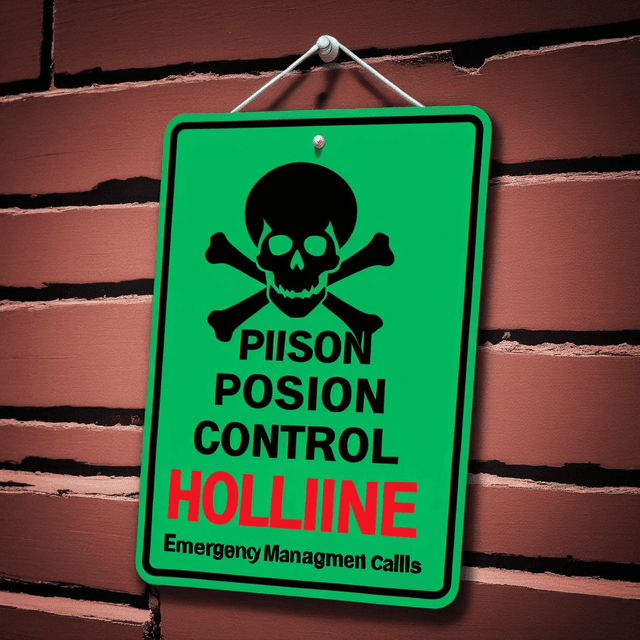
Contact a poison center promptly when someone may have swallowed, inhaled, touched, or otherwise been exposed to a potentially harmful substance.
Common situations include:
A child accidentally swallowing medication
An adult taking an incorrect medication dose
Accidental exposure to household cleaning products
Possible pesticide exposure
Exposure to fumes, gases, or chemical vapors
Accidental ingestion of an unfamiliar substance
Questions about toxic plants, mushrooms, or certain bites and stings
A person does not need to develop symptoms before contacting a poison center.
However, poison centers do not replace emergency medical services.
If someone collapses, has a seizure, has difficulty breathing, or cannot be awakened, call 911 immediately in the United States. Begin appropriate emergency first aid and follow dispatcher instructions. [2]
The U.S. Poison Help telephone number should not be presented as a universal international emergency number. People outside the United States should use their country's poison information service or emergency medical system.
Poison specialists follow a structured process to evaluate the reported exposure.
The specialist may ask about:
The person's age and approximate weight
Current symptoms and their timing
Known medical conditions
The product or substance involved
The amount potentially involved
The route of exposure
The time of exposure
Any first aid already provided
The caller's location and access to medical care
If possible, have the product container or medication packaging available. The ingredient list and strength may help the specialist identify the substance.
Do not delay seeking help simply because some information is unavailable. [1]
After collecting the available information, the specialist evaluates the exposure in context.
Important considerations include:
Whether the substance is potentially toxic
The estimated dose or exposure intensity
The person's age and underlying health
The time since exposure
Symptoms already present
The possibility of delayed complications
Whether the reported information is reliable
Whether safe monitoring is possible outside a healthcare facility
The specialist may recommend home observation, medical assessment, emergency transportation, or another appropriate action.
A poison center recommendation depends on the individual situation rather than the name of the substance alone.
Poison specialists can recommend appropriate immediate actions and explain whether medical evaluation is necessary.
Instructions differ according to the substance and exposure route.
For example, some chemical exposures require immediate irrigation, while certain ingestions require prompt emergency assessment.
Do not induce vomiting, give an antidote, or attempt an unapproved home treatment unless specifically directed by an appropriate medical professional.
Advice given for one exposure should not automatically be applied to another. [2]
Poison centers document reported exposures and the advice provided.
Depending on the case, specialists may arrange follow-up calls to assess symptom progression, confirm appropriate care, or obtain additional clinical information.
The U.S. Health Resources and Services Administration explains that poison center records can include the original report, treatment advice, and follow-up information. [1]
Follow-up is clinically important when effects may develop or change after the initial call.
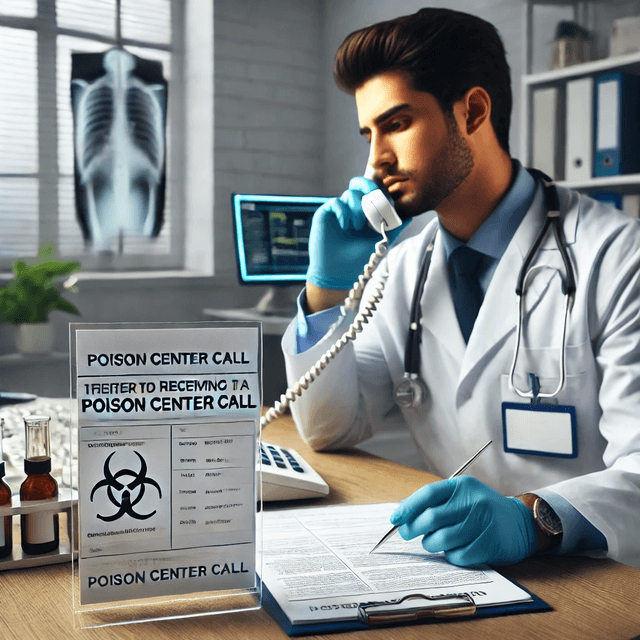
Poison centers assist physicians, nurses, pharmacists, emergency medical personnel, and other healthcare professionals.
Their expertise is particularly relevant when the exposure is uncertain, multiple substances may be involved, or the clinical course is difficult to predict.
Specialists may help clinicians interpret the relationship between an exposure history and the patient's clinical findings.
Consultation may support decisions about:
Appropriate observation
Relevant diagnostic testing
Expected onset and duration of toxic effects
Potential delayed complications
Whether a specific treatment or antidote should be considered
Need for escalation or specialist referral
These recommendations complement rather than replace examination, clinical judgment, and locally applicable treatment protocols.
For a broader clinical framework, see Comprehensive Guidelines for Managing Poisoning in Adults.
Communication can continue after a patient enters a healthcare facility.
A poison center may receive updated clinical findings and provide additional recommendations as the case evolves.
Effective communication requires documenting the suspected exposure, symptoms, laboratory findings, treatments, and relevant changes in the patient's condition.
Structured documentation helps reduce omissions, but no documentation system can eliminate clinical uncertainty.
The value of poison center services should be evaluated using direct clinical evidence rather than assuming that every consultation produces a measurable benefit.
Farkas and colleagues published a retrospective study in 2022 using Wisconsin hospital and poison center records from 2010–2017.
The investigators identified 127,224 hospitalized cases, with 44,628 included in a stratified analysis of hospital length of stay and charges.
Poison center consultation was associated with an average hospital stay approximately 11.6 hours shorter.
However, overall hospital charges were higher among consultation cases in the adjusted analysis, while the subgroup of children aged six years or younger had lower mean charges.
These findings support an association between consultation and certain healthcare utilization outcomes, but the retrospective design cannot establish that consultation itself caused every observed difference. [3]
A 2025 study by Wax and colleagues examined 52,836 patients admitted to participating U.S. pediatric intensive care units with poisoning diagnoses.
Of these, 2,857 patients had a documented medical toxicology consultation.
After adjustment for measured factors, consultation was associated with lower mortality and shorter lengths of stay.
The adjusted odds ratio for death in the pediatric ICU was 0.36, with a 95% confidence interval of 0.20–0.63.
However, this study was observational and focused on medical toxicology physician consultations among hospitalized PICU patients.
It should not be interpreted as proof that making an ordinary telephone call to Poison Help reduces an individual caller's mortality by the same percentage. [4]
Research supports the clinical value of specialist involvement and suggests potential healthcare utilization benefits.
However, the evidence must be interpreted according to the type of consultation, patient population, study design, and outcome measured.
Telephone poison center advice, bedside physician consultation, and AI-assisted documentation are distinct services. Evidence supporting one cannot automatically validate the others.
Beyond individual patient management, poison centers help identify population-level toxic exposure patterns.
In the United States, poison centers submit case information to the National Poison Data System (NPDS), maintained by America's Poison Centers.
According to the 2024 NPDS annual report, the system recorded 2,092,689 human exposure encounters during 2024.
These figures represent cases reported to participating poison centers. They are not a count of every poisoning or toxic exposure occurring in the United States. [5]
Aggregated poison center data can help identify unusual exposure patterns, including possible clusters involving medications, consumer products, chemicals, or emerging substances.
Near-real-time surveillance can support public-health investigations and help identify potential safety concerns.
However, poison center reports are surveillance data. A rise in reported exposures does not necessarily establish a corresponding rise in population incidence.
Changes in reporting behavior, awareness, access, and case definitions must also be considered.

Digital tools may help specialists document cases, retrieve toxicology references, organize relevant information, and communicate clinical recommendations.
Potential applications include structured case records, speech-to-text systems, decision-support tools, and searchable toxicology references.
Structured software can help organize important fields such as exposure timing, product information, reported symptoms, and follow-up findings.
Speech recognition may reduce manual typing, although transcription errors and incorrect interpretation of medical terminology remain important safety concerns.
For a detailed discussion of these technologies, see AI for Poison Control: Toxicology Documentation & Speech-to-Text Tools.
Machine learning and other AI approaches are being investigated for toxicology classification, prognostic modeling, and decision support.
Chary and colleagues described the potential applications of AI in medical toxicology in a 2020 review.
However, identifying possible applications is not equivalent to demonstrating safe and effective clinical deployment. [6]
AI-generated predictions or recommendations require evaluation for accuracy, bias, calibration, appropriate patient populations, and clinical consequences.
For poison center workflows, privacy, confidentiality, human oversight, and appropriate documentation are also essential.
AI should support trained poison specialists rather than independently determine emergency treatment or discharge decisions without adequate validation.
The following scenario is hypothetical and is not presented as a published clinical case.
A caregiver calls a poison center because a child may have swallowed an unknown quantity of acetaminophen.
The specialist gathers information about the child's age, weight, the product strength, time of possible ingestion, estimated quantity, symptoms, and whether other medicines may have been involved.
Depending on the exposure circumstances, the specialist may recommend emergency department evaluation and appropriate testing.
If the child requires clinical assessment, the treating team determines management based on the exposure history, relevant laboratory results, and current treatment guidance.
The scenario illustrates how structured information gathering and communication can support poisoning assessment.
It does not demonstrate that a particular app independently diagnosed an overdose, selected an antidote, or improved the patient's outcome.
Poison center services vary between countries and healthcare systems.
The World Health Organization describes poison centers as specialized resources that can support the prevention, diagnosis, and management of poisoning.
Their functions may also include toxicological surveillance, training, research, and preparedness for chemical incidents.
WHO's Guidelines for Establishing a Poison Centre describes considerations for developing and operating these services, including in settings where specialist resources are limited. [7]
Digital systems may help strengthen access to information, but reliable staffing, training, sustainable funding, and integration with healthcare systems remain fundamental.
Yes. The national Poison Help number, 1-800-222-1222, provides free and confidential advice from trained poison specialists.
Yes. U.S. poison centers are accessible through Poison Help 24 hours a day, seven days a week.
Call 911 immediately if someone collapses, has a seizure, cannot breathe normally, or cannot be awakened.
For a suspected poisoning without those immediate life-threatening signs, contact Poison Help promptly for individualized advice.
Yes. Call even if the exact substance or amount is uncertain. Share all available information without delaying the call.
Yes. Poison centers provide specialized information and consultation support to healthcare professionals as well as members of the public.
Follow-up depends on the substance, clinical findings, and risk of delayed complications. Specialists may arrange additional contact when appropriate.
Not on the basis of the evidence discussed here. AI may assist with documentation and selected decision-support tasks, but clinical recommendations require appropriate validation and professional oversight.
Poison center calls remain an important part of poisoning assessment, early advice, clinical consultation, and public-health surveillance.
Their value comes from specialist expertise, structured information gathering, appropriate risk assessment, and follow-up tailored to the individual exposure.
Clinical studies have identified associations between specialist consultation and certain healthcare outcomes, although findings differ according to the population and consultation model.
Technology may support these activities, but its benefits must be demonstrated rather than assumed.
For a possible poisoning in the United States, call 1-800-222-1222 for Poison Help. For collapse, seizures, severe breathing difficulty, or unresponsiveness, call 911 immediately.
© All copyright of this material is absolute to Medical toxicology
Dr. Omid Mehrpour (MD, FACMT) is a senior medical toxicologist and physician-scientist with over 15 years of clinical and academic experience in emergency medicine and toxicology. He founded Medical Toxicology LLC in Arizona and created several AI-powered tools designed to advance poisoning diagnosis, clinical decision-making, and public health education. Dr. Mehrpour has authored over 250 peer-reviewed publications and is ranked among the top 2% of scientists worldwide. He serves as an associate editor for several leading toxicology journals and holds multiple U.S. patents for AI-based diagnostic systems in toxicology. His work brings together cutting-edge research, digital innovation, and global health advocacy to transform the future of medical toxicology.
Keep reading
 Research and Innovations
Omid Mehrpour
 Research and Innovations

Paniz Seifi
 Research and Innovations
Omid Mehrpour
 Research and Innovations
Paniz Seifi
We would like to use analytics and session-replay tools to understand how this site is used. They are optional and the site works fully without them. Signing in still needs its own cookie either way. Our Privacy Policy names each one.