Environmental and Occupational Toxicology
Carbon Monoxide and Smoke Inhalation Prevention in Alaska: Why the Right Alarms Matter
Holly welson
Post on 06 Oct 2025 · Updated 14 Nov 2026 · 10 min read

Holly welson
Post on 06 Oct 2025 · Updated 14 Nov 2026 · 10 min read
 Medical Toxicologymedicaltoxic.com
https://medicaltoxic.com/blogs/how-fire-alarm-services-in-alaska-can-help-protect-your-prop
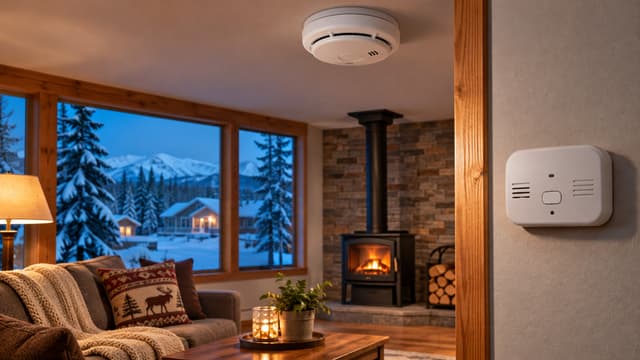
An Environmental and Clinical Toxicology Perspective
Alaska's long heating season, cold-weather conditions, and geographically isolated communities create important challenges for preventing carbon monoxide (CO) poisoning and smoke-inhalation injuries.
Furnaces, wood stoves, fuel-burning heaters, and portable generators provide essential heat and electricity. However, improperly maintained equipment, blocked ventilation systems, and unsafe combustion practices can lead to potentially fatal exposures.
Smoke alarms and carbon monoxide alarms are important components of primary prevention because they warn occupants of hazards and allow them to escape.
The essential distinction: Smoke alarms detect smoke, while CO alarms detect carbon monoxide. Neither necessarily detects the other hazard.
Carbon monoxide is an odorless, colorless toxic gas that can accumulate when fuel-burning equipment operates improperly.
Alaska's prolonged heating season, remote communities, and potential snow or ice obstruction of ventilation systems make prevention particularly important.
Smoke alarms and CO alarms detect different hazards; homes may need both.
Portable generators must operate outdoors, at least 20 feet from buildings, with exhaust directed away from openings.
Alaska law requires smoke detectors in dwelling units and CO detectors in qualifying dwelling units.
A silent CO alarm does not exclude exposure, and conventional pulse oximetry may appear normal despite significant poisoning.
Suspected significant CO poisoning requires immediate removal from exposure and medical assessment. Severe cases may require 100% oxygen and consideration of hyperbaric oxygen therapy.
The Alaska Department of Environmental Conservation identifies CO as an important environmental health hazard, particularly for children, older adults, pregnant individuals, and people with cardiovascular disease. High concentrations can also seriously harm otherwise healthy individuals. [1]
The University of Alaska Fairbanks Cooperative Extension Service describes several factors contributing to CO poisoning risk in Alaska, including:
Prolonged use of combustion-based heating during cold weather.
Limited access to qualified heating-equipment technicians in some communities.
Improperly installed or inadequately maintained heating appliances.
Tightly constructed homes in which CO may accumulate more readily when ventilation is inadequate. [2]
These factors do not imply that every Alaskan home is hazardous. They demonstrate why appropriate equipment installation, ventilation, maintenance, and CO detection are particularly important.
A State of Alaska Epidemiology Bulletin published February 14, 2017, documented CO exposures at two Anchorage workplaces in December 2016. [3]
The investigation identified:
Eight patients who received medical evaluation following CO exposure.
Elevated carboxyhemoglobin concentrations in all eight patients.
Three patients transferred to out-of-state hospitals for further care.
Ice accumulation obstructing boiler-room air-intake vents at both facilities.
Inadequate combustion air contributing to incomplete combustion and increased CO production.
Investigators also reported that a CO detector was present at one facility but did not activate during the exposure.
No deaths were reported among the eight medically evaluated patients.
This investigation illustrates how freezing temperatures, obstructed ventilation, and detection limitations can contribute to clinically significant CO exposures.
It is a historical case investigation, not an estimate of the current statewide incidence of CO poisoning.
Smoke and CO alarms detect different hazards and should not be considered interchangeable.
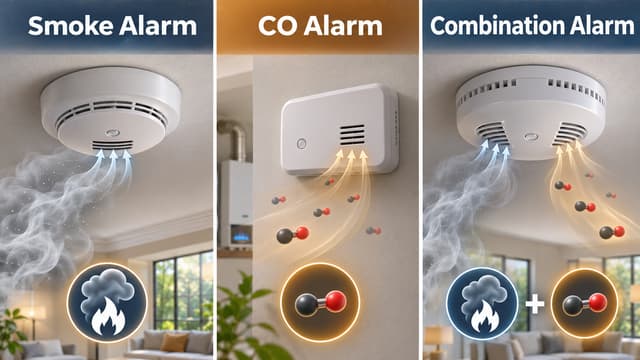
Alarm type | Primary detection function | Purpose |
|---|---|---|
Smoke alarm | Smoke particles from fires | Early fire warning and evacuation |
Carbon monoxide alarm | Elevated CO concentrations | Warning of hazardous CO exposure |
Combination smoke/CO alarm | Both smoke and CO | Integrated warning for both hazards |
A home may have functioning smoke alarms while CO accumulates from a malfunctioning furnace without visible smoke or fire.
Similarly, a CO alarm does not replace smoke detection.
Combination smoke/CO alarms are available. Consumers should select devices specifically labeled for both detection functions and follow the manufacturer's installation instructions. [4]
Carbon monoxide is produced during incomplete combustion of carbon-containing fuels.
Potential exposure sources include malfunctioning furnaces, inadequately vented wood stoves, portable generators, vehicles running in attached garages, charcoal grills used indoors, and other fuel-burning equipment.
Snow or ice may obstruct exhaust outlets or combustion-air intakes, creating additional concerns during severe winter conditions. [2] [3]
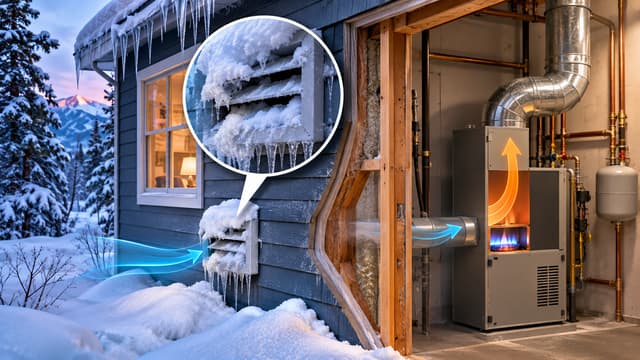
Portable generators can produce dangerous CO concentrations, particularly when operated indoors or near building openings.
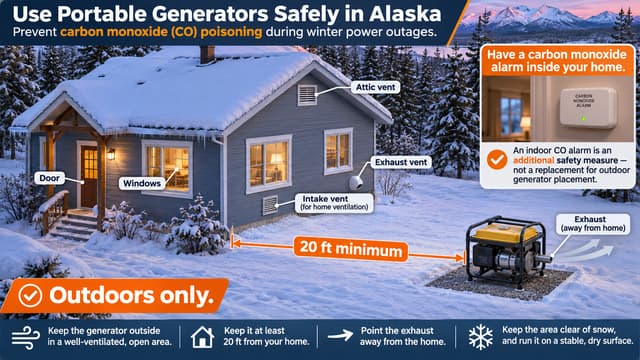
The U.S. Consumer Product Safety Commission (CPSC) recommends:
Operating portable generators outdoors only.
Positioning generators at least 20 feet away from homes, with exhaust directed away from buildings.
Keeping generators away from windows, doors, and ventilation openings.
Never operating a generator inside a home, garage, basement, shed, crawlspace, or other enclosed or partially enclosed space, even when doors or windows are open.
Choosing generators equipped with automatic CO shutoff technology as an additional safety measure. [5]
Automatic CO shutoff technology can reduce risk but does not make indoor generator operation safe.
A CO alarm is an additional protective measure, not a substitute for safe generator placement or adequate ventilation.
Reliable detection depends on proper placement and regular maintenance.
The CPSC recommends installing smoke alarms:
On every level of the home.
Inside every bedroom.
Outside sleeping areas.
CO alarms should be installed:
On each appropriate level of the home.
Outside sleeping areas.
In locations consistent with the manufacturer's instructions and applicable building requirements. [4]
Test smoke and CO alarms monthly.
Replace batteries and alarm units according to manufacturer instructions.
Use alarms with battery backup where appropriate.
Consider interconnected alarms so activation in one area alerts occupants elsewhere.
Have fuel-burning heating equipment inspected and maintained by qualified personnel.
Keep exterior combustion-air intakes and exhaust vents clear of snow, ice, and other obstructions. [3] [4] [5]
A functioning alarm should never be intentionally disabled because of repeated activation without first establishing the cause.
Consumer CO alarms have specified concentration-and-time activation characteristics.
A silent alarm does not establish that an environment is free of carbon monoxide.
People with symptoms compatible with CO poisoning should leave a potentially contaminated environment even if the alarm has not activated.
Alaska Statute AS 18.70.095 requires smoke detection devices in dwelling units and CO detection devices in qualifying dwelling units.
Under the published statutory text, a qualifying dwelling unit is one that meets at least one of the following conditions:
Contains or is served by a carbon-based-fueled appliance or device producing combustion by-products.
Has an attached garage or carport.
Is adjacent to a parking space. [6]
The statute also addresses responsibilities for landlords and tenants.
For rental properties, landlords generally must provide functioning required detection devices at occupancy and repair or replace deficient devices following notification.
Tenants have responsibilities for periodic testing, battery maintenance where possible, and avoiding permanent disabling of the devices. [6]
State statutory requirements may not be the only applicable rules. Building classifications, local codes, and occupancy-specific requirements may impose additional obligations.
Commercial and industrial facilities should consult the applicable fire-safety and occupational standards.
Carbon monoxide poisoning often presents with nonspecific symptoms, including headache, dizziness, weakness, nausea, vomiting, chest pain, and confusion.
Severe poisoning may cause loss of consciousness, myocardial ischemia, dysrhythmias, neurological impairment, coma, or death. [7]
An important diagnostic clue is the simultaneous development of symptoms among multiple occupants of the same building, especially when symptoms improve after leaving the environment.
Conventional pulse oximetry may display a normal oxygen saturation despite clinically significant CO poisoning. [7]
Diagnosis depends on exposure history, clinical findings, and carboxyhemoglobin measurement by blood co-oximetry when indicated.
Carboxyhemoglobin concentrations must be interpreted in context because they decline after removal from exposure and oxygen administration.
The measured concentration alone does not reliably predict clinical severity. [7]
Patients with suspected significant CO poisoning should be removed from the exposure source and treated with 100% oxygen. [7]
According to CDC guidance, hyperbaric oxygen therapy should be considered when clinically indicated, including in patients with:
Transient or prolonged unconsciousness.
Significant neurological impairment.
Evidence of myocardial involvement.
Severe metabolic acidosis.
Other concerning clinical findings or exposure circumstances.
The CDC recommends a more aggressive approach during pregnancy and identifies hyperbaric oxygen as the treatment of choice for pregnant patients with CO poisoning, even when maternal poisoning appears less severe. [7]
The need for hyperbaric oxygen and transfer to a specialized facility should be determined individually rather than from carboxyhemoglobin concentration alone.
For more detailed clinical guidance, see Understanding Carbon Monoxide (CO) Poisoning: Diagnosis, Symptoms, and Treatment.
Structural fires may expose occupants to several toxicants, including CO, hydrogen cyanide, irritant gases, and particulate matter.
Hydrogen cyanide inhibits cellular respiration and may contribute to severe toxicity following enclosed-space fires.
Not every smoke-inhalation patient has cyanide poisoning.
When cyanide poisoning is strongly suspected from the exposure circumstances and clinical findings, hydroxocobalamin may be indicated. Assessment may include enclosed-space fire exposure, altered mental status, cardiovascular instability, and marked lactic acidosis.
Treatment should not be delayed for confirmatory cyanide testing when clinical suspicion is high. [8]
Hydroxocobalamin should not be administered routinely to every smoke-exposed patient.
For further management details, see Cyanide Poisoning: Hydroxocobalamin, Antidotes, and Emergency Management.
Move everyone immediately to fresh outdoor air.
Call 911 from a safe location.
Do not reenter until emergency personnel have assessed the environment and confirmed that it is safe.
Anyone with symptoms or suspected significant exposure should receive appropriate medical evaluation. [5]
Evacuate immediately using the safest available exit.
Go to a designated outdoor meeting place.
Stay outside and contact emergency services.
Never reenter a burning building to retrieve belongings.
Seek urgent medical evaluation if smoke exposure is associated with respiratory distress, chest pain, confusion, syncope, or other concerning symptoms. [7] [9]
Households should develop and practice fire evacuation plans before an emergency.
Plans should include alternative exits and accommodations for children and people who may require assistance. [9]
For geographically isolated residences, cabins, lodges, and workplaces, delayed access to emergency services can complicate the response to CO exposure.
Facilities with limited access to emergency response should consider additional preparation, including:
Appropriate combustion-equipment installation and maintenance.
Regular ventilation and exhaust-system inspections.
Reliable smoke and CO detection systems.
Clear evacuation procedures.
Emergency communication and transport plans.
Staff education concerning CO exposure symptoms and emergency actions.
The National Institute for Occupational Safety and Health (NIOSH) recommends identifying potential workplace CO sources, evaluating exposure conditions, and regularly testing the air in areas where CO may be present.
NIOSH also recommends personal CO monitors with audible alarms where potential exposure sources exist. [10]
Residential CO alarms do not replace workplace-specific exposure assessment and monitoring.
The Anchorage investigation demonstrates why ventilation maintenance, environmental monitoring, and effective emergency procedures should be considered together.
Carbon monoxide poisoning and smoke-inhalation injuries are important preventable hazards in Alaska.
Safe combustion practices, properly maintained heating equipment, adequate ventilation, and reliable alarm systems are essential components of prevention.
Because smoke alarms and CO alarms detect different hazards, appropriate device selection and installation are particularly important.
For clinicians, awareness of the nonspecific presentation of CO poisoning, limitations of conventional pulse oximetry, and potential additional toxicants following smoke inhalation remains essential.
The primary objective is to prevent hazardous exposure before it occurs—not to rely solely on emergency recognition and treatment after poisoning develops.
© All copyright of this material is absolute to Medical toxicology
Keep reading
 Environmental and Occupational Toxicology

Amir Mohammad Mottaghi
 Environmental and Occupational Toxicology
Amir Mohammad Mottaghi
 Environmental and Occupational Toxicology

Omid Mehrpour
 Environmental and Occupational Toxicology
Omid Mehrpour
We would like to use analytics and session-replay tools to understand how this site is used. They are optional and the site works fully without them. Signing in still needs its own cookie either way. Our Privacy Policy names each one.