Emerging Toxins
Fentanyl vs Synthetic Cannabinoids in Emergency Care
Omid Mehrpour
Post on 16 Aug 2024 · Updated 13 Nov 2026 · 13 min read
Omid Mehrpour
Post on 16 Aug 2024 · Updated 13 Nov 2026 · 13 min read
 Medical Toxicologymedicaltoxic.com
https://medicaltoxic.com/blogs/fentanyl-synthetic-cannabinoids-emergency-care
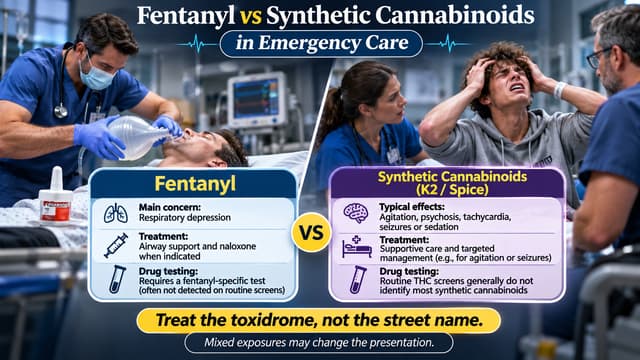
Fentanyl and synthetic cannabinoids are two very different causes of severe drug-related emergencies.
Fentanyl is a potent synthetic opioid. Its most dangerous acute effect is respiratory depression, which can progress to respiratory arrest and death.
Synthetic cannabinoid receptor agonists (SCRAs), often sold as K2 or Spice, are chemically diverse substances that activate cannabinoid receptors. They can produce unpredictable neurologic, psychiatric, cardiovascular and other systemic effects, including agitation, seizures, coma and serious complications.
Both may appear in unregulated drug markets, and neither can be reliably identified from appearance alone.
However, the correct emergency response depends on recognizing the patient's clinical presentation—not assuming that every suspected recreational-drug overdose requires the same treatment.
U.S. overdose mortality has also changed. CDC provisional estimates released in May 2026 reported approximately 69,973 drug overdose deaths during 2025, down from an estimated 81,313 in 2024. The estimated number involving synthetic opioids, including fentanyl, also declined. [1]
That reduction is encouraging, but it does not make an individual exposure predictable or safe.
Fentanyl is a synthetic opioid; K2 and Spice are synthetic cannabinoid products and are not opioids.
Fentanyl overdose typically causes impaired consciousness and respiratory depression.
Synthetic cannabinoids can cause agitation, panic, tachycardia, psychosis, seizures, sedation and other serious effects.
There is no specific approved antidote for synthetic cannabinoid intoxication.
Naloxone reverses opioid effects and should be administered when opioid-mediated respiratory depression is suspected.
Naloxone is not a direct antidote for synthetic cannabinoids, but an unknown or mixed exposure may still warrant naloxone.
Airway management, oxygenation, ventilation and reassessment remain central to emergency care.
Conventional urine drug screens may miss fentanyl unless a dedicated assay is included, and routine cannabinoid screens generally do not identify most SCRAs.
Direct clinical studies demonstrate why product history, laboratory testing and clinical findings must be interpreted together.
Brief incidental skin contact with illicit fentanyl is not expected to cause opioid overdose in healthcare workers or emergency responders.
Fentanyl and synthetic cannabinoids act at different receptor systems.
Fentanyl primarily activates μ-opioid receptors, leading to analgesia, sedation and potentially dangerous respiratory suppression.
Synthetic cannabinoids, including many substances marketed as K2 or Spice, activate cannabinoid receptors, particularly CB1.
Many SCRAs are high-efficacy agonists at cannabinoid receptors, unlike delta-9-THC, which has different receptor efficacy.
However, synthetic cannabinoids are not one uniform chemical class with a single predictable potency or toxicity profile.
Clinical severity depends on the specific compound, dose, formulation, other drugs and individual susceptibility.
Feature | Fentanyl overdose | Synthetic cannabinoid intoxication |
|---|---|---|
Main mechanism | μ-opioid receptor agonism | Cannabinoid receptor agonism |
Typical high-risk presentation | CNS depression and hypoventilation | Agitation, psychosis, tachycardia or seizures; sedation also possible |
Pupils | Often small, but not reliably diagnostic | Variable |
Respiratory depression | Major direct toxic effect | Possible, but not the defining feature |
Specific antidote | Naloxone | No approved specific antidote |
Routine screening | Requires appropriate fentanyl testing | Most SCRAs missed by routine THC screening |
Initial clinical priority | Airway, breathing, ventilation and opioid reversal | Stabilization, assessment of complications and supportive treatment |
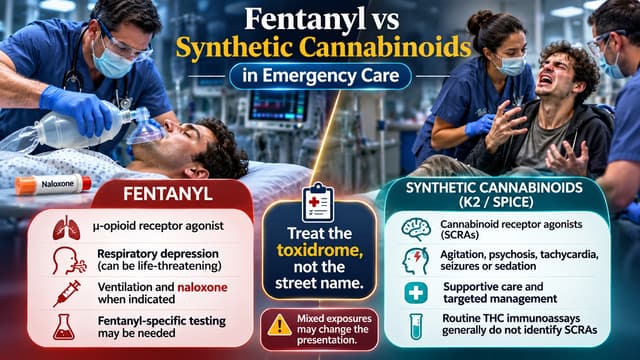
These patterns are guides, not rules that can identify the exact chemical.
Mixed exposures can blur the distinction.
A case series published in The American Journal of Emergency Medicine described nine patients who developed opioid toxicity after insufflating a substance they believed was cocaine.
The patients presented to two New York City emergency departments during a period of less than three hours in 2019.
Seven received naloxone before hospital arrival and showed improvement in respiratory function.
Blood or urine samples were obtained from eight patients. All eight tested positive for cocaine metabolites and had measurable concentrations of illicitly manufactured fentanyl-related substances. [2]
All nine patients were discharged after observation.
This was a small outbreak investigation, not a nationwide prevalence study.
Its main lesson remains highly relevant:
A patient who reports using a stimulant may still have opioid-mediated respiratory depression from an unexpected exposure.
Clinical assessment and treatment should not be restricted by the reported street-drug name.
A CDC analysis of the Toxicology Investigators Consortium (ToxIC) Case Registry identified 456 synthetic cannabinoid-associated cases evaluated by medical toxicologists at 50 U.S. registry sites during 2010–2015.
Of these:
277 were reported as single-agent synthetic cannabinoid exposures;
179 involved multiple agents;
neurologic and psychiatric abnormalities were prominent;
acute kidney injury and rhabdomyolysis were among the reported complications. [3]
Three deaths were recorded among patients with available outcome information, including cases involving multiple substances.
These figures are historical.
They do not describe the number of synthetic cannabinoid poisonings occurring in 2026.
The registry was also based primarily on clinical attribution and reported exposure history. Analytical confirmation was not available for most cases.
Therefore, it is inappropriate to convert these results into national incidence rates or assume that every observed complication was caused by a single confirmed SCRA.
A March 2026 British Journal of Clinical Pharmacology study reported 16 patients treated in emergency departments after analytically confirmed exposure to the synthetic cannabinoid ADB-CHMINACA.
Common manifestations included:
panic;
tachycardia;
agitation;
vomiting;
seizures.
One patient experienced posterior reversible encephalopathy syndrome (PRES), a serious neurologic complication. All 16 patients recovered, although the patient with PRES required several days of care. [4]
Importantly, measured serum concentrations did not demonstrate a clear correlation with clinical severity.
This provides a useful warning against treating a laboratory drug concentration as a stand-alone clinical severity score.
The study was conducted in European clinical settings, not U.S. emergency departments.
It supports the broader clinical understanding of ADB-CHMINACA toxicity, but should not be presented as evidence of U.S. exposure frequency.
Products sold as K2 or Spice can contain different synthetic cannabinoid receptor agonists.
Several factors contribute to uncertainty:
changing chemical structures;
variable concentration;
uneven distribution of active substances in the product;
differences in receptor activity;
metabolites with pharmacologic activity;
contamination or deliberate adulteration;
concurrent use of other drugs.
The name “synthetic marijuana” is therefore misleading.
It suggests equivalence with plant-derived cannabis when the actual chemical composition, pharmacology and clinical risks can differ substantially.
Not every serious illness associated with a synthetic cannabinoid product results from cannabinoid receptor activation alone.
In 2018, Illinois experienced a major outbreak of severe bleeding associated with synthetic cannabinoid use.
CDC documented 155 confirmed or probable cases as of April 25, 2018, including four deaths.
Laboratory testing identified brodifacoum, a long-acting anticoagulant used in some rodenticides, in the tested patient specimens. [5]
This outbreak established an additional clinical concern: unexpected product adulteration can produce a completely different toxidrome.
Severe bleeding after reported synthetic cannabinoid use should not simply be categorized as an expected effect of CB1 receptor agonism.
The specific exposure and laboratory findings matter.
The Illinois investigation is historical and product-associated; it does not establish that all present-day K2 or Spice products contain brodifacoum.
The immediate danger of severe opioid poisoning is inadequate ventilation.
A patient may present with:
reduced consciousness;
slow or absent breathing;
poor respiratory effort;
hypoxemia;
miosis, which may or may not be present.
The 2025 American Heart Association (AHA) resuscitation guidance emphasizes supporting breathing and administering opioid antagonists for suspected opioid-related respiratory depression or respiratory arrest.
For a patient with a definite pulse but inadequate breathing, trained rescuers should provide ventilations and administer an opioid antagonist such as naloxone. [6]
Naloxone is important, but it should not delay airway support or standard resuscitation.
If the patient is in cardiac arrest, perform standard high-quality CPR and other indicated resuscitation measures.
Do not treat naloxone as a replacement for CPR.
Naloxone can restore spontaneous ventilation when opioid receptor activation is responsible for respiratory depression.
Some patients require additional doses.
However, fentanyl exposure alone does not justify a universal fixed high starting dose.
The clinical goal is to reverse dangerous opioid-mediated respiratory depression while continuing appropriate supportive care.
Naloxone effects may diminish before the opioid exposure has resolved.
The AHA recommends observation until the risk of recurrent respiratory depression is low, consciousness has returned appropriately and vital signs are stable. [6]
Persistent abnormalities or recurrent hypoventilation require further assessment and management.
There is no approved specific antidote for the diverse compounds marketed as synthetic cannabinoids.
Treatment is largely supportive and guided by the actual abnormalities present.
The British Association for Psychopharmacology's 2026 consensus guideline discusses the limited evidence for management of synthetic cannabinoid intoxication, withdrawal and dependence.
Benzodiazepines are frequently used for severe agitation and seizures, while antipsychotic medications may be considered for selected patients with significant or persistent psychotic symptoms. [7]
These decisions require clinical judgment.
No single medication or dosing algorithm is validated for every synthetic cannabinoid.
Clinicians should assess:
airway protection and breathing;
consciousness;
temperature;
heart rate and blood pressure;
agitation or psychosis;
seizure activity;
possible trauma;
reported co-exposures.
When indicated by the clinical picture, evaluation may include:
blood glucose;
electrolytes;
kidney function;
creatine kinase when rhabdomyolysis is suspected;
ECG for significant cardiovascular symptoms or instability;
additional investigation for alternative diagnoses.
These are targeted assessments, not a requirement to order every possible laboratory test in every patient.
Severe agitation or seizures require prompt clinical stabilization.
Supportive measures, a low-stimulation environment and appropriately selected sedating medication may be necessary.
Persistent psychosis, unusual neurologic symptoms or a prolonged clinical course should prompt reassessment for another cause, co-exposure or complication.
Naloxone does not directly reverse cannabinoid receptor agonism.
However, when an unknown drug exposure causes respiratory depression, fentanyl or another opioid may also be present.
In that situation, naloxone remains appropriate when opioid toxicity is suspected.
An incomplete response to naloxone should prompt continued airway care and reassessment—not an assumption that naloxone reverses every substance in the product.
The illicit drug supply can contain combinations of opioids, stimulants, sedatives and other psychoactive compounds.
Some mixtures include xylazine, a non-opioid alpha-2 adrenergic agonist.
Naloxone can reverse an accompanying opioid component but does not directly reverse xylazine.
This distinction is reviewed in Fentanyl + Xylazine (‘Tranq’): Why Naloxone Alone Isn’t Enough.
For the current article, the key point is broader:
An unexpected clinical response may indicate more than one pharmacologically active substance.
Many conventional urine opiate immunoassays primarily detect morphine-related substances.
A fentanyl-specific assay is usually needed to screen for fentanyl exposure.
The availability of that assay depends on the laboratory.
A negative routine “opiate” result does not exclude fentanyl.
Routine urine cannabinoid immunoassays generally screen for metabolites associated with cannabis exposure.
They do not reliably identify the diverse chemicals sold as K2 or Spice.
Specialized analytical methods may detect specific synthetic cannabinoids and their metabolites, but a negative result still depends on which compounds the method covers.
The ToxIC registry's limitations illustrate why the exposure history, toxidrome and available analytical evidence must be considered together. [3]
Emergency stabilization should not wait for confirmatory toxicology testing.
Routine contact with patients who may have used fentanyl does not create the extreme overdose risk sometimes described in media reports.
In its November 2025 position statement, the American College of Medical Toxicology and American Academy of Clinical Toxicology concluded that clinically significant opioid intoxication from passive exposure during routine emergency response is essentially absent from the documented evidence.
The organizations noted that incidental dermal contact is not expected to produce opioid intoxication. [8]
CDC/NIOSH also states that brief skin contact with illicit fentanyl is not expected to cause toxic effects when contamination is removed promptly. [9]
The clinically appropriate response is to:
use appropriate gloves and standard precautions;
avoid transferring contaminated material to the mouth, nose or eyes;
wash contaminated skin appropriately;
assess circumstances where airborne powder exposure could occur;
use occupational respiratory protection when indicated by the actual task and risk assessment.
Ordinary patient care should not be delayed because of an exaggerated fear of overdose from touching a contaminated surface.
Disposition depends on the clinical condition and course.
Relevant factors include:
adequacy of ventilation;
recurrent sedation or respiratory depression;
persistent agitation or psychosis;
seizures;
cardiovascular abnormalities;
hyperthermia;
rhabdomyolysis or kidney injury;
possible co-ingestants;
ability to maintain safety after discharge.
A patient with persistent or recurrent abnormalities may need prolonged observation or admission.
For people who survive an opioid overdose, assessment for opioid use disorder and linkage to effective treatment should be considered.
The FDA recognizes methadone, buprenorphine and naltrexone as approved medication options for opioid use disorder. [10]
Poison centers can also support clinical decision-making during uncertain or unusual exposures.
For broader information, see Poison Control: Your Lifeline in Emergencies.
Fentanyl and synthetic cannabinoids are different pharmacologic classes.
One should not be mistaken for the other based only on a street-drug name.
Respiratory depression is the critical fentanyl emergency.
Ventilation and opioid-antagonist treatment should be prioritized appropriately.
Synthetic cannabinoids can cause both agitation and sedation.
Clinical presentation is variable and not always explained by the reported compound.
Naloxone is not a universal antidote.
It treats the opioid component, not cannabinoid receptor activation or every co-intoxicant.
A negative drug screen does not identify the substance.
Routine panels may miss fentanyl or synthetic cannabinoids.
Adulteration can change the toxidrome.
Brodifacoum-associated bleeding after synthetic cannabinoid use is a documented example.
Passive fentanyl contact is not a credible explanation for routine responder overdose.
Appropriate precautions matter, but patient care should not be delayed by unsupported exposure fears.
No. K2 and Spice commonly refer to products containing synthetic cannabinoid receptor agonists. Their pharmacology differs from fentanyl and other opioids.
Not directly. Naloxone reverses opioid receptor effects. It may still be indicated when fentanyl or another opioid could be contributing to respiratory depression.
Yes. Seizures have been documented in human case series, including analytically confirmed ADB-CHMINACA intoxications.
No. Testing depends on the assays used. Routine opiate screens may miss fentanyl, and conventional cannabinoid screening generally does not detect most synthetic cannabinoid receptor agonists.
Yes. Direct clinical and analytical evidence from a New York City outbreak documented opioid toxicity after patients believed they had used cocaine.
Brief incidental contact is not expected to produce opioid toxicity. Appropriate hygiene and occupational precautions should be used, particularly when loose powder or other exposure hazards are present.
Fentanyl and synthetic cannabinoids can both cause serious drug-related emergencies, but their mechanisms and clinical management are different.
Fentanyl overdose requires rapid recognition of respiratory depression, appropriate ventilation and naloxone when indicated.
Synthetic cannabinoid intoxication presents a wider range of neurologic, psychiatric and cardiovascular abnormalities. Treatment remains primarily supportive, with targeted management of seizures, severe agitation and other complications.
Direct clinical studies, outbreak investigations and current guidelines demonstrate why routine toxicology testing and reported substance names cannot replace careful assessment.
For emergency clinicians, the central principle is:
Treat the patient's physiology, consider mixed or misidentified exposures, and use evidence-based interventions rather than relying on assumptions about a drug's name or appearance.
© All copyright of this material is absolute to Medical toxicology
Dr. Omid Mehrpour (MD, FACMT) is a senior medical toxicologist and physician-scientist with over 15 years of clinical and academic experience in emergency medicine and toxicology. He founded Medical Toxicology LLC in Arizona and created several AI-powered tools designed to advance poisoning diagnosis, clinical decision-making, and public health education. Dr. Mehrpour has authored over 250 peer-reviewed publications and is ranked among the top 2% of scientists worldwide. He serves as an associate editor for several leading toxicology journals and holds multiple U.S. patents for AI-based diagnostic systems in toxicology. His work brings together cutting-edge research, digital innovation, and global health advocacy to transform the future of medical toxicology.
Keep reading
 Emerging Toxins
Omid Mehrpour
 Emerging Toxins
Omid Mehrpour
We would like to use analytics and session-replay tools to understand how this site is used. They are optional and the site works fully without them. Signing in still needs its own cookie either way. Our Privacy Policy names each one.