Why Is Smell Unreliable in Hydrogen Sulfide Exposure?

Amirhosein Shabrang
Post on 23 Nov 2026
Amirhosein Shabrang
Post on 23 Nov 2026
 Medical Toxicologymedicaltoxic.com
https://medicaltoxic.com/tox-spotlight/hydrogen-sulfide-smell-unreliable
Why Is Smell Unreliable in Hydrogen Sulfide Exposure?
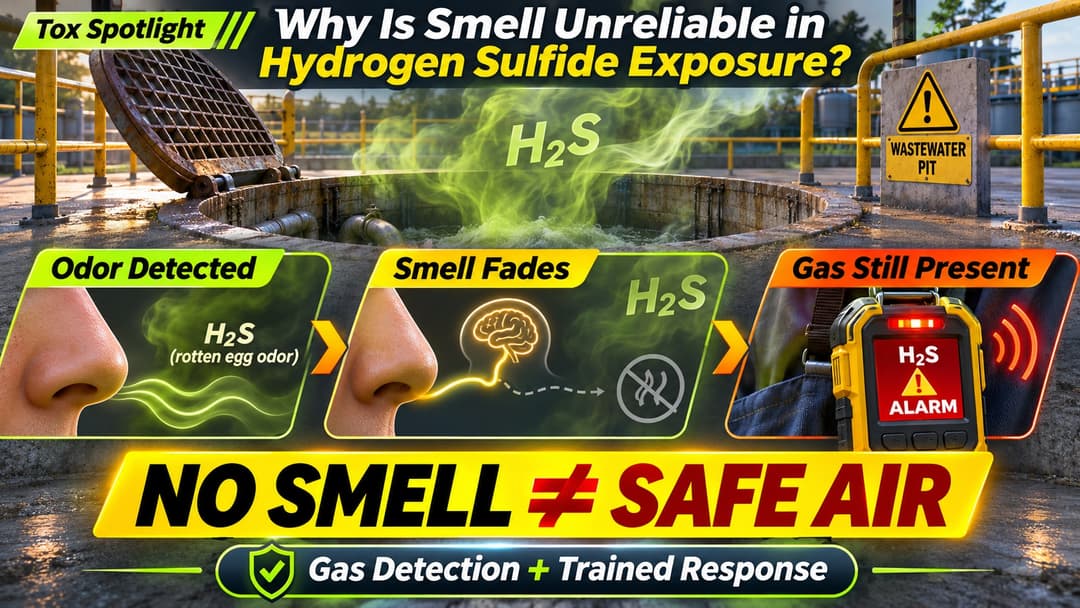
Hydrogen sulfide (H₂S) has a characteristic rotten-egg odor at low concentrations, but dangerous exposure can impair the ability to smell it. Absence of odor does not establish that the atmosphere is safe.
Hydrogen sulfide can cause rapid olfactory fatigue or paralysis. At high concentrations, the ability to detect its odor may disappear quickly, even while hazardous gas remains present. Smell cannot be used to assess exposure severity, confirm clearance, or authorize entry into a potentially contaminated space. [1]
A person who no longer smells hydrogen sulfide may still be exposed to concentrations capable of causing sudden collapse and respiratory failure. [2]
At low concentrations, hydrogen sulfide may be recognizable by its distinctive smell.
With continuing exposure, odor perception can diminish through olfactory fatigue. Higher concentrations can rapidly overwhelm olfactory function.
This creates a dangerous mismatch: the perceived warning may become weaker while the exposure remains hazardous or worsens. [1]
That is why the absence of a smell is not a reliable sign of recovery or environmental safety.
In enclosed or poorly ventilated spaces such as sewers, manure pits, tanks, and wastewater facilities, hydrogen sulfide exposure may be rapidly fatal.
If a worker collapses in a potentially contaminated atmosphere, unprotected entry can create additional victims.
Assessment of atmospheric safety requires appropriate gas detection and trained hazardous-environment response—not human smell. Unprotected personnel should not enter or re-enter the suspected area.
For the complete recognition, rescuer-safety, emergency stabilization, and critical-care framework, see Hydrogen Sulfide Poisoning: Recognition, Rescuer Safety, Respiratory Failure, and Emergency Management.
Hydrogen sulfide can take away its own warning signal.
No smell does not mean no gas—and a collapsed victim does not make unprotected rescue safe.
Occupational Safety and Health Administration (OSHA). Hydrogen Sulfide — Hazards. U.S. Department of Labor.
Centers for Disease Control and Prevention, NIOSH. Pocket Guide to Chemical Hazards: Hydrogen Sulfide.
As the Growth & Content Lead at MedicalToxic.com, I work on content strategy, development, and digital growth. My focus is on making MedicalToxic’s content clear, practical, and accessible, while helping expand the platform’s reach and strengthen its position as a trusted resource in clinical toxicology.
We would like to use analytics and session-replay tools to understand how this site is used. They are optional and the site works fully without them. Signing in still needs its own cookie either way. Our Privacy Policy names each one.