Hydrogen Sulfide Poisoning: Recognition, Rescuer Safety, Respiratory Failure, and Emergency Management
Published on 09 Nov 2026
Published on 09 Nov 2026
 Medical Toxicologymedicaltoxic.com
https://medicaltoxic.com/guidelines/hydrogen-sulfide-poisoning-management
Hydrogen sulfide (H₂S) is a rapidly acting, highly toxic gas found in sewage and wastewater systems, manure pits, petroleum and natural-gas operations, hot springs, mining, industrial processes, and environments where sulfur-containing organic matter decomposes. Severe exposure can cause abrupt loss of consciousness—the classic “knockdown” phenomenon—followed by apnea, seizures, cardiovascular collapse, pulmonary injury, and death. [1–5]
Management begins before patient contact. Hydrogen sulfide has repeatedly killed unprotected rescuers entering contaminated confined spaces, and odor cannot establish whether an atmosphere is safe. Rescue requires trained personnel, atmospheric monitoring, appropriate respiratory protection, and confined-space procedures. [1,2]
After safe removal, treatment is primarily supportive: oxygenation and ventilation, cardiovascular resuscitation, treatment of bronchospasm and pulmonary injury, seizure control, and monitoring for delayed pulmonary and neurologic complications. No antidote has proven clinical efficacy. Sodium nitrite remains controversial and must never delay resuscitation. [3–7]
Clinical reference based on the manuscript dated November 8, 2026. Author: Omid Mehrpour, MD, FACMT.
Clinical warning
High-concentration hydrogen sulfide can cause sudden collapse, apnea, cardiovascular arrest, and death within minutes. Never enter a suspected contaminated or confined space without trained rescue personnel, atmospheric monitoring, and appropriate positive-pressure SCBA; odor is not a safety indicator. After safe removal, prioritize ventilation, oxygenation, circulation, and standard resuscitation. No antidote has proven clinical efficacy; sodium nitrite must not delay lifesaving care. Any serious clinical feature occurring at any time since exposure, even if resolved, requires urgent ED assessment and the serious-exposure pathway. Concerning symptoms or high-risk circumstances also require ED assessment but do not automatically mandate admission. Do not discharge based only on a normal current appearance.
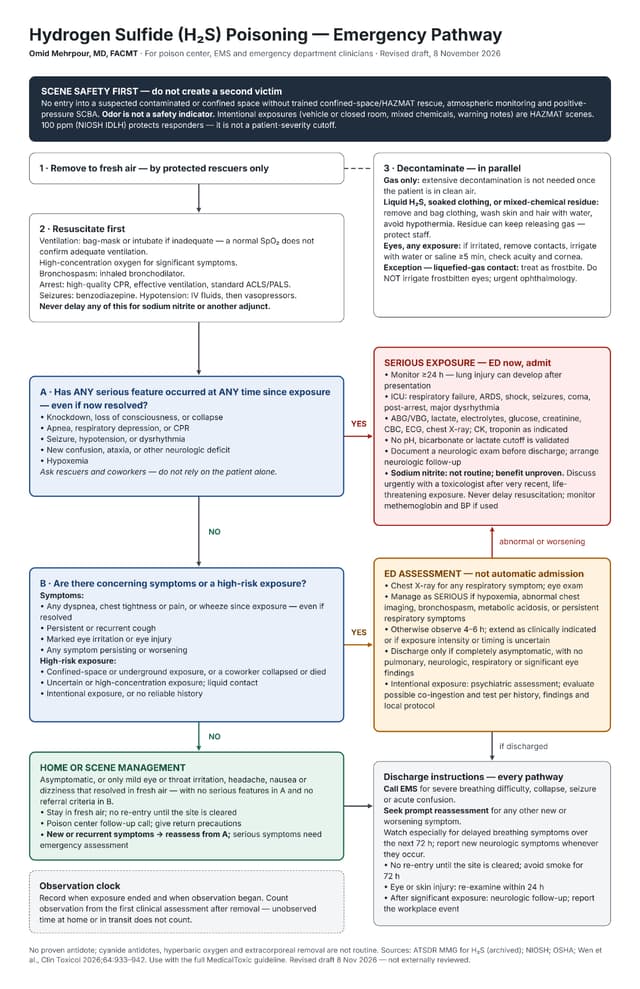
The pathway begins with scene and rescuer safety, then protected removal, resuscitation, and any necessary decontamination in parallel. Disposition follows two sequential assessments:
Step A — Serious features at any time since exposure.
If any serious feature occurred, even if it has resolved, follow the serious-exposure pathway with urgent ED referral and hospital admission.
Step B — Concerning symptoms or high-risk exposure.
If no Step A feature occurred, evaluate the symptoms and exposure circumstances that require ED assessment. A Step B referral does not automatically require admission.
Home or scene management is considered only when neither A nor B criteria apply and individualized poison-center assessment supports it.
The observation-clock convention and home/scene eligibility criteria are MedicalToxic operational guidance, not validated clinical prediction rules.
Rescuer safety is the first intervention. Do not enter potentially contaminated spaces without appropriate training, atmospheric assessment, rescue capability, and respiratory protection. [1,2]
Never rely on odor. Loss of the characteristic rotten-egg smell can reflect olfactory fatigue rather than disappearance of hydrogen sulfide. [1–3]
High-concentration exposure can cause rapid knockdown, apnea, seizures, shock, dysrhythmias, cardiac arrest, and death. [3–5]
A serious feature that has resolved still counts. Apparent recovery after knockdown does not make the exposure minor.
There is no proven antidote. Supportive cardiopulmonary care remains the treatment foundation; sodium nitrite is not routine therapy. [3–7]
Do not automatically transfer cyanide-antidote algorithms to H₂S poisoning.
Gas-only exposure generally creates little secondary-contamination risk after safe removal, whereas liquid H₂S, soaked clothing, or mixed-chemical residue requires decontamination. [3]
Serious exposures require monitoring for delayed pulmonary injury and neurologic sequelae, even after initial clinical recovery.
Use the pathway in sequence: A — serious features at any time; B — concerning symptoms or high-risk exposure; home/scene management only when both are negative.
Use the serious-exposure pathway if any of the following occurred, even if now resolved:
Knockdown, loss of consciousness, or collapse
Apnea, respiratory depression, or CPR
Seizure, hypotension, or dysrhythmia
New confusion, ataxia, or another neurologic deficit
Hypoxemia
Obtain collateral history from rescuers or coworkers. Recovery does not make a patient with a Step A feature eligible for minor-exposure discharge.
Disposition: Urgent ED assessment and hospital admission.
Monitor serious inhalational exposures for at least 24 hours, because clinically significant pulmonary injury may develop after presentation. [3]
ICU care is appropriate for:
Respiratory failure or mechanical ventilation
Pulmonary edema or ARDS
Persistent shock
Seizures or coma
Post-cardiac-arrest care
Major dysrhythmia
Document a neurologic examination before discharge and arrange appropriate follow-up.
When no Step A feature has occurred, refer for ED assessment if any of the following is present:
Any dyspnea, chest tightness or pain, or wheeze since exposure, even if resolved
Persistent or recurrent cough
Marked eye irritation or eye injury
Any symptom that persists or worsens
Confined-space or underground exposure, or a coworker who collapsed or died
High-concentration exposure or circumstances in which substantial exposure cannot be excluded
Liquid contact
Intentional exposure or unreliable exposure history
Step B referral means ED assessment, not automatic admission.
Examine the chest and symptomatic eyes. Obtain chest imaging for respiratory symptoms or significant exposure and assess for systemic toxicity or co-exposures as indicated.
Escalate to the serious-exposure pathway if evaluation identifies hypoxemia, exposure-related chest-imaging abnormalities, significant bronchospasm, metabolic acidosis, or persistent respiratory symptoms.
For intentional exposure, arrange psychiatric assessment after medical stabilization. Evaluate possible co-ingestion and select testing according to the clinical findings and local self-poisoning protocol.
Archived ATSDR guidance supports discharge after approximately 4–6 hours of observation when a patient is asymptomatic and has no evidence of pulmonary edema, CNS or respiratory compromise, or eye irritation. [3]
Observe for approximately 4–6 hours and extend the interval as clinically indicated, particularly when exposure intensity, timing, or other clinical factors are uncertain.
This is operational guidance, not a validated clearance threshold.
Discharge requires an appropriate clinical assessment, a reassuring observation course, and clear return precautions.
MedicalToxic operational judgment — not a validated rule
Home or scene management may be considered after individualized poison-center assessment only when:
No serious feature in Step A has occurred.
No ED-referral criterion in Step B is present.
The exposure history is reliable.
The patient is currently asymptomatic or experienced only mild eye/throat irritation, headache, nausea, or dizziness that fully resolved after removal to fresh air.
Reliable follow-up and prompt access to emergency care are available.
ATSDR explicitly permits scene release after minor or transient eye or throat irritation. The broader eligibility criteria above represent MedicalToxic operational judgment. [3]
For patients managed outside the ED:
Remain in clean air.
Do not re-enter the exposure area until qualified safety personnel have cleared it.
Arrange poison-center follow-up and provide the discharge instructions below.
Reassess any new or recurrent symptom using Step A first, then Step B.
Severe symptoms require emergency medical assessment.
MedicalToxic operational convention
Record:
When the exposure ended.
When clinical observation began.
For patients on a clinical observation pathway, count the observation period from the first clinical assessment after removal to clean air.
Unobserved time at home or in transit does not count toward the supervised observation period.
This convention does not require ED observation for patients who satisfy the individualized home/scene criteria.
Call emergency medical services immediately for severe breathing difficulty, collapse, seizures, or acute confusion.
Seek prompt reassessment for any other new or worsening symptom, including cough, chest discomfort, weakness, imbalance, worsening eye pain, redness, or visual disturbance.
Watch particularly for delayed respiratory symptoms over the next 72 hours. Report new neurologic symptoms whenever they occur; delayed neurologic deterioration has been described after apparent initial recovery. [3,8,10]
Additional instructions:
Do not re-enter the exposure site until qualified personnel confirm that it is safe.
Avoid cigarette smoke for 72 hours. [3]
Arrange re-examination of significant eye or skin injury within 24 hours. [3]
After significant exposure, document the neurologic follow-up plan.
Address occupational reporting requirements and the possibility that other people remain exposed.
Hydrogen sulfide is produced naturally and during industrial processes involving sulfur-containing material. [1–4]
Setting | Typical exposure |
|---|---|
Sewers and wastewater systems | Manholes, sewer vaults, treatment plants, sludge tanks |
Agriculture | Manure pits, slurry tanks, animal-waste systems, silos |
Oil and gas | Wells, drilling, refining, tanks, sour-gas environments |
Mining and underground work | Shafts, tunnels, pits, poorly ventilated spaces |
Industrial processing | Pulp and paper, rayon, tanning, petrochemical and food-processing operations |
Geothermal environments | Sulfur springs, hot-spring reservoirs |
Confined spaces | Tanks, pits, vaults, and other spaces where gas may accumulate |
Intentional generation | Hazardous chemical mixing in enclosed vehicles or rooms |
H₂S is slightly heavier than air and may accumulate in low-lying or poorly ventilated areas. It is also flammable, so scene management must address both inhalation and ignition hazards. [1–3]
In the 2026 Taiwan Poison Control Center series, more than 70% of 168 reported cases involved occupational exposure. Confined-space and underground exposures were associated with more severe outcomes. [4]
Assume that an unconscious person in a sewer, pit, tank, manure-storage area, or similar environment may be in a potentially lethal atmosphere.
Do not enter for an improvised rescue.
OSHA guidance emphasizes:
Trained confined-space rescue capability
Atmospheric testing before entry
Appropriate confined-space procedures
Continuous monitoring and ventilation when indicated
Suitable respiratory protection
Prepared rescue personnel and equipment [2]
NIOSH designates 100 ppm as immediately dangerous to life or health (IDLH). [1]
Entry into an IDLH or unknown atmosphere requires trained personnel using positive-pressure, full-face SCBA or an appropriately approved IDLH-capable supplied-air system.
An unknown concentration must never be assumed safe.
The NIOSH IDLH value is a responder-protection threshold, not a patient-severity or disposition cutoff.
Hydrogen sulfide has a characteristic rotten-egg odor at low concentrations.
However, continued or high-level exposure can rapidly impair the ability to detect that odor. [1–3]
“I can't smell it anymore” does not mean the atmosphere is safe.
Only appropriate atmospheric monitoring can establish conditions for safe entry.
An enclosed vehicle or room, evidence of chemical mixing, or warning notes should trigger HAZMAT precautions.
Do not investigate the source, open suspect containers, or enter the area without appropriate protection.
Inform rescuers and the receiving facility about possible ongoing gas generation, contaminated surfaces, and chemical residue. [9]
A patient exposed only to H₂S gas and removed into clean air generally presents little secondary-contamination risk to healthcare personnel. [3]
Risk may remain when:
Clothing is heavily soaked with H₂S-containing liquid.
Liquefied compressed H₂S has contaminated clothing or skin.
An unknown industrial mixture or chemical residue is present.
Communicate the exposure circumstances to EMS and the receiving hospital.
Decontamination should occur in parallel with lifesaving treatment.
Unnecessary decontamination must not delay airway or circulatory resuscitation.
A patient exposed only to gas, without skin or eye irritation, generally requires no extensive decontamination once in clean air. [3]
Remove contaminated clothing when safe.
Isolate and double-bag contaminated clothing according to HAZMAT procedures.
Wash exposed skin and hair with water.
Prevent hypothermia during decontamination, particularly in children and older adults.
Recognize that contaminated material may continue releasing hazardous gas.
For eye irritation after gas exposure, provided the ocular tissue is not frozen:
Remove contact lenses if easily removable.
Irrigate promptly with water or normal saline. ATSDR specifies at least 5 minutes; prolonged irrigation is appropriate when pain or irritation persists or a corrosive co-exposure is suspected. [3]
Assess visual acuity.
Examine for corneal injury.
Obtain ophthalmology assessment for persistent pain, visual impairment, or significant corneal injury.
Liquefied-gas exception: Direct contact with liquefied H₂S can cause frostbite.
Do not irrigate frostbitten eyes. Obtain urgent ophthalmology assessment and manage as a cold injury. [3]
Treat frostbitten skin using appropriate cold-injury care.
At high concentrations, hydrogen sulfide inhibits mitochondrial oxidative metabolism, including cytochrome-c oxidase activity, impairing ATP production. It also affects neurologic and cardiovascular function and directly irritates the eyes and respiratory tract. [5,8]
The mechanism of sudden knockdown is probably more complex than mitochondrial inhibition alone. Clinically, the important consequence is that a patient may collapse with little warning following an intense exposure.
Severe poisoning can produce:
Cellular hypoxia
Lactate elevation and metabolic acidosis
Respiratory depression or apnea
Reduced myocardial function
Hypotension or dysrhythmia
Seizures and cerebral injury
Pulmonary irritation or edema
Severity depends on exposure concentration, duration, environment, and co-exposures.
The following groups are descriptive, not a validated severity score. Disposition follows the worst feature recorded since exposure and the A/B pathway.
Clinical group | Typical findings | Pathway |
|---|---|---|
Local or mild nonspecific | Eye, nose, or throat irritation; tearing; mild headache, dizziness, or nausea | Home/scene only if no A or B criteria |
Respiratory or ocular concern | Cough, dyspnea, chest tightness or pain, wheeze, marked eye irritation or injury | Step B: ED assessment |
Serious systemic toxicity | Knockdown, collapse, apnea, respiratory depression, seizure, new confusion or ataxia, hypoxemia, hypotension, dysrhythmia, metabolic acidosis, significant pulmonary injury | Step A / serious-exposure pathway |
Critical illness | Respiratory failure or arrest, shock, pulmonary edema/ARDS, coma, cardiac arrest, severe hypoxic or neurologic injury | Serious-exposure pathway; ICU |
Rapid apparent recovery after knockdown does not establish a minor exposure.
New confusion and ataxia are serious features, not moderate ones.
Ask rescuers and coworkers when possible rather than relying only on the patient.
Determine:
Workplace and task
Confined-space or underground setting
Estimated exposure duration
Time exposure ended and first clinical assessment began
Atmospheric H₂S and oxygen measurements, if available
Other gas-monitor readings
Loss of consciousness, collapse, seizure, apnea, respiratory arrest, CPR, or any serious feature that occurred and resolved
Dyspnea, chest tightness or pain, or wheeze at any time
Persistent or recurrent cough
Other workers affected
Chemicals or industrial processes involved
Possible intentional generation
Possible cyanide, carbon monoxide, simple asphyxiants, or other industrial gases
Liquid exposure
Trauma during collapse
Treatments already administered
A cluster of suddenly collapsed workers strongly suggests a hazardous-atmosphere event and should trigger occupational and emergency-response investigation.
Diagnosis is primarily clinical and exposure-based.
Do not wait for a blood sulfide concentration before treatment. H₂S is rapidly metabolized, and direct blood measurements do not routinely guide acute management. [3,5]
For severe or symptomatic exposure, consider:
Continuous pulse oximetry
Cardiac monitoring and 12-lead ECG
Arterial or venous blood gas
Lactate
Electrolytes and bicarbonate
Glucose
Creatinine
Complete blood count
Chest radiography for respiratory symptoms or significant exposure
Creatine kinase after seizure, prolonged immobilization, or suspected muscle injury
Troponin when myocardial injury is suspected
Select additional investigations according to suspected trauma or co-exposure.
Lower initial pH and bicarbonate were associated with severe-to-fatal poisoning in the 2026 Taiwan cohort. [4]
However, no pH, bicarbonate, or lactate threshold has been validated as a standalone treatment, disposition, or futility criterion for H₂S poisoning.
Treat the underlying physiologic failure rather than a single laboratory value.
Pulmonary infiltrates were strongly associated with severe-to-fatal outcomes in the Taiwan series. [4]
This association does not establish a validated prognostic rule.
An abnormal chest radiograph attributed to the exposure supports hospital admission and respiratory monitoring.
Depending on the exposure setting, consider:
Cyanide
Carbon monoxide
Oxygen-deficient or simple-asphyxiant atmosphere
Methemoglobinemia
Smoke inhalation
Hydrocarbon or solvent exposure
Other industrial gases
Unrelated seizures, syncope, or cardiac events
Trauma associated with collapse
“It smelled bad, then the smell went away.”
This is not reassurance. Odor perception may fail during continued hazardous exposure. [1–3]
“Pulse oximetry is normal.”
A normal SpO₂ does not exclude H₂S toxicity. Cellular oxygen utilization and neurologic or cardiovascular function may be impaired despite apparently acceptable peripheral oxygen saturation.
“This is basically cyanide poisoning.”
H₂S and cyanide share some toxicodynamic mechanisms, but their clinical evidence and antidote strategies differ.
Do not automatically administer cyanide antidotes solely because H₂S exposure is suspected.
For independently suspected cyanide poisoning, follow Cyanide Poisoning: Hydroxocobalamin, Antidotes, and Emergency Management.
Removing the patient from exposure is lifesaving—but only when performed by properly protected rescuers.
Do not compromise responder safety to accelerate patient contact.
Give high-concentration supplemental oxygen to significantly symptomatic patients.
When spontaneous ventilation is inadequate:
Provide bag-mask ventilation.
Secure the airway when clinically required.
Provide mechanical ventilation according to standard critical-care principles.
Hydrogen sulfide may depress central respiratory drive and injure the lungs.
A normal SpO₂ does not necessarily establish adequate ventilation.
For general poisoned-patient stabilization, see Comprehensive Guidelines for Managing Poisoning in Adults.
Treat clinically significant bronchospasm with inhaled bronchodilators. [3]
Manage stridor, airway edema, or severe upper-airway irritation according to standard inhalational-injury principles.
Treat hypotension with appropriate IV fluids.
Use vasopressors when clinically important shock persists despite appropriate initial resuscitation.
Continue cardiac monitoring because severe poisoning can impair myocardial function and produce dysrhythmias.
Treat seizures promptly, generally beginning with a benzodiazepine according to standard toxicologic seizure protocols.
Correct hypoxia and hypoglycemia, and evaluate for trauma or toxic co-exposure.
Rescuer protection remains essential.
Once the patient is safely removed:
Begin high-quality CPR.
Establish effective ventilation.
Provide high-concentration oxygen.
Follow current ACLS/PALS principles.
Treat conventional reversible causes.
There is no proven H₂S-specific cardiac-arrest antidote.
Do not delay CPR, airway management, or oxygenation while preparing sodium nitrite or another investigational adjunct.
H₂S is a direct respiratory irritant.
Severe exposure can cause:
Bronchitis
Bronchospasm
Pneumonitis
Noncardiogenic pulmonary edema
Acute respiratory distress syndrome (ARDS)
Pulmonary injury can evolve after the patient leaves the exposure area. [3]
Treatment follows standard respiratory and critical-care principles:
Oxygen supplementation
Inhaled bronchodilators when bronchospasm is present
Positive-pressure ventilation when required
Lung-protective mechanical ventilation for ARDS
No H₂S-specific diuretic or corticosteroid regimen has demonstrated clinical benefit.
Correct inadequate oxygenation, ventilation, perfusion, and shock.
Sodium bicarbonate is not an H₂S antidote.
It may be considered for severe persistent acidemia according to general critical-care or toxicology principles, but must never distract from definitive supportive resuscitation.
Nitrite therapy has historically been proposed because methemoglobin can bind sulfide and potentially create a circulating sulfide sink. [3,6,7]
Clinical evidence remains limited to uncontrolled reports and nondefinitive observational data.
The archived ATSDR guidance recommends considering nitrite if it can be started very shortly after exposure, while explicitly acknowledging anecdotal evidence and uncertainty beyond the first few minutes. It also emphasizes that nitrite must not interfere with ventilation or oxygenation. [3]
MedicalToxic takes a more restrictive position because benefit is unproven, the proposed treatment window is extremely short, and nitrite can cause methemoglobinemia and hypotension.
In the 2026 Taiwan cohort, nitrite administered before out-of-hospital cardiac arrest was associated with lower adjusted odds of death, but the association was not statistically significant:
Adjusted OR 0.43; P=0.49. [4]
This does not demonstrate a mortality benefit.
MedicalToxic clinical position
Do not administer sodium nitrite routinely for H₂S poisoning.
For a very recent, life-threatening exposure, discuss possible use urgently with a poison center or medical toxicologist.
Never delay protected removal, oxygen, ventilation, CPR, or cardiovascular resuscitation to administer nitrite.
If nitrite is used under expert direction, monitor methemoglobin by co-oximetry and monitor hemodynamics closely.
No routine sodium-nitrite dosing order set is provided because efficacy is not established.
Mechanistic similarity does not establish therapeutic equivalence.
Sodium thiosulfate
Its established role in cyanide poisoning does not translate into proven benefit in H₂S poisoning. Routine use for isolated H₂S exposure is unsupported.
Hydroxocobalamin
Experimental and isolated human reports exist, but reliable clinical evidence establishing efficacy for H₂S poisoning is lacking. Do not administer it routinely solely for H₂S exposure. [5,9]
Methylene blue and other sulfide countermeasures
Preclinical and animal studies have explored several agents, but none is established as standard human H₂S therapy. [5,9]
If cyanide is independently suspected, treat it according to the cyanide-specific pathway.
Hyperbaric oxygen therapy (HBOT) for severe H₂S poisoning is supported mainly by case reports and limited observational experience.
Routine HBOT is not evidence-based. [3,5]
Case-specific discussion with medical toxicology and hyperbaric specialists may be reasonable for persistent coma or major neurologic dysfunction after initial cardiopulmonary stabilization, provided that transport does not compromise critical care.
Hemodialysis, hemoperfusion, and other extracorporeal toxin-removal strategies have no established routine role in H₂S poisoning.
H₂S is rapidly redistributed and metabolized.
Renal replacement therapy remains appropriate for conventional organ-support indications, not as routine H₂S removal.
Survivors of severe H₂S poisoning may develop persistent or delayed:
Memory or concentration difficulties
Ataxia or movement abnormalities
Dysarthria
Hearing impairment
Headache
Sleep disturbance
Behavioral or neuropsychiatric symptoms
Long-term neurologic complications have been documented, and deterioration after initial recovery of consciousness has been described. [8,10]
Patients experiencing knockdown, coma, seizures, respiratory arrest, prolonged hypoxia, or objective neurologic abnormalities should receive a documented neurologic assessment before discharge.
Persistent symptoms may justify:
Neurology referral
Neuropsychological testing
Hearing assessment
Rehabilitation
Neuroimaging when indicated
No validated universal schedule exists for long-term neurologic surveillance. [8]
Children may inhale a greater amount relative to body weight and may be physically closer to gas accumulating near ground level.
Smaller airways may also increase vulnerability to irritant injury. [3]
Management principles are otherwise the same:
Protect rescuers.
Remove the patient safely.
Support airway and ventilation.
Provide oxygen.
Treat seizures and shock using established pediatric resuscitation principles.
Observe significant exposures in an appropriate healthcare setting.
No pediatric H₂S-specific antidote regimen is established.
Maternal stabilization is the immediate priority.
Treat respiratory failure, hypoxemia, hypotension, seizures, and cardiac arrest aggressively according to appropriate maternal-resuscitation principles.
There is no proven pregnancy-specific H₂S antidote.
A workplace H₂S poisoning should trigger investigation beyond the individual patient.
Review:
Atmospheric monitoring
Confined-space permits and entry procedures
Ventilation
Alarm and detection systems
Respiratory protection
Rescue procedures
Standby personnel
Worker training
Whether other employees remain at risk
OSHA emphasizes testing atmospheres before entry, monitoring during work, continuous ventilation when indicated, trained attendants, rescue planning, and appropriate positive-pressure respiratory protection for hazardous atmospheres. [2]
Occupational and public-health reporting requirements vary by jurisdiction.
Wen and colleagues conducted a retrospective review of 168 patients reported to the Taiwan Poison Control Center between 1986 and 2021; the results were published in 2026. [4]
Three findings are clinically important.
First, occupational exposure predominated. More than 70% of cases were occupational, emphasizing the importance of workplace prevention and responder safety.
Second, exposure environment influenced risk. Confined-space and underground exposures were associated with severe-to-fatal outcomes.
Third, early clinical abnormalities were informative. Metabolic acidosis and pulmonary infiltrates were associated with severe-to-fatal poisoning.
The study does not:
Validate a new severity score.
Establish a universal pH or bicarbonate treatment threshold.
Prove sodium nitrite reduces mortality.
Justify routine nitrite administration.
Establish a validated disposition algorithm.
The sodium-nitrite finding is hypothesis-generating.
Referral patterns, treatment selection, exposure severity, and changes in clinical practice across 35 years limit causal interpretation.
Pitfall | Correct approach |
|---|---|
Entering a confined space without respiratory protection to rescue the patient | Do not enter without trained rescue capability and appropriate SCBA |
Using smell to judge atmospheric safety | Odor is unreliable; use appropriate gas monitoring |
Delaying ventilation to prepare an antidote | Oxygenation and ventilation come first |
Treating H₂S exactly like cyanide | Similar mechanisms do not establish the same antidotal evidence |
Administering sodium nitrite routinely | Efficacy is unproven; reserve consideration for urgent expert risk–benefit discussion |
Assuming normal SpO₂ excludes serious toxicity | Cellular, neurologic, and cardiovascular toxicity may occur despite acceptable SpO₂ |
Discharging a patient after recovery from knockdown | Use the serious-exposure pathway even if currently asymptomatic |
Sending home a patient whose dyspnea has resolved | Any dyspnea, chest tightness, or wheeze since exposure requires ED assessment |
Missing contamination from soaked clothing or chemical residue | Remove contaminated clothing and decontaminate safely |
Treating an occupational incident as a single-patient problem | Address ongoing site hazards and other potentially exposed workers |
In hydrogen sulfide poisoning, safe rescue is part of medical treatment.
A patient who recovers from knockdown still has a history of serious exposure.
A serious feature at any time determines the high-risk pathway.
Airway, ventilation, oxygenation, and cardiovascular support remain the established treatment.
No antidote has proven clinical efficacy. Sodium nitrite is an uncertain adjunct, not routine care.
Monitor serious exposures for evolving pulmonary injury and arrange appropriate neurologic follow-up.