Pediatric Nicotine Pouch Exposure
Published on 20 Nov 2026 · Updated 24 Nov 2026

Published on 20 Nov 2026 · Updated 24 Nov 2026
 Medical Toxicologymedicaltoxic.com
https://medicaltoxic.com/guidelines/pediatric-nicotine-pouch-exposure
Poison Center (SPI) Triage and Emergency Department Management
Version 1.6.19 | November 23, 2026
Author: Omid Mehrpour, MD, FACMT | MedicalToxic.com
Numerical cut-offs (Box 1) are operational definitions chosen from the evidence cited beside each one.
Specialist in Poison Information (SPI) home dispositions (Sections 7A and 7B) require all eligibility and observation criteria for the applicable pathway to be met. Medical-toxicologist (TOX) review applies where specified in the pathway.
These criteria are not validated pediatric safe-dose thresholds. Implementation of the home-observation pathways requires authorization through the responsible poison center's clinical governance process.
Included: Accidental oral exposure of children, particularly those younger than 6 years, to commercially packaged tobacco-leaf-free nicotine pouches. First aid and recognition of toxicity also apply to tobacco-containing snus, but the home tier in Section 7B does not.
Excluded: E-liquids, patches, gum and lozenges, loose tobacco, cigarettes, dermal or ocular exposure, and intentional self-poisoning in adolescents.
Key distinction: Brief mouthing with recovery of a whole, intact pouch is a different exposure from a swallowed, chewed, torn, ruptured, or missing pouch. The labeled mg per pouch is the nicotine content, not the released or absorbed dose.
Clinical warning
Clinical Safety Warning
Choking, apnea, major respiratory compromise, seizure, collapse, or unresponsiveness requires immediate EMS activation.
Persistent vomiting, tremor, marked secretions, lethargy, weakness, abnormal vital signs, or aspiration concerns require ED assessment. Mild or resolved symptoms require toxicologist review.
Apply triage steps 1–5 in order. SPI HOME and SPI CLOSE are permitted only when every criterion of the applicable pathway is met under authorized poison-center practice.
The 3-mg, 6-mg, 10-kg, 12-month, and four-hour boundaries are operational definitions, not validated pediatric safety thresholds. Used pouches retain nicotine.
Any new symptom, changed exposure history, or missed callback requires re-triage from step 1.
This guideline is intended for clinical professionals and must not be used by caregivers to determine home-management eligibility independently.
Term | Definition used in this guideline | Basis |
|---|---|---|
Infant | Younger than 12 months. | Expert consensus; age is a risk modifier rather than a sharp boundary. |
Early / late call | Early: <4 hours since the latest possible exposure. Late: ≥4 hours, with the child continuously well since exposure. | Symptoms typically develop within 4 hours; stimulatory effects may occur within minutes and, in larger exposures, depressant effects at 1–4 hours. [1], [2] |
Weight | Most recent known weight, documented for every swallowed pouch: a measured weight or a caregiver-reported weight from a recent clinic or home measurement. If no weight is available, the <10 kg strength limit applies. | Exposure scales with dose per kg; nominal mg/kg is recorded for every swallowed-pouch case when calculable. |
Witnessed swallow | A caregiver saw the child swallow a whole pouch, and the pouch was whole and undamaged beforehand. A pouch that is simply missing, or found to be gone after unobserved access, is not a witnessed swallow and is managed under route C. | Once swallowed, pouch integrity cannot be inspected; the history is the only evidence of what entered the child. |
Standard strength | Confirmed ≤6 mg nicotine per pouch, read from the container (mg per pouch). Brand name never establishes strength. | FDA-authorized U.S. pouches span 2, 3, 4, 6, 9, and 11 mg per pouch. One brand family covers much of that range: ZYN is authorized at 3 and 6 mg, and ZYN ULTRA at 9 and 11 mg. A U.S. product is not presumptively ≤6 mg. [3] |
High strength | >6 mg per pouch. Unknown strength, or a label giving only mg/g without the pouch mass, is managed as high strength. | Moderate or major outcomes occurred in 1.6% of exposures involving ≤6 mg and 3.3% involving >6 mg in one retrospective series. The comparison used reported substance quantity, not labeled strength per pouch, and does not validate a per-pouch threshold. [4] |
Brief mouthing | Incidental oral contact ≤5 minutes without sustained sucking, chewing, rupture, or swallowing; pouch recovered intact. Contact >5 minutes, sustained sucking, or unknown duration is prolonged. | Adults extracted approximately 22–28% of pouch nicotine within 10 minutes. Brief oral contact without ingestion is considered lower risk. Five minutes is a pragmatic boundary. [5], [1] |
Intact | No chewing, tear, puncture, leak, or visible loss of contents. | Damage makes the released dose indeterminate. |
Hazardous co-exposure | Any other nicotine product, or any medication or substance whose ingestion cannot be excluded. | Expert consensus. |
Reliable observation | An adult who can watch the child continuously for the full observation period, answer callbacks, and reach EMS immediately. | Expert consensus. |
In the retrospective series supporting the operational 6-mg division, reported exposure quantity was available in only 25.7% of cases. Moderate or major outcomes occurred in 1.6% of exposures involving ≤6 mg and 3.3% involving >6 mg (unadjusted OR 2.12, 95% CI 1.01–4.31). [4]
That comparison used the reported substance quantity in milligrams, not labeled nicotine strength per pouch.
FDA-authorized U.S. strengths reach 11 mg, and products reaching 43 mg per pouch have been described. Neither a U.S. nor an imported product can be assumed to be standard strength without reading the container. [3], [1]
Nicotine is a weak base (pKa approximately 8). The un-ionized form crosses membranes more readily, so oral products are buffered to an alkaline pH to favor absorption through the oral mucosa, which bypasses first-pass metabolism.
This is why sustained sucking matters more than contact alone. [6]
In the acidic stomach, nicotine is largely ionized and poorly absorbed. Absorption occurs mainly in the small intestine and is followed by hepatic first-pass metabolism, chiefly by CYP2A6. [6]
Oral bioavailability averaged 44% in an adult study of ingested nicotine. [7]
These adult data suggest that systemic exposure after swallowing may be lower than the labeled content, but they do not establish the absorbed dose from an intact swallowed pouch in a child.
No study among the sources reviewed here measured nicotine release from a swallowed intact pouch. Pouches may cause delayed toxicity compared with liquid nicotine.
The four-hour observation period used here is extrapolated from general pediatric nicotine guidance. [1], [2]
After 30 minutes of adult use, 7.04 mg remained in a pouch labeled 11 mg and 13.18 mg remained in a pouch labeled 20 mg. [5]
A previously used pouch is not nicotine-free.
Adult elimination half-life averaged 203 minutes in a stable-isotope pharmacokinetic study. Pediatric kinetic data are limited. [7]
Phase | Typical timing | Clinical manifestations |
|---|---|---|
Early stimulatory effects | Within minutes to <1 hour | Vomiting, salivation, sweating, pallor, tachycardia, hypertension, tremor, agitation, fasciculation, and seizures |
Later depressant effects in larger exposures | 1–4 hours | Bradycardia, arrhythmia, hypotension, weakness, hypoventilation or apnea, and coma |
These phases describe general nicotine toxicity rather than a validated time course for every swallowed pouch formulation. [2]
Toxic effects in young children have been reported after nicotine exposures as low as 1–4 mg. [8]
The traditional adult lethal-dose estimate, on which historical dose-based warnings have relied, has been challenged because of its origins in nineteenth-century self-experiments and its inconsistency with subsequent clinical observations. Mayer proposed a substantially higher adult estimate, but this remains an estimate and does not establish a pediatric safe dose. [9]
No pediatric threshold below which a swallowed nicotine pouch is harmless has been established.
Apply the rows in order. The first row that applies decides the disposition.
Rows 1–5 are the ordered steps. Routes 7A–7C apply only when steps 1–5 are all negative.
Any new symptom, change in the history, or missed callback restarts triage at row 1.
Step / route | Presentation | Disposition | Basis |
|---|---|---|---|
1 | Choking or airway obstruction, apnea, major respiratory compromise, seizure, collapse, or unresponsiveness | EMS / 911 | |
2 | Persistent or recurrent vomiting, tremor, marked drooling or secretions, lethargy or agitation, weakness, abnormal vital signs, or cough or dyspnea after a choking episode | ED; EMS if deteriorating | |
3 | Any other symptom that is mild and isolated, or has resolved (for example, one emesis or transient pallor), child otherwise at baseline | TOX REVIEW | Expert consensus |
4 | Late call (≥4 hours), child continuously well | Late pathway — Section 8 | |
5 | Early actual or possible swallowing, or a chewed, torn, or missing pouch, with ANY of: >1 pouch or uncertain count; high or unknown strength; infant; hazardous co-exposure; unreliable observation | ED DEFAULT; toxicologist may individualize | |
7A | Mouthing, pouch recovered intact: standard strength, brief mouthing, asymptomatic, reliable observation | SPI HOME, 4 hours with callbacks* | |
7A | Mouthing, pouch recovered intact: high or unknown strength, contact >5 minutes or unknown, sustained sucking, or unreliable observation | TOX REVIEW | |
7B | Witnessed swallow of one whole pouch, no sustained sucking or prolonged oral contact beforehand, ALL home-tier criteria met including the weight-based strength limit | SPI HOME, 4 hours with callbacks* | Expert consensus |
7B | Witnessed swallow of one whole pouch, any home-tier criterion not met (for example, sustained sucking before swallowing, 6 mg in a child <10 kg, a used pouch, chronic illness, or snus) | TOX REVIEW | Expert consensus |
7C | One standard-strength pouch chewed, torn, leaking, not recovered, or missing with the swallow unwitnessed | TOX REVIEW |
SPI HOME disposition applies only when all criteria for the indicated pathway are met under authorized clinical practice.
EMS: Emergency medical services.
ED: Emergency department assessment.
ED DEFAULT: ED referral is the initial disposition; the medical toxicologist may individualize it.
TOX REVIEW: Case-specific medical-toxicologist assessment.
SPI HOME: Poison-center-directed home observation.
SPI CLOSE: Closure by the Specialist in Poison Information after all applicable criteria and reassessment requirements are satisfied.
Steps 1–4 are expert consensus for this product, aligned with general nicotine guidance and public first-aid advice to clear the mouth and rinse. No pouch-specific first-aid study was identified among the sources reviewed here. [1], [2], [12]
Assess breathing and choking first. Remove only a visible pouch or loose material that can be retrieved safely. Do not perform blind finger sweeps.
Gently wipe the lips and gums with a damp cloth. A cooperative older child may rinse and spit a little water. Do not force rinsing in an infant.
Do not induce vomiting or give activated charcoal at home. Do not force water, milk, or food. Resume normal intake once the child is alert, not vomiting, and without signs of aspiration.
Keep the container, the recovered pouch, and the remaining pouches for identification and counting. Do not delay EMS or ED referral to verify the brand.
U.S. Poison Help: 1-800-222-1222 (24 hours). [12], [13]
Domain | Required assessment and documentation |
|---|---|
Child | Age in months; most recent known weight and how it was obtained. Ask for it in every swallowed-pouch case and record it as unavailable if the caregiver has none. Document baseline status, chronic illness, and airway or swallowing problems. |
Timing | Earliest and latest possible contact; time of pouch retrieval or expulsion; symptom onset and resolution; time of first call; hours since latest possible exposure (early <4 hours, late ≥4 hours). |
Route and integrity | Incidental mouthing, sustained sucking, swallowed whole, or chewed, torn, or leaking; contact duration; pouch recovered intact; filling missing; choking or aspiration event. |
Inventory | Maximum number accessible, number recovered, new or used, loose or discarded material, and reliability of the count. Ask specifically about discarded pouches in the garbage and in bottles or spit cups, the commonest identified sources in one series. [14] |
Product | Brand, product line, and formulation (tobacco-leaf-free pouch, snus, unknown); mg per pouch read from the container. Ask for the printed strength in every case: one brand family can span 3–11 mg, so brand name alone does not establish strength. Convert mg/g only when pouch mass is known. |
Symptoms | Vomiting (timing, number, ongoing), drooling, pallor, sweating, tremor, weakness, agitation, lethargy, cough, and dyspnea. |
Context | Co-exposures; caregiver able to observe; reliable callback number; time to EMS or ED; availability of toxicologist backup. |
Nominal content (mg) = number of pouches × labeled mg per pouch
Nominal mg/kg = nominal content (mg) ÷ weight (kg)
Record nominal mg/kg in every swallowed-pouch case where a weight is available. Record it as not calculable when no weight is available.
Neither figure is the absorbed dose. Never substitute mg/g for mg per pouch, and never assume a used pouch is nicotine-free. [5]
Apply steps 1–5 in order. The first YES decides the disposition. Routes A–C apply only when all five are NO.
The complete eligibility criteria in Sections 7A–7C govern disposition.
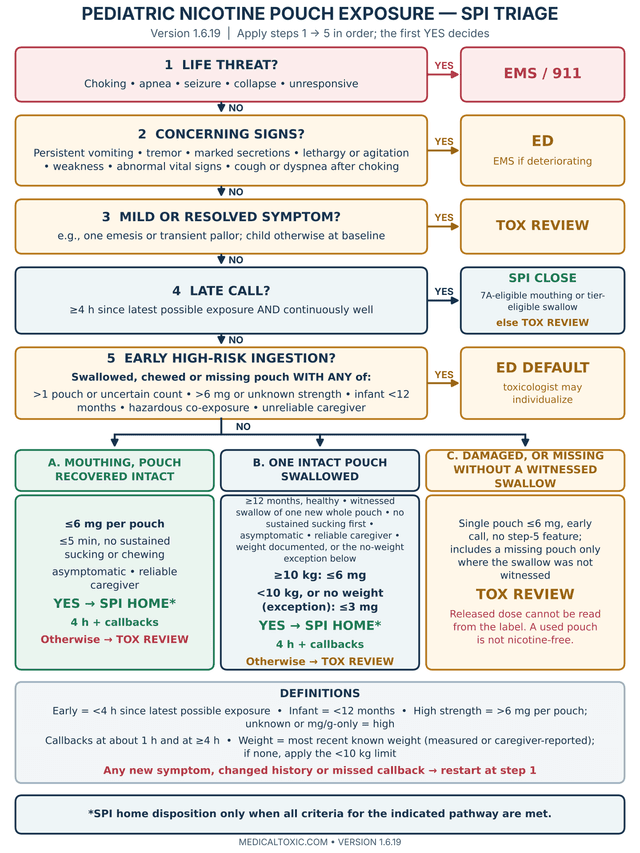
Apply these pathways only after steps 1–5 are negative.
SPI HOME when all of the following criteria are met:
The pouch was recovered whole and intact.
The pouch is standard strength (≤6 mg).
Contact was incidental and lasted ≤5 minutes without sustained sucking or chewing.
No other pouch is unaccounted for.
The child is asymptomatic.
Observation is reliable.
The same criteria apply at every age and weight.
Observe for four hours from the latest credible contact, with callbacks at approximately one hour and at ≥4 hours.
TOX REVIEW is required for sustained sucking, contact >5 minutes or of unknown duration, or high or unknown strength, even when the pouch was recovered intact.
Sustained sucking at an alkaline pH favors absorption through the oral mucosa, which bypasses first-pass metabolism. [6]
A pouch recovered torn, even with contents reported as intact, is managed under route C.
Route A applies the same criteria at every weight. The operational distinction it rests on is between incidental contact and sustained sucking.
Adults extracted approximately 22–28% of pouch nicotine over a full 10 minutes of deliberate use. [5]
Sustained sucking in a child plausibly approaches deliberate use, whereas brief incidental contact does not.
How much nicotine an infant actually releases within five minutes was not measured in any source reviewed here, and adult data cannot establish it.
The route therefore depends on recovering the pouch intact, the child being asymptomatic, and four-hour observation with callbacks rather than on an estimated absorbed dose.
Age ≥12 months and otherwise healthy.
A caregiver witnessed the child swallow one whole pouch that was undamaged beforehand. A pouch that is merely missing does not qualify and follows route C.
Weight documented when available (measured or caregiver-reported from a recent measurement). If no weight can be obtained, the ≤3 mg limit applies and nominal mg/kg is recorded as not calculable.
One new, tobacco-leaf-free pouch, with strength confirmed directly from the container.
For a child weighing ≥10 kg: pouch strength ≤6 mg.
For a child weighing <10 kg: pouch strength ≤3 mg.
Where no weight can be obtained, the ≤3 mg limit applies as an explicit expert-opinion exception. No weight-based risk statement can be made for that child, and the center may instead require TOX REVIEW for these cases.
No sustained sucking, chewing, or oral contact beyond approximately five minutes before the pouch was swallowed. Oral contact adds buccal absorption to the swallowed dose, so a pouch that was sucked and then swallowed carries both and goes to TOX REVIEW.
Completely asymptomatic since exposure.
Reliable caregiver with immediate access to emergency services.
No hazardous co-exposure.
Most recent known weight | Maximum labeled pouch strength for the operational home tier |
|---|---|
≥10 kg | ≤6 mg |
<10 kg | ≤3 mg |
No weight available | ≤3 mg as an expert-opinion exception; the center may instead require TOX REVIEW |
These limits are operational eligibility criteria, not validated safe-dose thresholds.
Management: Home observation for four hours from exposure, with SPI callbacks at approximately one hour and at ≥4 hours.
Any symptom means immediate re-triage from step 1.
This pathway applies only when all home-tier eligibility criteria are met under authorized poison-center practice.
Weight | Pouch | Nominal dose | Disposition |
|---|---|---|---|
9 kg | 3 mg | 0.33 mg/kg | SPI home tier* |
9 kg | 6 mg | 0.67 mg/kg | TOX REVIEW |
10 kg | 6 mg | 0.60 mg/kg | SPI home tier* |
12 kg | 6 mg | 0.50 mg/kg | SPI home tier* |
When all other home-tier criteria are met.
The tier rests on case selection and follow-up, not on a dose argument.
Eligibility is confined to a well child with a witnessed single low-strength exposure and a caregiver who can observe and be reached. The scheduled callbacks exist to bring a child who becomes symptomatic back into the pathway.
They are intended to facilitate timely re-triage; they do not guarantee that deterioration is detected, and the proportion of eligible children who become symptomatic is not known.
The weight bands are an arithmetic constraint, not a dose ceiling:
6 mg at 10 kg is 0.60 mg/kg nominal.
6 mg at 12 kg is 0.50 mg/kg nominal.
3 mg at 9 kg is 0.33 mg/kg nominal.
3 mg at 7 kg is approximately 0.43 mg/kg nominal.
The nominal mg/kg figure is not bounded by a weight-based calculation when no weight is available.
The operational home tier permits a nominal exposure of 0.60 mg/kg in a 10-kg child who swallowed one 6-mg pouch.
This exceeds the >0.5 mg/kg historical minimum potentially lethal dose still reported in the Royal Children's Hospital guideline. [2]
Section 3 explains why historical lethal-dose estimates are unreliable. Nevertheless, this divergence should be recorded explicitly in the center's clinical adoption decision rather than left implicit.
The pharmacology in Section 3 gives a mechanistic reason to expect systemic exposure after swallowing to be less than labeled pouch content, but that reasoning rests on adult kinetics.
No study among the sources reviewed here measured release from a swallowed intact pouch, and none establishes a safe pediatric dose.
Toxic effects have been reported after 1–4 mg, and neither 3 mg nor 6 mg is a validated pediatric threshold. [8]
Moderate or major outcomes occurred in 1.6% of ≤6 mg exposures in one poison-center series. [4]
Nicotine pouches carried higher odds of a serious medical outcome (OR 1.53, 95% CI 1.10–2.13) and medical admission (OR 2.03, 95% CI 1.31–3.15) than other nicotine formulations combined. [11]
One study covers nicotine ingestions of all formulations, and the other covers oral pouch exposures across strengths, ages, and symptom states.
Neither isolates the witnessed single-swallow subgroup this tier describes.
Neither establishes the risk for an eligible child, so the residual risk under this tier is unquantified rather than known to be small. That is the reason for the callbacks and for the monitoring plan in Section 12.
Pointing the other way, a single-center series of 82 pediatric pouch exposures managed 86.6% on site and reported no serious outcome. However, 59.8% of those cases had no ascertained outcome, so the series cannot establish that no serious outcome occurred. It is also too small to establish a safe subgroup. [14]
TOX REVIEW is required for exposures outside the home tier, including:
Sustained sucking or prolonged oral contact before swallowing.
Unwitnessed swallowing.
A 6-mg pouch swallowed by a child weighing <10 kg or with no weight available.
A previously used pouch.
Chronic illness.
Tobacco-containing snus.
Strength not confirmed.
The toxicologist chooses home observation with callbacks, ED assessment, or extended monitoring. Earlier high-risk criteria continue to govern the initial disposition.
Expect the tier to cover a minority of calls.
Where pouch history was recorded in one series, 85.4% of exposures involved a used pouch. [14]
Used pouches are excluded because their residual content cannot be confirmed. Adult-use data demonstrate substantial residual nicotine even after 30 minutes of use. [5]
A center adopting 7B should size the expected workload accordingly rather than assume most swallowed-pouch calls will become SPI home dispositions.
The National Capital Poison Center advises the public to seek immediate medical attention if a child swallows a nicotine pouch, while also directing callers to contact a poison center. [12]
Route 7B concerns the disposition made by a clinical professional on that call. For the narrowly defined group, the proposed disposition does not end in an in-person evaluation.
A center adopting the tier should be ready to explain that difference to a caller who has read the public guidance.
If prompt TOX REVIEW is unavailable, use the center's backup process. If none is available, refer to the ED.
Early infant swallowing, high or unknown strength, more than one pouch, hazardous co-exposure, and unreliable observation are captured earlier at step 5 (ED DEFAULT).
For example, a 15-mg intact pouch swallowed 20 minutes earlier is ED DEFAULT.
This route covers:
A pouch that was chewed, torn, or leaking.
An unrecovered pouch when there was no reliably witnessed swallow of a whole pouch.
A pouch that is unrecovered because a caregiver watched the child swallow it whole follows route B, not route C. The distinction is the witnessed history, not whether the pouch was found.
The amount of nicotine released or absorbed cannot be determined from labeled pouch strength alone. Where the number of pouches is uncertain, the total available nicotine is unknown.
Single standard-strength pouch, early call, with no step-5 feature: TOX REVIEW.
High or unknown strength, uncertain count, or any other step-5 feature: ED DEFAULT.
Prior use does not make a pouch nicotine-free. [5]
Use the same ordered steps.
Tobacco-containing snus is outside the home tier because its formulation differs. Manage by TOX REVIEW unless a preceding step assigns a higher level.
Imported products labeled only in mg/g, without the pouch mass, are unknown-strength exposures.
Evaluate co-ingested medications or other nicotine products independently.
Setting | Observation and closure |
|---|---|
Mouthing, SPI HOME (7A) | Observe for four hours from the latest credible contact. Callbacks at approximately one hour and at ≥4 hours. SPI closes at the completion callback if the child is at baseline and all applicable criteria remain met. |
Swallowed pouch, home tier (7B) | Observe for four hours from exposure. Callbacks at approximately one hour and at ≥4 hours. SPI closes at the completion callback if the child has remained completely asymptomatic. |
Swallowed pouch, toxicologist-authorized home care | The toxicologist sets the duration. Four hours after the latest credible exposure is the starting framework, extended when formulation, strength, or history warrants. |
Symptoms that resolved | Count four consecutive symptom-free hours from complete clinical recovery, when continued observation is authorized; extend for significant toxicity. [1] |
Late call (≥4 hours), continuously well | SPI may close after a full history and reassessment only when the exposure meets every criterion of route 7A or the 7B home tier. Prolonged or sustained-sucking mouthing, high or unknown strength, unwitnessed swallowing, and every other actual or possible ingestion go to TOX REVIEW. Elapsed time alone neither forces ED referral nor permits SPI closure. |
ED-managed exposure | Discharge according to Section 9. Elapsed time alone is not clearance. |
Child at baseline.
Observation completed and documented.
No unresolved co-exposure.
Responsible caregiver identified.
EMS and ED return precautions provided.
Disposition authority documented: SPI pathway (7A or 7B), or the name of the authorizing toxicologist.
A missed callback is an unknown outcome, not recovery. Re-attempt contact and escalate according to center policy.
Record whether ED referral was advised or actual arrival was confirmed.
Assess airway, breathing, mental status, age-appropriate heart rate and blood pressure, perfusion, hydration, aspiration, and co-exposures.
Use continuous cardiorespiratory monitoring for symptomatic patients.
For symptomatic patients, obtain an ECG initially and repeat at four hours until normal. An ECG is not routinely required for an asymptomatic child without another clinical indication. [2]
Check bedside glucose when mental status is altered.
Obtain electrolytes and blood gas as clinical severity dictates.
Serum nicotine or cotinine rarely changes acute management.
Follow institutional pediatric protocols.
Problem | Treatment |
|---|---|
Airway compromise or hypoventilation | Positioning, suction, oxygen, assisted ventilation, and intubation as needed. [15] |
Hypotension | Isotonic crystalloid 10–20 mL/kg with reassessment after each bolus; vasoactive infusion for fluid-refractory shock. [15] |
Seizures | Benzodiazepines according to the dosing guidance below; check glucose and oxygenation. |
Symptomatic bradycardia | Correct hypoxia and inadequate ventilation first. Follow pediatric resuscitation guidance, with atropine reserved for its appropriate indication. |
Persistent neurologic depression, respiratory insufficiency, arrhythmia, or instability | Pediatric critical-care consultation and ICU admission. |
Gastrointestinal decontamination | Do not induce emesis. Activated charcoal is very rarely indicated; consult a toxicologist. |
With IV access:
Lorazepam: 0.1 mg/kg IV (maximum 4 mg per dose).
Diazepam: 0.15–0.2 mg/kg IV (maximum 10 mg per dose).
Without IV access:
Midazolam: 0.2 mg/kg IM or intranasal (maximum 10 mg per dose).
The fixed midazolam doses of 5 mg for children weighing 13–40 kg and 10 mg for children weighing >40 kg apply only at or above 13 kg. Most children in this guideline therefore require weight-based dosing.
Rectal diazepam 0.2–0.5 mg/kg (maximum 20 mg) is an alternative.
Repeat a benzodiazepine only if seizure activity continues approximately five minutes after the first dose. Account for any benzodiazepine doses already administered and follow the institutional status epilepticus pathway for persistent seizures.
Check glucose and oxygenation. [16], [17]
Correct hypoxia and inadequate ventilation first, as in any pediatric bradycardia.
Nicotine can also slow the heart through direct autonomic effects, so adequate oxygenation and ventilation may not resolve it.
Atropine is recommended only for bradycardia with cardiopulmonary compromise due to increased vagal tone or primary atrioventricular block not due to factors such as hypoxia (Class of Recommendation 1).
This distinction matters because nicotine-associated bradycardia may not be of that type, and the mechanism is often not established in an individual patient.
Intervention | Indication and dose |
|---|---|
Atropine | When indicated: 0.02 mg/kg IV/IO, minimum dose 0.1 mg, maximum single dose 0.5 mg; may repeat once. |
CPR | Start if heart rate is <60/min with cardiopulmonary compromise despite effective ventilation with oxygen (Class of Recommendation 1). |
Epinephrine | 0.01 mg/kg IV/IO using the 0.1 mg/mL concentration, maximum 1 mg, if compromise persists after correction of hypoxia and other factors (Class of Recommendation 1). |
Emergency transcutaneous pacing | May be considered for complete heart block or sinus node dysfunction unresponsive to CPR (Class of Recommendation 2b). |
Transvenous pacing | Requires specialist evaluation. |
Atropine treats muscarinic effects only; it is not a nicotine antidote. [15]
Do not induce emesis.
Activated charcoal is very rarely indicated. A dose of 1 g/kg may be considered in high-risk patients who present early, after discussion with a toxicologist.
Give activated charcoal only when the airway is intact or protected, according to standard decontamination safety practice.
Routine gastric lavage or endoscopy is not indicated solely for a swallowed nicotine pouch. [2]
No specific antidote reverses nicotine toxicity. Treatment is supportive. [10], [18]
Normal mental status (normal GCS).
Normal ECG where one was obtained.
Completion of an appropriate observation period.
Stable age-appropriate vital signs.
Adequate oral intake.
Reliable supervision at home.
These criteria must be considered together rather than using elapsed time alone as medical clearance. [2]
These cases confirm whether the text, rapid triage table, and figure assign the same disposition.
Scenarios 36 and 37 check treatment doses against Section 9.
They test internal logic, not clinical performance.
# | Scenario | Disposition | Deciding step |
|---|---|---|---|
1 | 8-month-old; 6-mg pouch in mouth for 30 seconds, no sucking, recovered intact, well, early call | SPI HOME* | 7A: brief, standard strength; same criteria at every age |
2 | 18-month-old, 11 kg; caregiver saw child swallow one new whole 3-mg pouch 15 minutes ago; healthy, well | SPI HOME* | 7B: all tier criteria met |
3 | 18-month-old, 11 kg; one new 3-mg pouch missing after unobserved access; swallow not seen; well, early call | TOX REVIEW | 7C: unwitnessed, not a tier swallow |
4 | 2-year-old, 13 kg; 6-mg pouch mouthed for about 12 minutes, recovered intact; first call at five hours; well | TOX REVIEW | Step 4: late, but contact >5 minutes fails 7A |
5 | 3-year-old, 14 kg; 11-mg pouch briefly mouthed, recovered intact; first call at six hours; well | TOX REVIEW | Step 4: late, but high strength fails 7A |
6 | 2-year-old, 12 kg; witnessed swallow of one new whole 6-mg pouch; healthy, well | SPI HOME* | 7B: ≥10 kg, ≤6 mg |
7 | 2-year-old, 12 kg; witnessed swallow of one new whole 9-mg U.S. ZYN ULTRA pouch; well, early call | ED DEFAULT | Step 5: >6 mg is high strength; a U.S. brand is not presumptively ≤6 mg |
8 | 13-month-old, 9 kg; witnessed swallow of one new whole 6-mg pouch; healthy, well | TOX REVIEW | 7B: <10 kg limit is ≤3 mg |
9 | 14-month-old, 9 kg; witnessed swallow of one new whole 3-mg pouch; healthy, well | SPI HOME* | 7B: <10 kg, ≤3 mg |
10 | 20-month-old, no weight available; witnessed swallow of one new whole 6-mg pouch; well | TOX REVIEW | 7B: no weight, so the ≤3 mg limit applies |
11 | 20-month-old, no weight available; witnessed swallow of one new whole 3-mg pouch; well | SPI HOME* | 7B: ≤3 mg limit satisfied under the no-weight exception |
12 | 2-year-old, 12 kg; new 6-mg pouch actively sucked for about 10 minutes, then witnessed swallowed whole; well, early call | TOX REVIEW | 7B: sustained sucking before swallowing; buccal plus swallowed exposure |
13 | 2-year-old, 12 kg; one used intact 3-mg pouch swallowed; well, early call | TOX REVIEW | 7B: used pouch excluded |
14 | 2-year-old; one 6-mg pouch chewed, powder missing; well, early call | TOX REVIEW | 7C: damaged, standard strength |
15 | 2-year-old; one 11-mg pouch chewed; well, early call | ED DEFAULT | Step 5: high strength |
16 | 3-year-old; used pouch of confirmed 6-mg strength mouthed briefly, recovered intact; well at 4.5 hours | SPI CLOSE | Step 4: late, meets 7A |
17 | 16-month-old; 3-mg pouch swallowed, vomited once, now at baseline | TOX REVIEW | Step 3: resolved symptom |
18 | 2-year-old; 6-mg pouch mouthed for two minutes; mild drooling persisting, otherwise well | TOX REVIEW | Step 3: mild isolated symptom |
19 | 2-year-old; several pouches accessible, number missing unclear, early call | ED DEFAULT | Step 5: uncertain count |
20 | 4-year-old; mouthing followed by recurrent vomiting and tremor | ED | Step 2 |
21 | Child apneic after any pouch exposure | EMS | Step 1 |
22 | 20-month-old; one intact 11-mg pouch swallowed; first call at five hours, continuously well | TOX REVIEW | Step 4: late, outside tier |
23 | 2-year-old, 12 kg; witnessed swallow of one new whole 3-mg pouch; first call at five hours, always well | SPI CLOSE* | Step 4: late, meets tier |
24 | 10-month-old, 8 kg; 3-mg pouch in mouth for one minute, recovered intact; well, early call | SPI HOME* | 7A: weight does not enter route A |
25 | 9-month-old; one new 3-mg pouch swallowed; early call, well | ED DEFAULT | Step 5: infant |
26 | 11-month-old; 3-mg pouch swallowed; first call at five hours, always well | TOX REVIEW | Step 4: late, infant outside tier |
27 | 2-year-old; 3-mg pouch swallowed, open medication bottle nearby, early call | ED DEFAULT | Step 5: co-exposure |
28 | 3-year-old; intact 15-mg pouch swallowed 20 minutes earlier; well | ED DEFAULT | Step 5: high strength |
29 | 2-year-old; imported pouch labeled only in mg/g, mass unknown, swallowed, early call | ED DEFAULT | Step 5: unknown strength |
30 | 20-month-old; 6-mg tobacco-containing snus pouch swallowed; well, early call | TOX REVIEW | 7B: snus outside tier |
31 | 2-year-old; 3-mg pouch swallowed; caregiver unable to observe or answer callbacks, early call | ED DEFAULT | Step 5: unreliable observation |
32 | 8-month-old; 20-mg pouch in mouth for three minutes, recovered intact; well, early call | TOX REVIEW | 7A: high strength |
33 | 3-year-old; 6-mg pouch in mouth for eight minutes, recovered intact; well, early call | TOX REVIEW | 7A: contact >5 minutes |
34 | 2-year-old; 3-mg pouch actively sucked for approximately three minutes, recovered intact; well, early call | TOX REVIEW | 7A: sustained sucking |
35 | 3-year-old; two new pouches possibly missing; first call at five hours, well | TOX REVIEW | Step 4: late, outside tier |
36 | 2-year-old, 12 kg; seizure in the ED after a swallowed pouch; no IV access yet | IM midazolam 2.4 mg | Section 9: below 13 kg, so 0.2 mg/kg, not the 5-mg fixed dose; repeat only if still seizing at five minutes |
37 | 7-month-old, 7 kg; bradycardia with poor perfusion, hypoxia corrected, vagal pattern | Atropine 0.14 mg IV | Section 9: 0.02 mg/kg = 0.14 mg, above the 0.1-mg minimum; vagal pattern with hypoxia corrected meets the PALS indication |
38 | 3-year-old; torn 6-mg pouch recovered, caregiver reports contents intact, early call | TOX REVIEW | 7C: not intact |
39 | 18-month-old; pouch recovered intact after choking, now persistent cough | ED | Step 2: aspiration signs |
Only when all criteria for the indicated pathway are met. Scenarios assume that any criteria not explicitly mentioned have been assessed and satisfied where required for the proposed disposition.
These synthetic scenarios assess routing consistency and dose arithmetic. They are not evidence of clinical safety, sensitivity, specificity, or real-world prediction accuracy.
The study analyzed 134,663 single-substance nicotine ingestions in children younger than six years reported to U.S. poison centers from 2010 through 2023.
The reported rate of nicotine pouch ingestions rose 763.1% from 2020 to 2023.
Compared with other formulations combined, pouches were associated with:
Serious medical outcomes: OR 1.53 (95% CI 1.10–2.13).
Medical admission: OR 2.03 (95% CI 1.31–3.15).
Pouches accounted for 1.4% of all nicotine ingestions in the series, representing an uncommon but disproportionately severe reported exposure.
NPDS ingestion coding does not establish that a whole pouch was swallowed. [11]
This retrospective conference abstract described 7,222 oral nicotine pouch exposures in children aged 0–12 years reported to the National Poison Data System from January 2020 through December 2025.
Reported cases increased from 158 in 2020 to 3,375 in 2025. Median age was 16 months.
Reported measure | Finding |
|---|---|
Managed on site | 78.2% |
Evaluated and released | 15.8% |
Admitted | 0.9% |
Cases with reported nicotine quantity | 1,856 (25.7%) |
Reported quantity ≤6 mg among cases with quantity available | 75.3% |
Reported quantity >6 mg among cases with quantity available | 24.7% |
Moderate or major outcomes in ≤6 mg group | 1.6% |
Moderate or major outcomes in >6 mg group | 3.3% |
Unadjusted odds ratio for higher reported quantity | 2.12 (95% CI 1.01–4.31; p = 0.033) |
Reported substance quantity in milligrams is not the same variable as labeled strength per pouch.
Two important limitations apply to the odds ratio:
The groups cover all oral nicotine pouch exposures rather than the witnessed single-swallow subgroup.
The comparison is unadjusted. The >6 mg group was older (median 22 versus 18 months) and heavier, so dose and body size are not separated.
This conference-abstract evidence does not validate a pediatric safe-dose or home-disposition threshold. [4]
This conference abstract described 82 pediatric pouch exposures reported to one statewide poison center from January 2021 through April 2026.
Reports increased from two in 2021 to 41 in 2025.
Whether the pouch was new or used was documented or inferred in 41 cases (50.0%).
Dose was reported in 46 cases (56.1%), most often 6 mg (27 of 46, 58.7%).
Management site | Number of cases |
|---|---|
Managed on site | 71 (86.6%) |
Seen at a healthcare facility | 9 (11.0%) |
Lost to follow-up or left against medical advice | 2 (2.4%) |
Outcome ascertainment is a separate variable from management site.
Forty-seven cases (57.3%) were coded as lost to follow-up because minimal or no clinical effects were anticipated.
A further two cases (2.4%) were lost to follow-up with potential for toxicity.
Clinical effects were reported in 17 cases (20.7%), most often vomiting (12 cases).
Taken together, 49 of 82 cases (59.8%) had no ascertained outcome.
No serious outcome was reported, but with almost 60% of outcomes never established, this is not equivalent to confirmation that no serious outcome occurred.
Read the two denominators together: a case managed at home may also be counted among cases lost to follow-up.
Of the 41 cases where pouch history was known, 35 (85.4%) involved a previously used pouch.
Where the source was described, pouches most often came from the garbage (7 of 21) or from bottles and spit cups (4 of 21).
The incomplete follow-up and small sample limit conclusions about home-observation safety. [14]
This study analyzed 92,973 single-substance nicotine exposures in children aged one month to five years from 2016 through 2023.
It included all nicotine products and exposure routes rather than pouches specifically. Pouches fall within the other non-tobacco nicotine category.
There were 1,023 exposures with moderate effects, 31 with major effects, and two deaths, both following ingestion of e-cigarette liquid.
The published correction states that 98.9% of exposures had no or minor effects or were lost to follow-up.
That figure cannot be interpreted as 98.9% of children having confirmed benign outcomes. [19], [20]
The FDA reported toxic effects in young children following nicotine exposures as low as 1–4 mg.
The notice provides no exposure denominator and no dose-response dataset.
The figure marks a level at which harm has been reported, not a validated threshold. [8]
The bulletin recommends four hours of observation for asymptomatic patients and four hours symptom-free for patients who had signs of toxicity.
Brief oral exposures that are spat out are considered unlikely to cause significant toxicity.
These recommendations are not based on prospective validation of the specific home tier in Section 7B. [1]
The general pediatric nicotine poisoning guideline recommends four hours of monitoring before discharge for asymptomatic children or those recovering from gastrointestinal symptoms only.
It is not a prospective validation of swallowed nicotine pouch home management. [2]
The 2026 Journal of Clinical Pharmacology study investigated 11-mg and 20-mg nicotine pouches in adults, showing time-dependent nicotine release and substantial residual nicotine after use.
The study was industry-funded (British American Tobacco).
Adult pharmacokinetics cannot establish pediatric toxicity or home-observation thresholds. [5]
Question | Position in this guideline |
|---|---|
What strength of swallowed pouch is safe for home observation, by weight? | Not established by outcome data. This guideline uses ≤6 mg at ≥10 kg and ≤3 mg below 10 kg, with strict eligibility and callbacks under Section 7B. These are operational choices requiring clinical authorization. |
Is there a sharp safe age or mg/kg boundary? | No. Age <12 months, weight <10 kg, and strength >6 mg are operational triggers for closer review. |
Does four hours capture symptom onset after a swallowed intact pouch? | Pouch-specific timing data are lacking. Four hours is extrapolated from general pediatric nicotine guidance and extended by the toxicologist when warranted. [1], [2] |
Is a previously used pouch low risk? | No. Substantial nicotine remains after use. [5] |
Record the date of implementation and any local modification of the SPI home pathways (7A and 7B).
Before activating 7B, review local outcomes for children weighing <10 kg exposed to ≤3 mg.
For every 7B case, log weight and how it was obtained (or that none was available), nominal mg/kg (or not calculable), and whether the swallow was witnessed.
For every 7A and 7B case, log callback completion, any symptom with its time from exposure, ED referral after a callback, ED arrival, admission, and any moderate or major outcome.
Weight is not an eligibility criterion in route 7A, so record it there only when known.
Pause 7B and review if any tier case has a moderate or major outcome, or if callback completion falls below the center's target.
Report, with 95% confidence intervals:
The adverse-event rate among home-managed cases.
Follow-up completeness, counting losses to follow-up as unknown outcomes.
Unexpected escalations after an initial home disposition.
Agreement between the algorithm's disposition and the disposition actually given.
Do not report overall accuracy. Do not report sensitivity for deterioration from the home tier alone.
Sensitivity requires ascertained outcomes across all disposition groups, including children sent to the ED.
Record time from exposure to first symptom in every symptomatic case. This is the measurement that will confirm or overturn the four-hour observation window for swallowed pouches.
Early audits are small.
Zero adverse outcomes in 50 fully followed cases still leaves a one-sided exact 95% upper confidence bound of approximately 5.8% for the event rate.
A clean first audit does not establish safety.
The 39 scenarios in Section 10 test routing and dosing logic, not clinical safety; they add nothing to these risk estimates.
For the regulatory warning and pediatric poisoning-prevention context, see FDA Safety Alert: Nicotine Pouches and Pediatric Poisoning Risk.
Keep reading
We would like to use analytics and session-replay tools to understand how this site is used. They are optional and the site works fully without them. Signing in still needs its own cookie either way. Our Privacy Policy names each one.