Kratom and 7-Hydroxymitragynine Poisoning
Published on 07 Oct 2026 · Updated 14 Oct 2026

Published on 07 Oct 2026 · Updated 14 Oct 2026
 Medical Toxicologymedicaltoxic.com
https://medicaltoxic.com/guidelines/kratom-7-oh-poisoning
Clinical warning
Kratom products are not clinically interchangeable. Concentrated 7-hydroxymitragynine (7-OH), mitragynine pseudoindoxyl, MGM compounds, and unidentified or enhanced products may produce opioid-type respiratory depression, coma, recurrent toxicity, dependence, and withdrawal. Ventilation takes priority over naloxone; use naloxone for clinically significant opioid-type respiratory depression or apnea and titrate to adequate spontaneous ventilation. Any Step 1 criterion warrants immediate ED evaluation; Step 1 is the complete ED-referral list. No validated toxic-dose threshold, pediatric threshold, home-triage rule, or observation interval exists for 7-OH. Product labels and claimed serving sizes must not be used as toxicity thresholds.
Kratom/7-OH management flowchart: triage, ED care, observation, discharge
Any Step 1 criterion sends the patient straight to the ED; otherwise product class, then tolerance, decides home versus ED, and every ED patient stays until the longest applicable clock has run.
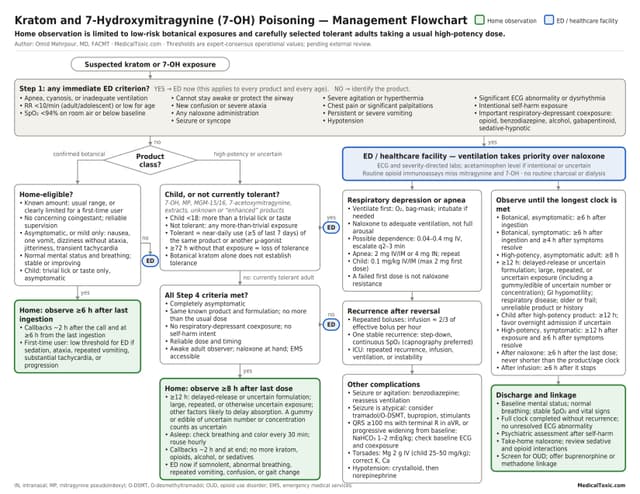
Recommend ED evaluation now for any of the following:
Apnea, cyanosis, or visibly inadequate ventilation
Respiratory rate <10/min in an adolescent or adult, or otherwise abnormally low for age
Oxygen saturation <94% on room air in a patient without known chronic hypoxemia, or a clinically meaningful decrease below the patient's documented baseline.
Inability to remain awake or protect the airway
New confusion or severe ataxia
Any naloxone administration
Seizure
Syncope
Severe agitation or hyperthermia
Chest pain
Significant palpitations
Persistent or severe vomiting
Hypotension
Significant ECG abnormality or dysrhythmia
Intentional self-harm exposure
Clinically important opioid, benzodiazepine, alcohol, gabapentinoid, sedative-hypnotic, or other respiratory-depressant coexposure
[EC]
If YES → ED.
If NO → Step 2.
Includes:
7-OH
Mitragynine pseudoindoxyl
MGM-15
MGM-16
7-acetoxymitragynine
Concentrated kratom extracts
Other chemically modified kratom alkaloids
Any unidentified or “enhanced” kratom product
If product identity or concentration cannot be established, manage it as a high-potency/uncertain product. [EC]
Commercial 7-OH products vary widely in dose per serving; see Product Classification below.
→ Proceed to Step 3.
Leaf, powder, tea, or conventional capsules without evidence of alkaloid concentration or enhancement.
→ Proceed to Step 5.
Clearly Trivial Exposure
A witnessed lick or taste with no appreciable amount swallowed, no symptoms, and a reliable exposure history may be considered for individualized poison-center-directed home observation. [EC]
If the amount swallowed cannot be confidently classified as trivial, apply the age- and tolerance-based criteria below.
Child <18 years:
Any oral exposure to a high-potency or uncertain product identified in Step 2, including a lick or taste:
→ ED regardless of current symptoms. [EC]
In children <12 years, poison-center data show higher odds of serious respiratory and neurologic effects after 7-OH or MP than after mitragynine. [31; H2] Extension of this rule to adolescents 12–17 years is expert consensus. [EC]
Adult: Clearly Trivial Exposure
An adult exposure is clearly trivial only when all of the following are true:
Witnessed or reliably reported lick or taste only
No bite, chew, or swallowed portion of a tablet, capsule, gummy, or edible
No swallowed liquid
No product unaccounted for
Completely asymptomatic
No clinically important coexposure
No self-harm intent
An adult meeting all criteria may be considered for individualized poison-center-directed home observation for ≥8 hours after exposure, using the Step 4 Home Monitoring requirements. [EC]
If any criterion is not met or cannot be established, the exposure is not trivial. Apply the tolerance-based criteria below.
For this algorithm, an adult is currently tolerant only when all of the following are true:
Reliable history of use of the same high-potency product and formulation on approximately ≥5 of the preceding 7 days
Last use of that product <72 hours ago
None of the following loss-of-tolerance factors:
Recent detoxification
Incarceration or hospitalization interrupting use
Significant deliberate taper or dose reduction
Treatment that substantially reduced opioid exposure
Uncertain recent use history
[EC]
Tolerance to another μ-opioid agonist, or regular botanical kratom use, does not qualify a patient for the Step 4 home pathway. [EC]
A person returning to a previously tolerated dose after ≥72 hours without that product does not qualify. [EC]
Home observation may be considered only when all of the following are true:
Meets the Operational Definition of Current Opioid Tolerance
Completely asymptomatic
Same product and formulation as the tolerated product, with no change in brand, formulation, or labeled concentration
No more than the current usual dose
No clinically important coexposure
No self-harm intent
Reliable dose and time
Responsible adult observer present
Naloxone immediately available
Emergency services readily accessible
[EC]
Same product does not guarantee same dose, because commercial products vary in measured content. [2–4,30; P] This pathway accepts that residual risk only because established tolerance, a responsible observer, and immediate naloxone availability are all present.
Keep the existing If any criterion is not met → ED, Observation Duration, and Suggested Poison-Center Follow-Up text unchanged.
At the end of Home Monitoring, immediately after:
“No further kratom, 7-OH, opioids, alcohol, benzodiazepines, sleep medications, or other sedatives should be used during observation.”
Add:
In a dependent patient, opioid withdrawal may emerge during the observation period. Advise a poison-center callback rather than redosing; manage withdrawal as in Dependence, Withdrawal, and MOUD Linkage.
Product composition cannot be confirmed from telephone history. Classify an exposure as conventional botanical kratom only when all of the following are true:
Leaf, powder, tea, or conventional capsule
Packaging is available or the product is otherwise reliably identified
Not labeled or marketed as an extract, concentrate, liquid shot, resin, or “enhanced,” “fortified,” or “extra-strength” product
No 7-OH, 7-HMG, mitragynine pseudoindoxyl, MGM compound, or other modified alkaloid listed
If any criterion is not met → manage as high-potency/uncertain → Step 3. [EC]
→ Otherwise, proceed to Step 5.
Clinical Reclassification
After a product identified as conventional botanical kratom, manage the exposure as high-potency/uncertain and apply the high-potency observation clocks in Step 6 when any of the following occurs:
Clinically significant opioid-type respiratory depression (bradypnea, apnea, or hypoventilation-related hypoxemia)
Inability to protect the airway
CNS or respiratory depression with an objective response to naloxone
[EC]
This is a disposition rule, not a determination of product identity. Adulteration and label-content discrepancies are documented in commercial kratom products. [2,3,30; P]
Empiric naloxone given without preceding respiratory depression and without an objective clinical response does not by itself trigger reclassification. When the indication for prehospital naloxone or the response cannot be reliably established, see Step 6, After Naloxone.
Observation duration should be determined by the longest applicable clock.
≥6 hours after the last ingestion. [EC]
For a botanical exposure with clinically meaningful symptoms evaluated in an ED or other healthcare facility, observe until the later of:
≥6 hours after the last ingestion; or
≥4 hours after complete resolution of clinically meaningful symptoms.
[EC]
Longer observation may be required when a coingestant or clinical complication dictates.
≥8 hours after the last ingestion. [EC]
Use ≥12 hours for delayed-release or uncertain formulation, large, repeated, or otherwise uncertain exposure, or other factors likely to delay absorption.
A gummy or edible with an uncertain number of pieces or unknown concentration should be treated as an uncertain exposure. [EC]
Also use ≥12 hours when any of the following is present:
Gastrointestinal hypomotility
Significant underlying respiratory disease
Older or frail patient
Unreliable product composition
Unreliable exposure history
[EC]
≥12 hours after the last ingestion. [EC]
Favor overnight monitored admission when:
Amount or timing is uncertain
A whole tablet, gummy, or potentially substantial amount was swallowed
Any clinically meaningful symptom occurred
Important coexposure is present
Safe post-discharge observation cannot be ensured
For high-potency exposure with CNS depression, ataxia, respiratory abnormality, repeated vomiting, clinically important cardiovascular effects, or other significant toxicity, even when naloxone was not required, observe until the later of:
≥12 hours after the last exposure; or
≥6 hours after complete resolution of clinically meaningful symptoms.
[EC]
Longer observation may be required when the coingestant or clinical complication dictates.
Naloxone never shortens the underlying product- or age-specific observation interval.
Observe until the latest of:
≥6 hours after the last naloxone dose
Completion of the applicable product- and age-specific interval
If significant symptoms occurred, ≥6 hours after complete symptom resolution
[EC]
Examples:
Adult liquid 7-OH exposure requiring naloxone for respiratory depression: observe until the latest of ≥12 hours after exposure, ≥ 6 hours after the last naloxone dose, or ≥6 hours after complete resolution of clinically meaningful symptoms.
Adult high-potency exposure meeting a ≥12-hour criterion, plus naloxone: at least 12 hours after exposure and at least 6 hours after the final naloxone dose.
Child after any high-potency product, plus naloxone: at least 12 hours after exposure and at least 6 hours after the final naloxone dose.
Persistent sedation resolving late in the course: continue until at least 6 hours after full clinical resolution.
Any clinically important recurrence requiring additional naloxone or assisted ventilation warrants monitored admission. [EC]
A single recurrence that responds promptly and remains stable may be managed in a step-down or equivalent monitored setting only when all of the following are available:
Continuous pulse oximetry
Preferably continuous capnography
Frequent bedside nursing assessment
Immediate naloxone availability
Immediate airway support
Use ICU-level care for:
Repeated respiratory recurrence
Naloxone infusion
Assisted ventilation
Escalating naloxone requirements
Persistent substantial sedation
Hemodynamic instability
Significant pulmonary complication
Lack of an appropriate high-acuity monitored unit
Observe until the later of:
≥6 hours after infusion discontinuation
Completion of the applicable product/age interval
≥6 hours after complete resolution of significant symptoms
[EC]
This is a rapid evidence-informed poison-center guideline rather than a formal systematic review or GRADE guideline.
Literature search updated through October 5, 2026. The targeted literature and regulatory review used PubMed/MEDLINE and authoritative primary sources including ACMT, CDC/MMWR, FDA, DEA, HHS, and the Federal Register.
Search concepts included kratom, Mitragyna speciosa, mitragynine, 7-hydroxymitragynine, 7-OH, 7-HMG, mitragynine pseudoindoxyl, MGM-15, MGM-16, poisoning, overdose, respiratory depression, naloxone, pharmacokinetics, cardiac, pulmonary, seizure, interaction, liver injury, pregnancy, neonatal withdrawal, psychosis, withdrawal, and buprenorphine.
[H1] Controlled/prospective human experimental evidence.
[H2] Observational human evidence. Prospective cohorts, poison-center studies, surveillance datasets, and pharmacokinetic derivation studies without controlled clinical outcome testing.
[H3] Human case-level evidence.
[H3-SR] Systematic review of case-level evidence. Systematic synthesis does not elevate the underlying case reports to controlled evidence.
[M] Mechanistic evidence. Animal, receptor, or in-vitro evidence.
[P] Product/market-analysis evidence. Analytical chemistry, label-content studies, stability testing, contaminant testing, or systematic product-market characterization.
[EC] Expert consensus/extrapolation.
Professional or regulatory authority is identified separately, for example [ACMT guidance], [FDA], or [DEA], rather than treated as an evidence grade.
No validated toxic-dose threshold, pediatric threshold, prospective poison-center triage rule, or validated observation interval currently exists for 7-OH.
Leaf, powder, tea, or conventional capsules without evidence of alkaloid concentration or enhancement.
Liquid shots, concentrated extracts, resins, or products advertising enhanced alkaloid content.
Any formulation marketed as containing 7-hydroxymitragynine, 7-OH, or 7-HMG.
Includes products marketed as containing:
Mitragynine pseudoindoxyl
MGM-15
MGM-16
7-acetoxymitragynine
Other chemically modified kratom alkaloids
Human toxicity and relative potency cannot be assumed to be equivalent among these compounds.
If the composition or concentration cannot be confidently established, manage it as a high-potency/uncertain product. [EC]
This approach is supported by extreme variability in the commercial 7-OH market. DEA reports that the concentration of commercial 7-OH products varied significantly, ranging from 1 mg to 700 mg in a single dose or serving. [4; P/DEA]
Commercial analytical studies have also identified substantial discrepancies between labeled and measured alkaloid composition. [2,3; P]
Mitragynine is the predominant alkaloid in conventional botanical kratom. Experimental studies describe relatively low-efficacy or partial μ-opioid receptor agonism together with activity at adrenergic and serotonergic systems. [5,6; M]
7-OH has substantially greater μ-opioid activity than mitragynine.
Mitragynine undergoes CYP3A-mediated metabolism to 7-OH. A controlled human itraconazole study demonstrated reduced 7-OH formation and increased mitragynine exposure, supporting an important CYP3A contribution. [7; H1]
7-OH can convert in human plasma in vitro to mitragynine pseudoindoxyl, a potent μ-opioid agonist. The clinical contribution of this conversion following commercial 7-OH exposure remains uncertain. [8; M]
After oral botanical kratom, mitragynine and 7-OH generally reach peak plasma concentrations within approximately 1–2 hours. Mitragynine has a substantially longer terminal elimination phase than the period of peak clinical effect, so terminal half-life should not independently determine disposition. [9; H1]
Experimental findings suggesting that mitragynine may produce less respiratory depression than conventional full μ-opioid agonists should not be extrapolated to concentrated 7-OH.
7-OH causes substantial respiratory depression in animal models, with naloxone reversal demonstrated experimentally, and severe naloxone-responsive human toxicity has now been reported. [10,11; H3 + M]
Possible acute findings include:
Nausea or vomiting
Dizziness
Drowsiness
Miosis
Ataxia
Tremor
Anxiety
Agitation
Diaphoresis
Tachycardia
Hypertension
Severe toxicity may include:
Profound CNS depression
Bradypnea or apnea
Hypoxemia
Coma
Aspiration
Seizure
Hypotension
QTc prolongation
QRS widening
Ventricular dysrhythmia
Brugada-pattern ECG abnormality
Hyperthermia
Rhabdomyolysis
Acute kidney injury
Respiratory failure
[10,12–16; H2/H3]
In national poison-center surveillance from 2015–2025, multiple substances were involved in 184 of 233 reported kratom-associated deaths. The dataset does not reliably distinguish botanical kratom from concentrated 7-OH or semisynthetic products, so it cannot establish formulation-specific mortality. [12; H2]
Psychosis and delirium have been reported after prolonged heavy 7-OH use and cessation, but this currently remains case-level evidence rather than an established common overdose phenotype. [17; H3]
Central opioid-type respiratory depression is the most clinically important acute pulmonary effect.
A 2026 systematic review of case reports and forensic series proposed additional pulmonary phenotypes including:
ARDS/diffuse acute lung injury
Diffuse alveolar hemorrhage
Eosinophilic or hypersensitivity pneumonitis
Pulmonary edema/congestion
Central respiratory depression
These remain case-level associations rather than established kratom-specific pulmonary syndromes. [15; H3-SR]
Persistent hypoxemia after restoration of adequate ventilation should prompt evaluation for aspiration, pulmonary edema, ARDS, alveolar hemorrhage, infection, pulmonary embolism, and other causes of acute lung injury.
The authoritative ED-referral criteria for this guideline are contained in the Page-One Algorithm, Step 1.
This section deliberately does not reproduce a second list.
If any Step 1 criterion is present → Recommend ED evaluation.
Steps 2–5 define disposition when no immediate ED criterion is present.
For clinically important exposures:
Continuous pulse oximetry
Frequent respiratory assessment
Cardiac monitoring when appropriate
Serial mental-status examination
Consider continuous capnography with significant sedation
Temperature monitoring with agitation, seizure, or hyperthermia
Obtain an ECG for:
Moderate or severe poisoning
Seizure
Syncope
Chest pain
Significant palpitations
Symptomatic high-potency exposure
Important cardiotoxic coingestant
Relevant electrolyte abnormality
Repeat when abnormal or when clinical status changes.
Testing should be severity-directed. Consider:
Point-of-care glucose
Electrolytes
Magnesium
Creatinine
Blood gas for significant hypoventilation
Lactate in severe poisoning
CK after seizure, hyperthermia, severe agitation, or prolonged immobilization
AST, ALT, alkaline phosphatase, bilirubin, and INR when hepatic injury is suspected
Acetaminophen concentration after intentional or uncertain overdose
Salicylate concentration when clinically appropriate
Pregnancy testing when relevant
Routine opioid immunoassays generally do not detect mitragynine or 7-OH.
A negative routine opioid screen does not exclude kratom-derived opioid toxicity.
Ventilation takes priority over antidote administration.
Provide:
Airway positioning
Suction
Supplemental oxygen
Bag-mask ventilation when spontaneous ventilation is inadequate
Endotracheal intubation when ventilation or airway protection cannot otherwise be maintained
Do not delay ventilation while waiting for naloxone.
Use naloxone for clinically significant opioid-type respiratory depression or apnea.
The endpoint is adequate spontaneous ventilation, not necessarily complete wakefulness.
If opioid dependence is possible:
Naloxone 0.04–0.4 mg IV initially
Escalate every 2–3 minutes according to respiratory response
Naloxone 2 mg IV/IM, or
standard intranasal naloxone, typically 4 mg/device
Continue assisted ventilation and repeat naloxone as clinically necessary.
Failure of a single dose does not demonstrate naloxone resistance.
Naloxone 0.1 mg/kg IV/IM, generally maximum 2 mg for the initial parenteral dose.
Repeat according to respiratory response.
When repeated boluses are necessary, a reasonable starting infusion is approximately two-thirds of the total effective reversal bolus per hour.
This dosing approach derives from naloxone pharmacokinetic modeling and established opioid-toxicology practice rather than kratom-specific trials. [18; H2/extrapolated]
ACMT reports that naloxone has been effective in 7-OH respiratory depression based on animal evidence and human case reports. [1,10,11; H3 + M, ACMT guidance]
Treat seizures with benzodiazepines according to standard toxicologic seizure management.
Because concurrent opioid-type respiratory depression may be present:
continuously reassess ventilation;
use pulse oximetry;
prefer capnography with substantial sedation;
maintain immediate readiness for assisted ventilation.
Seizure is atypical for an uncomplicated pure opioid toxidrome.
Evaluate for:
Tramadol/O-desmethyltramadol
Bupropion
Stimulants
Serotonergic drugs
Adulterants
Hypoglycemia
Electrolyte abnormalities
Hypoxemia
Benzodiazepines may also be used for clinically significant agitation, with the same respiratory precautions.
Isotonic crystalloid initially
Norepinephrine for persistent clinically significant hypotension after appropriate volume assessment [EC]
Correct potassium, magnesium, and calcium abnormalities
Avoid additional QT-prolonging drugs when feasible
Continue cardiac monitoring
Adults: magnesium sulfate 2 g IV
Children: magnesium sulfate 25–50 mg/kg IV, maximum 2 g
Defibrillate unstable or pulseless patients.
For recurrent acquired pause-dependent torsades despite correction and magnesium, consider overdrive pacing or isoproterenol with cardiology/medical-toxicology input. [EC]
No kratom-specific trial supports sodium bicarbonate.
For progressive QRS widening from baseline, or QRS ≥100 ms with a terminal R wave in aVR or another ECG feature consistent with sodium-channel blockade, or ventricular dysrhythmia suggesting sodium-channel blockade:
Sodium bicarbonate 1–2 mEq/kg IV is reasonable while obtaining medical-toxicology consultation. [EC]
Compare with any available baseline ECG and evaluate for coexposure, since a QRS of 100–120 ms may reflect pre-existing conduction disease rather than acute sodium-channel blockade.
Repeat according to ECG response while monitoring potassium and systemic pH.
Do not administer bicarbonate solely for QTc prolongation or an isolated Brugada-pattern ECG without evidence of conduction delay. [16; H3]
Activated charcoal is generally not indicated for isolated kratom or 7-OH ingestion. [EC]
Potential benefit is uncertain, while evolving opioid-type sedation creates an aspiration risk.
Consider charcoal primarily when a separate dangerous coingestant independently warrants gastrointestinal decontamination and the airway is reliably protected.
If used:
Activated charcoal approximately 1 g/kg, maximum 50 g.
Do not induce vomiting.
There is no routine role for gastric lavage, whole-bowel irrigation, or multidose activated charcoal.
There is no established role for hemodialysis, hemoperfusion, or urinary manipulation solely to increase elimination of mitragynine, 7-OH, or related compounds.
Use extracorporeal therapy only for another established indication.
Observation intervals are expert-consensus operational recommendations rather than validated prediction rules.
Use Page-One Algorithm, Step 6 as the single source of truth for observation clocks.
After recurrent respiratory depression, monitored step-down care is acceptable only when continuous respiratory monitoring and immediate airway intervention are available.
Use ICU-level care for repeated recurrence, naloxone infusion, assisted ventilation, escalating antidote requirements, hemodynamic instability, major pulmonary complications, or lack of an appropriate high-acuity monitored unit.
Pharmacodynamic interactions with other respiratory depressants are the immediate clinical concern.
Alcohol, conventional opioids, benzodiazepines, sedative-hypnotics, and other CNS depressants can increase respiratory risk.
A controlled human crossover study using 2 g of kratom tea increased midazolam AUC by approximately 39% and Cmax by approximately 50%, supporting intestinal CYP3A inhibition at that exposure. [19; H1]
In the same study, kratom did not meaningfully alter dextromethorphan/dextrorphan pharmacokinetics despite strong in-vitro CYP2D6 inhibition signals. [19; H1]
Therefore:
Human evidence supports a CYP3A interaction signal.
Clinically meaningful CYP2D6 inhibition was not demonstrated at the studied human dose.
Different effects after larger doses, chronic exposure, or concentrated extracts cannot be excluded.
Unexpected toxicity should prompt consideration of adulteration or contamination.
The marketed preparation Krypton contained O-desmethyltramadol and was associated with fatal intoxications. [20; H3/forensic]
A 2017–2018 multistate outbreak linked contaminated kratom to 199 Salmonella infections across 41 states. [21; H2/public-health surveillance]
FDA testing of 30 kratom products identified concerning concentrations of lead and nickel in multiple samples. [22; P/FDA]
Consider another substance or contaminant when the presentation includes:
Seizure
Serotonergic toxicity
Unexpectedly prolonged opioid toxicity
Fever and diarrhea suggesting infectious disease
Subacute neurologic or hematologic findings
Findings inconsistent with the labeled product
Whenever possible, document:
product name;
manufacturer;
lot number;
photograph of the packaging;
labeled alkaloid concentrations;
whether remaining product is available.
Kratom-associated drug-induced liver injury is among the better-characterized non-opioid complications of repeated kratom use.
In the prospective U.S. Drug-Induced Liver Injury Network, 11 adjudicated cases were attributed to kratom. Median latency to symptoms was 14 days (range 5–28 days). Six had mixed injury, two cholestatic injury, and three hepatocellular injury. All developed jaundice, most required hospitalization, and all ultimately recovered. [23; H2]
A broader review of the earlier literature found a median symptom latency of approximately 20.6 days, with reported cases ranging from 2 to 49 days after exposure. [24; H3-SR]
Accordingly, a compatible history may extend from a few days to approximately 7 weeks after starting kratom, although presentation around the second to fourth week is more typical.
A 2026 systematic review identified 32 patients across 31 published studies. The accumulated case literature was predominantly cholestatic, and four reported patients progressed to liver transplantation. [25; H3-SR]
Evaluate for kratom-associated liver injury when patients develop:
Jaundice
Dark urine
Pruritus
Persistent nausea
Right-upper-quadrant discomfort
Unexplained fatigue
Evidence of impaired hepatic synthetic function
Management includes:
Discontinue the suspected product
Evaluate competing causes of liver injury
Trend AST/ALT, alkaline phosphatase, bilirubin, and INR as appropriate
Obtain hepatology consultation for significant synthetic dysfunction, severe jaundice, encephalopathy, or progressive injury
Routine serial liver testing is not required after a small isolated asymptomatic acute exposure. [EC]
Regular kratom use, and particularly concentrated 7-OH use, can produce tolerance, craving, physical dependence, opioid-like withdrawal, and substance use disorder.
Withdrawal may include:
Restlessness
Anxiety
Myalgias
Diaphoresis
Rhinorrhea
Abdominal cramping
Nausea or vomiting
Diarrhea
Insomnia
Tachycardia
Hypertension
[26–28; H3]
Buprenorphine has been used successfully in published 7-OH cases and small series. [26–28; H3]
For standard induction, wait for objective opioid withdrawal.
A COWS score around 8–12 or greater may support initiation, but there is no validated kratom- or 7-OH-specific threshold. [EC]
Low-dose buprenorphine initiation may be considered when there is concern for precipitated withdrawal, including:
Heavy high-potency 7-OH use
Uncertain duration of opioid effect
Concurrent fentanyl or methadone exposure
Previous precipitated withdrawal
Inability to tolerate abstinence
[27; H3]
ACMT notes successful treatment of kratom/7-OH dependence using medications for opioid use disorder including buprenorphine and methadone. [1; ACMT guidance]
Methadone treatment for OUD should follow the applicable regulated treatment pathway.
Symptom-directed options may include:
clonidine when hemodynamically appropriate;
ondansetron;
loperamide;
NSAIDs;
acetaminophen.
Patients with dependence, escalating use, recurrent overdose, or OUD should be offered:
Buprenorphine when appropriate
Methadone-treatment referral when appropriate
Addiction-medicine follow-up
Take-home naloxone
Harm-reduction counseling
Do not simply advise a heavily dependent patient to abruptly stop high-dose 7-OH without addressing withdrawal and access to treatment.
Maternal stabilization takes priority.
Do not withhold naloxone from a pregnant patient with clinically important opioid-type respiratory depression.
Published prenatal-exposure literature supports a neonatal opioid-withdrawal signal after chronic maternal kratom use. Available evidence remains limited to case-level literature and does not establish incidence. [29; H3-SR]
Newborns with substantial chronic prenatal kratom or 7-OH exposure should be monitored according to local neonatal withdrawal protocols.
Human lactation pharmacokinetic and safety data remain inadequate.
Kratom and concentrated kratom-derived opioid products should generally be avoided while breastfeeding. [EC]
Before ED discharge confirm:
Baseline mental status
Normal spontaneous ventilation
Stable room-air oxygenation or established baseline
Stable vital signs
Completion of the applicable observation period
No recurrent toxicity
No clinically significant unresolved ECG abnormality
Safe ambulation
Adequate oral intake when appropriate
Psychiatric assessment after self-harm exposure
After clinically significant opioid-type toxicity:
Provide take-home naloxone
Review respiratory-depressant interactions
Screen for dependence or OUD
Offer MOUD linkage when appropriate
For significant, unusual, or emerging toxicity:
Record exact product/formulation
Photograph packaging
Record labeled alkaloid concentrations
Record manufacturer and lot
Record dose and timing
Record current tolerance and any recent interruption in use
Record coexposures
Report through the regional poison center
Consider FDA MedWatch for serious product-related adverse events
Product-level documentation is important because surveillance datasets frequently cannot distinguish conventional botanical kratom from concentrated or semisynthetic products.
Major limitations include:
No validated toxic dose for botanical kratom or 7-OH
No validated pediatric threshold
No validated home-triage rule
No prospective disposition rule
No validated observation duration
No controlled clinical naloxone trial specific to kratom/7-OH
Limited human pharmacokinetic data for purified 7-OH
Major commercial-product variability
Frequent polysubstance exposure
Limited evidence for newer modified alkaloids
Cardiac and pulmonary complications supported predominantly by mechanistic or case-level evidence
Pregnancy evidence limited to case reports
MOUD literature for 7-OH limited primarily to case reports and small retrospective series
The [EC] recommendations in this guideline are explicit operational decisions made where poison-center practice requires a disposition despite incomplete direct evidence.
This section is informational and does not define toxic doses or clinical disposition thresholds.
DEA temporarily placed these three substances into federal Schedule I effective August 26, 2026 through August 26, 2028, unless the order is extended or superseded. [30]
DEA published a July 6, 2026 notice of intent concerning temporary Schedule I placement of 7-OH above a specified threshold.
The proposed threshold includes:
Botanical Mitragyna speciosa material containing >0.050% 7-OH on a dry-weight basis
Synthetic or processed alternative articles containing >0.050% 7-OH by the applicable concentration measure or >1.00 mg of 7-OH per article
[4]
The same notice also documents wide per-serving variability in commercial 7-OH products.
HHS extended the threshold-related comment period through September 10, 2026. [31]
At the October 5, 2026 literature-search date, no subsequently published Federal Register temporary scheduling order for 7-OH itself was identified in the sources reviewed.
Regulatory thresholds are not toxicity thresholds and should not be used to determine home versus ED disposition.
Keep reading