Acetaminophen Poisoning: NAC, Rumack–Matthew Nomogram, High-Risk Ingestion, and Dialysis
Published on 19 Sept 2026 · Updated 20 Nov 2026

Published on 19 Sept 2026 · Updated 20 Nov 2026
 Medical Toxicologymedicaltoxic.com
https://medicaltoxic.com/guidelines/acetaminophen-poisoning
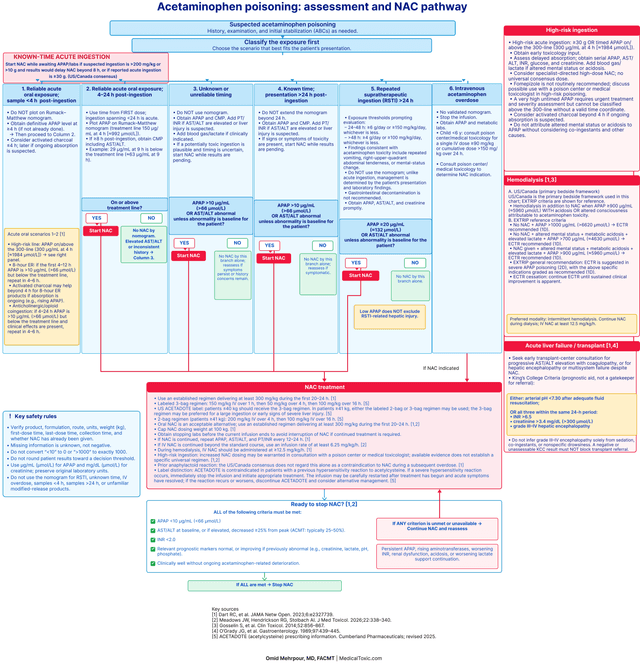
Acetaminophen (paracetamol; APAP) poisoning is a common toxicologic emergency and can progress from an initially asymptomatic or nonspecific presentation to hepatocellular injury, acute liver failure, multiorgan dysfunction, and death. Timely administration of acetylcysteine (N-acetylcysteine; NAC) can prevent or reduce hepatic injury, but safe management depends on correctly identifying the exposure pattern and applying the appropriate decision pathway. [1]
The Rumack–Matthew nomogram is central to selected acute ingestions, but it is frequently misapplied. It should not be used for repeated supratherapeutic ingestion lasting more than 24 hours, an unreliable or unknown ingestion time, or intravenous acetaminophen exposure. Extended-release products, delayed absorption, high-risk ingestions, and opioid or anticholinergic co-ingestion also require additional considerations. [1]
This guideline provides a practical framework for emergency clinicians, poison-center teams, intensivists, pharmacists, pediatric teams, and medical toxicologists to determine when NAC is required, when additional acetaminophen concentrations are necessary, when treatment should be extended, when hemodialysis should be considered, and when liver-transplant consultation is appropriate.
Clinical warning
Do not delay indicated acetylcysteine while waiting for an acetaminophen result if testing would postpone treatment beyond 8 hours after a potentially significant acute ingestion. Do not stop NAC automatically at 20 or 21 hours. Treatment must continue until appropriate stopping criteria are met. [1]
The Rumack–Matthew nomogram is not a universal acetaminophen-toxicity calculator. Do not use it for repeated supratherapeutic ingestion lasting >24 hours, unreliable/unknown timing, or intravenous acetaminophen overdose. [1]
An acetaminophen concentration ≥900 µg/mL with acetaminophen-associated acidosis or altered consciousness is a rare high-risk presentation in which hemodialysis should be considered in addition to NAC. Dialysis does not replace NAC. [1]
Determine first whether the exposure is acute with a reliable time, acute with an unreliable/unknown time, repeated supratherapeutic ingestion, extended/modified release, or intravenous exposure.
A serum acetaminophen concentration obtained before 4 hours after an acute ingestion cannot be used to risk-stratify the patient on the Rumack–Matthew nomogram. [1]
For an eligible acute ingestion, NAC is indicated when the concentration measured 4–24 hours after ingestion is on or above the treatment line, which begins at 150 µg/mL at 4 hours. [1]
The high-risk nomogram line begins at 300 µg/mL at 4 hours. A concentration on or above this line identifies increased risk, but no single intensified NAC regimen is established by the consensus statement. [1]
If waiting for laboratory testing would delay NAC beyond 8 hours and there is strong concern for an acute ingestion >200 mg/kg or >10 g, begin NAC while awaiting the result. These values are an empiric-treatment trigger in that circumstance, not universal toxicity thresholds. [1]
For repeated supratherapeutic ingestion over >24 hours, do not use the nomogram. Give NAC if acetaminophen is >20 µg/mL or AST/ALT is abnormal. [1]
For unreliable or unknown timing, obtain acetaminophen and hepatic/metabolic studies. NAC is indicated when acetaminophen is >10 µg/mL or AST/ALT is abnormal, unless the aminotransferase abnormality is known to be baseline. [1]
NAC duration is determined by clinical and laboratory stopping criteria, not simply by completion of a labeled infusion duration. [5]
Hemodialysis is reserved for exceptional high-risk poisoning with extreme concentrations and early mitochondrial toxicity; it is not routine treatment for ordinary acetaminophen overdose. [7]
Fomepizole remains an adjunct of uncertain role; current US/Canada consensus does not support a standard recommendation. [1]
Exposure pattern | Use Rumack–Matthew nomogram? | Core approach |
|---|---|---|
Acute exposure, reliable timing, blood level available 4–24 h after ingestion | Yes | Plot concentration; treat if on/above treatment line |
Acute exposure, but timing unreliable or unknown | No | APAP concentration + AST/ALT/CMP; treat according to detectable concentration and liver tests |
Repeated supratherapeutic ingestion spanning >24 h | No | Treat if APAP >20 µg/mL or AST/ALT abnormal |
US/Canada 8-hour extended-release product | Usually, with repeat-level rules | Repeat level when first 4–12 h value is >10 µg/mL but below treatment line |
Non-US modified-release formulation | Do not assume standard ER kinetics | Poison-center/toxicology consultation; delayed absorption may be more important |
Intravenous acetaminophen overdose | No validated nomogram application | Specialist-directed assessment |
High-risk acute ingestion | Nomogram may identify risk, but additional management required | Assess mitochondrial toxicity, intensified NAC discussion, dialysis when criteria met |
The 2023 consensus defines an acute ingestion as an ingestion pattern occurring over less than 24 hours, while repeated supratherapeutic ingestion occurs over more than 24 hours. [1]
For rapid bedside assessment of a single-time, known-time exposure within the tool's stated scope, see RumackCalc: Fast, Accurate Acetaminophen Overdose Assessment.
For broader calculator-supported assessment, see Acetaminophen Toxicity Calculator: A handy Tool for Healthcare Professionals.
At therapeutic doses, most acetaminophen undergoes glucuronidation and sulfation. A smaller proportion is metabolized through cytochrome P450 pathways to the reactive metabolite N-acetyl-p-benzoquinone imine (NAPQI), which is normally detoxified by glutathione.
After sufficiently large exposure, normal conjugation pathways become overwhelmed, glutathione stores become depleted, and NAPQI binds cellular proteins. Mitochondrial oxidative injury contributes to hepatocellular necrosis.
NAC restores glutathione availability and has additional beneficial effects in established acetaminophen-related liver failure. Benefit is greatest when NAC is started early, but late treatment remains indicated when hepatotoxicity or acute liver failure is present. [5]
Determine:
exact acetaminophen-containing product;
immediate-, extended-, or modified-release formulation;
tablet or liquid strength;
maximum possible dose;
patient weight in kilograms;
time the first dose was taken;
time the last dose was taken;
whether exposure occurred at one time or over multiple doses;
whether the history is reliable;
intentional versus accidental exposure;
co-ingestants, especially opioids or anticholinergic agents;
chronic alcohol use where clinically relevant;
underlying liver disease;
pregnancy status when relevant;
current vomiting, right-upper-quadrant pain, altered mental status, or other symptoms.
If timing or dose information is internally inconsistent, incomplete, or incompatible with the patient's clinical or laboratory findings, treat the history as unreliable/unknown rather than forcing the case onto the nomogram. [1]
Many patients are initially asymptomatic. Possible early findings include:
nausea;
vomiting;
diaphoresis;
malaise;
abdominal discomfort.
Normal early examination or laboratory findings do not exclude subsequent hepatotoxicity.
As hepatocellular injury develops, findings may include:
rising AST and ALT;
right-upper-quadrant pain;
prolonged INR;
hypoglycemia;
rising lactate;
metabolic acidosis;
acute kidney injury.
Severe poisoning can progress to:
hepatic encephalopathy;
coagulopathy;
profound metabolic acidosis;
hypoglycemia;
acute kidney injury;
shock;
cerebral edema;
multiorgan failure.
A separate early syndrome can occur after exceptionally large acute ingestions, with altered consciousness, metabolic/lactic acidosis, and mitochondrial dysfunction before established hepatic failure. This phenotype is particularly relevant to dialysis decisions. [1] [7]
Obtain a serum acetaminophen concentration at 4 hours after ingestion or later.
A level drawn before 4 hours cannot be plotted reliably on the nomogram. A nondetectable concentration obtained between approximately 2 and 4 hours usually argues against significant exposure, but the consensus recommends poison-center or toxicology input rather than converting an early level into a universal exclusion rule. [1]
Additional studies should be obtained according to presentation and timing, particularly when the patient presents later, appears ill, or is at high risk:
AST and ALT;
electrolytes and bicarbonate;
glucose;
creatinine;
bilirubin;
PT/INR when liver injury is suspected or transaminases are elevated;
lactate and blood gas for severe/high-risk poisoning;
pregnancy test when applicable.
Obtain:
serum acetaminophen concentration;
AST and ALT;
metabolic panel.
Use the unknown-time pathway rather than the nomogram.
Administer NAC if:
acetaminophen concentration is >10 µg/mL, or
AST or ALT is abnormal, unless the abnormality is established as the patient's baseline. [1]
If acetaminophen is ≤10 µg/mL and AST/ALT are normal, NAC is generally not indicated by the consensus pathway, provided the clinical picture does not raise another concern requiring toxicology consultation. [1]
Use the revised nomogram when:
the exposure meets the acute-ingestion definition;
the ingestion time is sufficiently reliable;
the acetaminophen concentration was obtained between 4 and 24 hours after ingestion.
The treatment line begins at:
150 µg/mL at 4 hours
NAC should be started when a 4–24-hour acetaminophen concentration falls on or above this line. [1]
The high-risk line begins at:
300 µg/mL at 4 hours
Patients on or above this line have greater risk of liver injury. Intensification of NAC is practiced in some centers, but available evidence does not establish one universal intensified regimen. Discuss these patients early with a poison center or medical toxicologist. [1]
repeated supratherapeutic ingestion >24 hours;
unknown or unreliable ingestion time;
intravenous acetaminophen overdose;
a serum concentration obtained before 4 hours;
non-US modified-release preparations without formulation-specific assessment.
The 2026 Clinical Toxicology Recommendations Collaborative provides more specific acetaminophen recommendations than older universal charcoal windows. [2]
Exposure | Activated-charcoal recommendation |
|---|---|
Immediate-release ≥200 mg/kg, ≤2 h | Recommend SDAC (1, B) |
Immediate-release ≥200 mg/kg, up to 3 h | Suggest SDAC (2, B) |
Immediate-release >6 h | Suggest against SDAC (2, B) |
Modified-release ≥200 mg/kg, ≤5 h | Recommend SDAC (1, B) |
Modified-release ≥200 mg/kg, up to 6 h | Suggest SDAC (2, B) |
Other dose/time combinations | Individualized risk assessment |
Immediate-release ≥350 mg/kg | Recommend additional-dose charcoal (1, D) |
Modified-release ≥300 mg/kg | Recommend additional-dose charcoal (1, D) |
Routine multiple-dose charcoal for enhanced elimination | Recommend against (1, B) |
Terminology matters: an additional dose used to complete gastrointestinal decontamination is not the same as a multiple-dose charcoal regimen intended to enhance systemic elimination.
The Collaborative recommends 50 g in adults or 1 g/kg in children, up to the adult dose, for single-dose or additional-dose activated charcoal. [2]
Do not give activated charcoal when aspiration risk is unacceptable unless the airway is appropriately protected. Do not delay NAC or resuscitation to administer charcoal.
When there is strong concern for an acute ingestion >200 mg/kg or >10 g, begin NAC before the level is available if waiting for testing would result in treatment starting more than 8 hours after ingestion. [1]
These dose values are used for an empiric-treatment decision when laboratory delay threatens timely NAC. They should not replace the nomogram when an appropriate 4–24-hour level is available.
For a patient presenting more than 24 hours after ingestion with clinical evidence of toxicity, begin NAC while laboratory evaluation is pending. [1]
NAC is the established antidote for potentially hepatotoxic acetaminophen exposure. The US/Canada consensus recommends using a regimen that delivers at least 300 mg/kg during the first 20–24 hours. [1]
Stage | Acetylcysteine dose | Infusion duration |
|---|---|---|
Bag 1 | 150 mg/kg | 1 hour |
Bag 2 | 50 mg/kg | 4 hours |
Bag 3 | 100 mg/kg | 16 hours |
Total | 300 mg/kg | 21 hours |
The 2023 consensus specifically states that when a 150-mg/kg loading dose is used, it should be infused over at least 1 hour. [1]
For patients ≥100 kg, the consensus recommends capping the acetylcysteine dosing weight at 100 kg. [1]
The current ACETADOTE label also provides an alternative two-bag regimen for patients ≥41 kg:
Stage | 41–99 kg | ≥100 kg | Duration |
|---|---|---|---|
Bag 1 | 200 mg/kg | 20,000 mg | 4 hours |
Bag 2 | 100 mg/kg | 10,000 mg | 16 hours |
Total | 300 mg/kg | 30,000 mg | 20 hours |
Patients ≤40 kg require weight-adjusted diluent volumes; the current US two-bag label is limited to patients ≥41 kg. Avoid excess free-water administration in smaller children. [3]
Systematic review evidence has generally found comparable liver outcomes with commonly studied two-bag regimens and fewer nonallergic anaphylactoid reactions than the traditional three-bag regimen. [6]
When oral NAC is used, the labeled regimen is:
140 mg/kg loading dose
then 70 mg/kg every 4 hours for 17 doses. [4]
The traditional label describes a 72-hour course, but current toxicology practice does not require an inflexible duration when validated stopping criteria and specialist guidance support a shorter course. The 2026 ACMT statement specifically recognizes shorter oral courses when acetaminophen is no longer detectable and hepatic markers/synthetic function are normal or improving. [5]
A previous nonallergic/anaphylactoid reaction to NAC is not a contraindication to treatment during a subsequent acetaminophen overdose. When NAC remains indicated, manage the reaction and adjust the infusion route or rate as clinically appropriate rather than abandoning antidotal therapy. [1]
NAC is a high-risk weight-based infusion. Verify:
weight in kilograms;
selected regimen;
calculated dose;
concentration;
diluent volume;
infusion stage;
pump rate;
transition between infusion stages.
For a detailed medication-safety discussion, see Iatrogenic Acetylcysteine Overdose: New Review Maps Severe Medication Errors.
Completion of an initial protocol is a reassessment point, not an automatic treatment endpoint.
The 2026 ACMT Practice Statement strongly recommends that all of the following be present before discontinuing IV NAC:
Criterion | Required status |
|---|---|
Acetaminophen | <10 µg/mL |
AST/ALT | At baseline, or if elevated, decreased 25–50% from peak |
INR | <2.0 |
Prognostic markers | Improving, including relevant creatinine, lactate, pH, and phosphate |
Continue NAC when any of the following remains present:
persistent acetaminophen;
rising aminotransferases;
established hepatotoxicity;
worsening INR;
worsening metabolic acidosis or lactate;
deteriorating renal function;
other markers of poor prognosis.
Treatment duration must be individualized, preferably with poison-center or medical-toxicology input. [5]
Repeated supratherapeutic ingestion (RSTI) is defined by the US/Canada consensus as repeated ingestion over a period greater than 24 hours.
Do not use the Rumack–Matthew nomogram.
Obtain:
acetaminophen concentration;
AST and ALT;
metabolic and renal studies as clinically appropriate.
Administer NAC when:
acetaminophen concentration is >20 µg/mL, or
AST or ALT is abnormal.
Continue treatment until stopping criteria are met. [1]
A low acetaminophen concentration does not exclude clinically important toxicity in RSTI if hepatic injury is already present.
For US/Canadian acetaminophen formulations labeled for 8-hour dosing, general management remains similar to immediate-release exposure, with an important repeat-level rule.
If a concentration obtained 4–12 hours after ingestion is:
below the treatment line, but
>10 µg/mL,
repeat the acetaminophen concentration 4–6 hours after the first measurement. [1]
If any concentration is on or above the treatment line, administer NAC.
Non-US modified-release products may have different pharmacokinetics and have been associated with more markedly delayed absorption. Do not automatically substitute the US/Canada extended-release pathway for an unfamiliar modified-release product; involve a poison center or medical toxicologist. [1]
Opioids and anticholinergic drugs may delay gastric emptying and acetaminophen absorption.
When the first 4–24-hour acetaminophen concentration is:
≤10 µg/mL: another concentration is generally not required solely because of the co-ingestion, and NAC is not indicated by this pathway;
>10 µg/mL but below the treatment line, with opioid or anticholinergic clinical effects: repeat the concentration 4–6 hours later;
on or above the treatment line: administer NAC. [1]
Treat the co-ingestant independently according to its own toxicology pathway.
The 2023 consensus defines high-risk ingestion as:
an acute ingestion of at least 30 g, or
an acetaminophen concentration on or above the high-risk nomogram line, beginning at 300 µg/mL at 4 hours. [1]
These patients warrant:
early poison-center/medical-toxicology involvement;
evaluation for delayed or prolonged absorption;
serial acetaminophen concentrations when indicated;
AST/ALT, INR, glucose, creatinine;
lactate and blood gas when severe toxicity is suspected;
assessment for early altered consciousness and metabolic acidosis;
consideration of intensified NAC under specialist direction;
assessment for hemodialysis when extreme concentrations and mitochondrial toxicity are present.
The literature remains insufficient to endorse one universal high-dose NAC regimen. [1]
Fomepizole has been proposed as an adjunct to NAC in severe or high-risk acetaminophen poisoning because of effects on toxic-metabolite formation and mitochondrial injury.
However, the 2023 US/Canada consensus concluded that available evidence does not support a standard recommendation for routine fomepizole use. [1]
Do not delay NAC, appropriate monitoring, hemodialysis assessment, or transplant-center escalation while considering an investigational adjunct.
NAC is effective in the overwhelming majority of acetaminophen poisonings, so hemodialysis is not routine therapy.
EXTRIP reserves extracorporeal treatment primarily for exceptionally large ingestions with early mitochondrial dysfunction, manifested by altered mental status and severe metabolic/lactic acidosis before hepatic failure. [7]
Clinical setting | Acetaminophen concentration | EXTRIP recommendation |
|---|---|---|
NAC not administered | >1000 mg/L (µg/mL) | Recommend ECTR |
NAC not administered + altered mental status, metabolic acidosis, elevated lactate | >700 mg/L | Recommend ECTR |
NAC administered + altered mental status, metabolic acidosis, elevated lactate | >900 mg/L | Recommend ECTR |
The 2023 US/Canada consensus operationally recommends hemodialysis in addition to NAC when the acetaminophen concentration is ≥900 µg/mL with acidosis or altered consciousness attributable to acetaminophen toxicity. [1]
Intermittent hemodialysis is the preferred extracorporeal modality when extracorporeal removal is indicated. [7]
For general extracorporeal principles, see Hemodialysis in Poisoning: A Comprehensive Guide for Healthcare Providers.
Do not stop NAC during hemodialysis.
When IV NAC is used during dialysis, the consensus recommends an infusion rate of at least 12.5 mg/kg/h. The oral NAC regimen does not require dose adjustment during hemodialysis. [1]
Hemodialysis is an adjunct in these exceptional cases, not a replacement for NAC.
Patients with evolving hepatotoxicity require serial reassessment of:
AST and ALT;
INR;
glucose;
creatinine;
pH/bicarbonate;
lactate;
phosphate when clinically useful;
mental status;
urine output;
hemodynamics.
Continue NAC when liver injury or poor prognostic markers remain present even if circulating acetaminophen is no longer measurable. [5]
For broader ICU management principles, see Comprehensive Guide to Managing Poisoning in the Intensive Care Unit: Best Practices and Protocols.
Do not wait for terminal deterioration before discussing transfer.
The 2023 consensus recommends considering liver-transplant-team consultation when there are:
progressive increases in AST/ALT with coagulation abnormalities;
hepatic encephalopathy despite NAC;
multisystem failure despite NAC. [1]
Acetaminophen-related acute liver failure can evolve rapidly, and hepatology literature similarly supports early transplant evaluation rather than waiting for a prognostic score to become unequivocally positive. [8]
Prognostic systems such as King's College Criteria can inform specialist assessment but should not be used as the sole reason to delay referral.
For an otherwise stable patient with an eligible acute ingestion:
obtain an appropriate ≥4-hour acetaminophen concentration;
if below the treatment line, reassess the accuracy of the history and identify any reason for delayed absorption or separate admission;
follow repeat-level rules for extended-release or opioid/anticholinergic co-ingestion when applicable.
A single early level obtained before 4 hours is not a discharge test.
Do not discharge merely because the initial 20- or 21-hour regimen is complete.
Confirm appropriate stopping criteria and ensure:
acetaminophen is <10 µg/mL;
aminotransferases meet stopping criteria;
INR is acceptable;
relevant prognostic markers are improving;
no other medical or psychiatric reason for admission remains. [5]
hepatic injury;
abnormal or worsening INR;
metabolic/lactic acidosis;
hypoglycemia;
acute kidney injury;
altered mental status;
shock;
persistent acetaminophen after the expected treatment course;
high-risk ingestion requiring intensified monitoring;
dialysis;
acute liver failure;
other major co-ingestant toxicity.
Patients with acute liver failure or rapidly deteriorating multiorgan dysfunction require ICU-level care and early transplant-center involvement.
Before discharge after deliberate self-poisoning, complete appropriate psychiatric and safety assessment.
Standard acetaminophen-poisoning assessment and treatment are the same in pregnancy. Some clinicians favor IV NAC, but the US/Canada consensus found no evidence that oral NAC is less effective in pregnant patients. [1]
Do not delay indicated NAC because of pregnancy.
Cap the NAC dosing weight at 100 kg under the US/Canada consensus. [1]
General management principles are the same as in older patients.
Ensure:
measured weight in kilograms;
independent verification of dose calculations;
age- and weight-appropriate IV fluid volumes;
avoidance of excessive free-water administration;
poison-center/toxicology involvement for complex exposures.
For children younger than 6 years, the consensus specifically advises poison-center or medical-toxicology consultation after a single IV acetaminophen dose of 90 mg/kg or a cumulative IV dose >150 mg/kg in 24 hours. [1]
The Rumack–Matthew nomogram has not been validated for IV acetaminophen overdose. [1]
Manage dosing errors with poison-center or medical-toxicology guidance rather than extrapolating an oral-ingestion nomogram.
Common preventable problems include:
failure to recognize acetaminophen within combination products;
duplicated acetaminophen-containing medications;
incorrect pediatric concentration or weight;
repeated supratherapeutic dosing;
incorrect ingestion time entered into a nomogram;
premature cessation of NAC;
NAC dose-calculation or pump-programming errors.
Use standardized order sets, kilogram-only weights, independent high-risk-medication checks, explicit NAC stopping criteria, and clear handoffs between pharmacy, nursing, emergency medicine, toxicology, and critical care.
Classify the exposure before choosing the treatment pathway.
Use the Rumack–Matthew nomogram only when its criteria are satisfied.
A pre-4-hour acetaminophen level cannot be used for nomogram risk stratification.
The treatment line begins at 150 µg/mL at 4 hours.
The high-risk line begins at 300 µg/mL at 4 hours, but no universal intensified NAC regimen is established.
If laboratory delay would postpone treatment beyond 8 hours after a strongly suspected >200 mg/kg or >10 g acute ingestion, begin NAC while awaiting the level.
Do not use the nomogram for RSTI >24 hours; treat when acetaminophen is >20 µg/mL or AST/ALT is abnormal.
For unknown/unreliable timing, NAC is indicated when acetaminophen is >10 µg/mL or AST/ALT is abnormal.
Deliver at least 300 mg/kg NAC during the first 20–24 hours using an appropriate established protocol.
Do not stop NAC automatically at 20 or 21 hours.
Activated-charcoal timing should follow formulation- and dose-specific guidance.
Hemodialysis is reserved for exceptional massive exposures with extreme levels and mitochondrial toxicity and must be combined with NAC.
Fomepizole remains nonstandard and specialist-directed.
Progressive hepatotoxicity, coagulopathy, encephalopathy, or multiorgan failure should trigger early liver-transplant-center consultation.
Keep reading
We would like to use analytics and session-replay tools to understand how this site is used. They are optional and the site works fully without them. Signing in still needs its own cookie either way. Our Privacy Policy names each one.