Public Health and Poison Prevention
Are Fireworks Toxic? Smoke, Burns, and Poisoning Risks
Omid Mehrpour
Post on 03 Jul 2024 · Updated 11 Nov 2026 · 14 min read

Omid Mehrpour
Post on 03 Jul 2024 · Updated 11 Nov 2026 · 14 min read
 Medical Toxicologymedicaltoxic.com
https://medicaltoxic.com/blogs/are-fireworks-toxic-smoke-burns-poisoning
Fireworks are designed to produce brilliant light, heat, sound, and color. Their risks, however, extend beyond accidental explosions. Firework combustion releases fine airborne particles and metal-containing residues, while direct contact can cause serious burns, eye trauma, and, in unusual circumstances, chemical poisoning.
So, are fireworks toxic?
The accurate answer depends on the route of exposure.
A nearby explosion can cause immediate thermal or mechanical injury. Breathing dense firework smoke can increase exposure to particulate pollution and irritate the respiratory tract, especially in people with existing lung disease. Swallowing certain unignited fireworks may cause genuine systemic poisoning.
These are different hazards and should not be confused.
The U.S. Consumer Product Safety Commission (CPSC) reported at least 15 fireworks-related deaths and an estimated 13,000 emergency department-treated injuries during 2025, according to its June 2026 safety announcement. Approximately 1,300 injuries involved sparklers. [1]
Environmental studies also demonstrate substantial short-term increases in airborne particulate matter during fireworks displays. But measuring metal-containing particles in the air does not automatically establish that spectators developed systemic metal poisoning.
Understanding these distinctions helps clinicians and the public respond to the actual risk.
Fireworks can cause thermal burns, eye injuries, blast trauma, smoke exposure, and occasional ingestion-related poisoning.
CPSC estimated 13,000 U.S. emergency department-treated fireworks injuries in 2025.
Sparklers are not harmless toys; they can burn at approximately 2,000°F.
Fireworks can produce substantial temporary increases in PM2.5, especially near displays or downwind.
Firework smoke may contain metal-bearing particles, including compounds of barium, strontium, and copper, depending on composition.
Exposure to particulate pollution is a particular concern for people with asthma, COPD, cardiovascular disease, children, and older adults.
Environmental measurements and laboratory toxicity findings should not be presented as proof of specific human illness.
Direct ocular trauma, serious burns, difficulty breathing, and suspected ingestion of firework material require appropriate urgent assessment.
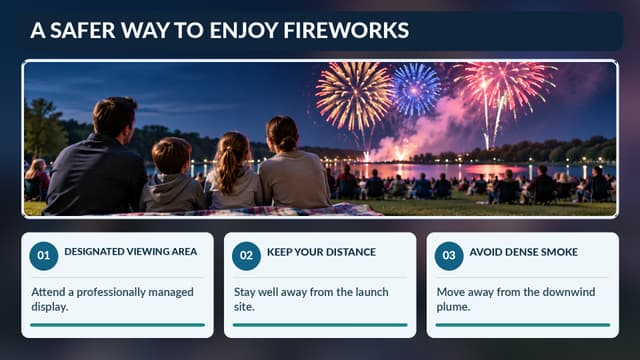
Attending a professional display from a designated viewing area is safer than handling consumer fireworks.
Fireworks contain combinations of fuels, oxidizing agents, color-producing compounds, and other materials that allow controlled combustion or explosions.
Their composition varies by product.
Commonly used materials can include:
Component | Typical function |
|---|---|
Potassium nitrate or perchlorate compounds | Oxidizing agents |
Sulfur and charcoal | Fuel components in certain pyrotechnic mixtures |
Strontium compounds | Red color |
Barium compounds | Green color |
Copper compounds | Blue color |
Sodium compounds | Yellow color |
Aluminum, magnesium, or titanium | Bright sparks or light effects |
Not every firework contains every listed ingredient.
During combustion, some constituents become gases, aerosols, or condensed particles, while others remain in the residue.
Consequently, the hazards of fireworks fall into several categories:
Physical injury: blast force, projectiles, flames, and hot particles.
Inhalation exposure: particulate matter and other combustion products.
Chemical contact: unburned powder, debris, and certain reactive substances.
Ingestion: accidental or intentional swallowing of pyrotechnic material.
The route, amount, duration, product composition, and characteristics of the exposed person all matter.
Yes. This is one of the strongest findings in the environmental literature.
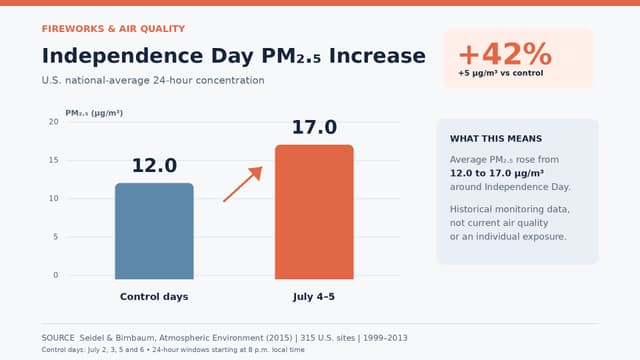
In a widely cited study published in Atmospheric Environment, Seidel and Birnbaum analyzed measurements from 315 U.S. air-quality monitoring sites using data collected between 1999 and 2013.
The researchers compared particulate concentrations around July 4 with nearby control days.
They found that the national-average 24-hour PM2.5 concentration increased by approximately 5 µg/m³, or 42%, during the Independence Day period. [2]
The increase was concentrated around the evening of July 4 and the following morning.
At one monitoring site near fireworks, short-term concentrations were considerably higher.
These results demonstrate a recurring air-pollution episode associated with Independence Day celebrations.
They do not mean that every city experiences the same increase or that every spectator inhales the same concentration of pollutants.
A 2026 study of a fireworks display near Lake Union in Seattle used a distributed network of local particle sensors.
Among monitoring locations within approximately 1.5 km of the launch area, event-average PM2.5 concentrations varied by more than threefold. The study also showed that hourly regulatory monitoring could miss or smooth over short-lived local peaks. [3]
This matters because an air-quality reading from a distant monitoring station may not fully describe what a spectator briefly encounters in a concentrated plume.
Wind direction, location, weather, and proximity to the smoke can strongly influence exposure.
The Seattle findings concern one monitored event, not a universal exposure level for all public fireworks displays.
Fireworks release a mixture of fine particles and combustion products.
A New York City study examining a large Fourth of July fireworks event found substantial local PM2.5 increases and identified changes in metal concentrations in air and nearby river water. Elements detected in airborne particles included barium, copper, strontium, magnesium, and zinc, among others. [4]
A separate study in Fullerton, California, measured unusually high concentrations of selected particulate metals around Independence Day celebrations in 2020 and 2021. These included barium, copper, strontium, lead, and chromium, although their concentration patterns varied between measurements. [5]
The results are evidence of environmental contamination, not proof that spectators developed clinically significant heavy-metal poisoning.
Yes.
A 2026 airborne study published in ACS ES&T Air identified firework-related particles during flights over parts of East and Southeast Asia around the Spring Festival period.
The researchers detected particles containing fireworks-associated elements such as barium and strontium at different altitudes and across broad geographic areas. [6]
This indicates that firework pollution is not always confined to the immediate launch area.
However, particle transport alone does not quantify the absorbed human dose or establish long-term health effects.
The strongest direct fireworks evidence demonstrates temporary increases in air pollution.
The broader medical evidence establishes that inhaled fine particulate matter can harm respiratory and cardiovascular health.
EPA identifies associations between particulate pollution and several outcomes, including:
coughing and airway irritation;
reduced lung function;
worsening asthma;
respiratory symptoms;
cardiovascular effects in susceptible people.
People with heart or lung disease, children, and older adults are among those at higher risk. [7]
It is important to distinguish general PM2.5 health evidence from studies proving clinical outcomes after a specific fireworks event.
A fireworks study showing a large increase in airborne particles does not automatically demonstrate that the display caused a particular heart attack, arrhythmia, or neurological disorder.
Exposure reduction is especially sensible for people with:
asthma;
chronic obstructive pulmonary disease;
significant cardiovascular disease;
other conditions that make breathing particulate pollution more hazardous.
Young children and older adults also warrant particular attention.
Individuals with respiratory disease should follow their established treatment plans and avoid dense smoke when practical.
Indoor pyrotechnic effects deserve separate consideration because combustion emissions can accumulate in enclosed spaces.
A 2026 study examined volcano-type fireworks used inside wedding halls in Bursa, Türkiye.
The investigators measured substantial concentrations of fine airborne particles and detected metal-containing particulate matter. [8]
This was an environmental exposure study, not a clinical trial demonstrating a specific rate of illness among attendees.
Nevertheless, the findings provide a clear reason to avoid uncontrolled indoor pyrotechnic smoke exposure.
A product labeled for outdoor use should never be used indoors. Even products marketed for indoor effects require appropriate venue controls, fire-safety procedures, and professional oversight.
Firework injuries frequently involve direct heat, flames, and hot debris.
CPSC reports that sparklers can reach approximately 2,000°F, hot enough to cause severe skin burns. [1]
A sparkler should therefore not be treated as a safe toy simply because it is small or commonly used at family celebrations.
Burn injuries can range from superficial skin damage to deep tissue destruction.
The 2024 American Heart Association and American Red Cross first-aid guidelines recommend immediately cooling thermal burns, preferably with clean running water.
Cooling for approximately 5–20 minutes may be reasonable, although the optimal duration is not definitively established. [9]
Practical first-aid steps include:
Move away from the heat source and make sure the scene is safe.
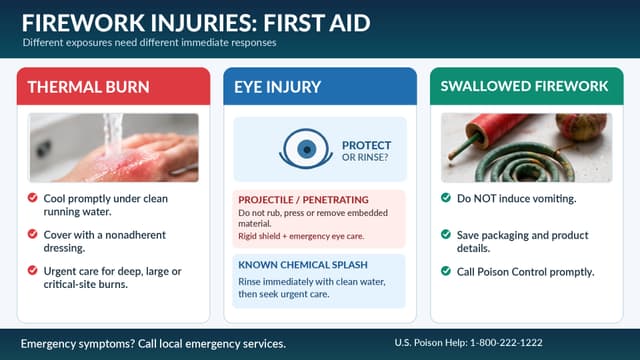
Cool the burned area with clean running water.
Remove jewelry or restrictive items near the burn before swelling develops, if this can be done safely.
Cover the area loosely with a clean, nonadherent dressing after cooling.
Seek appropriate medical evaluation for significant injuries.
Do not apply ice directly to the burn. Do not forcibly remove clothing stuck to damaged skin.
Urgent medical assessment is necessary for full-thickness burns, significant partial-thickness burns, injuries involving the face, hands, feet, or genitals, and burns accompanied by possible inhalation injury. [9]
Fireworks can injure the eyes through several mechanisms:
blunt impact;
penetrating fragments;
hot particles;
thermal burns;
chemical splashes.
The American Academy of Ophthalmology warns that these injuries can cause corneal damage, retinal injury, ruptured eyeballs, and permanent vision loss. [10]
Any suspected serious eye injury requires immediate medical assessment.
If there has been an explosion, projectile impact, or possible penetrating injury:
do not rub the eye;
do not press on the eye;
do not try to remove embedded material;
protect the eye with a rigid shield that does not apply pressure;
seek emergency ophthalmic care.
Chemical splash injuries require a different response. For a known chemical splash without suspected penetrating trauma, immediate irrigation with clean water is recommended while obtaining urgent medical evaluation. [11]
These two mechanisms should not be confused. A suspected open-globe injury should not be managed like an uncomplicated chemical splash.
If the type of injury is unclear after an explosion, obtain emergency medical assistance rather than attempting invasive removal or examination.
Yes. Although uncommon, ingestion of certain fireworks can produce systemic toxicity.
This is a more direct example of chemical poisoning than breathing ordinary diluted outdoor firework smoke.
Some small fireworks marketed as “snakes” contain barium compounds.
A 2025 Clinical Toxicology study examined 64 suspected or confirmed oral exposures to snake fireworks reported to a poison center.
Most exposed children did not develop symptoms. Six children had gastrointestinal complaints, and six developed hypokalemia, including some who had no initial symptoms. No deaths, dysrhythmias, weakness, or respiratory compromise were reported in that series. [12]
This is a useful finding because it distinguishes a documented but product-specific ingestion hazard from a claim that all fireworks cause severe systemic poisoning.
However, severe toxicity is possible.
An earlier human case report described an adult who developed profound hypokalemia, cardiac dysrhythmias, and respiratory failure after swallowing multiple snake fireworks. [13]
The case demonstrates potential severity, but it should not be interpreted as the typical outcome after a small accidental exposure.
If someone has swallowed an unignited firework or its contents:
do not induce vomiting;
do not attempt home detoxification;
preserve the packaging or product information;
contact a poison center promptly;
seek emergency care for significant symptoms or suspected substantial ingestion.
In the United States, Poison Help is available at 1-800-222-1222.
For more information about how poison centers support emergency exposure assessment, see Poison Control: Your Lifeline in Emergencies.
The specific product and ingredients matter. A firecracker, sparkler, and snake firework should not automatically be managed as identical exposures.
This requires a cautious answer.
Environmental studies establish that fireworks can temporarily increase airborne particulate matter and certain metal-containing particles.
Broader epidemiological evidence establishes that prolonged exposure to particulate air pollution can affect respiratory and cardiovascular health.
However, these two findings do not automatically prove a particular chronic disease is caused by attending occasional fireworks displays.
Key unanswered questions include:
the absorbed dose from different types of displays;
differences between spectators and frequent occupational exposure;
the effects of repeated short-duration exposure;
how firework-derived particles compare biologically with particles from other sources;
whether fireworks produce identifiable long-term clinical outcomes after accounting for other exposures.
Laboratory evidence of oxidative stress or inflammation should not be treated as a confirmed human disease outcome.
The most practical approach is to avoid the densest plume and limit time in areas with poor air quality.
For people with respiratory or cardiovascular disease, useful precautions include:
choose a viewing area well away from the launch location;
avoid standing directly downwind of dense smoke;
reduce prolonged outdoor activity when smoke accumulates;
follow local air-quality alerts;
remain indoors when outdoor particle levels are poor, provided the indoor environment is safe and adequately cooled;
use suitable particle filtration when available.
EPA guidance for smoke episodes supports high-efficiency filtration and appropriately sized portable air cleaners to reduce indoor particle concentrations. [14]
Although much of this filtration guidance was developed for wildfire smoke, the particle-removal principle is relevant to airborne particulate pollution more broadly.
Air filtration does not make it safe to operate unsuitable fireworks indoors.
CPSC recommends several practical safety measures:
Prefer professional public displays over consumer fireworks.
Never allow young children to ignite fireworks, including sparklers.
Follow local law and use only appropriately labeled consumer products where permitted.
Never attempt homemade or altered fireworks.
Never use fireworks while impaired by alcohol or drugs.
Keep water available for fire emergencies and safe handling of used devices.
Do not aim, throw, or point fireworks toward people.
Never handle or attempt to relight fireworks that have failed to ignite. [1]
When children are present, prevention also means keeping unused fireworks and pyrotechnic materials securely stored and inaccessible.
For broader household safety and poison-prevention measures, see How to Prevent Poisoning at Home: A Parent's Essential Safety Guide.
Firework smoke exposure is not automatically metal poisoning.
Detection of a metal in environmental particles does not prove an absorbed toxic dose.
Physical injury has the strongest direct clinical evidence.
Burns, eye injuries, and blast trauma are established fireworks hazards.
Firework-related PM2.5 spikes are measurable.
National and local studies demonstrate short-duration increases, but exposure varies considerably.
Different eye injuries require different first aid.
Suspected penetrating injury should be protected from pressure and manipulation, while confirmed chemical splashes require prompt irrigation.
Some ingestions are genuinely toxic.
Barium-containing snake fireworks have caused hypokalemia and, rarely, life-threatening poisoning.
Environmental evidence is not automatically clinical causation.
Laboratory and air-monitoring studies should be interpreted according to what they actually measured.
Firework smoke contains particles and other combustion products that can worsen air quality. Dense exposure may irritate airways, particularly in susceptible people. The amount inhaled and the clinical response vary by exposure conditions.
Yes. Studies have identified metal-containing particles in fireworks emissions, including barium, strontium, copper, and other elements. Detecting these materials in environmental samples does not by itself establish systemic heavy-metal poisoning in spectators.
Yes. Sparklers can reach approximately 2,000°F and cause serious burns. CPSC advises against allowing young children to handle them.
Yes. Certain fireworks, including some snake-type products containing barium salts, have caused hypokalemia and occasionally severe systemic toxicity. Poison-center assessment is appropriate after a suspected ingestion.
Viewing from a designated area at a professional event reduces direct handling and blast-injury risks. Smoke exposure still depends on local conditions, including wind and the location of the plume.
Fireworks present several distinct health risks.
Thermal burns, blast injuries, and eye trauma are well-established immediate hazards. Firework displays also create measurable short-term increases in airborne particulate matter and, in some settings, metal-containing pollution.
The clinical significance of smoke exposure depends on concentration, duration, individual susceptibility, and other environmental conditions. Environmental measurements alone should not be treated as a diagnosis of human poisoning.
Certain unignited fireworks can also cause genuine chemical poisoning when swallowed, as documented in barium-containing snake firework exposures.
The most useful approach is therefore to recognize the actual type of hazard:
Prevent direct injury, avoid dense smoke, obtain urgent care for serious burns or eye trauma, and consult Poison Control when firework material has been swallowed.
Professional displays, appropriate viewing distances, and careful attention to air quality offer a safer way to enjoy fireworks without underestimating their risks.
© All copyright of this material is absolute to Medical toxicology
Dr. Omid Mehrpour (MD, FACMT) is a senior medical toxicologist and physician-scientist with over 15 years of clinical and academic experience in emergency medicine and toxicology. He founded Medical Toxicology LLC in Arizona and created several AI-powered tools designed to advance poisoning diagnosis, clinical decision-making, and public health education. Dr. Mehrpour has authored over 250 peer-reviewed publications and is ranked among the top 2% of scientists worldwide. He serves as an associate editor for several leading toxicology journals and holds multiple U.S. patents for AI-based diagnostic systems in toxicology. His work brings together cutting-edge research, digital innovation, and global health advocacy to transform the future of medical toxicology.
Keep reading
 Public Health and Poison Prevention
Omid Mehrpour
 Public Health and Poison Prevention
Omid Mehrpour
 Public Health and Poison Prevention

Sherika Whitelocke
 Public Health and Poison Prevention
Omid Mehrpour
We would like to use analytics and session-replay tools to understand how this site is used. They are optional and the site works fully without them. Signing in still needs its own cookie either way. Our Privacy Policy names each one.